Brief Report - (2025) Volume 11, Issue 2
Received: 01-Apr-2025, Manuscript No. jssc-26-188250;
Editor assigned: 03-Apr-2025, Pre QC No. P-188250;
Reviewed: 17-Apr-2025, QC No. Q-188250;
Revised: 22-Apr-2025, Manuscript No. R-188250;
Published:
29-Apr-2025
, DOI: 10.37421/2472-0437.2025.11.286
Citation: Jonsdottir, Anna. "Enhancing Seismic Performance of
Steel Structures: Methods". J Steel Struct Constr 11 (2025):286.
Copyright: © 2025 Jonsdottir A. This is an open-access article distributed under the terms of the Creative Commons Attribution License, which permits unrestricted use,
distribution and reproduction in any medium, provided the original author and source are credited.
The seismic performance of steel structures is a critical area of research, with numerous studies exploring various aspects to enhance their resilience against earthquake events. One fundamental approach involves optimizing the structural configuration through the implementation of different bracing systems. Investigations into various bracing types have revealed their significant influence on the lateral stiffness, strength, and energy dissipation capacity of steel frames. Understanding these influences is paramount for engineers seeking to select the most effective bracing strategies for seismic-resistant designs, aiming to improve ductility and prevent catastrophic failures under severe seismic conditions [1].
Beyond bracing, the fundamental behavior of steel frames under seismic loads is also heavily influenced by the type of frame system employed. Steel moment-resisting frames, a common structural typology, have been extensively studied concerning their response to different seismic excitations. Research has focused on identifying critical design parameters that govern inter-story drift and the formation of plastic hinges, particularly when subjected to impulsive ground motions characteristic of near-fault events. The findings underscore the necessity of considering the specific characteristics of ground motion records when designing steel frames for seismically active regions to ensure adequate performance and safety margins [2].
The exploration of advanced materials has also become a significant avenue in improving seismic resilience. The integration of high-strength steel into multi-story steel frames presents a promising avenue for enhancing structural performance. Evaluations through nonlinear time-history analysis examine factors such as material and geometric nonlinearity, as well as connection behavior. While high-strength steel can lead to reduced member sizes, careful detailing of connections is crucial to maintain ductile behavior and avert premature failure during seismic events, highlighting a nuanced aspect of material application [3].
In addition to material choices and framing systems, the incorporation of supplementary damping devices offers another effective strategy for seismic performance enhancement. Studies have presented comparative analyses of various damper types, including viscous and metallic dampers, under diverse seismic scenarios. The judicious application of these damping devices has been demonstrated to significantly reduce seismic forces, minimize structural damage, and improve the overall safety and serviceability of steel frame buildings [4].
Innovative design concepts, such as the use of replaceable fuse elements, are being investigated to concentrate damage in designated replaceable components, thereby protecting primary structural elements. Research has validated the effectiveness of this approach through experimental and numerical analyses, showing that fuse designs can facilitate rapid repair and reduce downtime following seismic events, offering a practical solution for post-earthquake recovery [5].
The application of lightweight steel framing systems, often utilized in low-to-mid-rise construction, also warrants specific seismic design considerations. Investigations into the influence of material properties and connection details on the overall seismic performance are crucial. While lightweight steel offers economic advantages, specific design considerations are necessary to ensure adequate stiffness and prevent instability under dynamic seismic loading, addressing a common construction practice [6].
The retrofitting of existing steel frames with advanced seismic protection systems, such as buckling-restrained braces (BRBs), is another area of significant research interest. Comparative studies focusing on energy dissipation, ductility, and residual drift have confirmed that BRBs are highly effective in enhancing seismic resistance by providing stable hysteretic behavior and reducing damage to primary frame members [7].
The influence of design codes on seismic performance is also a vital consideration. Detailed numerical studies have analyzed the seismic response of steel frames designed according to different seismic codes. These analyses have highlighted discrepancies in performance predictions based on code provisions and identified areas where current seismic design standards for steel structures may require refinement to ensure consistent safety levels across varying seismic hazard regions [8].
Furthermore, the behavior of connections within steel frames significantly impacts overall seismic performance. Research into steel frames with semi-rigid connections explores how connection flexibility influences lateral stiffness, damping, and ultimate load-carrying capacity. These findings underscore the importance of accurately modeling connection behavior for reliable seismic design, especially in structures featuring semi-rigid joints [9].
Finally, the application of base isolation systems represents a high-level strategy for mitigating seismic effects in steel frames. Analyses have demonstrated the significant reduction in seismic forces transmitted to the superstructure and the overall improvement in structural response. Base isolation is concluded to be a highly effective strategy for enhancing the seismic resilience of steel frame buildings, particularly in high seismic zones [10].
The seismic performance of steel frames is a multifaceted subject, with numerous studies detailing strategies for enhancing their resilience against earthquake forces. One key area of investigation revolves around the impact of various bracing configurations on structural behavior. Different bracing types have been shown to significantly influence the lateral stiffness, strength, and energy dissipation capabilities of steel frames. This understanding is crucial for engineers in selecting optimal bracing designs to improve ductility and prevent catastrophic failures during seismic events [1].
Another significant aspect of seismic performance analysis pertains to the behavior of steel moment-resisting frames when subjected to different types of ground motions. Research has explored the critical design parameters affecting inter-story drift and plastic hinge formation, especially under the impulsive seismic excitations typical of near-fault earthquakes. The findings emphasize the importance of accounting for the specific characteristics of seismic ground motion records when designing steel frames for seismically active areas to ensure adequate safety and performance [2].
The use of advanced materials, such as high-strength steel, in the construction of multi-story steel frames is an active area of research aimed at improving seismic resilience. Evaluations utilizing nonlinear time-history analysis assess factors including material nonlinearity, geometric nonlinearity, and the behavior of connections. While high-strength steel can allow for reduced member sizes, the careful design and detailing of connections are essential to maintain ductile behavior and prevent premature failure during seismic events, highlighting a critical design consideration [3].
Strategies to enhance the seismic performance of steel frames also include the implementation of seismic dampers. Comparative studies have analyzed different damper types, such as viscous and metallic dampers, under various seismic scenarios. The research demonstrates that the appropriate use of damping devices can substantially reduce seismic forces, minimize structural damage, and improve the overall safety and serviceability of steel frame buildings [4].
Innovative design concepts, like the incorporation of replaceable fuse elements, are being explored to concentrate damage in specific, easily replaceable components, thus safeguarding the primary structural members. Experimental and numerical analyses have validated the effectiveness of this approach, indicating that fuse designs can simplify post-earthquake repairs and reduce downtime, offering a practical solution for enhanced seismic resilience [5].
For lightweight steel frames, commonly used in low-to-mid-rise construction, specific seismic design considerations are necessary. Studies have investigated the influence of material properties and connection details on their seismic performance. While lightweight steel offers economic advantages, adequate stiffness and prevention of instability under dynamic seismic loading require careful design attention [6].
Retrofitting existing steel frames with systems like buckling-restrained braces (BRBs) is another effective strategy for seismic performance enhancement. Comparative studies of frames with and without BRBs, focusing on energy dissipation, ductility, and residual drift, confirm the efficacy of BRBs in providing stable hysteretic behavior and reducing damage to primary frame members [7].
The seismic response of steel frames is also influenced by the seismic codes used for their design. Numerical studies comparing frames designed under different seismic codes have revealed discrepancies in performance predictions. These findings highlight areas where current seismic design standards for steel structures may need revisions to ensure uniform safety levels across various seismic hazard regions [8].
Furthermore, the seismic performance of steel frames with semi-rigid connections has been investigated. This research explores how the flexibility of connections affects lateral stiffness, damping, and ultimate load-carrying capacity. The results emphasize the critical need for accurate modeling of connection behavior to achieve reliable seismic designs for steel structures with semi-rigid joints [9].
Finally, the application of base isolation systems for steel frames is examined as a means to mitigate seismic effects. Analyses show a significant reduction in seismic forces transmitted to the superstructure and an overall improvement in structural response. Base isolation is identified as a highly effective strategy for enhancing the seismic resilience of steel frame buildings, particularly in high seismic zones [10].
This collection of research explores various methods to enhance the seismic performance of steel structures. Studies investigate the impact of different bracing systems on lateral stiffness and strength, the behavior of moment-resisting frames under varying ground motions, and the benefits of high-strength steel. The effectiveness of seismic dampers and replaceable fuse elements in reducing damage and facilitating repairs is also examined. Furthermore, research addresses the seismic considerations for lightweight steel frames, the retrofitting of frames with buckling-restrained braces, and the influence of different seismic codes on design outcomes. The role of semi-rigid connections and the application of base isolation systems are also highlighted as crucial factors in improving seismic resilience.
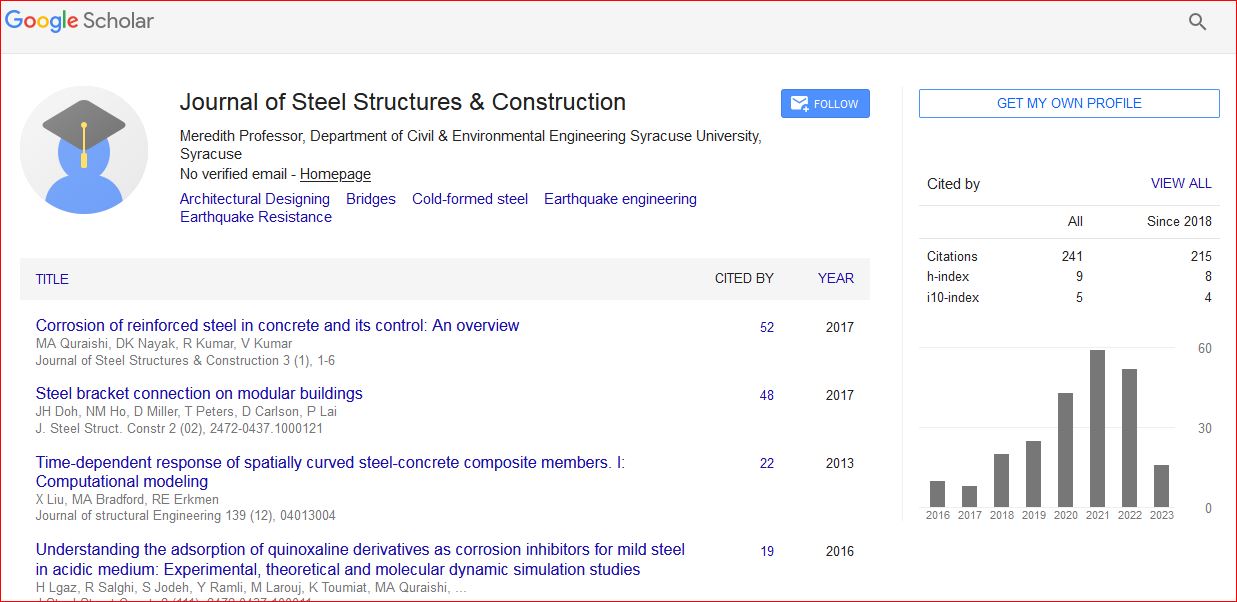
Journal of Steel Structures & Construction received 583 citations as per Google Scholar report