Opinion - (2025) Volume 11, Issue 3
Received: 02-Jun-2025, Manuscript No. abp-25-173822;
Editor assigned: 04-Jun-2025, Pre QC No. P-173822;
Reviewed: 18-Jun-2025, QC No. Q-173822;
Revised: 23-Jun-2025, Manuscript No. R-173822;
Published:
30-Jun-2025
, DOI: 10.37421/2472-0496.2025.11.325
Citation: Narayanan, Priya. ”Enhancing Dietary Adherence: A Multifaceted Approach.” Abnorm Behav Psychol 11 (2025):325.
Copyright: © 2025 Narayanan P. This is an open-access article distributed under the terms of the Creative Commons Attribution License, which permits unrestricted use, distribution and reproduction in any medium, provided the original author and source are credited.
Digital health tools show promise in improving dietary adherence by supporting personalized feedback, self-monitoring, and educational content. These interventions can significantly aid individuals in adopting healthier eating patterns through accessible technological platforms. However, the effectiveness and long-term engagement levels of these tools vary, indicating a strong need for tailored, user-centered design to maximize their impact and ensure sustained behavioral changes[1].
Adherence to dietary recommendations, especially in complex conditions like chronic kidney disease, is influenced by a multitude of factors. These include socioeconomic status, an individual's level of knowledge regarding their condition, robust family support networks, and the quality of communication between patients and their healthcare providers. Effective interventions must comprehensively address these multifaceted determinants to achieve successful and lasting dietary compliance[2].
Greater adherence to the Mediterranean diet consistently links with improved health outcomes, particularly among elderly populations. This dietary pattern is associated with a reduced risk of cardiovascular disease, a slower rate of cognitive decline, and lower overall mortality rates. These robust findings strongly reinforce the importance of actively promoting this beneficial dietary pattern as a cornerstone for healthy aging and longevity[3].
Diverse methods exist for comprehensively assessing dietary adherence in both clinical trials and daily practice, ranging from self-report questionnaires to advanced biomarkers. Each assessment technique presents its own set of strengths and limitations concerning accuracy, overall cost, and the burden placed on the patient. This highlights the critical necessity of selecting appropriate tools meticulously based on specific research objectives and the unique clinical context[4].
Social support plays a crucial and often indispensable role in enhancing dietary adherence, particularly among individuals managing obesity. Encouragement and practical assistance from family members, friends, and organized support groups can provide accountability and motivation. Ultimately, this collective support contributes significantly to better long-term weight management outcomes and improved dietary consistency[5].
Personalized nutrition approaches, which consider an individual's unique genetic makeup, lifestyle habits, and gut microbiome factors, hold significant potential to improve dietary adherence. By offering highly tailored recommendations, these methods aim to optimize individual responses. Nevertheless, substantial challenges persist in translating complex scientific data into actionable dietary advice and in ensuring the widespread accessibility and cost-effectiveness of these advanced interventions[6].
Mindfulness-based interventions can profoundly and positively impact eating behavior and dietary adherence. They achieve this by fostering greater awareness of internal hunger and satiety cues, effectively reducing instances of emotional eating, and actively promoting healthier, more conscious food choices. These meditative approaches offer a valuable and complementary strategy to traditional dietary counseling methods, enhancing overall well-being[7].
Adherence to dietary recommendations for managing type 2 diabetes involves a complex interplay of individual, social, and environmental factors. Common barriers frequently include a lack of adequate knowledge, significant financial constraints, cultural influences on food choices, and various emotional challenges. Conversely, consistent support from both family and healthcare providers emerges as a significant and pivotal facilitator for successful adherence[8].
Digital health interventions also demonstrate considerable potential in promoting dietary adherence among younger populations, specifically children and adolescents. These programs often leverage engaging elements such as gamification, interactive content, and active parental involvement to foster healthier habits. However, more extensive research is still needed to fully understand their long-term effectiveness and to precisely tailor interventions to specific age groups and varying health conditions[9].
The broader food environment profoundly impacts an individual's capacity to adhere to healthy dietary patterns. Factors such as food accessibility, its affordability, aggressive marketing strategies, and existing policy regulations directly shape food choices. These elements can either robustly support or significantly hinder adherence efforts, making it crucial to address these systemic issues for achieving widespread, population-level improvements in dietary health[10].
Dietary adherence represents a fundamental cornerstone in the prevention and management of a wide array of chronic diseases, ultimately influencing overall health and longevity. The consistent adoption of healthy eating patterns, such as the Mediterranean diet, has been demonstrably linked to significantly improved health outcomes in various populations, particularly among the elderly. Studies show a robust association between greater adherence to this diet and a reduced risk of cardiovascular disease, delayed cognitive decline, and a decrease in overall mortality rates, underscoring its profound importance for healthy aging[3]. However, achieving and maintaining dietary adherence is a complex endeavor, influenced by a myriad of individual, social, and environmental factors that require comprehensive understanding and targeted intervention strategies.
A significant area of development in promoting dietary adherence involves innovative technological and personalized approaches. Digital health tools, for instance, are increasingly recognized for their potential to enhance compliance by offering features like personalized feedback mechanisms, tools for self-monitoring, and accessible educational content[1]. These interventions prove beneficial across the lifespan, extending their reach to children and adolescents where gamification, interactive elements, and parental involvement can effectively foster healthier eating habits[9]. Complementing this, personalized nutrition strategies delve deeper, considering an individual's unique genetic profile, lifestyle choices, and the composition of their gut microbiome to deliver highly tailored dietary recommendations. This bespoke approach promises to optimize adherence by aligning dietary advice with individual physiological and behavioral nuances, though challenges persist in translating this intricate data into practical, cost-effective, and widely accessible guidance[6].
Beyond individual-centric strategies, the broader social and environmental landscapes exert profound influences on dietary adherence. In conditions like chronic kidney disease, adherence is shaped by a complex interplay of socioeconomic status, the patient's knowledge base, the presence of strong family support, and the quality of patient-provider communication[2]. Similarly, the role of social support is paramount, particularly for individuals managing obesity, where encouragement and practical assistance from family, friends, and organized groups provide vital accountability and motivation, contributing to more successful long-term weight management outcomes[5]. Furthermore, the surrounding food environment â?? encompassing factors such as the accessibility and affordability of healthy options, pervasive food marketing, and existing policy regulations â?? directly dictates food choices. These systemic elements can either bolster or significantly impede efforts towards healthy dietary adherence, highlighting the critical need for population-level interventions that address these foundational issues[10]. For individuals with type 2 diabetes, a similar complexity exists, with common barriers including insufficient knowledge, financial constraints, cultural dietary influences, and emotional eating. Conversely, strong support from family and healthcare professionals acts as a powerful facilitator[8].
Behavioral and psychological interventions also offer valuable pathways to improving dietary adherence. Mindfulness-based interventions, for instance, demonstrate a positive impact on eating behavior by cultivating a heightened awareness of internal hunger and satiety cues. This increased self-awareness helps in reducing impulsive emotional eating and encourages more conscious, healthier food choices. Such approaches serve as an effective complement to conventional dietary counseling, enhancing an individual's intrinsic capacity for self-regulation in their eating habits[7].
Finally, accurate and reliable methods for assessing dietary adherence are indispensable for both clinical management and robust research. A diverse spectrum of assessment tools exists, ranging from straightforward self-report questionnaires to sophisticated biochemical biomarkers. Each method carries inherent strengths and limitations concerning its accuracy, the associated cost, and the burden it places on patients. Therefore, the judicious selection of appropriate assessment tools is crucial, dictated by the specific research objectives, the available resources, and the unique clinical context in which adherence is being evaluated[4]. Taken together, a holistic strategy for improving dietary adherence must thoughtfully integrate technological innovation, personalized insights, robust social and environmental support, behavioral psychology, and precise assessment.
Dietary adherence is critical for health, with benefits seen in reduced disease risk and improved well-being, particularly for chronic conditions and in populations like the elderly following specific diets. Digital health interventions, leveraging personalized feedback, self-monitoring, and gamification, show promise in enhancing adherence for both adults and children, though long-term engagement remains a challenge. Personalized nutrition, factoring in genetics and lifestyle, also offers tailored recommendations but faces implementation hurdles. Adherence is not solely an individual responsibility; it is heavily influenced by external factors like social support from family and friends, and the broader food environment, including accessibility, affordability, and marketing. Barriers such as lack of knowledge, financial constraints, and cultural influences must be addressed, while support from healthcare providers acts as a facilitator. Behavioral strategies, such as mindfulness, can improve eating habits by fostering awareness and reducing emotional eating. Finally, diverse methods exist for assessing dietary adherence, each with pros and cons, necessitating careful selection based on context. Overall, improving dietary adherence requires a multifaceted approach integrating technology, personalized strategies, social support, and environmental considerations.
None
None
1. Sara A, Rachel D, Frederick E. "Effectiveness of digital health interventions on dietary adherence: A systematic review and meta-analysis".Nutrients 15 (2023):4619.
Indexed at, Google Scholar, Crossref
2. Shuyu R, Tingting W, Fengyan M. "Determinants of Dietary Adherence in Patients with Chronic Kidney Disease: A Systematic Review".Nutrients 14 (2022):3094.
Indexed at, Google Scholar, Crossref
3. Andrea LZ, Michele DC, Maurizio B. "Adherence to the Mediterranean Diet and Health Outcomes in Elderly Individuals: A Systematic Review and Meta-Analysis".Nutrients 15 (2023):3406.
Indexed at, Google Scholar, Crossref
4. Frauke F, Cornelius N, Oliver S. "Methods for Assessing Dietary Adherence in Clinical Trials and Practice: A Scoping Review".Nutrients 13 (2021):1793.
Indexed at, Google Scholar, Crossref
5. Hadeel E, Rahaf A, Afnan A. "The Role of Social Support in Dietary Adherence among Adults with Obesity: A Scoping Review".Obesity Reviews 23 (2022):e13456.
Indexed at, Google Scholar, Crossref
6. Josephine P, Diana AH, Laura AM. "Challenges and Opportunities in Personalized Nutrition for Improving Dietary Adherence: A Narrative Review".Nutrients 12 (2020):3338.
Indexed at, Google Scholar, Crossref
7. MarÃa SP, Anna R, Magnus B. "Mindfulness-Based Interventions and Their Effects on Eating Behavior and Dietary Adherence: A Systematic Review".Journal of Clinical Medicine 10 (2021):4519.
Indexed at, Google Scholar, Crossref
8. Nicole QT, Catherine TL, Yien SL. "Barriers and Facilitators to Dietary Adherence in Individuals with Type 2 Diabetes Mellitus: A Qualitative Systematic Review".International Journal of Environmental Research and Public Health 17 (2020):7983.
Indexed at, Google Scholar, Crossref
9. Esther CdN, Fleur JG, Max CB. "Digital Health Interventions for Improving Dietary Adherence in Children and Adolescents: A Systematic Review and Meta-Analysis".Journal of Medical Internet Research 23 (2021):e23246.
Indexed at, Google Scholar, Crossref
10. Tonje H, Elisabeth BL, Marte S. "The Role of the Food Environment in Shaping Dietary Adherence: A Narrative Review".Nutrients 14 (2022):3351.
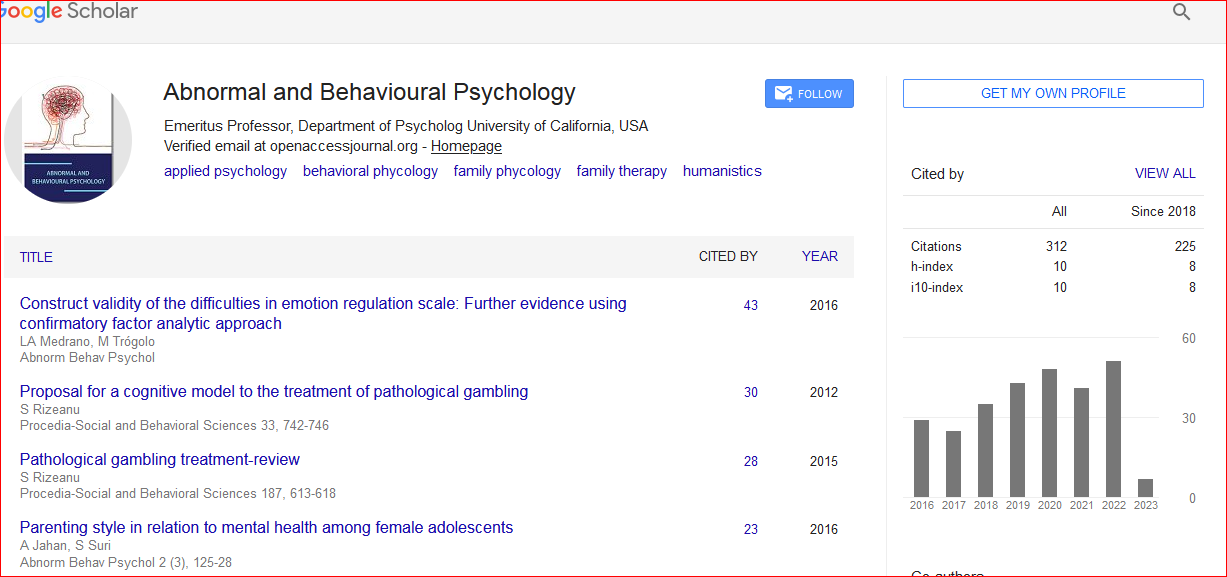
Abnormal and Behavioural Psychology received 361 citations as per Google Scholar report