Short Communication - (2025) Volume 10, Issue 5
Received: 01-Sep-2025, Manuscript No. apn-26-179170;
Editor assigned: 03-Sep-2025, Pre QC No. P-179170;
Reviewed: 14-Sep-2025, QC No. Q-179170;
Revised: 22-Sep-2025, Manuscript No. R-179170;
Published:
29-Sep-2025
, DOI: 10.37421/2573-0347.2025.10.448
Citation: Mendoza, Carlos. âEnhancing Advanced Health Assessment Skills: A Nurseâs Guide.â J Adv Practice Nurs 10 (2025):448.
Copyright: © 2025 Mendoza C. This is an open-access article distributed under the terms of the Creative Commons Attribution License, which permits unrestricted use,
distribution and reproduction in any medium, provided the original author and source are credited.
The landscape of advanced health assessment is undergoing a significant transformation, driven by the imperative for nurses to possess sophisticated diagnostic and evaluative capabilities. This evolving domain necessitates a continuous commitment to learning and adaptation within nursing practice to effectively address the complexities of modern healthcare scenarios. Strategies such as simulation, interprofessional education, and reflective practice are paramount in honing essential skills like diagnostic reasoning, physical examination techniques, and patient communication, thereby enhancing the quality of patient care. [1] The integration of technology is emerging as a powerful catalyst for advancing these clinical skills. Virtual and augmented reality, for instance, offer immersive and realistic simulation environments, enabling nurses to safely practice complex procedures and refine their decision-making processes. This technological advancement holds the potential to significantly improve patient outcomes by fostering a more skilled and confident nursing workforce. [2] Simulation-based education, in particular, plays a crucial role in cultivating advanced physical assessment proficiency among nursing students. The use of standardized patients and high-fidelity manikins provides invaluable opportunities to develop the ability to recognize subtle clinical signs and execute intricate examinations. Evidence suggests that simulation serves as a highly effective complement to traditional clinical learning experiences. [3] A core component of advanced health assessment is the development of robust diagnostic reasoning skills. A proposed framework integrates evidence-based practice, critical thinking, and accumulated clinical experience to elevate the accuracy of diagnoses. Structured learning modules and mentored practice are advocated as essential elements for fostering these vital cognitive abilities in nurses. [4] Furthermore, the impact of interprofessional education on advanced health assessment competencies cannot be overstated. Collaborative learning experiences involving physicians and other healthcare professionals broaden nurses' perspectives on patient care and enhance their capacity for comprehensive assessments. These inclusive learning environments are instrumental in fostering improved communication and teamwork. [5] Reflective practice stands as a fundamental element in the continuous refinement of advanced health assessment skills. Nurses who engage in critical self-reflection on their clinical encounters are better positioned to identify areas for improvement, enhance their decision-making processes, and systematically evolve their assessment strategies over time. Practical methods for embedding reflection into daily practice are increasingly being outlined. [6] The application of artificial intelligence (AI) is beginning to revolutionize advanced health assessment by providing tools that assist nurses in interpreting complex data, identifying subtle patterns, and predicting potential patient deterioration. AI has the capacity to augment human judgment, thereby improving both the efficiency and accuracy of clinical assessments, though its implementation requires careful consideration. [7] Complementing technical proficiency, advanced communication skills are indispensable for effective health assessment. Empathetic listening, clear articulation of findings, and adept negotiation of care plans are critical. Strategies for building rapport, navigating challenging conversations, and conducting patient-centered, culturally sensitive assessments are essential for optimal patient outcomes. [8] A systematic review of competency-based education highlights a significant shift in training approaches for advanced health assessment. This paradigm emphasizes outcome-focused learning over time-based training, requiring clearly defined learning objectives, standardized assessment tools, and continuous evaluation of clinical proficiencies. Such approaches ensure that nurses attain a high level of skill mastery. [9] Finally, the ethical considerations inherent in advanced health assessment demand careful attention. Principles such as informed consent, patient privacy, and the responsible utilization of advanced technologies are paramount. Guidance for nurses in navigating complex ethical dilemmas is crucial to ensure that advanced assessments are conducted with the utmost integrity and respect for patient autonomy. [10]
The fundamental objective of advanced health assessment training is to equip nurses with the sophisticated skills necessary for accurate diagnosis and comprehensive patient evaluation in increasingly complex healthcare environments. Continuous professional development and adaptability are thus essential components of advanced nursing practice, underscoring the importance of innovative educational strategies. Techniques such as high-fidelity simulation, collaborative interprofessional learning, and consistent reflective practice are identified as key methodologies for refining diagnostic acumen, mastering physical examination techniques, and fostering effective patient communication, particularly in challenging clinical situations. [1] The incorporation of cutting-edge technology represents a significant frontier in the enhancement of clinical skills for advanced health assessment. The exploration of virtual reality (VR) and augmented reality (AR) technologies offers the promise of highly realistic simulation settings, allowing nurses to gain practical experience with intricate procedures in a safe, controlled environment. These immersive tools are instrumental in sharpening decision-making capabilities, ultimately contributing to improved patient outcomes through more skilled and confident practitioners. [2] Simulation-based learning has emerged as a cornerstone in the development of advanced physical assessment expertise among nursing students. The strategic use of standardized patients, who provide realistic patient interactions, and advanced high-fidelity manikins, which mimic physiological responses, enables students to hone their ability to detect subtle clinical indicators and perform complex examination maneuvers. Research consistently supports simulation as a powerful adjunct to traditional hands-on clinical experiences, bridging the gap between theoretical knowledge and practical application. [3] Central to the concept of advanced health assessment is the cultivation of sophisticated diagnostic reasoning skills. A proposed framework offers a structured approach by integrating principles of evidence-based practice, critical thinking methodologies, and the accumulation of extensive clinical experience. This multifaceted approach aims to significantly improve the accuracy and reliability of nursing diagnoses. The authors strongly advocate for the implementation of well-designed learning modules and supervised, mentored practice to effectively foster these essential cognitive abilities within the nursing profession. [4] Moreover, the positive influence of interprofessional education on the acquisition of advanced health assessment competencies is a growing area of focus. When nurses engage in collaborative learning alongside physicians, therapists, and other healthcare professionals, they gain a more holistic understanding of patient care pathways and enhance their capacity to conduct thorough and comprehensive assessments. Studies indicate that these interprofessional learning environments are conducive to fostering superior communication skills and promoting effective teamwork among healthcare providers. [5] Reflective practice is consistently identified as a critical and indispensable component in the ongoing development of advanced health assessment skills. The practice encourages nurses to critically analyze their clinical encounters, thereby identifying specific areas requiring improvement. This process of deep self-examination enhances their decision-making prowess and allows for the continuous refinement of their assessment strategies over time. Practical, actionable methods for integrating reflective practices into the daily routines of nurses are now being widely disseminated. [6] The integration of artificial intelligence (AI) into advanced health assessment presents a transformative opportunity for nursing practice. AI-driven tools are being developed to assist nurses in the complex tasks of interpreting large volumes of patient data, identifying subtle but significant patterns, and predicting potential patient deterioration with greater accuracy. While AI holds significant potential to augment human clinical judgment and enhance the efficiency and precision of assessments, its successful and ethical implementation requires careful planning and execution. [7] Beyond technical skills, the development of advanced communication proficiencies is crucial for conducting effective health assessments. This encompasses the ability to actively listen with empathy, clearly explain complex findings to patients, and collaboratively negotiate care plans. Providing nurses with practical strategies to build strong patient rapport, manage sensitive or difficult conversations, and ensure that assessments are both patient-centered and culturally appropriate is vital for optimal care delivery. [8] A comprehensive review of current evidence concerning competency-based education for advanced health assessment reveals a significant paradigm shift in nursing education. This approach moves away from traditional time-based training models towards a focus on demonstrable outcomes and mastery of skills. It necessitates the establishment of precise learning objectives, the development of standardized assessment tools, and the implementation of ongoing evaluation mechanisms to verify clinical competency. Adherence to competency-based frameworks ensures that nurses are indeed proficient in the essential skills required for advanced practice. [9] Lastly, the ethical dimensions associated with advanced health assessment warrant thorough examination and discussion. Key ethical principles, including obtaining informed consent, safeguarding patient privacy, and the judicious and responsible use of emerging advanced technologies, are paramount. This article aims to provide clear guidance for nurses to effectively navigate the complex ethical dilemmas that can arise during advanced assessment procedures, thereby ensuring that all patient care is delivered with the highest standards of integrity and profound respect for individual patient autonomy. [10]
This collection of articles explores the multifaceted development of advanced health assessment skills in nursing. It emphasizes the need for continuous learning and highlights key strategies such as simulation, interprofessional education, and reflective practice to enhance diagnostic reasoning, physical examination, and patient communication. The role of technology, including virtual and augmented reality, and artificial intelligence, in improving assessment accuracy and efficiency is discussed, alongside the importance of advanced communication and competency-based education. Ethical considerations, including informed consent and patient privacy, are also addressed. The overarching goal is to empower nurses with the skills and knowledge necessary for sophisticated patient evaluation and care.
None
None
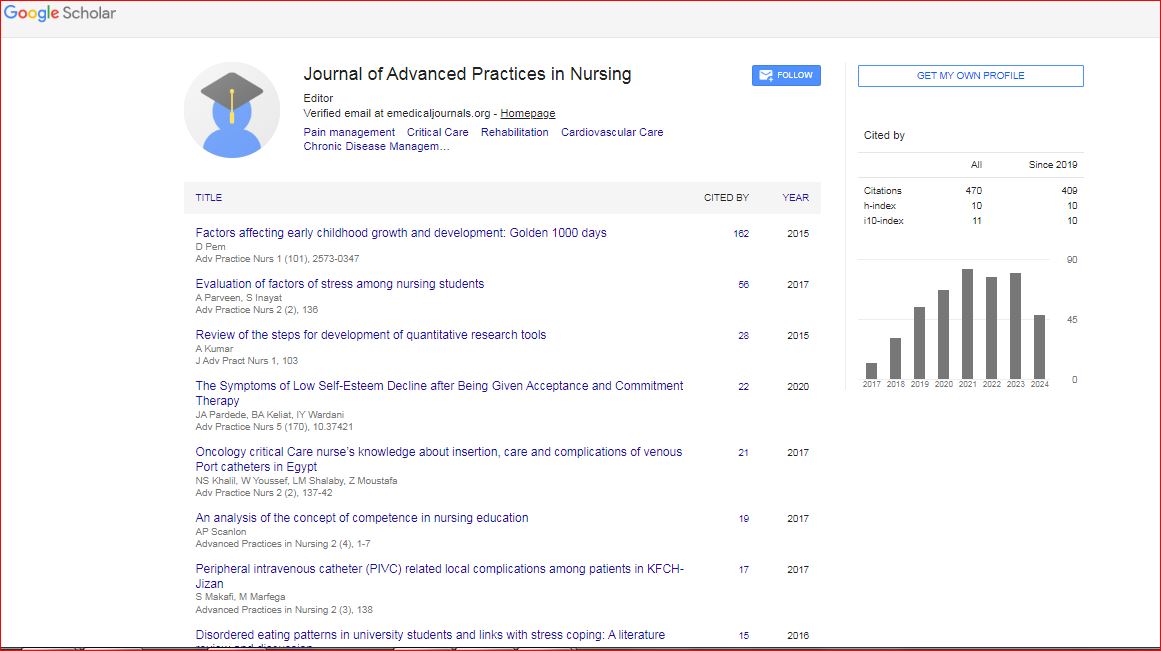
Journal of Advanced Practices in Nursing received 410 citations as per Google Scholar report