Commentary - (2025) Volume 16, Issue 5
Received: 30-Sep-2025, Manuscript No. gjto-25-176020;
Editor assigned: 02-Oct-2025, Pre QC No. P-176020;
Reviewed: 14-Oct-2025, QC No. QC-176020;
Revised: 21-Oct-2025, Manuscript No. R-176020;
Published:
28-Oct-2025
, DOI: 10.37421/2229-8711.2025.16.466
Citation: Hawthorne, Emily. ”Enhanced WOA: Solving Diverse Complex Problems.” Global J Technol Optim 16 (2025): 466.
Copyright: © 2025 Hawthorne E. This is an open-access article distributed under the terms of the Creative Commons Attribution License, which permits unrestricted use, distribution and reproduction in any medium, provided the original author and source are credited.
The Whale Optimization Algorithm (WOA) has emerged as a significant nature-inspired metaheuristic, designed to solve various complex optimization problems. Inspired by the hunting strategy of humpback whales, WOA simulates their unique bubble-net feeding behavior. Its inherent ability to balance global exploration and local exploitation makes it a compelling choice for researchers. Continuous innovation has led to numerous enhancements and applications, extending its utility across diverse scientific and engineering domains. The following paragraphs detail recent contributions, highlighting improved variants and their impact in specific problem areas. A recent research effort introduces an enhanced Whale Optimization Algorithm (WOA) engineered for more effective global optimization and real-world engineering design challenges. This improved variant emphasizes a refined balance between exploration and exploitation, which in turn delivers superior convergence speed and accuracy compared to the initial WOA and other metaheuristic algorithms. Its effectiveness is well-demonstrated through various benchmark functions and practical engineering problems, solidifying its reliability and efficiency in identifying optimal solutions [1].
For feature selection problems, an enhanced WOA incorporates a novel mutation operator. This particular enhancement aims to significantly improve the algorithm's search capability and its ability to avoid local optima, providing a highly effective approach for selecting optimal feature subsets. Experimental evaluations across various datasets confirm that this improved WOA variant surpasses standard WOA and other common algorithms in terms of classification accuracy and substantial feature reduction, underscoring its practical utility in data preprocessing for machine learning tasks [2].
A comprehensive survey offers an in-depth review of the Whale Optimization Algorithm (WOA), covering its foundational principles, various modifications, and diverse hybridizations. The survey also explores its wide array of applications across different domains. It systematically categorizes existing WOA variants, highlights their individual strengths and weaknesses, and discusses open research challenges that remain to be addressed. This paper serves as an invaluable resource for both researchers and practitioners, providing guidance for future developments and applications of WOA in tackling complex optimization problems [3].
In the realm of cyberattack detection, a hybrid model has been proposed, combining the Whale Optimization Algorithm (WOA) with a Deep Neural Network (DNN). The WOA component is specifically tasked with optimizing the weights and biases of the DNN, a process that significantly boosts its learning capability. This integration allows for more accurate classification of network traffic as either normal or malicious. The synergy between WOA and DNN improves the system's performance in identifying a variety of cyber threats, showcasing its potential for building resilient intrusion detection systems, particularly in industrial informatics settings [4].
Addressing complex high-dimensional optimization problems, a hybrid multi-strategy improved Whale Optimization Algorithm (WOA) has been introduced. This advanced algorithm integrates multiple enhancement strategies, specifically designed to improve convergence speed, global search capability, and overall solution accuracy. Extensive experiments performed on various benchmark functions unequivocally demonstrate that this improved WOA outperforms the original WOA and other state-of-the-art metaheuristics, marking it as a promising tool for solving challenging optimization tasks [5].
For optimal power flow problems, an improved Whale Optimization Algorithm (WOA) has been developed, incorporating chaotic initialization and Lévy flight. These specific enhancements aim to effectively prevent premature convergence and significantly improve the global search ability of the WOA. This leads to more efficient and reliable solutions for power system optimization. The proposed methodology consistently demonstrates superior performance in minimizing generation costs and transmission losses, thereby underscoring its considerable potential for practical applications within smart grids and energy management systems [6].
In the medical field, an intelligent diagnostic system for COVID-19 has been presented, which cleverly leverages a deep learning model optimized by the Whale Optimization Algorithm (WOA). The WOA plays a crucial role by fine-tuning the parameters of the deep learning architecture. This optimization improves the model's ability to accurately classify COVID-19 cases from various medical images, such as X-rays or CT scans. The ultimate goal of this approach is to provide a reliable and efficient automated diagnostic tool, offering significant assistance to medical professionals in achieving rapid and accurate disease detection, especially during public health crises [7].
Further research introduces another improved Whale Optimization Algorithm (WOA) that integrates chaotic theory and Gaussian mutation specifically for enhanced feature selection. The strategic inclusion of chaotic maps contributes to improving the diversity within the population and is effective in preventing premature convergence. Concurrently, Gaussian mutation plays a vital role in aiding local exploitation. This particular variant markedly enhances the algorithm's capacity to identify optimal feature subsets, which subsequently leads to improved classification accuracy and reduced computational complexity in various machine learning tasks [8].
For optimal resource scheduling in cloud computing environments, an improved Whale Optimization Algorithm (WOA) has been proposed to tackle this complex problem. The enhancements are primarily focused on efficiently allocating virtual machines and tasks with the dual objective of minimizing response time and maximizing resource utilization. The algorithm consistently demonstrates superior performance in balancing workloads and notably improving the overall efficiency of cloud data centers, offering a significant and valuable contribution to the field of cloud resource management [9].
Finally, research centers on optimizing the parameters of Support Vector Machines (SVM) by employing an improved Whale Optimization Algorithm (WOA). The WOA is strategically utilized to search for the best combination of SVM’s hyperparameters, including the regularization parameter and kernel parameters, with the aim of significantly enhancing its classification performance. Experimental outcomes across various datasets consistently show that the WOA-optimized SVM achieves higher accuracy and improved generalization ability when compared to traditional methods, thereby proving its effectiveness in enhancing machine learning models [10].
These collective advancements and applications underscore the Whale Optimization Algorithm's transformative potential and its increasing relevance across a multitude of domains. The continuous development of novel variants and hybrid approaches ensures its position as a robust and efficient metaheuristic capable of providing effective solutions to a broad spectrum of real-world optimization challenges.
The core of recent research on the Whale Optimization Algorithm (WOA) often revolves around enhancing its fundamental capabilities to tackle complex problems. For example, an improved WOA has been developed to more effectively handle global optimization and engineering design challenges, focusing on refining the balance between exploration and exploitation. This leads to better convergence speed and accuracy compared to the original WOA and other metaheuristic algorithms, with its efficacy proven across diverse benchmark functions and practical scenarios [1]. Similarly, a hybrid multi-strategy improved WOA was introduced for high-dimensional optimization problems. This variant integrates multiple enhancement strategies to boost convergence speed, global search, and solution accuracy. Extensive testing on various benchmark functions confirms its superior performance over the standard WOA and other state-of-the-art metaheuristics, making it a promising tool for complex tasks [5]. These works highlight a continuous effort to make the WOA more robust and efficient for general optimization.
A significant application area for enhanced WOA is feature selection, a critical step in machine learning. One approach presents an enhanced WOA that incorporates a novel mutation operator specifically tailored for feature selection problems. This innovation aims to improve the algorithm's search capability and its ability to avoid local optima, ultimately providing a more effective method for identifying optimal feature subsets. Experimental results on various datasets demonstrate that this improved variant outperforms standard WOA and other common algorithms in terms of both classification accuracy and feature reduction, proving its value in data preprocessing [2]. Another related study introduces an improved WOA that integrates chaotic theory and Gaussian mutation for enhanced feature selection. The chaotic maps contribute to increasing population diversity and preventing premature convergence, while Gaussian mutation assists in local exploitation. This variant significantly improves the algorithm's capacity to identify optimal feature subsets, resulting in higher classification accuracy and reduced computational complexity in machine learning tasks [8].
WOA also finds strong applications in specific engineering and system optimization problems. For instance, a hybrid model combining WOA with a Deep Neural Network (DNN) has been proposed for effective cyberattack detection. Here, WOA optimizes the weights and biases of the DNN, enhancing its learning capability and enabling more accurate classification of network traffic as normal or malicious. This integration significantly improves the DNN's performance in identifying various cyber threats, highlighting its potential for building reliable intrusion detection systems in industrial informatics [4]. In power systems, an improved WOA, which includes chaotic initialization and Lévy flight, has been explored for solving optimal power flow problems. These enhancements are designed to prevent premature convergence and improve the global search ability of the WOA, leading to more efficient and dependable solutions for power system optimization. The method shows superior performance in minimizing generation costs and transmission losses, indicating its practical utility in smart grids and energy management [6]. Furthermore, an improved WOA addresses optimal resource scheduling in cloud computing environments. The algorithm's enhancements focus on efficiently allocating virtual machines and tasks to minimize response time and maximize resource utilization, demonstrating superior performance in balancing workloads and improving overall efficiency in cloud data centers [9].
Beyond direct application, WOA serves as a powerful optimizer for other machine learning models. An intelligent diagnostic system for COVID-19, for example, leverages a deep learning model optimized by WOA. The algorithm fine-tunes the deep learning architecture's parameters, enhancing its ability to accurately classify COVID-19 cases from medical images like X-rays or CT scans. This approach aims to provide a reliable and efficient automated diagnostic tool, assisting medical professionals in rapid and accurate disease detection during public health crises [7]. Similarly, research has focused on optimizing the parameters of Support Vector Machines (SVM) using an improved WOA. The WOA searches for the best combination of SVM’s hyperparameters, such as the regularization parameter and kernel parameters, to significantly enhance its classification performance. Experimental results on diverse datasets illustrate that the WOA-optimized SVM achieves higher accuracy and generalization ability compared to traditional methods, proving its effectiveness in improving machine learning models [10].
The growing body of work on the Whale Optimization Algorithm underscores the need for comprehensive reviews. A significant survey provides a detailed overview of WOA, covering its fundamental principles, numerous modifications, and various hybridizations. It also explores a wide range of applications across different domains. The paper categorizes existing WOA variants, highlighting their strengths and weaknesses, and discusses open research challenges. This survey is a valuable resource for researchers and practitioners, guiding future developments and applications of WOA in solving complex optimization problems, offering a broad perspective on the algorithm's evolution and potential [3].
Recent research explores and enhances the Whale Optimization Algorithm (WOA), a powerful metaheuristic method, to tackle various complex problems. One focus is on refining WOA's core mechanics, aiming for a better balance between exploring new solutions and exploiting promising areas. These enhancements lead to superior convergence speed and accuracy compared to the original WOA and other metaheuristic algorithms, with validation across diverse benchmark functions and practical engineering problems. Innovations include a novel mutation operator to improve search capabilities for feature selection, preventing local optima and boosting classification accuracy and feature reduction. Hybrid models, like combining WOA with Deep Neural Networks (DNN) for cyberattack detection, show promise by optimizing DNN weights and biases for more accurate threat identification. Other improvements integrate multi-strategy approaches to address high-dimensional optimization problems, enhancing global search and solution accuracy. Additionally, researchers use chaotic initialization and Lévy flight to improve WOA for optimal power flow problems, minimizing costs and losses in smart grids. WOA also helps in medical diagnostics, optimizing deep learning models for accurate COVID-19 detection from medical images. Further studies use chaotic theory and Gaussian mutation to refine feature selection, boosting diversity and local exploitation. The algorithm also finds use in cloud computing for optimal resource scheduling, ensuring efficient task allocation and maximizing utilization. Finally, WOA plays a role in optimizing Support Vector Machine (SVM) parameters, improving classification performance across various datasets. This collective work highlights WOA's adaptability and growing impact across many computational and real-world challenges.
None
None
Sarvar AG, Haval MA, Hazhar RI. "An improved whale optimization algorithm for solving global optimization and engineering design problems".Applied Soft Comp. 139 (2023):110298.
Indexed at, Google Scholar, Crossref
Xiaohan H, Yongsheng G, Ruiling Z. "An enhanced whale optimization algorithm with a novel mutation operator for feature selection".Expert Syst. Appl. 205 (2022):117671.
Indexed at, Google Scholar, Crossref
K. KK, S. PK, B. C. "Whale Optimization Algorithm: A comprehensive survey, variants, and applications".Applied Soft Comp. 103 (2021):107149.
Indexed at, Google Scholar, Crossref
Harmanpreet K, Aman S, Parvinder KS. "Hybrid Whale Optimization Algorithm-Based Deep Neural Network for Cyberattack Detection".IEEE Trans. Ind. Inform. 16 (2020):5493-5501.
Indexed at, Google Scholar, Crossref
Jian Z, Zhensheng Z, Yufeng L. "A hybrid multi-strategy improved whale optimization algorithm for solving high-dimensional optimization problems".Knowledge-Based Syst. 263 (2023):110294.
Indexed at, Google Scholar, Crossref
P. RJRKB, K. K, A. M. "Optimal power flow using an improved whale optimization algorithm with chaotic initialization and Lévy flight".Energy Rep. 8 (2022):1673-1688.
Indexed at, Google Scholar, Crossref
A. R, M. SSK, G. K. "An intelligent diagnostic system for COVID-19 using Whale Optimization Algorithm based deep learning model".Comput. Biol. Med. 139 (2021):104996.
Indexed at, Google Scholar, Crossref
Jiaxin S, Jianshe Z, Haitao W. "An improved whale optimization algorithm based on chaotic theory and Gaussian mutation for feature selection".Swarm Evol. Comput. 86 (2023):101340.
Indexed at, Google Scholar, Crossref
Xiaohua W, Chao L, Jiajun N. "An improved whale optimization algorithm for optimal resource scheduling in cloud computing".Future Gener. Comput. Syst. 125 (2021):169-183.
Indexed at, Google Scholar, Crossref
Jing L, Ding-Gang W, Shui-Tang Y. "Parameter optimization of support vector machine using an improved whale optimization algorithm".Applied Soft Comp. 82 (2019):105574.
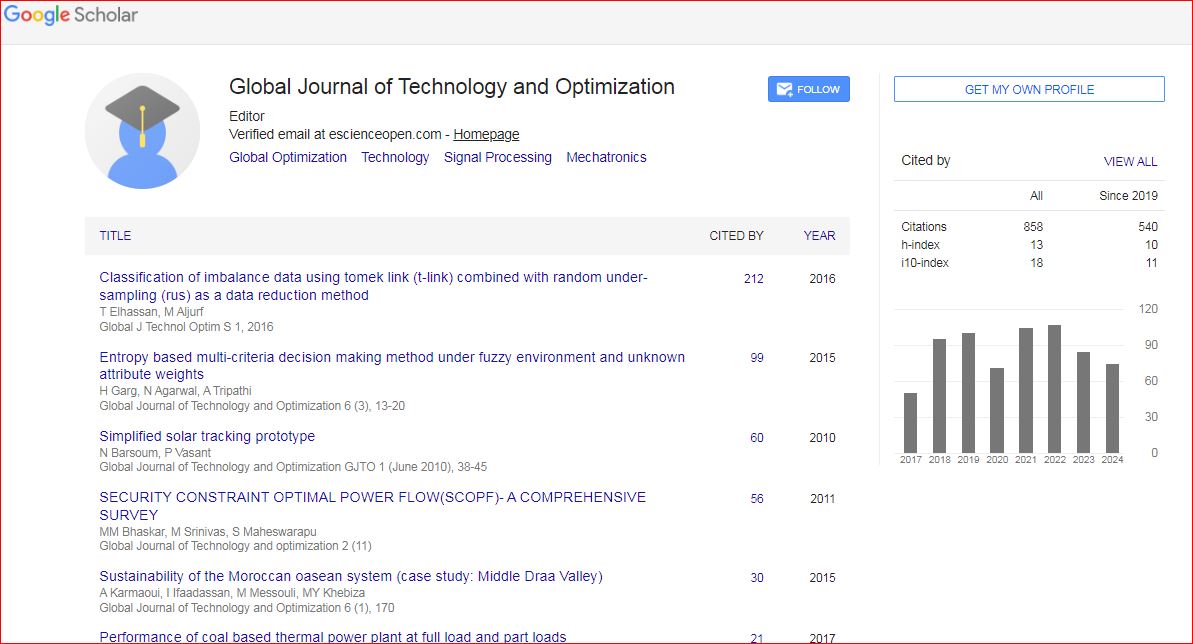
Global Journal of Technology and Optimization received 847 citations as per Google Scholar report