Brief Report - (2025) Volume 14, Issue 3
Received: 01-Jun-2025, Manuscript No. idse-26-182803;
Editor assigned: 03-Jun-2025, Pre QC No. P-182803;
Reviewed: 17-Jun-2025, QC No. Q-182803;
Revised: 23-Jun-2025, Manuscript No. R-182803;
Published:
30-Jun-2025
, DOI: 10.37421/2168-9768.2025.14.488
Citation: Ochieng, Samuel. ”Engineering Principles For Effective
Water Management.” Irrigat Drainage Sys Eng 14 (2025):488.
Copyright: © 2025 Ochieng S. This is an open-access article distributed under the terms of the Creative Commons Attribution License, which permits unrestricted use,
distribution and reproduction in any medium, provided the original author and source are credited.
The efficient management of water in agricultural systems is paramount for ensuring food security and environmental sustainability. Engineering principles play a foundational role in optimizing both water application and drainage control, addressing critical challenges faced by modern agriculture. This introduction will explore key aspects of these engineering principles, drawing upon recent research and advancements. Firstly, the fundamental engineering principles guiding effective water application and drainage control in agricultural systems are examined. This involves understanding how optimizing irrigation strategies, considering factors like soil type, crop water requirements, and climate, directly impacts water use efficiency and crop yield. Simultaneously, it highlights the critical role of proper drainage in preventing waterlogging, salinity buildup, and soil degradation, thereby ensuring long-term agricultural productivity and environmental sustainability. The discussion also touches upon the integration of these principles with modern technologies for enhanced system performance [1].
Focusing on micro-irrigation systems, research evaluates the engineering considerations for precise water delivery and efficient drainage. This analysis delves into the design parameters for drip and sprinkler systems, emphasizing uniformity of application and minimizing conveyance losses. Furthermore, the study investigates the impact of drainage design on soil aeration and nutrient management in the root zone, crucial for maximizing crop performance and reducing environmental pollution. The findings underscore the importance of integrated design approaches [2].
Another significant area of focus is the hydrological principles behind designing effective subsurface drainage systems for agricultural lands. This exploration examines the influence of soil hydraulic properties, rainfall intensity, and topography on drainage system performance. The article also discusses the engineering challenges associated with installing and maintaining these systems to prevent waterlogging and improve soil conditions, with the benefits of enhanced drainage for soil health and crop resilience being thoroughly discussed [3].
In parallel, the application of remote sensing and GIS technologies is investigated for optimizing irrigation water application and assessing drainage needs. These tools demonstrate their capability to provide accurate data on soil moisture, crop stress, and topographical variations, enabling more precise water management. The study also highlights their role in identifying areas prone to waterlogging, facilitating targeted drainage interventions, and offering significant potential for improving water use efficiency [4].
Furthermore, the engineering design of surface drainage systems for agricultural lands is explored, taking into account factors such as land slope, rainfall patterns, and soil characteristics. This analysis examines different types of surface drainage structures, like open ditches and land grading, and their effectiveness in removing excess water and preventing erosion. The article also discusses the interplay between surface and subsurface drainage for comprehensive water management [5].
Energy efficiency in pumping systems used for irrigation and drainage is another crucial engineering consideration. This involves analyzing the principles involved in selecting and operating pumps to minimize energy consumption while meeting crop water demands and effectively draining excess water. The study also explores the potential of renewable energy sources for powering these systems, contributing to sustainable agricultural practices [6].
Engineering challenges related to managing drainage in saline-affected agricultural lands are also addressed. This research investigates how drainage design influences salt movement and leaching, aiming to mitigate secondary salinization. The exploration covers various drainage techniques and their effectiveness in improving soil properties and supporting crop growth in arid and semi-arid environments, emphasizing the importance of integrated water and salt management [7].
An engineering evaluation of irrigation scheduling methods is conducted, focusing on optimizing water application based on actual crop needs and environmental conditions. This comparison of volumetric, time-based, and sensor-based approaches highlights their advantages and limitations in terms of water saving and yield improvement, with implications for drainage requirements also being considered [8].
Finally, the profound influence of soil physical properties on the engineering design of both irrigation and drainage systems is examined. The emphasis is placed on how soil texture, structure, and hydraulic conductivity affect water infiltration, percolation, and water holding capacity, directly impacting system efficiency and performance. Understanding these properties is deemed crucial for designing systems that effectively manage water for optimal crop growth and soil health [9].
Moreover, the economic and environmental impacts of implementing advanced engineering principles for water application and drainage control in smallholder farming systems are assessed. This involves a cost-benefit analysis of adopting improved irrigation technologies and drainage practices, considering factors like increased yields, reduced water usage, and improved soil quality, along with the challenges and opportunities for scaling up these practices [10].
The field of agricultural water management relies heavily on sound engineering principles to ensure efficient water application and effective drainage. These principles are essential for optimizing crop production while simultaneously protecting the environment. The following sections delve into various facets of this critical domain, providing a comprehensive overview of current research and established practices. This article examines the fundamental engineering principles guiding effective water application and drainage control in agricultural systems. It delves into how optimizing irrigation strategies, considering factors like soil type, crop water requirements, and climate, directly impacts water use efficiency and crop yield. Simultaneously, it highlights the critical role of proper drainage in preventing waterlogging, salinity buildup, and soil degradation, thereby ensuring long-term agricultural productivity and environmental sustainability. The discussion also touches upon the integration of these principles with modern technologies for enhanced system performance [1].
Focusing on micro-irrigation systems, this research evaluates the engineering considerations for precise water delivery and efficient drainage. It analyzes the design parameters for drip and sprinkler systems, emphasizing uniformity of application and minimizing conveyance losses. Furthermore, the study investigates the impact of drainage design on soil aeration and nutrient management in the root zone, crucial for maximizing crop performance and reducing environmental pollution. The findings underscore the importance of integrated design approaches [2].
This paper explores the hydrological principles behind designing effective subsurface drainage systems for agricultural lands. It examines the influence of soil hydraulic properties, rainfall intensity, and topography on drainage system performance. The article also discusses the engineering challenges associated with installing and maintaining these systems to prevent waterlogging and improve soil conditions. The benefits of enhanced drainage for soil health and crop resilience are thoroughly discussed [3].
The research investigates the application of remote sensing and GIS technologies for optimizing irrigation water application and assessing drainage needs. It demonstrates how these tools can provide accurate data on soil moisture, crop stress, and topographical variations, enabling more precise water management. The study also highlights their role in identifying areas prone to waterlogging, facilitating targeted drainage interventions. This integration of technology offers significant potential for improving water use efficiency [4].
This study focuses on the engineering principles of surface drainage design for agricultural lands, considering factors like land slope, rainfall patterns, and soil characteristics. It analyzes different types of surface drainage structures, such as open ditches and land grading, and their effectiveness in removing excess water and preventing erosion. The article also discusses the interplay between surface and subsurface drainage for comprehensive water management [5].
The article examines the energy efficiency of pumping systems used in irrigation and drainage. It analyzes the engineering principles involved in selecting and operating pumps to minimize energy consumption while meeting the water demands of crops and effectively draining excess water. The study also explores the potential of renewable energy sources for powering these systems, contributing to sustainable agricultural practices [6].
This paper addresses the engineering challenges of managing drainage in saline-affected agricultural lands. It investigates how drainage design influences salt movement and leaching, aiming to mitigate secondary salinization. The research explores various drainage techniques and their effectiveness in improving soil properties and supporting crop growth in arid and semi-arid environments. The importance of integrated water and salt management is emphasized [7].
The study evaluates the performance of different irrigation scheduling methods from an engineering perspective, focusing on optimizing water application based on actual crop needs and environmental conditions. It compares volumetric, time-based, and sensor-based approaches, highlighting their advantages and limitations in terms of water saving and yield improvement. The implications for drainage requirements are also considered [8].
This article explores the role of soil physical properties in the engineering design of both irrigation and drainage systems. It emphasizes how soil texture, structure, and hydraulic conductivity influence water infiltration, percolation, and water holding capacity, directly impacting system efficiency and performance. Understanding these properties is crucial for designing systems that effectively manage water for optimal crop growth and soil health [9].
The research examines the economic and environmental impacts of implementing advanced engineering principles for water application and drainage control in smallholder farming systems. It assesses the cost-benefit analysis of adopting improved irrigation technologies and drainage practices, considering factors like increased yields, reduced water usage, and improved soil quality. The study also discusses the challenges and opportunities for scaling up these practices [10].
Effective water management in agriculture necessitates a strong foundation in engineering principles for both water application and drainage. Optimizing irrigation strategies based on soil, crop, and climate factors is crucial for water use efficiency and yield. Proper drainage is vital to prevent waterlogging, salinity, and soil degradation, ensuring long-term productivity. Micro-irrigation systems require careful engineering for precise water delivery and efficient drainage, impacting soil aeration and nutrient management. Subsurface and surface drainage systems are designed considering hydrological principles, soil properties, and topography to manage excess water and improve soil conditions. Advanced technologies like remote sensing and GIS offer precise data for optimizing irrigation and identifying drainage needs. Pumping system efficiency and the integration of renewable energy sources are also key engineering considerations. Managing drainage in saline lands requires specific engineering solutions to mitigate salinization and improve soil properties. Evaluating irrigation scheduling methods from an engineering perspective helps in optimizing water use and yield. Soil physical properties fundamentally influence the design of both irrigation and drainage systems. Finally, assessing the economic and environmental impacts of adopting advanced engineering principles is important, especially for smallholder farming systems, to promote sustainability and scalability.
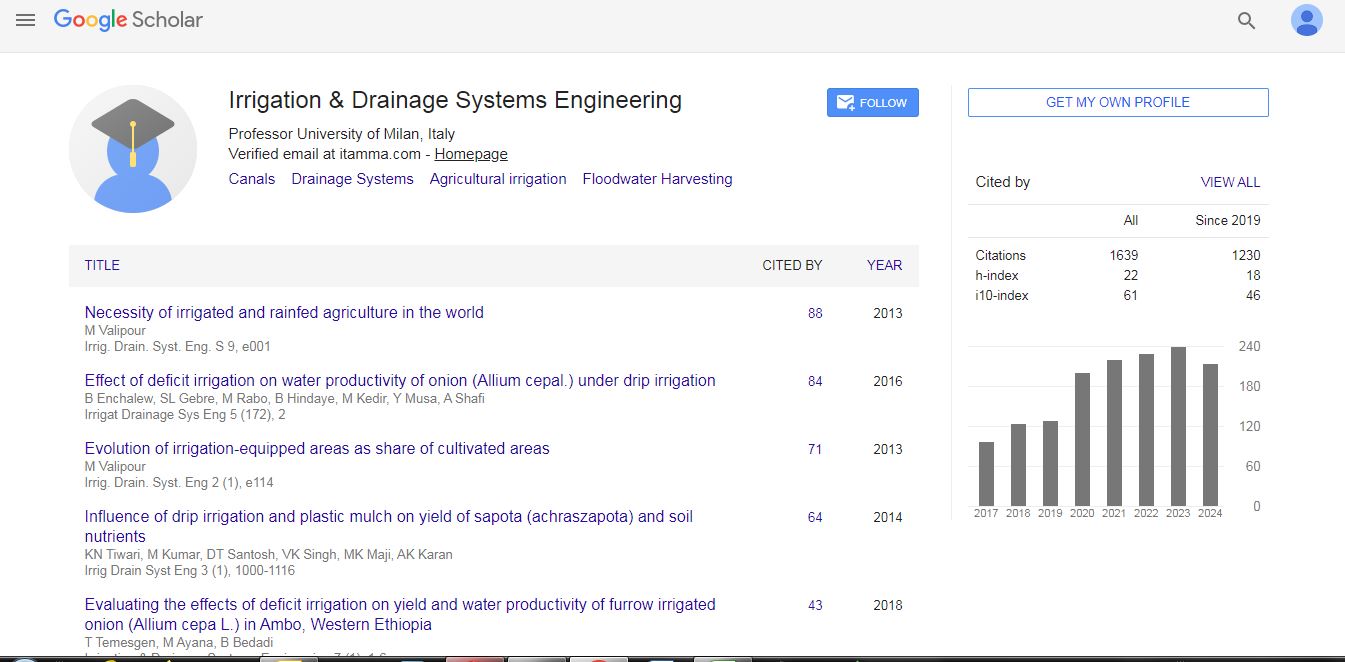
Irrigation & Drainage Systems Engineering received 835 citations as per Google Scholar report