Short Communication - (2025) Volume 13, Issue 4
Received: 01-Jul-2025, Manuscript No. economics-26-186064;
Editor assigned: 03-Jul-2025, Pre QC No. P-186064;
Reviewed: 17-Jul-2025, QC No. Q-186064;
Revised: 22-Jul-2025, Manuscript No. R-186064;
Published:
29-Jul-2025
, DOI: 10.37421/2375-4389.2025.13.540
Citation: O’Connell, Sarah. ”Energy Price Shocks: Macroeconomic
Impacts and Resilience Strategies.” J Glob Econ 13 (2025):540.
Copyright: © 2025 O’Connell S. This is an open-access article distributed under the terms of the Creative Commons Attribution License, which permits unrestricted use,
distribution and reproduction in any medium, provided the original author and source are credited.
The macroeconomic consequences stemming from energy price shocks are a subject of considerable academic inquiry, with a significant body of research dedicated to understanding their multifaceted impacts. These shocks, particularly those originating from volatile oil and gas markets, have been shown to trigger substantial supply-side disruptions. These disruptions lead to increased production costs for businesses and subsequently translate into higher consumer prices, thereby fueling inflationary pressures across economies [1].
The transmission mechanisms through which these shocks propagate are diverse, affecting economic growth and employment in complex ways. Emerging economies, in particular, are susceptible to the inflationary dynamics influenced by fluctuations in global oil prices. Studies employing sophisticated econometric models, such as vector autoregression (VAR), trace these shocks through import prices, domestic inflation, and exchange rates, revealing that indirect channels like currency depreciation and changes in inflation expectations play a pivotal role in amplifying inflationary effects [2].
The distributional consequences of energy price shocks are also a critical area of focus, with research highlighting their disproportionate impact on household consumption and welfare. Microdata analyses from developed economies consistently demonstrate that low-income households, due to their higher expenditure share on energy, bear a greater burden from these price surges, quantifying significant welfare losses and underscoring the regressive nature of energy price volatility [3].
Beyond household impacts, energy price volatility exerts a considerable influence on corporate investment decisions. Empirical studies focusing on sectors like manufacturing reveal that heightened uncertainty in energy markets leads to a discernible reduction in capital expenditures. This is often attributed to increased risk premiums associated with energy price fluctuations and a greater reluctance among firms to commit to long-term projects in an unpredictable environment [4].
Geopolitical events represent a significant exogenous factor that can trigger substantial energy price shocks. The interplay between geopolitical occurrences and global energy prices has profound implications for international trade patterns, influencing import and export flows and potentially leading to significant alterations in trade balances and the redirection of energy trade routes [5].
The effects of energy price shocks extend directly to labor markets, influencing employment levels, wages, and labor productivity. Research indicates that industries with high energy intensity are more vulnerable to job losses during periods of price surges, whereas sectors with lower energy dependence may experience a relative advantage, necessitating an examination of labor market flexibility and retraining programs [6].
In light of these pervasive impacts, the transition to renewable energy sources is increasingly viewed as a strategy to enhance economic resilience against energy price shocks. Modeling studies suggest that a robust renewable energy sector can insulate economies from the volatility of fossil fuel markets, potentially leading to reduced inflation and improved trade balances, albeit with substantial upfront investment and transition challenges [7].
Monetary policy plays a crucial role in navigating the macroeconomic turbulence caused by energy price shocks. Central banks adjust interest rates and other tools to manage inflationary pressures and output gaps. Comparative analyses of different monetary regimes highlight the trade-offs between inflation control and supporting economic activity, emphasizing the importance of clear communication and pre-emptive action [8].
Furthermore, energy price shocks have significant implications for fiscal balances. Government revenues, derived from energy taxes, and expenditures, such as subsidies and infrastructure investments, can be profoundly affected. Countries with substantial reliance on energy exports or imports are particularly vulnerable to fiscal deterioration, underscoring the need for fiscal buffers and prudent debt management [9].
The very structure of energy markets themselves can amplify or dampen the macroeconomic effects of price shocks. Market concentration, regulatory frameworks, and speculative trading dynamics influence price volatility and its transmission to the real economy. Well-regulated and competitive energy markets are generally considered more resilient, contributing to price stabilization and mitigating broader macroeconomic impacts [10].
The macroeconomic consequences of energy price shocks are a significant area of study, with the transmission mechanisms to inflation, economic growth, and employment being central to ongoing research. Volatility in energy markets, particularly for oil and gas, can initiate supply-side disruptions, leading to augmented production costs and subsequent consumer price increases. The differential impacts across various economic sectors and income strata are also a key concern, as these shocks can exacerbate existing inequalities [1].
Emerging economies face particular vulnerabilities when global oil prices fluctuate, influencing their inflation dynamics. Empirical studies utilizing vector autoregression (VAR) models have effectively traced the propagation of oil price shocks through import prices, domestic inflation, and exchange rates. These analyses reveal that while direct effects on import prices are substantial, indirect channels such as currency depreciation and shifts in inflation expectations play a critical role in magnifying the overall inflationary impact, highlighting the need for astute exchange rate management and anchored inflation expectations [2].
The impact of energy price shocks on household consumption and welfare is a crucial dimension of macroeconomic analysis. Research employing microdata from developed economies consistently demonstrates that low-income households are disproportionately affected due to their higher expenditure shares on energy. This differential impact leads to quantifiable welfare losses and underscores the regressive nature of energy price volatility, emphasizing the necessity for targeted support mechanisms to safeguard vulnerable populations [3].
The relationship between energy price volatility and corporate investment decisions is another critical aspect explored in the literature. Empirical analyses, particularly within the manufacturing sector, have shown that increased uncertainty in energy markets correlates with a reduction in capital expenditures. This phenomenon is often explained by heightened risk premiums and a diminished inclination among firms to commit to long-term projects in an environment of unpredictable energy costs, suggesting that policies promoting energy price stability or offering hedging instruments could stimulate investment [4].
Geopolitical events serve as potent triggers for energy price shocks, with significant repercussions for global trade patterns. Specific geopolitical shocks have been identified as drivers of substantial oil and gas price spikes, altering import and export flows and potentially reshaping energy trade routes. The implications for energy security and the strategic imperative of diversified energy sources are also critically examined in this context [5].
The influence of energy price shocks on labor market dynamics is a vital consideration, encompassing effects on employment levels, wages, and labor productivity across different industries. Research suggests that sectors characterized by high energy intensity are more prone to job losses following price surges, while those with lower energy dependence may gain a relative advantage. Consequently, the study of labor market flexibility and the efficacy of retraining programs in adapting to such volatility becomes paramount [6].
The ongoing transition to renewable energy sources is viewed as a strategy to enhance economic resilience against energy price shocks. This transition can potentially insulate economies from the inherent volatility of fossil fuel markets. Modeling efforts explore the economic benefits, such as reduced inflation and improved trade balances, that can arise from a well-developed renewable energy sector, while also acknowledging the significant investment requirements and potential transition challenges [7].
The effectiveness of monetary policy in responding to energy price shocks is a subject of continuous analysis. Central banks employ tools such as interest rate adjustments to manage inflationary pressures and output gaps. Comparative studies of different monetary regimes highlight the inherent trade-offs between combating inflation and fostering economic activity, underscoring the critical importance of clear communication strategies and proactive policy interventions [8].
Furthermore, energy price shocks have direct implications for fiscal balances. Changes in energy prices can significantly affect government revenues, derived from taxes on energy production and consumption, as well as government expenditures, which may include subsidies or investments in energy infrastructure. Countries heavily reliant on energy trade are particularly susceptible to fiscal deterioration, making robust fiscal buffers and prudent debt management essential for mitigating these risks [9].
The very structure of energy markets plays a significant role in either amplifying or dampening the macroeconomic effects of energy price shocks. Factors such as market concentration, regulatory frameworks, and the prevalence of speculative trading can significantly influence price volatility and its transmission to the broader economy. The consensus is that well-regulated and competitive energy markets exhibit greater resilience to external shocks, contributing to price stabilization and mitigating adverse macroeconomic consequences [10].
Energy price shocks have profound macroeconomic consequences, affecting inflation, economic growth, and employment through various transmission mechanisms. Emerging economies are particularly vulnerable to the inflationary impacts of fluctuating oil prices, amplified by indirect channels like currency depreciation. These shocks disproportionately impact low-income households, leading to welfare losses and increased inequality. Corporate investment decisions are also affected by heightened energy price uncertainty, potentially leading to reduced capital expenditures. Geopolitical events are significant triggers for energy price volatility, impacting international trade patterns and energy security. Labor markets, especially in energy-intensive sectors, face job losses during price surges. The transition to renewable energy is seen as a strategy to enhance economic resilience. Monetary policy plays a crucial role in managing inflationary pressures and output gaps, with clear communication and pre-emptive action being vital. Fiscal balances are also vulnerable, especially for energy-dependent nations, necessitating fiscal buffers and prudent debt management. The structure of energy markets, including competition and regulation, can influence the severity of these macroeconomic impacts.
None
None
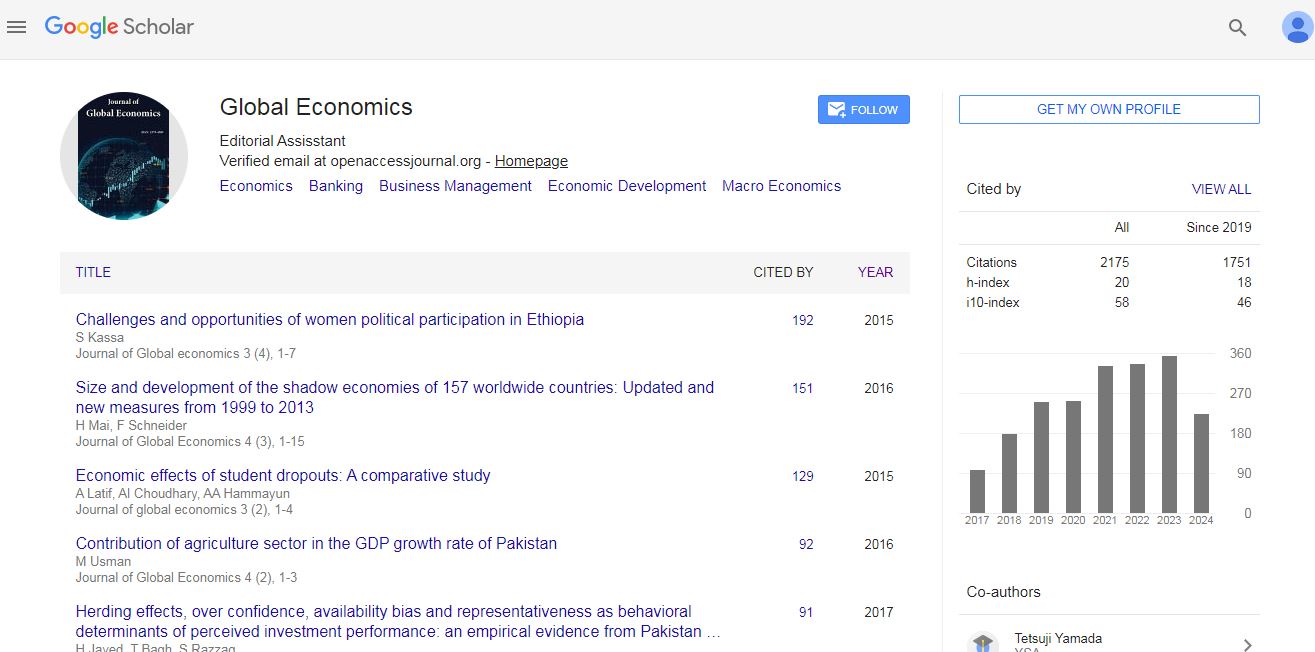
Journal of Global Economics received 2175 citations as per Google Scholar report