Brief Report - (2025) Volume 11, Issue 6
Received: 01-Dec-2025, Manuscript No. JOV-26-186446;
Editor assigned: 03-Dec-2025, Pre QC No. P-186446;
Reviewed: 17-Dec-2025, QC No. Q-186446;
Revised: 22-Dec-2025, Manuscript No. R-186446;
Published:
29-Dec-2025
, DOI: 10.37421/2471-9544.2025.11.331
Citation: Fernandez, Miguel. ”Endothelial Cell Dysregulation: Key to Rare Vascular Anomalies.” J Vasc 11 (2025):331.
Copyright: © 2025 Fernandez M. This is an open-access article distributed under the terms of the Creative Commons Attribution License, which permits unrestricted use, distribution and reproduction in any medium, provided the original author and source are credited.
Rare vascular anomalies represent a complex group of conditions characterized by aberrant development of blood vessels. At the core of understanding these pathologies lies the critical role of endothelial cells, the specialized cells forming the inner lining of blood vessels. Their intricate functions, including angiogenesis, inflammation, and communication with other cell types, are profoundly dysregulated in these disorders, leading to significant clinical challenges. This section will explore the multifaceted contributions of endothelial cells to the pathogenesis of rare vascular anomalies, drawing upon recent advancements in the field. The intricate role of endothelial cells in the pathogenesis of rare vascular anomalies is highlighted, emphasizing their dysregulation in processes such as angiogenesis and inflammation. This understanding of 'endothelial whispers' can unlock novel therapeutic targets for conditions previously considered intractable [1].
Focusing on specific genetic underpinnings, research delves into how mutations affecting endothelial cell signaling pathways contribute to the development of rare vessel malformations. The findings point towards personalized medicine approaches based on individual genetic profiles [2].
Investigations into the inflammatory milieu surrounding rare vessel anomalies emphasize the critical role of endothelial cells in orchestrating immune responses. This highlights the potential of anti-inflammatory strategies to modulate disease progression [3].
Examining the intricate communication between endothelial cells and smooth muscle cells elucidates how disruptions in this crosstalk contribute to abnormal vessel development. This suggests therapeutic avenues targeting this intercellular communication [4].
This review synthesizes current knowledge on the role of extracellular matrix remodeling by endothelial cells in rare vascular anomalies. It highlights how aberrant matrix deposition and degradation contribute to structural integrity defects [5].
Investigating the contribution of microRNAs to endothelial cell behavior in rare vessel anomalies identifies specific miRNA signatures associated with disease subtypes. This opens possibilities for miRNA-based diagnostics and therapeutics [6].
This paper examines the intricate balance of pro-angiogenic and anti-angiogenic factors produced by endothelial cells in the context of rare vessel anomalies. Understanding this balance is key to developing therapies that promote vessel normalization [7].
The authors investigate the role of endothelial cell mechanotransduction in the development of rare vessel malformations, focusing on how mechanical forces influence cellular behavior and vessel integrity [8].
This article delves into the molecular pathways governing endothelial cell migration and proliferation in rare vessel anomalies, identifying key signaling molecules that could be targeted for therapeutic intervention [9].
Finally, the authors explore the epigenetic modifications influencing endothelial cell function in rare vascular anomalies, providing insights into how these changes contribute to aberrant vessel development and offering potential targets for epigenetic therapies [10].
The pathogenetic mechanisms underlying rare vascular anomalies are intricately linked to the aberrant behavior of endothelial cells. These specialized cells, forming the single layer that lines blood vessels, are central to maintaining vascular homeostasis. However, in the context of rare vascular anomalies, their normal functions are disrupted, leading to malformations and disease progression. This disruption manifests in various ways, from altered cellular signaling to changes in their interaction with the surrounding environment and other cell types. One significant aspect is the dysregulation of angiogenic processes. Angiogenesis, the formation of new blood vessels, is a tightly controlled process essential for growth and repair. In rare vascular anomalies, this process can be either excessively activated or improperly regulated, leading to the formation of abnormal vascular structures. Understanding these endothelial dysfunctions is crucial for developing effective treatments [1].
Genetic factors play a pivotal role in predisposing individuals to rare vascular anomalies. Mutations in genes that regulate endothelial cell development, signaling, and function can lead to impaired vascular integrity and abnormal vessel formation. Identifying these genetic underpinnings allows for a more personalized approach to diagnosis and treatment, tailoring therapies to an individual's genetic makeup [2].
The inflammatory milieu within the affected tissues also significantly influences endothelial cell behavior. Endothelial cells are key players in orchestrating inflammatory responses, and their dysregulation can contribute to the chronic inflammation often observed in rare vascular anomalies. Modulating these inflammatory pathways holds promise for therapeutic intervention [3].
Furthermore, the communication between endothelial cells and other vascular cell types, such as smooth muscle cells, is essential for proper vessel development and function. Disruptions in this intercellular crosstalk can lead to abnormal vascular architecture and contribute to the pathogenesis of these anomalies. Targeting these communication pathways is a promising therapeutic strategy [4].
The extracellular matrix (ECM), a complex network of molecules surrounding cells, plays a crucial role in maintaining tissue structure and regulating cell behavior. Endothelial cells are involved in remodeling the ECM, and in rare vascular anomalies, aberrant ECM deposition and degradation by these cells can lead to structural defects in the vessels, compromising their integrity [5].
MicroRNAs (miRNAs), small non-coding RNA molecules, have emerged as important regulators of gene expression, including in endothelial cells. Dysregulation of specific miRNAs in endothelial cells has been implicated in the pathogenesis of rare vascular anomalies, suggesting their potential as diagnostic markers and therapeutic targets [6].
The balance between pro-angiogenic and anti-angiogenic factors produced by endothelial cells is critical for maintaining vascular health. In rare vascular anomalies, this balance is often disturbed, leading to either excessive vessel growth or impaired vascularization. Understanding this angiogenic balance is key to developing therapies aimed at normalizing vessel structure and function [7].
Mechanical forces, such as shear stress and pressure, play a significant role in shaping blood vessels. Endothelial cells are mechanosensitive, and their response to mechanical cues influences vascular development and integrity. Dysregulation of endothelial cell mechanotransduction can contribute to the formation of abnormal vessels in rare vascular anomalies [8].
The processes of endothelial cell migration and proliferation are fundamental to both normal vascular development and pathological conditions. In rare vascular anomalies, these processes can be aberrantly regulated, leading to the formation of malformed vascular networks. Identifying the molecular pathways that control these cellular behaviors provides targets for therapeutic intervention [9].
Finally, epigenetic modifications, such as DNA methylation and histone modifications, can influence endothelial cell function and gene expression without altering the underlying DNA sequence. Aberrant epigenetic regulation in endothelial cells is implicated in the development of rare vascular anomalies, opening avenues for novel epigenetic therapies [10].
Rare vascular anomalies are complex conditions driven by endothelial cell dysfunction. Research highlights the dysregulation of angiogenesis, inflammation, and intercellular communication involving endothelial cells in these pathologies. Genetic mutations affecting endothelial cell signaling pathways are key contributors, necessitating personalized medicine approaches. The inflammatory microenvironment and extracellular matrix remodeling orchestrated by endothelial cells also play significant roles. MicroRNA dysregulation, the imbalance of angiogenic factors, mechanotransduction alterations, and aberrant migration/proliferation pathways further underscore the central role of endothelial cells. Epigenetic modifications influencing endothelial cell function are also implicated, offering potential therapeutic targets. Understanding these multifaceted endothelial cell contributions is essential for developing effective treatments for previously intractable conditions.
None
None
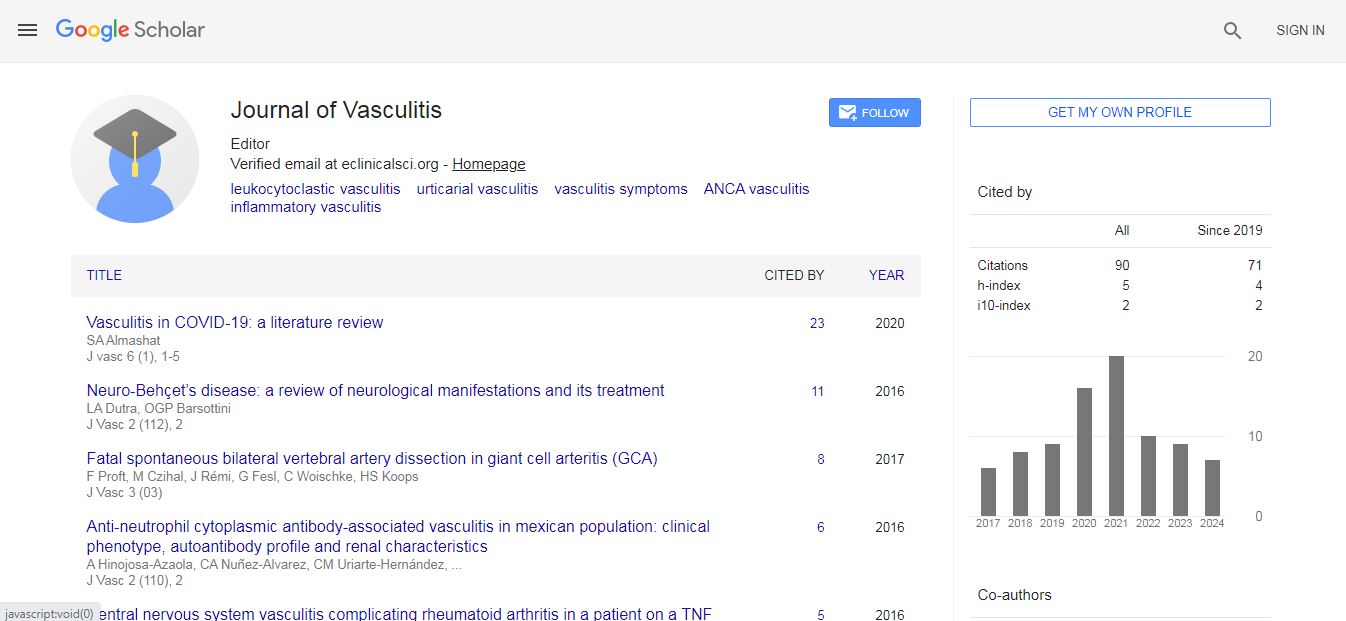
Journal of Vasculitis received 83 citations as per Google Scholar report