Perspective - (2025) Volume 16, Issue 6
Received: 01-Nov-2025, Manuscript No. assj-25-174910;
Editor assigned: 01-Nov-2025, Pre QC No. P-174910;
Reviewed: 17-Nov-2025, QC No. Q-174910;
Revised: 14-Nov-2025, Manuscript No. R-174910;
Published:
01-Dec-2025
, DOI: 10.37421/2151-6200.2025.16.698
Citation: Harris, Isabella. "Educational Inequality: Pervasive Health and Systemic Barriers." Arts Social Sci J 16 (2025):698
Copyright: © 2025 Harris I. This is an open-access article distributed under the terms of the Creative Commons Attribution License, which permits unrestricted use, distribution and reproduction in any medium, provided the original author and source are credited
Understanding the multifaceted nature of educational inequality requires examining how various health and socioeconomic factors influence learning experiences. For instance, chronic health conditions profoundly impact the school experiences and educational journey for young people, underlining the critical need for schools to implement more inclusive and tailored support systems. What this really means is that a student's health status often creates unseen barriers to their learning, making educational equity a significant challenge if not properly addressed [1].
Here's the thing: external crises can exacerbate existing vulnerabilities. The COVID-19 pandemic, for example, significantly worsened pre-existing educational inequalities in England, prompting various government policy responses. While these policies were enacted, their effectiveness in truly leveling the playing field often fell short, leaving some students further behind and highlighting gaps in rapid, equitable intervention strategies [2].
Beyond general health and global crises, specific neurodevelopmental conditions introduce unique challenges. Racial and ethnic disparities are clearly evident in educational outcomes for youth diagnosed with Autism Spectrum Disorder. This brings to light systemic barriers that hinder equitable support, making it unequivocally clear that a one-size-fits-all approach just doesn't work for this diverse student population, demanding culturally sensitive and individualized educational frameworks [3].
Furthermore, geographical and economic contexts heavily influence educational access. A systematic review underscores stark inequalities in educational access for children with developmental disabilities, especially in low- and middle-income countries. This research pinpoints significant barriers to their learning and emphasizes the urgent need for inclusive policies that genuinely reach every child, regardless of their circumstances or location [4].
Socioeconomic factors frequently intersect with health conditions to create additional hurdles. One investigation specifically looks at how socioeconomic factors contribute to significant differences in educational outcomes for adolescents living with chronic kidney disease. What surfaces is a clear picture of disparities, underscoring the necessity for targeted support and interventions to help these students achieve their full academic potential, requiring a holistic understanding of their lived experiences [5].
Mental health is another critical domain where disparities are pronounced. Research exposes considerable disparities in adolescent mental health and access to school-based services across the United States. It emphasizes the pressing need for equitable and holistic support systems within schools to ensure all students, regardless of their background, can get the mental health care they need, fostering a supportive learning environment [6].
Early identification processes also reveal systemic biases. A meta-analysis highlights ongoing racial and ethnic disparities in how special education is identified during early childhood. This truly points to systemic inequities in assessment practices, making a strong case for fairer and more culturally responsive evaluations to ensure all children receive appropriate support early on, setting a foundation for long-term academic success [7].
Addressing these complex issues often involves proactive interventions. One study explores the vital role school-based health centers play in narrowing achievement gaps and fostering educational equity. The findings suggest that by directly addressing students' health needs, these centers effectively remove barriers to learning, leading to better academic outcomes for everyone, demonstrating the impact of integrated support services [8].
Beyond formal schooling, broader societal health knowledge is also inequitably distributed. A systematic review and meta-analysis uncovers global educational inequalities in health literacy. What this really means is that socioeconomic and systemic factors create vast disparities in how people access crucial health information and education worldwide, hindering individuals' ability to make informed health decisions and manage their well-being effectively [9].
Finally, the long-term repercussions of major events continue to unfold. This systematic review further illustrates how the COVID-19 pandemic significantly broadened existing educational inequalities, especially impacting vulnerable populations. It stresses the urgent need for targeted recovery strategies to mitigate these detrimental effects and ensure a more equitable path forward for all students, emphasizing resilience and adaptive educational planning [10].
The landscape of educational equity is significantly shaped by a range of health conditions and disabilities, which often create substantial barriers to learning. Research consistently shows how chronic health conditions impact young people's school experiences, necessitating inclusive and tailored support systems to overcome these unseen obstacles [1]. Similarly, adolescents living with chronic kidney disease face distinct socioeconomic disparities that affect their educational attainment, underscoring the need for targeted interventions to help them succeed academically [5]. Beyond individual health conditions, broader developmental disabilities present stark inequalities in educational access. This is particularly evident in low- and middle-income countries, where significant systemic barriers prevent many children from learning, highlighting the urgent call for truly inclusive policies [4].
Racial and ethnic disparities emerge as a recurring theme, revealing deep-seated systemic inequities within educational systems. For youth diagnosed with Autism Spectrum Disorder, these disparities are clear in their educational outcomes, demonstrating that a rigid, one-size-fits-all approach is ineffective for this diverse student population [3]. Moreover, early childhood special education identification processes are marred by ongoing racial and ethnic biases. This meta-analysis points to systemic inequities in assessment practices, making a strong argument for fairer, more culturally responsive evaluations to ensure all children receive appropriate, early support [7]. These findings collectively highlight how ingrained biases affect access to crucial educational resources and appropriate diagnoses from a young age.
The COVID-19 pandemic acted as a major disruptor, significantly broadening existing educational inequalities, especially for vulnerable populations. Studies in England reveal how the pandemic worsened pre-existing disparities, with government policy responses often falling short in truly leveling the playing field, leaving some students further behind [2]. This theme is echoed by other systematic reviews illustrating how the pandemic significantly broadened educational gaps for vulnerable groups, stressing the critical need for targeted recovery strategies to ensure a more equitable path forward [10]. The pandemic exposed and intensified existing fragilities, demonstrating the need for resilient and adaptable educational frameworks capable of protecting the most vulnerable during crises.
Mental health support within educational settings also shows considerable disparities. Research exposes significant differences in adolescent mental health and access to school-based services across the United States. This points to a pressing demand for equitable and holistic support systems within schools, ensuring all students, regardless of their background, can access the mental health care they need [6]. In a more positive light, school-based health centers have shown a vital role in addressing these achievement gaps and fostering educational equity. By directly attending to students' health needs, these centers effectively remove learning barriers, leading to better academic outcomes for everyone involved [8]. This illustrates the profound impact that integrated health and educational support can have.
Beyond traditional academic outcomes, the concept of health literacy is also subject to global educational inequalities. A systematic review and meta-analysis reveals that socioeconomic and systemic factors create vast disparities in how people access crucial health information and education worldwide [9]. This directly hinders individuals' ability to make informed health decisions, impacting overall well-being. What this really means is that the challenge of educational inequality extends far beyond the classroom, touching upon fundamental aspects of public health and individual empowerment. The collective findings across these studies paint a comprehensive picture of educational disparities, stemming from complex intersections of health, socioeconomic status, race, and systemic structures, all demanding comprehensive, multi-faceted solutions.
This collection of research consistently reveals the pervasive issue of educational inequality, highlighting how diverse factors create barriers to equitable learning experiences. Chronic health conditions, for example, often lead to unseen obstacles for students, necessitating tailored school support systems. The COVID-19 pandemic significantly worsened these existing inequalities, with policy responses frequently falling short in truly leveling the playing field. Beyond general health concerns, specific neurodevelopmental conditions like Autism Spectrum Disorder show clear racial and ethnic disparities in educational outcomes, underscoring the failure of one-size-fits-all approaches. Access to education for children with developmental disabilities, particularly in low- and middle-income countries, remains severely unequal, calling for robust inclusive policies. Socioeconomic factors further compound these disparities, notably affecting adolescents with chronic kidney disease, which demands targeted interventions. Mental health services within US schools also demonstrate considerable access disparities among adolescents, pointing to a critical need for holistic support. Moreover, systemic inequities are apparent in the early identification of special education needs, with racial and ethnic biases requiring fairer assessment practices. On a positive note, school-based health centers show promise in narrowing achievement gaps by addressing students' health needs, thereby removing learning barriers. However, global educational inequalities in health literacy persist, shaped by socioeconomic and systemic factors that impede access to vital health information. All this points to an urgent call for comprehensive, equitable, and culturally responsive strategies across educational systems to ensure every student can reach their full potential.
None
None
Indexed at, Google Scholar, Crossref
Indexed at, Google Scholar, Crossref
Indexed at, Google Scholar, Crossref
Indexed at, Google Scholar, Crossref
Indexed at, Google Scholar, Crossref
Indexed at, Google Scholar, Crossref
Indexed at, Google Scholar, Crossref
Indexed at, Google Scholar, Crossref
Indexed at, Google Scholar, Crossref
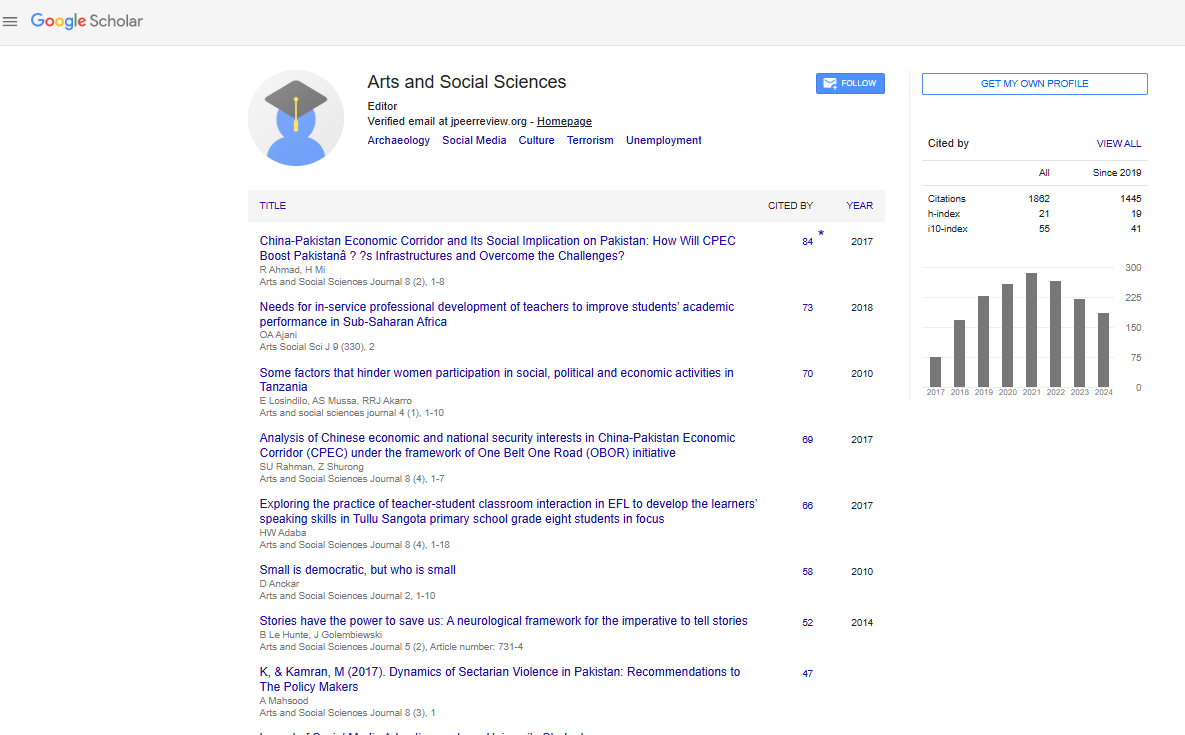
Arts and Social Sciences Journal received 1413 citations as per Google Scholar report