Opinion - (2025) Volume 13, Issue 6
Received: 03-Nov-2025, Manuscript No. economics-26-186082;
Editor assigned: 05-Nov-2025, Pre QC No. P-186082;
Reviewed: 19-Nov-2025, QC No. Q-186082;
Revised: 24-Nov-2025, Manuscript No. R-186082;
Published:
01-Dec-2025
, DOI: 10.37421/2375-4389.2025.13.555
Citation: Muller, Patrick. ”Economic Policy: Driver of Sustainable
Development Goals.” J Glob Econ 13 (2025):555.
Copyright: © 2025 Muller P. This is an open-access article distributed under the terms of the Creative Commons Attribution License, which permits unrestricted use, distribution
and reproduction in any medium, provided the original author and source are credited.
This scholarly discourse critically examines the multifaceted interplay between sustainable development goals and the intricate landscape of economic policy, positing that the establishment of robust and effective policy frameworks is an indispensable prerequisite for the successful attainment of global sustainability targets. The analysis underscores how strategically conceived economic incentives, thoughtfully crafted fiscal policies, and precisely implemented regulatory measures can serve as powerful catalysts for fostering green growth and substantially mitigating the pervasive issue of environmental degradation. This research fundamentally emphasizes the urgent necessity for adopting integrated policy approaches that harmoniously align overarching economic objectives with the crucial tenets of social equity and comprehensive environmental protection, thereby transcending the limitations of a singular, often myopic, focus on Gross Domestic Product growth alone [1].
Furthermore, a significant avenue of inquiry delves into the critical role of fiscal policy in actively promoting the widespread adoption of renewable energy sources, recognizing this as a cornerstone for achieving Sustainable Development Goal 7. The investigation meticulously analyzes how a range of fiscal instruments, including targeted tax credits, strategic subsidies, and the implementation of robust carbon pricing mechanisms, can collectively serve to accelerate the essential transition towards clean energy paradigms. The empirical findings derived from this analysis strongly suggest that fiscal incentives, when appropriately structured and deployed, are instrumental in overcoming significant market barriers and effectively attracting vital private investment into renewable energy infrastructure, thereby contributing synergistically to both broader economic development and crucial climate change mitigation efforts [2].
Another key area explored herein is the potent capacity of monetary policy to be strategically leveraged in support of sustainable economic growth, with a particular emphasis on its implications for advancing Sustainable Development Goal 8. This examination scrutinizes the multifaceted implications of central bank actions, such as the active purchase of green bonds and the systematic integration of climate-related risks into critical financial stability assessments, all aimed at fostering the development of a low-carbon economy. The paper ultimately posits that monetary policy, while perhaps often indirect in its influence, can indeed play a significant and impactful role in aligning the complex operations of financial markets with overarching sustainability objectives [3].
The subsequent investigation meticulously analyzes the profound impact that international trade policies exert on the successful achievement of Sustainable Development Goal 12, specifically focusing on Responsible Consumption and Production. This analysis delves into how various trade mechanisms, including comprehensive trade agreements, the application of tariffs, and the establishment of rigorous standards, can exert considerable influence over the sustainability trajectory of global supply chains, thereby actively promoting enhanced resource efficiency and more effective waste reduction strategies. The study strongly underscores the paramount importance of judiciously incorporating specific sustainability criteria into the very fabric of trade negotiations to ensure that the expansive realm of global commerce actively contributes in a positive and meaningful manner to the broader agenda of sustainable development [4].
Continuing this thematic exploration, the research carefully examines the essential economic policies that are demonstrably required to foster and stimulate innovation specifically geared towards sustainable development, with a particular focus on its relevance to Sustainable Development Goal 9, which addresses Industry, Innovation, and Infrastructure. The analysis scrutinizes the vital role of strategic public investment in critical research and development activities, the judicious management of intellectual property rights, and the cultivation of supportive regulatory environments, all of which are crucial for effectively driving the development and adoption of green technologies and promoting sustainable industrialization. This body of research unequivocally highlights the critical need for policy coherence to effectively incentivize and subsequently scale up the adoption and implementation of sustainable innovations [5].
Moreover, this study critically investigates the specific economic policies that hold the potential to actively promote the achievement of Sustainable Development Goal 10, which is centered on Reduced Inequalities, through the strategic implementation of inclusive growth strategies. The analysis meticulously assesses the impact of key policy levers, such as progressive taxation systems, comprehensive social protection programs, and carefully designed labor market regulations, on critical outcomes like income distribution and the equitable expansion of economic opportunities. The study compellingly argues that economic policies, when thoughtfully designed and meticulously implemented, are absolutely essential for ensuring that the multifaceted benefits derived from economic development are broadly shared across society and that the principle of leaving no one behind is rigorously upheld [6].
In parallel, this research meticulously examines the pivotal role that green finance plays in actively supporting the critical objectives of Sustainable Development Goal 13, which focuses on Climate Action. The analysis scrutinizes how a variety of innovative financial instruments, including the issuance of green bonds, the establishment of climate-focused investment funds, and the functioning of robust carbon market mechanisms, can collectively serve to mobilize essential capital for vital climate mitigation and adaptation projects. The paper emphatically stresses the imperative need for supportive economic policies and enabling regulatory frameworks to fully unlock and harness the substantial potential of green finance for achieving meaningful climate action [7].
Furthermore, this paper undertakes a comprehensive examination of the intricate economic policy implications directly associated with achieving Sustainable Development Goal 14 (Life Below Water) and Sustainable Development Goal 15 (Life on Land). The analysis critically evaluates the relative effectiveness of various policies specifically designed for the protection of marine environments, the implementation of sustainable fisheries management practices, the crucial conservation of forests, and the broader protection of biodiversity, all with the aim of achieving a delicate balance between economic development and essential environmental stewardship. The study pointedly highlights the profound need for the integration of both economic and environmental policies to ensure the responsible and sustainable utilization of the planet's invaluable natural resources [8].
Additionally, this research undertakes an in-depth examination of the crucial intersection between economic policy and the achievement of Sustainable Development Goal 16, which focuses on Peace, Justice, and Strong Institutions. The analysis meticulously investigates how policies that actively promote principles of good governance, enhance transparency and accountability, and strengthen the rule of law can significantly contribute to the creation of stable economic environments that are inherently conducive to achieving sustainable development. The research emphatically underscores the fundamental premise that the presence of strong and effective institutions serves as an absolute prerequisite for the successful implementation of sound economic policies and, consequently, for the realization of both inclusive and peaceful societies [9].
Finally, this article specifically concentrates on Sustainable Development Goal 17 (Partnerships for the Goals) and its critical economic policy dimensions. The investigation meticulously examines how various mechanisms, including robust international cooperation, strategic financial flows, effective technology transfer initiatives, and targeted capacity-building programs, can substantially support developing countries in their efforts to achieve their overarching sustainability objectives. The paper emphatically highlights the absolutely critical role that well-conceived economic policies, coupled with strong and functional international partnerships, play in effectively mobilizing necessary resources and fostering a global environment that is genuinely supportive of the broad agenda of sustainable development [10].
This article critically examines the intricate relationship between sustainable development goals (SDGs) and economic policy, arguing that effective policy frameworks are crucial for achieving global sustainability targets. It highlights how economic incentives, fiscal policies, and regulatory measures can be strategically designed to foster green growth and address environmental degradation. The research emphasizes the need for integrated policy approaches that align economic objectives with social equity and environmental protection, moving beyond a singular focus on GDP growth [1].
This study investigates the role of fiscal policy in promoting renewable energy adoption as a key component of SDG 7. It analyzes how tax credits, subsidies, and carbon pricing mechanisms can accelerate the transition to clean energy sources. The findings suggest that well-structured fiscal incentives are instrumental in overcoming market barriers and attracting private investment in renewable energy infrastructure, thereby contributing to both economic development and climate change mitigation [2].
The research explores how monetary policy can be leveraged to support sustainable economic growth, focusing on SDG 8. It examines the implications of central bank actions, such as green bond purchases and the integration of climate risk into financial stability assessments, for fostering a low-carbon economy. The paper concludes that monetary policy can play a significant, albeit often indirect, role in aligning financial markets with sustainability objectives [3].
This paper analyzes the impact of international trade policies on achieving SDG 12 (Responsible Consumption and Production). It investigates how trade agreements, tariffs, and standards can influence the sustainability of global supply chains, promoting resource efficiency and waste reduction. The study underscores the importance of incorporating sustainability criteria into trade negotiations to ensure that global commerce contributes positively to sustainable development [4].
This article delves into the economic policies required to foster innovation for sustainable development, particularly for SDG 9 (Industry, Innovation, and Infrastructure). It examines the role of public investment in research and development, intellectual property rights, and supportive regulatory environments in driving green technologies and sustainable industrialization. The research highlights the critical need for policy coherence to incentivize and scale up sustainable innovations [5].
The paper investigates the economic policies that can promote SDG 10 (Reduced Inequalities) through inclusive growth strategies. It analyzes the impact of progressive taxation, social protection programs, and labor market regulations on income distribution and economic opportunities. The study argues that carefully designed economic policies are essential for ensuring that the benefits of economic development are shared broadly and that no one is left behind [6].
This research examines the role of green finance in supporting SDG 13 (Climate Action). It analyzes how financial instruments such as green bonds, climate-focused investment funds, and carbon market mechanisms can mobilize capital for climate mitigation and adaptation projects. The paper emphasizes the need for supportive economic policies and regulatory frameworks to unlock the potential of green finance for climate action [7].
The article explores the economic policy implications for achieving SDG 14 (Life Below Water) and SDG 15 (Life on Land). It analyzes the effectiveness of policies related to marine protected areas, sustainable fisheries management, forest conservation, and biodiversity protection in balancing economic development with environmental stewardship. The study highlights the need for integrated economic and environmental policies to ensure the sustainable use of natural resources [8].
This paper examines the intersection of economic policy and SDG 16 (Peace, Justice, and Strong Institutions). It analyzes how policies promoting good governance, transparency, accountability, and the rule of law contribute to creating stable economic environments conducive to sustainable development. The research emphasizes that strong institutions are a prerequisite for effective economic policy implementation and for achieving inclusive and peaceful societies [9].
This article focuses on SDG 17 (Partnerships for the Goals) and its economic policy dimensions. It investigates how international cooperation, financial flows, technology transfer, and capacity-building initiatives can support developing countries in achieving their sustainability objectives. The paper highlights the critical role of well-designed economic policies and international partnerships in mobilizing resources and fostering a global environment supportive of sustainable development [10].
This collection of research explores the critical role of economic policy in achieving Sustainable Development Goals across various sectors. It highlights how fiscal and monetary policies, trade agreements, green finance, and institutional frameworks are essential for fostering sustainable economic growth, promoting renewable energy, ensuring responsible consumption, driving innovation, reducing inequalities, conserving biodiversity, and strengthening international partnerships. The overarching theme emphasizes the need for integrated, coherent, and supportive economic policies to address global sustainability challenges and ensure inclusive, equitable development.
None
None
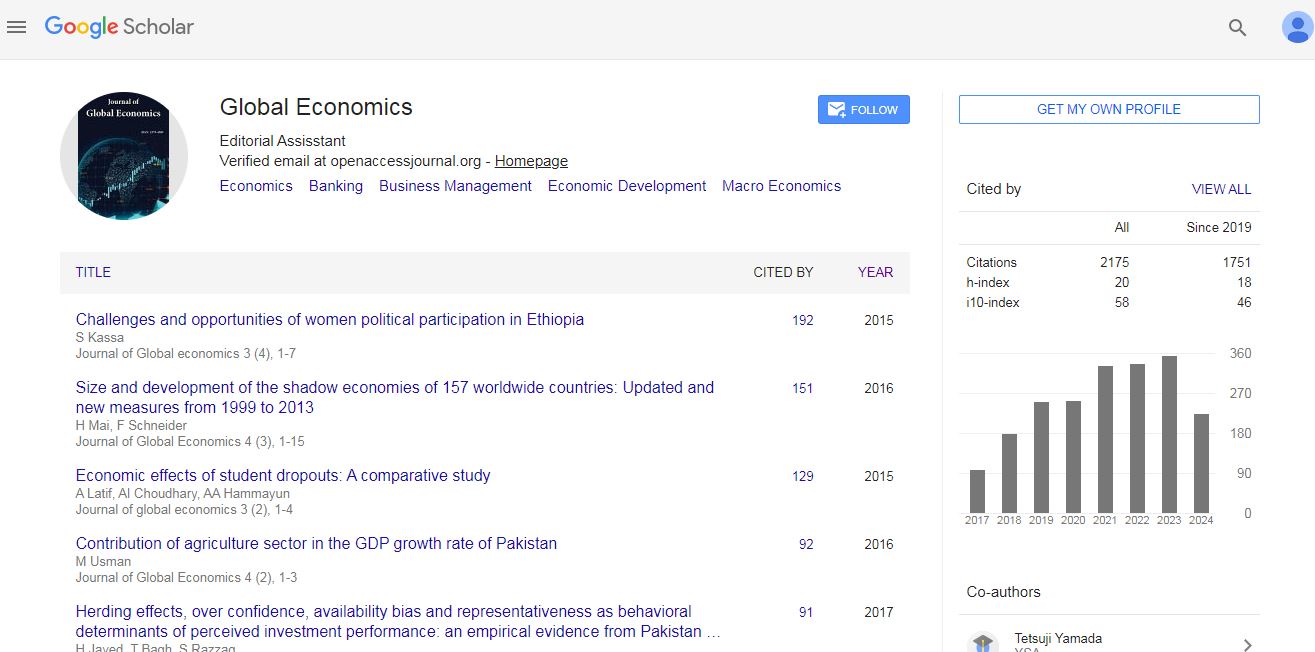
Journal of Global Economics received 2175 citations as per Google Scholar report