Perspective - (2025) Volume 14, Issue 4
Received: 01-Aug-2025, Manuscript No. jeom-26-188181;
Editor assigned: 04-Aug-2025, Pre QC No. P-188181;
Reviewed: 18-Aug-2025, QC No. Q-188181;
Revised: 22-Aug-2025, Manuscript No. R-188181;
Published:
29-Aug-2025
, DOI: 10.37421/2169-026X.2025.14.544
Citation: Horvat, Ivan. ”E-commerce: Fueling Entrepreneurship, Innovation, and Global Reach.” J Entrepren Organiz Manag 14 (2025):544.
Copyright: © 2025 Horvat I. This is an open-access article distributed under the terms of the Creative Commons Attribution License, which permits unrestricted use, distribution and reproduction in any medium, provided the original author and source are credited.
The burgeoning field of entrepreneurship is increasingly intertwined with the digital landscape, particularly through the transformative power of e-commerce platforms. These platforms serve as crucial enablers, significantly reducing the traditional barriers to market entry and providing aspiring entrepreneurs with unprecedented access to global customer bases. This has democratized opportunities, allowing small and medium-sized enterprises (SMEs) to compete on a larger scale by leveraging robust digital infrastructure and sophisticated online marketing strategies [1].
The rapid evolution of digital technologies has further amplified these effects, driving a profound digital transformation that directly influences the trajectory of entrepreneurial development. As businesses embrace e-commerce, they unlock new avenues for growth and innovation, necessitating a keen understanding of key success factors such as digital literacy and strategic online engagement [2].
In emerging markets, the adoption of e-commerce presents a unique set of challenges and opportunities. Entrepreneurs must navigate specific local consumer preferences, complex logistical networks, and the increasing prevalence of mobile commerce, while also addressing concerns related to trust and secure online transactions [3].
The influence of social media has also become a significant factor, with social commerce emerging as a powerful catalyst for entrepreneurial brand building and enhanced sales performance. By integrating social media marketing with e-commerce strategies, businesses can create engaging customer experiences, cultivate communities, and drive conversions through user-generated content and influencer collaborations [4].
Beyond individual businesses, e-commerce marketplaces are fostering a new wave of platform entrepreneurship. These platforms provide essential infrastructure, enabling new ventures to reach wider markets and access vital resources, thereby stimulating innovation and economic development, though they also bring forth regulatory and ethical considerations regarding market dominance [5].
The strategic utilization of data analytics and artificial intelligence is also becoming indispensable for e-commerce entrepreneurs. By harnessing data-driven insights, entrepreneurs can gain a deeper understanding of customer behavior, personalize offerings, and optimize marketing campaigns, leading to improved performance and a stronger competitive edge [6].
A significant segment of entrepreneurship is now operating within the gig economy, often facilitated by e-commerce platforms. These models offer flexibility and autonomy but also present challenges related to income stability and the absence of traditional benefits, while simultaneously fostering the development of unique entrepreneurial skills [7].
The growing emphasis on sustainability is also shaping e-commerce entrepreneurship. Entrepreneurs are increasingly integrating environmental and social considerations into their online business models, appealing to a conscious consumer base and building resilient, long-term brand value [8].
Furthermore, cross-border e-commerce plays a pivotal role in entrepreneurial internationalization. Online platforms are instrumental in helping small businesses transcend traditional trade barriers, access global markets, and manage international supply chains, accelerating their growth and competitiveness on a worldwide scale [9].
Finally, navigating the dynamic digital marketing landscape is critical for e-commerce entrepreneurs. Adapting to evolving trends through agile marketing, effective SEO, PPC advertising, and content marketing is essential for reaching and engaging target audiences in a highly competitive online environment [10].
E-commerce platforms are fundamentally reshaping the entrepreneurial landscape by dismantling traditional market entry barriers and extending reach to a global customer base. This phenomenon empowers Small and Medium-sized Enterprises (SMEs) by providing access to essential digital infrastructure and effective online marketing tools, enabling them to thrive in the contemporary digital economy. However, entrepreneurs must also contend with intense competition and the imperative for continuous adaptation to shifting consumer behaviors [1].
The pervasive digital transformation is profoundly impacting entrepreneurial development, with e-commerce adoption emerging as a key driver of business growth and innovation. Critical success factors identified include high levels of digital literacy, the establishment of a strong strategic online presence, and the adept management of customer relationships through digital channels. Additionally, government support and targeted digital skill development programs are recognized as vital for fostering sustained entrepreneurial growth [2].
For entrepreneurs operating in emerging markets, e-commerce presents a complex interplay of challenges and opportunities. Success hinges on a deep understanding of localized consumer preferences, the intricate realities of logistical networks, and the significant role of mobile commerce. Crucially, building trust and ensuring secure payment systems are paramount for facilitating online transactions [3].
Social commerce has emerged as a potent force in entrepreneurial success, significantly impacting brand building and sales performance. The integration of social media marketing with e-commerce strategies fosters engaging customer experiences, cultivates online communities, and drives higher conversion rates through the strategic use of influencer marketing and user-generated content [4].
The rise of platform entrepreneurship, facilitated by e-commerce marketplaces, is a significant trend driving innovation and economic development. These platforms offer essential infrastructure that enables new ventures to access wider markets and resources, although they also introduce important regulatory and ethical discussions concerning market concentration and dominance [5].
The strategic application of data analytics and artificial intelligence is increasingly crucial for enhancing e-commerce entrepreneurship. Entrepreneurs can leverage data-driven insights to gain a granular understanding of customer behavior, personalize their offerings, and optimize marketing campaigns, ultimately leading to enhanced business performance and a sustainable competitive advantage [6].
The gig economy, heavily influenced by e-commerce platforms, offers a distinct entrepreneurial pathway characterized by flexibility and autonomy. Yet, entrepreneurs in this space face challenges such as income variability and the lack of traditional employment benefits, while simultaneously developing unique entrepreneurial skill sets [7].
The pursuit of sustainable e-commerce businesses is gaining momentum, contributing significantly to entrepreneurial development. Entrepreneurs are increasingly embedding environmental and social considerations into their online business models, effectively attracting a growing segment of ethically conscious consumers and building enduring brand value [8].
Cross-border e-commerce is a powerful engine for entrepreneurial internationalization, enabling small businesses to overcome conventional trade impediments. Online platforms facilitate access to global markets and assist in the management of international supply chains, thereby accelerating business growth and global competitiveness [9].
Adapting to the ever-evolving digital marketing landscape is a critical challenge for e-commerce entrepreneurs. The adoption of agile marketing approaches, coupled with a strong grasp of search engine optimization (SEO), pay-per-click (PPC) advertising, and content marketing, is essential for effectively reaching and engaging target audiences in the competitive online sphere [10].
E-commerce platforms are instrumental in fostering entrepreneurship by lowering market entry barriers and providing access to global markets, particularly for SMEs. Digital transformation, driven by e-commerce adoption, fuels business growth and innovation, with digital literacy and strategic online presence being key success factors. Emerging markets face unique challenges in e-commerce, including logistics and trust-building, while social commerce enhances brand building and sales through integrated social media strategies. Platform entrepreneurship, fueled by e-commerce, drives innovation, and the use of data analytics and AI optimizes business performance. The gig economy facilitated by e-commerce offers flexibility but also income instability. Sustainability is becoming a core aspect of e-commerce entrepreneurship, appealing to conscious consumers. Cross-border e-commerce facilitates internationalization by overcoming trade barriers, and effective digital marketing strategies are crucial for engaging audiences in the competitive online space.
None
None
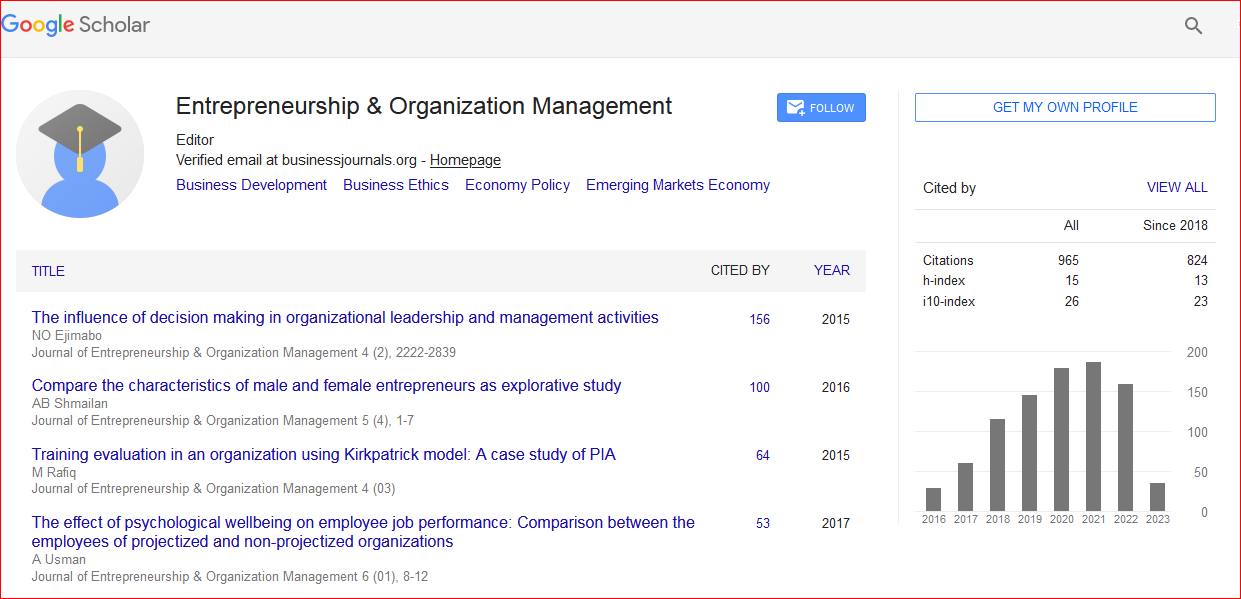
Entrepreneurship & Organization Management received 1115 citations as per Google Scholar report