Short Communication - (2025) Volume 10, Issue 4
Received: 01-Aug-2025, Manuscript No. jcct-26-183221;
Editor assigned: 04-Aug-2025, Pre QC No. P-183221;
Reviewed: 18-Aug-2025, QC No. Q-183221;
Revised: 22-Aug-2025, Manuscript No. R-183221;
Published:
29-Aug-2025
, DOI: 10.37421/2577-0535.2025.9.319
Citation: Gomez-Fernandez, Laura. ”Early Oncology Trials: Beyond Survival to Efficacy.” J Cancer Clin Trials 10 (2025):319.
Copyright: © 2025 Gomez-Fernandez L. This is an open-access article distributed under the terms of the Creative Commons Attribution License, which permits unrestricted use, distribution and reproduction in any medium, provided the original author and source are credited.
Early phase oncology trials are undergoing a significant transformation, shifting from traditional survival endpoints to a more nuanced approach that incorporates translational measures. This evolution aims to accelerate the drug development process by providing earlier insights into drug efficacy and mechanisms of action. Translational endpoints are increasingly the focus, moving beyond overall survival to include biomarkers, pharmacodynamics, and patient-reported outcomes. This shift is driven by the need for more sensitive and informative data early in development, allowing for quicker go/no-go decisions. The integration of these endpoints facilitates more personalized treatment strategies and supports informed decision-making in clinical practice. Biomarker-driven strategies are revolutionizing the design of early oncology trials. By incorporating molecular profiling, researchers can identify targetable alterations and assess treatment response through these biomarkers, leading to more efficient drug evaluation. This approach allows for the stratification of patients who are most likely to benefit from specific therapies, thereby increasing response rates and potentially shortening the overall development timelines. It represents a paradigm shift towards precision medicine in early-stage research. Pharmacodynamic endpoints offer crucial insights into a drug's biological effect on both the tumor and the host. Measuring early changes in cellular proliferation, apoptosis, or target engagement can provide early evidence of activity, guiding dose selection and predicting clinical benefit. Understanding the mechanism of action and identifying optimal dosing regimens are vital aspects that pharmacodynamic endpoints help to elucidate. This detailed mechanistic understanding is indispensable for rational drug development. Patient-reported outcomes (PROs) are gaining prominence as essential translational endpoints in early oncology trials. They capture the patient's subjective experience, including symptoms, quality of life, and functional status, providing a comprehensive assessment of treatment benefit. Integrating PROs early helps to understand the patient experience and identify toxicities that might impact treatment adherence and overall well-being. This patient-centric approach ensures that drug development considers the real-world impact on those receiving the treatment. The convergence of multi-omics data, including genomics, transcriptomics, and proteomics, is enhancing the utility of translational endpoints. Analyzing these complex datasets from early trials provides a deeper understanding of tumor biology and drug resistance mechanisms. This integrative approach facilitates the identification of novel biomarkers and therapeutic targets, paving the way for more effective and targeted cancer therapies. The synergy of various molecular data types promises to unlock new avenues for treatment.
Early phase oncology trials are increasingly prioritizing translational endpoints, moving away from solely relying on traditional measures like overall survival to encompass a broader spectrum of data. This strategic shift aims to expedite drug development by yielding earlier signals of efficacy and a deeper understanding of how drugs work at a biological level. The incorporation of biomarkers, pharmacodynamics, and patient-reported outcomes allows for a more personalized approach to treatment strategies and empowers more informed clinical practice decisions. This multifaceted evaluation provides a richer picture of a drug's potential. [1] Biomarker-driven strategies are fundamentally altering early oncology trial design. By integrating molecular profiling, researchers can pinpoint specific targetable alterations in tumors and subsequently assess treatment responses through these identified biomarkers. This facilitates a more efficient evaluation of drug candidates. [2] This refined approach aids in stratifying patients who are most likely to respond positively to particular therapies, thereby enhancing response rates and potentially reducing the duration of development timelines. It signifies a move towards highly targeted interventions. [2] Pharmacodynamic endpoints provide critical insights into a drug's biological impact on both the tumor and the patient's body. Early measurement of changes in cellular proliferation, apoptosis, or target engagement can offer prompt evidence of therapeutic activity. [3] This evidence is crucial for guiding dose selection and predicting potential clinical benefit, offering vital information for understanding the drug's mechanism of action and optimizing dosing regimens. This mechanistic insight is invaluable for refining drug development. [3] Patient-reported outcomes (PROs) are emerging as indispensable translational endpoints. They capture the patient's perspective on their symptoms, quality of life, and overall functional status, offering a holistic assessment of treatment benefits that extends beyond objective clinical measures. [4] The early integration of PROs helps researchers understand the patient experience more thoroughly and identify any toxicities that might compromise treatment adherence or negatively affect well-being. This patient-centered data is crucial for comprehensive trial evaluation. [4] The integration of multi-omics data, encompassing genomics, transcriptomics, and proteomics, is significantly boosting the effectiveness of translational endpoints. Analyzing these complex datasets from early trials offers profound insights into tumor biology and the mechanisms underlying drug resistance. [5] This comprehensive, data-driven approach accelerates the identification of novel biomarkers and therapeutic targets, ultimately leading to the development of more effective and personalized cancer treatments. The synergistic use of diverse data streams enhances discovery. [5]
Early oncology trials are shifting focus from traditional survival metrics to translational endpoints like biomarkers, pharmacodynamics, and patient-reported outcomes. This approach aims to accelerate drug development by providing earlier efficacy signals and insights into drug mechanisms. Biomarker-driven strategies and molecular profiling help identify targetable alterations and patient subgroups likely to benefit from specific therapies, increasing efficiency. Pharmacodynamic endpoints reveal a drug's biological effects early on, guiding dose selection and predicting outcomes. Patient-reported outcomes capture the patient experience, offering a comprehensive view of treatment benefit beyond objective measures. The integration of multi-omics data enhances the understanding of tumor biology and resistance mechanisms, facilitating the discovery of new biomarkers and targets. Adaptive trial designs, liquid biopsies, and AI are also playing increasing roles in optimizing early-stage research. Ethical considerations regarding data privacy and equitable access remain paramount.
None
None
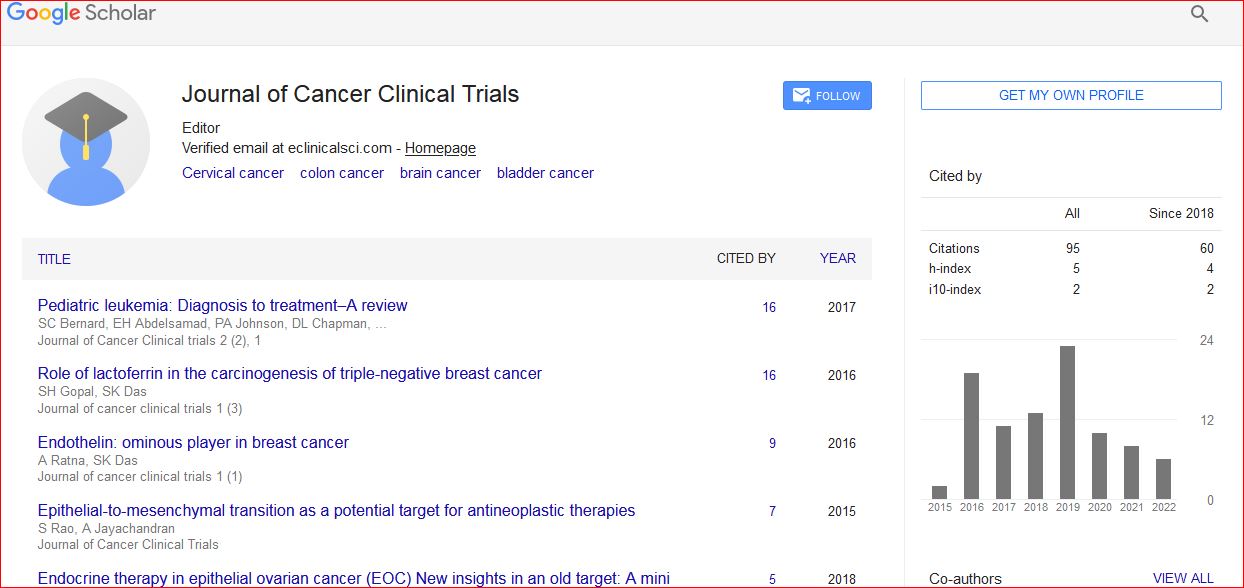
Journal of Cancer Clinical Trials received 95 citations as per Google Scholar report