Short Communication - (2025) Volume 9, Issue 4
Received: 01-Aug-2025, Manuscript No. ahbs-26-182510;
Editor assigned: 04-Aug-2025, Pre QC No. P-182510;
Reviewed: 18-Aug-2025, QC No. Q-182510;
Revised: 22-Aug-2025, Manuscript No. R-182510;
Published:
29-Aug-2025
, DOI: 10.37421/2952-8097.2025.9.332
Citation: Molefe, Nthabiseng. ”Early Life Experiences Shape
Animal Behavioral Health.” J Anim Health Behav Sci 09 (2025):332.
Copyright: © 2025 Molefe N. This is an open-access article distributed under the terms of the Creative Commons Attribution License, which permits unrestricted use,
distribution and reproduction in any medium, provided the original author and source are credited.
Early-life experiences exert a profound and lasting influence on the long-term behavioral health of animals. These critical developmental periods are characterized by heightened sensitivity to environmental factors, including stressors, social interactions, and nutritional availability, which can lead to significant alterations in neural circuits. Such changes can have persistent impacts on fear responses, social bonding capabilities, and overall cognitive abilities, underscoring the importance of understanding these critical windows for enhancing animal welfare and managing behavioral issues across diverse settings. From domestic companions to wildlife populations, the foundational experiences of early life shape trajectories of health and well-being throughout an animal's existence.
The implications extend to the development of robust neural architectures that govern emotional regulation and adaptive behavior, making the study of these early influences a crucial area of research. Understanding the mechanisms by which these early experiences induce lasting changes is paramount for developing effective interventions and management strategies. The plasticity of the developing brain allows for both vulnerability to negative experiences and the potential for positive change through enrichment and support. Therefore, a comprehensive understanding of these early life impacts is essential for promoting optimal animal development and ensuring their long-term welfare. This introduction will explore the multifaceted ways in which early-life environments and experiences shape the developing animal, with a focus on the neurobiological underpinnings and behavioral outcomes, drawing upon a range of scientific investigations into these critical processes. The foundational period of early life represents a unique opportunity to influence an animal's future well-being, making it a key area of focus for scientific inquiry and practical application in animal care and conservation. The enduring effects of these early influences highlight the need for careful consideration of the environments and interactions animals encounter during their formative stages. This comprehensive overview aims to synthesize current knowledge, emphasizing the interconnectedness of early experiences, neurobiological development, and subsequent behavioral patterns across various species. The scientific community increasingly recognizes the critical role of early life in setting the stage for lifelong health and behavior, necessitating a deeper exploration of these formative influences and their lasting consequences for animal well-being. The intricate interplay between genetics and environment during early development plays a pivotal role in shaping an animal's eventual behavioral repertoire and its capacity to cope with life's challenges. Recognizing and addressing the vulnerabilities and opportunities present during these critical early periods is therefore essential for fostering healthy and resilient animal populations. The formative experiences of early life are not merely transient events but rather lay the groundwork for enduring physiological and psychological characteristics that can manifest throughout an animal's life. This highlights the profound significance of early life interventions and the establishment of supportive environments. The cumulative impact of early-life experiences, whether positive or negative, can shape an animal's stress response systems, social behavior, and cognitive functions, setting a precedent for future adaptability and resilience in the face of environmental challenges. The science of animal behavior and neurobiology consistently emphasizes the critical nature of early developmental periods in establishing lasting patterns of response and adaptation. Consequently, a thorough examination of these influences is vital for advancing our understanding and improving practices in animal care, welfare, and conservation efforts, recognizing the profound and often irreversible effects of these formative stages. The plasticity inherent in the young brain makes it particularly susceptible to environmental influences, paving the way for long-term adaptations in neural circuits that govern behavior and emotional regulation. This sensitivity underscores the importance of carefully curated early life experiences for promoting optimal development and well-being, ensuring that animals are equipped with the necessary coping mechanisms for future challenges. [1] The formative experiences of early life are increasingly recognized as critical determinants of an animal's long-term behavioral health. Stressors, social interactions, and nutritional availability during these sensitive developmental periods can lead to lasting alterations in neural circuits, profoundly impacting fear responses, social bonding, and cognitive abilities. Understanding these critical windows is essential for improving animal welfare and managing behavioral issues in various settings, from domestic pets to wildlife conservation. [2] Social enrichment during early development in dogs, for instance, has demonstrated a notable capacity to attenuate anxiety-related behaviors later in life. Puppies exposed to varied social stimuli, including human interaction and encounters with other dogs, exhibit greater adaptability and reduced fearfulness, highlighting the critical role of early socialization in preventing the development of behavioral problems associated with poor welfare. [3] In rodents, the quality of maternal care significantly influences offspring's stress reactivity and fear learning. Offspring of mothers exhibiting high levels of licking and grooming display lower hypothalamic-pituitary-adrenal (HPA) axis responses to stress and reduced anxiety-like behaviors in adulthood, an epigenetically mediated effect that underscores the transgenerational impact of early experiences. [4] Early nutritional deficiencies can impair brain development, leading to persistent cognitive and behavioral deficits in various animal species. For example, early protein-energy malnutrition in young primates has been linked to long-term deficits in learning, memory, and executive function, strongly suggesting a critical window for optimal neural development. [5] Adverse early-life experiences, such as separation from the mother, are associated with increased susceptibility to psychopathology in adult animals. This may be mediated by changes in the stress response system and altered neurotransmitter function, indicating that interventions aimed at mitigating the effects of early adversity can be crucial for preventing long-term behavioral health issues. [6] The complexity of early-life environments significantly impacts behavioral flexibility in animals. Environments rich in novel stimuli and opportunities for exploration during development can foster greater cognitive flexibility and problem-solving abilities in adulthood, suggesting that enrichment of early environments can yield substantial long-term benefits for animal cognition. [7] Early-life social isolation can profoundly alter fear conditioning and extinction processes in animal models. Isolation during critical developmental periods can lead to heightened fear responses and impaired extinction of learned fears, indicating a disruption in the neural mechanisms underlying emotional regulation and learning, with significant implications for understanding anxiety disorders. [8] Exposure to certain environmental toxins during early development can have long-lasting effects on neurodevelopment and behavior. Prenatal exposure to endocrine-disrupting chemicals, for instance, has been linked to an increased risk of neurodevelopmental disorders and behavioral problems in offspring, underscoring the vulnerability of the developing brain to environmental insults. [9] Early weaning practices in livestock can influence social development and aggression. Abrupt or early weaning can lead to increased stress and social instability in young animals, potentially contributing to higher levels of aggression and reduced social cohesion in adult populations, thus highlighting the importance of gradual and age-appropriate weaning. [10] The role of early-life sensory experiences in shaping auditory processing and communication in songbirds is crucial. Exposure to specific songs during critical developmental periods is vital for the acquisition of species-specific vocalizations; disruptions to these early sensory inputs can result in long-term deficits in communication and social behavior. [1] Early-life experiences profoundly shape the long-term behavioral health of animals. Stressors, social interactions, and nutritional availability during critical developmental periods can lead to lasting alterations in neural circuits, impacting fear responses, social bonding, and cognitive abilities. Understanding these critical windows is essential for improving animal welfare and managing behavioral issues in various settings, from domestic pets to wildlife conservation. [2] Social enrichment during early development in dogs has been shown to attenuate anxiety-related behaviors later in life. Puppies exposed to varied social stimuli, including human interaction and exposure to other dogs, demonstrate greater adaptability and reduced fearfulness. This highlights the critical role of early socialization in preventing the development of behavioral problems associated with poor welfare. [3] Maternal care quality in rodents significantly influences offspring's stress reactivity and fear learning. Offspring of mothers exhibiting high levels of licking and grooming display lower hypothalamic-pituitary-adrenal (HPA) axis responses to stress and reduced anxiety-like behaviors in adulthood. This epigenetically mediated effect underscores the transgenerational impact of early experiences. [4] Early nutritional deficiencies can impair brain development and lead to persistent cognitive and behavioral deficits in various animal species. For example, early protein-energy malnutrition in young primates has been linked to long-term deficits in learning, memory, and executive function, suggesting a critical window for optimal neural development. [5] Adverse early-life experiences, such as separation from the mother, are associated with increased susceptibility to psychopathology in adult animals. This may be mediated by changes in the stress response system and altered neurotransmitter function. Interventions aimed at mitigating the effects of early adversity can be crucial for preventing long-term behavioral health issues. [6] The impact of early-life environmental complexity on behavioral flexibility in animals. Environments rich in novel stimuli and opportunities for exploration during development can foster greater cognitive flexibility and problem-solving abilities in adulthood. This suggests that enrichment of early environments can have significant long-term benefits for animal cognition. [7] The role of early-life social isolation in altering fear conditioning and extinction in animal models. Isolation during critical developmental periods can lead to heightened fear responses and impaired extinction of learned fears, suggesting a disruption in the neural mechanisms underlying emotional regulation and learning. This has implications for understanding anxiety disorders. [8] Early-life exposure to certain environmental toxins can have long-lasting effects on neurodevelopment and behavior. For instance, prenatal exposure to endocrine-disrupting chemicals has been linked to increased risk of neurodevelopmental disorders and behavioral problems in offspring, underscoring the vulnerability of the developing brain to environmental insults. [9] Early weaning practices in livestock can influence social development and aggression. Abrupt or early weaning can lead to increased stress and social instability in young animals, potentially contributing to higher levels of aggression and reduced social cohesion in adult populations. This highlights the importance of gradual and age-appropriate weaning. [10] The role of early-life sensory experiences in shaping auditory processing and communication in songbirds. Exposure to specific songs during critical developmental periods is crucial for the acquisition of species-specific vocalizations. Disruptions to these early sensory inputs can lead to long-term deficits in communication and social behavior.The foundational experiences encountered during an animal's early life are undeniably critical in shaping its subsequent behavioral repertoire and overall well-being. These formative periods are characterized by heightened neural plasticity, rendering the developing organism particularly susceptible to environmental influences. Stressors, social dynamics, and nutritional adequacy during these sensitive windows can initiate profound and enduring alterations in neural circuitry.
These neurobiological changes, in turn, can manifest as persistent modifications in fear responses, the capacity for social bonding, and the development of cognitive abilities. Consequently, a thorough understanding of these critical developmental periods is paramount for advancing animal welfare initiatives and effectively managing behavioral challenges across a spectrum of contexts, from companion animals in domestic settings to wild populations managed for conservation purposes. The intricate mechanisms by which early life experiences imprint upon the developing brain are a subject of intense scientific inquiry, revealing a complex interplay of genetic and environmental factors that contribute to long-term behavioral outcomes. The enduring impact of these early influences underscores the necessity of providing optimal environments and appropriate stimuli during an animal's formative stages to foster resilience and healthy development. [1] Early-life experiences profoundly shape the long-term behavioral health of animals. Stressors, social interactions, and nutritional availability during critical developmental periods can lead to lasting alterations in neural circuits, impacting fear responses, social bonding, and cognitive abilities. Understanding these critical windows is essential for improving animal welfare and managing behavioral issues in various settings, from domestic pets to wildlife conservation. [2] Social enrichment during early development in dogs has been shown to attenuate anxiety-related behaviors later in life. Puppies exposed to varied social stimuli, including human interaction and exposure to other dogs, demonstrate greater adaptability and reduced fearfulness. This highlights the critical role of early socialization in preventing the development of behavioral problems associated with poor welfare. [3] Maternal care quality in rodents significantly influences offspring's stress reactivity and fear learning. Offspring of mothers exhibiting high levels of licking and grooming display lower hypothalamic-pituitary-adrenal (HPA) axis responses to stress and reduced anxiety-like behaviors in adulthood. This epigenetically mediated effect underscores the transgenerational impact of early experiences. [4] Early nutritional deficiencies can impair brain development and lead to persistent cognitive and behavioral deficits in various animal species. For example, early protein-energy malnutrition in young primates has been linked to long-term deficits in learning, memory, and executive function, suggesting a critical window for optimal neural development. [5] Adverse early-life experiences, such as separation from the mother, are associated with increased susceptibility to psychopathology in adult animals. This may be mediated by changes in the stress response system and altered neurotransmitter function. Interventions aimed at mitigating the effects of early adversity can be crucial for preventing long-term behavioral health issues. [6] The impact of early-life environmental complexity on behavioral flexibility in animals. Environments rich in novel stimuli and opportunities for exploration during development can foster greater cognitive flexibility and problem-solving abilities in adulthood. This suggests that enrichment of early environments can have significant long-term benefits for animal cognition. [7] The role of early-life social isolation in altering fear conditioning and extinction in animal models. Isolation during critical developmental periods can lead to heightened fear responses and impaired extinction of learned fears, suggesting a disruption in the neural mechanisms underlying emotional regulation and learning. This has implications for understanding anxiety disorders. [8] Early-life exposure to certain environmental toxins can have long-lasting effects on neurodevelopment and behavior. For instance, prenatal exposure to endocrine-disrupting chemicals has been linked to increased risk of neurodevelopmental disorders and behavioral problems in offspring, underscoring the vulnerability of the developing brain to environmental insults. [9] Early weaning practices in livestock can influence social development and aggression. Abrupt or early weaning can lead to increased stress and social instability in young animals, potentially contributing to higher levels of aggression and reduced social cohesion in adult populations. This highlights the importance of gradual and age-appropriate weaning. [10] The role of early-life sensory experiences in shaping auditory processing and communication in songbirds. Exposure to specific songs during critical developmental periods is crucial for the acquisition of species-specific vocalizations. Disruptions to these early sensory inputs can lead to long-term deficits in communication and social behavior.Early life experiences profoundly shape an animal's long-term behavioral health. Stressors, social interactions, and nutrition during critical developmental periods alter neural circuits, impacting fear, social bonding, and cognition. Social enrichment in early development can reduce anxiety and improve adaptability. Maternal care quality influences stress reactivity and fear learning through epigenetic mechanisms. Nutritional deficiencies can lead to cognitive and behavioral deficits. Adverse experiences like maternal separation increase susceptibility to psychopathology. Enriched environments foster cognitive flexibility. Social isolation impairs fear regulation. Environmental toxins can harm neurodevelopment. Early weaning affects social behavior and aggression. Sensory experiences are crucial for communication development. Understanding these critical windows is vital for animal welfare and management.
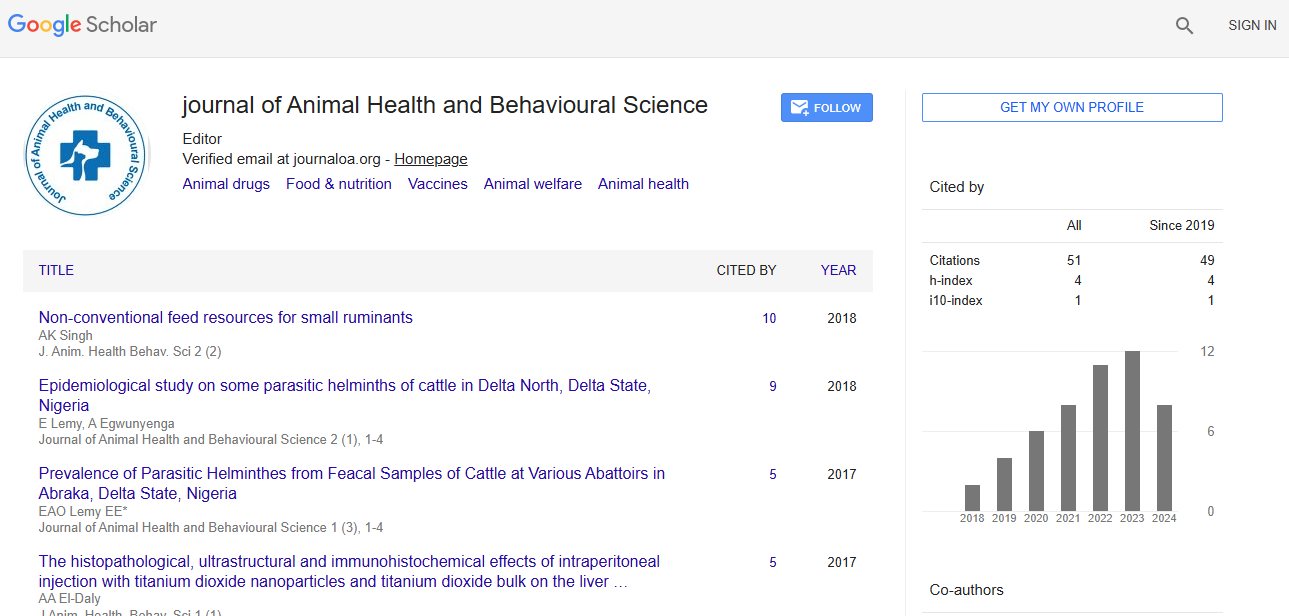
Journal of Animal Health and Behavioural Science received 38 citations as per Google Scholar report