Short Communication - (2025) Volume 16, Issue 5
Received: 01-Oct-2025, Manuscript No. jvst-26-188130;
Editor assigned: 03-Oct-2025, Pre QC No. P-188130;
Reviewed: 17-Oct-2025, QC No. Q-188130;
Revised: 22-Oct-2025, Manuscript No. R-188130;
Published:
29-Oct-2025
, DOI: 10.37421/2157-7579.2025.16.323
Citation: Naz, Farah. ”Early Disease Detection: Enhancing Animal
Health and Welfare.” J Vet Sci Techno 16 (2025):323.
Copyright: © 2025 Naz F. This is an open-access article distributed under the terms of the Creative Commons Attribution License, which permits unrestricted use, distribution
and reproduction in any medium, provided the original author and source are credited.
The early detection of diseases in veterinary medicine is paramount for effective and timely intervention, leading to improved treatment outcomes and better disease control across animal populations [1].
This necessitates the implementation of a diverse array of diagnostic tools and strategic approaches designed to identify subclinical or early-stage pathological changes before overt clinical signs become apparent [1].
Significant advancements in areas such as molecular diagnostics, sophisticated imaging techniques, and sensitive serological assays are collectively enhancing the capability to diagnose diseases at their nascent stages, thereby playing a crucial role in reducing economic losses and elevating animal welfare standards [1].
The Department of Veterinary Community Practice Technology at the University of Dhaka, Bangladesh, actively contributes to the development and deployment of these advanced diagnostic methodologies within community-based veterinary settings [1].
Molecular diagnostic techniques, including Polymerase Chain Reaction (PCR) and Enzyme-Linked Immunosorbent Assay (ELISA), are revolutionizing the early identification of infectious diseases affecting both livestock and companion animals [2].
These methods are distinguished by their high sensitivity and specificity, enabling the detection of pathogens or their genetic material even at very low concentrations, which is critical for the prompt prevention of outbreaks and the implementation of robust biosecurity measures [2].
Serological assays, encompassing rapid agglutination tests and ELISA, serve as invaluable tools for the detection of antibodies produced by animals in response to infections [3].
Such assays can indicate either past or ongoing exposure to various pathogens, thereby assisting in the early diagnosis of diseases like brucellosis and leptospirosis, even in the absence of clinical manifestations [3].
Advanced imaging modalities, including ultrasound, radiography, and computed tomography (CT), are instrumental in visualizing internal organs and pinpointing pathological alterations that suggest early disease onset [4].
For instance, subtle deviations in organ texture or size observed via ultrasound can serve as early indicators of hepatic or renal disease before any symptoms emerge [4].
Biomarker discovery, especially through the application of proteomics and metabolomics, presents promising avenues for identifying novel indicators of disease at its very earliest stages [5].
These cutting-edge approaches involve the detailed analysis of complex biological samples to detect subtle molecular alterations that precede clinical signs, thereby facilitating proactive health management strategies [5].
Point-of-care diagnostics are increasingly vital for enabling rapid disease detection directly on farms or within veterinary clinics [6].
These technologies, often utilizing lateral flow assays or portable PCR devices, deliver swift diagnostic results, which in turn support immediate treatment decisions and help curtail the propagation of infectious agents [6].
Genomic and transcriptomic analyses are emerging as powerful methodologies for identifying genetic predispositions to specific diseases and for detecting early molecular changes associated with disease development [7].
This capability can pave the way for personalized preventive strategies and enable early therapeutic interventions, significantly improving disease management [7].
The integration of artificial intelligence (AI) and machine learning (ML) with diagnostic data holds immense potential for enhancing early disease detection capabilities [8].
AI algorithms are adept at analyzing vast datasets from diverse diagnostic sources to identify subtle patterns and predict disease risk with high accuracy, even before overt symptoms become evident [8].
Non-invasive diagnostic methods, such as urinalysis, fecal analysis, and breath analysis, are gaining prominence due to their ability to furnish critical health information with minimal stress to the animal [9].
These techniques can identify early biochemical changes that are indicative of metabolic or infectious diseases, offering a less invasive diagnostic route [9].
Finally, the systematic implementation of routine health surveillance programs that incorporate early diagnostic measures is fundamental for effective herd health management and for mitigating economic losses within the livestock sector [10].
Early detection empowers prompt isolation and treatment, which are critical for limiting the spread of diseases and maintaining herd health [10].
The foundational importance of early disease detection in veterinary medicine cannot be overstated, as it directly correlates with the ability to initiate timely interventions, thereby enhancing treatment efficacy and facilitating robust disease control measures [1].
To achieve this, a comprehensive suite of diagnostic tools and strategic approaches is employed, aiming to identify subclinical or early-stage pathological changes before any observable clinical signs manifest [1].
Progress in molecular diagnostics, sophisticated imaging modalities, and sensitive serological assays has considerably advanced the capacity to diagnose diseases in their incipient phases, consequently minimizing economic repercussions and improving overall animal welfare [1].
The Department of Veterinary Community Practice Technology at the University of Dhaka, Bangladesh, plays a significant role in the development and practical application of these advanced diagnostic techniques within community settings [1].
Molecular diagnostic techniques, prominently including PCR and ELISA, are profoundly transforming the landscape of early infectious disease detection in both livestock and companion animals [2].
The inherent high sensitivity and specificity of these methods allow for the accurate identification of pathogens or their genetic material, even when present in trace amounts, which is crucial for preventing widespread outbreaks and reinforcing biosecurity protocols [2].
Serological assays, such as rapid agglutination tests and enzyme-linked immunosorbent assays (ELISA), represent indispensable instruments for identifying antibodies produced by animals in response to infectious agents [3].
These assays provide critical insights into an animal's past or present exposure to pathogens, significantly aiding in the early diagnosis of diseases like brucellosis and leptospirosis, often before clinical symptoms are evident [3].
Advanced imaging techniques, including ultrasound, radiography, and computed tomography (CT), are vital for visualizing the internal structures of animals and for detecting subtle pathological alterations indicative of early disease processes [4].
For example, minor variations in the texture or size of organs observed during an ultrasound examination can signal the nascent stages of hepatic or renal disease prior to the appearance of any clinical signs [4].
The exploration of biomarker discovery, particularly through proteomic and metabolomic analyses, offers highly promising avenues for identifying novel indicators of disease at extremely early stages [5].
These sophisticated approaches involve the detailed analysis of complex biological samples to detect minute molecular changes that precede the onset of clinical symptoms, thereby enabling a more proactive approach to animal health management [5].
The increasing importance of point-of-care diagnostics lies in their ability to provide rapid, on-site disease detection, either in field settings or within veterinary clinics [6].
Technologies such as lateral flow assays and portable PCR devices facilitate quick diagnostic results, enabling immediate treatment decisions and effectively limiting the transmission of infectious agents [6].
Emerging genomic and transcriptomic analyses are proving to be powerful tools for identifying genetic susceptibilities to diseases and for detecting early molecular deviations associated with disease progression [7].
This offers the potential for developing personalized preventive strategies and implementing timely therapeutic interventions, thereby revolutionizing disease management [7].
The integration of artificial intelligence (AI) and machine learning (ML) with diagnostic data presents a substantial opportunity to enhance early disease detection capabilities [8].
AI algorithms possess the ability to process and analyze extensive datasets from a variety of diagnostic sources, identifying subtle patterns and accurately predicting disease risk even before the manifestation of overt symptoms [8].
Non-invasive diagnostic methodologies, including urinalysis, fecal analysis, and breath analysis, are gaining traction for their capacity to yield essential health information with minimal disturbance to the animal [9].
These non-invasive techniques can effectively detect early biochemical alterations that are indicative of metabolic or infectious diseases, providing a less stressful diagnostic option [9].
The consistent implementation of comprehensive health surveillance programs that integrate early diagnostic measures is fundamental for effective herd health management and for the prevention of significant economic losses within the livestock industry [10].
The capacity for early detection allows for the prompt isolation of affected animals and the immediate initiation of treatment, thereby effectively containing disease spread [10].
Early disease detection is critical in veterinary medicine for timely intervention, improved outcomes, and disease control. Advanced diagnostics like molecular techniques (PCR, ELISA), serological assays, and imaging modalities (ultrasound, CT) identify diseases before clinical signs appear, reducing economic losses and enhancing animal welfare. Biomarker discovery through proteomics and metabolomics offers new early indicators. Point-of-care diagnostics enable rapid on-site testing, while genomic and transcriptomic analyses identify genetic predispositions and early molecular changes. Artificial intelligence and machine learning are improving pattern recognition and risk prediction. Non-invasive methods like urinalysis and fecal analysis provide valuable health information with minimal stress. Routine surveillance programs incorporating these early detection tools are essential for herd health management and preventing disease spread.
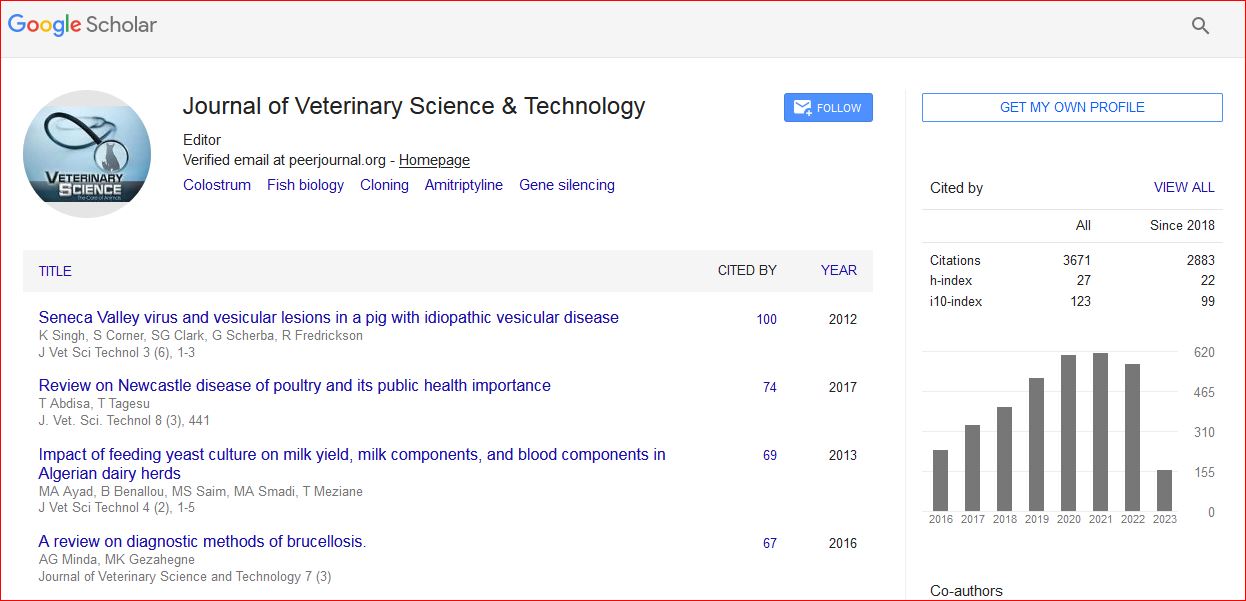
Veterinary Science & Technology received 4472 citations as per Google Scholar report