Opinion - (2025) Volume 11, Issue 4
Received: 02-Nov-2025, Manuscript No. jmt-25-175205;
Editor assigned: 04-Nov-2025, Pre QC No. P-175205;
Reviewed: 18-Nov-2025, QC No. Q-175205;
Revised: 24-Nov-2025, Manuscript No. R-175205;
Published:
29-Nov-2025
, DOI: 10.37421/2471-271X.2025.11.359
Citation: Sabry, Ahmed. ”Early Diagnosis, Genetics, and Neurodevelopmental Care.” J Ment Disord Treat 11 (2025):359.
Copyright: © 2025 Sabry A. This is an open-access article distributed under the terms of the Creative Commons Attribution License, which permits unrestricted use, distribution and reproduction in any medium, provided the original author and source are credited.
This review highlights that identifying early markers for Autism Spectrum Disorder, such as atypical social communication and repetitive behaviors, is crucial for timely diagnosis. It points out that early intervention significantly improves developmental outcomes, emphasizing the need for robust screening tools and clinical observation in infancy and early childhood[1].
The article explores the intricate neurobiological underpinnings of comorbidity in Attention-Deficit/Hyperactivity Disorder, suggesting that shared genetic vulnerabilities and common neurocircuitry dysfunction contribute to the frequent co-occurrence of ADHD with other psychiatric conditions. Understanding these shared pathways could lead to more integrated and effective treatment strategies[2].
This piece examines the current understanding of genetic causes behind intellectual disability, illustrating how advancements in genomic sequencing have significantly increased diagnostic yield. It underscores the importance of identifying specific genetic variants for more precise prognoses and the potential development of targeted therapies[3].
The authors discuss progress in understanding the brain mechanisms involved in Tourette Syndrome, shedding light on dysfunctional neural networks linked to tics. The paper reviews recent therapeutic strategies, including pharmacological interventions and neuromodulation techniques, offering hope for improved symptom management and quality of life[4].
This systematic review synthesizes findings on cognitive profiles in children with specific learning disabilities, demonstrating variability across different types of learning challenges. It emphasizes that a nuanced understanding of these profiles is essential for tailoring effective educational and therapeutic interventions to meet individual learning needs[5].
The article provides an update on genetic diagnostic methods for global developmental delay and intellectual disability, noting the increasing role of whole-exome and whole-genome sequencing in uncovering underlying genetic etiologies. It highlights how accurate genetic diagnoses can inform recurrence risk, prognosis, and potential personalized management strategies[6].
This review delves into Fragile X syndrome as a multi-systemic disorder, outlining its diverse clinical manifestations beyond cognitive impairment, including neurological, behavioral, and physical features. It stresses that a comprehensive understanding of these varied symptoms is critical for holistic patient management and the development of targeted therapies[7].
The paper covers recent advancements in understanding the genetics of Rett Syndrome, primarily linked to MECP2 gene mutations, and improvements in clinical management. It discusses evolving therapeutic strategies aimed at ameliorating symptoms and enhancing functional abilities, emphasizing a multidisciplinary approach to care[8].
This overview addresses Selective Mutism, describing its characteristic features and emphasizing the importance of early and accurate assessment to differentiate it from other communication difficulties. It outlines evidence-based intervention strategies, primarily behavioral and cognitive-behavioral therapies, to help children and adolescents overcome their reluctance to speak in specific social settings[9].
The authors explore Developmental Coordination Disorder, focusing on criteria for accurate diagnosis and practical intervention strategies. They highlight that early identification of motor skill difficulties is key, and tailored occupational and physical therapy interventions can significantly improve motor performance and participation in daily activities for affected children[10].
Neurodevelopmental disorders represent a spectrum of conditions characterized by impairments in the growth and development of the brain or central nervous system. Early identification and intervention are paramount across many of these conditions, significantly improving developmental trajectories. For example, recognizing atypical social communication and repetitive behaviors as early markers for Autism Spectrum Disorder is crucial for timely diagnosis and intervention [1]. Similarly, early identification of motor skill difficulties in Developmental Coordination Disorder is key to implementing tailored occupational and physical therapy interventions that can substantially enhance motor performance and daily participation for affected children [10]. Even in cases like Selective Mutism, where children show a consistent failure to speak in specific social situations despite speaking in others, early and accurate assessment is vital to differentiate it from other communication challenges, paving the way for evidence-based behavioral and cognitive-behavioral therapies [9]. These efforts underscore a foundational principle in neurodevelopmental care: proactive and precise early intervention can profoundly alter long-term trajectories.
Significant advancements in understanding the genetic causes behind intellectual disability and global developmental delay are transforming diagnostic and prognostic capabilities. Modern genomic sequencing technologies, including whole-exome and whole-genome sequencing, have dramatically increased diagnostic yield [3,6]. This capability allows for the identification of specific genetic variants, which provides more precise prognoses and opens avenues for developing targeted therapies for individuals. This genetic insight is particularly crucial for conditions like Fragile X syndrome, now recognized as a multi-systemic disorder with diverse neurological, behavioral, and physical features extending beyond mere cognitive impairment [7]. A comprehensive understanding of these varied symptoms is therefore critical for holistic patient management and the development of specialized therapeutic approaches. Likewise, Rett Syndrome, primarily linked to MECP2 gene mutations, has seen considerable progress in genetic understanding and clinical management. Evolving therapeutic strategies are now aimed at ameliorating symptoms and enhancing functional abilities, emphasizing a multidisciplinary approach to care that leverages these genetic insights [8].
Beyond genetic factors, the neurobiological underpinnings and mechanisms of comorbidity in neurodevelopmental disorders are areas of intense investigation. For instance, the intricate neurobiological basis of comorbidity in Attention-Deficit/Hyperactivity Disorder (ADHD) is being explored, suggesting that shared genetic vulnerabilities and common neurocircuitry dysfunction contribute significantly to its frequent co-occurrence with other psychiatric conditions [2]. A deeper understanding of these shared pathways is expected to lead to more integrated and effective treatment approaches. In Tourette Syndrome, progress in deciphering the brain mechanisms involved has shed light on dysfunctional neural networks linked to tics [4]. This understanding is critical as it informs the development of recent therapeutic strategies, including innovative pharmacological interventions and neuromodulation techniques, offering renewed hope for improved symptom control and an enhanced quality of life for affected individuals.
When addressing specific learning challenges, research highlights the importance of understanding varied cognitive profiles. A systematic review has synthesized findings on cognitive profiles in children with specific learning disabilities, demonstrating considerable variability across different types of learning challenges [5]. The key takeaway here is that a nuanced comprehension of these individual profiles is absolutely essential for tailoring effective educational and therapeutic interventions. Moving beyond generic approaches, personalized strategies can better meet individual learning needs, ensuring interventions are as effective and impactful as possible.
Collectively, these studies underscore a profound shift towards more precise, personalized, and multidisciplinary approaches in the field of neurodevelopmental disorders. From the earliest markers of Autism Spectrum Disorder to the complex genetics of Intellectual Disability and the neurobiological intricacies of ADHD and Tourette Syndrome, the focus remains on advancing diagnostic capabilities and refining therapeutic strategies [1,2,3,4,5,6,7,8,9,10]. This integrated perspective, leveraging genetic insights, neurobiological understandings, and tailored interventions, holds immense promise for improving the lives and developmental outcomes for individuals and families impacted by these challenging conditions, fostering a future where care is increasingly effective and individualized.
Recent research highlights crucial advancements in understanding and managing various neurodevelopmental disorders. For Autism Spectrum Disorder, identifying early markers like atypical social communication and repetitive behaviors is key for timely diagnosis and intervention, which significantly improves developmental outcomes. Attention-Deficit/Hyperactivity Disorder comorbidity is better understood through its neurobiological underpinnings, revealing shared genetic vulnerabilities and neurocircuitry dysfunction that could inform integrated treatment strategies. Genetic causes of Intellectual Disability and Global Developmental Delay are increasingly elucidated by genomic sequencing, boosting diagnostic yield and allowing for precise prognoses and potential targeted therapies. Specific conditions like Fragile X syndrome are recognized as multi-systemic, demanding a comprehensive approach to its diverse neurological, behavioral, and physical manifestations for holistic patient management. Similarly, Rett Syndrome research has progressed in genetics, leading to improved clinical management and multidisciplinary therapeutic strategies. Tourette Syndrome research continues to uncover dysfunctional neural networks, inspiring new pharmacological and neuromodulation techniques for better symptom management. For Specific Learning Disabilities, understanding varied cognitive profiles is paramount for tailoring effective educational interventions. Lastly, conditions like Selective Mutism benefit from early, accurate assessment and evidence-based behavioral therapies, while Developmental Coordination Disorder emphasizes early identification of motor skill difficulties to guide effective occupational and physical therapy. This collective body of work underscores the importance of early diagnosis, advanced genetic understanding, and multidisciplinary, tailored interventions across a spectrum of neurodevelopmental challenges.
None
None
F. S, S. M, K. C. "Early predictors of autism spectrum disorder: a review".J Dev Behav Pediatr 41 (2020):47-59.
Indexed at, Google Scholar, Crossref
Joseph B, Timothy JS, Ronald F. "The Neurobiological Basis of Comorbidity in Attention-Deficit/Hyperactivity Disorder".J Atten Disord 25 (2021):1219-1234.
Indexed at, Google Scholar, Crossref
Lisenka EV, Christian G, Joris AV. "Genetic causes of intellectual disability: current knowledge and future perspectives".Semin Cell Dev Biol 97 (2020):139-144.
Indexed at, Google Scholar, Crossref
Christos G, Jan K, Jens K. "Advances in the Pathophysiology and Treatment of Tourette Syndrome".Curr Neurol Neurosci Rep 22 (2022):149-160.
Indexed at, Google Scholar, Crossref
Judith L, Vanesa A, MarÃa CRdM. "Cognitive Profiles in Children with Specific Learning Disabilities: A Systematic Review".Brain Sci 13 (2023):478.
Indexed at, Google Scholar, Crossref
Marjolein HW, Anya H, Anneke TVS. "Recent Advances in the Genetic Diagnosis of Global Developmental Delay/Intellectual Disability".Clin Genet 99 (2021):610-618.
Indexed at, Google Scholar, Crossref
Egidio D, Marina M, Flora T. "Fragile X syndrome: a multi-systemic disease".J Neurodev Disord 14 (2022):15.
Indexed at, Google Scholar, Crossref
Margaret L, Ingrid Ã?, Bengt E. "Rett Syndrome: Advances in Genetics and Clinical Management".Children (Basel) 8 (2021):749.
Indexed at, Google Scholar, Crossref
Katharina M, Allison R, Hilary R. "Selective Mutism: An Overview of Assessment and Intervention".Child Adolesc Psychiatr Clin N Am 29 (2020):227-238.
Indexed at, Google Scholar, Crossref
Raghu L, Lesley PH, Jean G. "Developmental Coordination Disorder: Diagnosis and Intervention Strategies".J Dev Behav Pediatr 41 (2020):60-70.
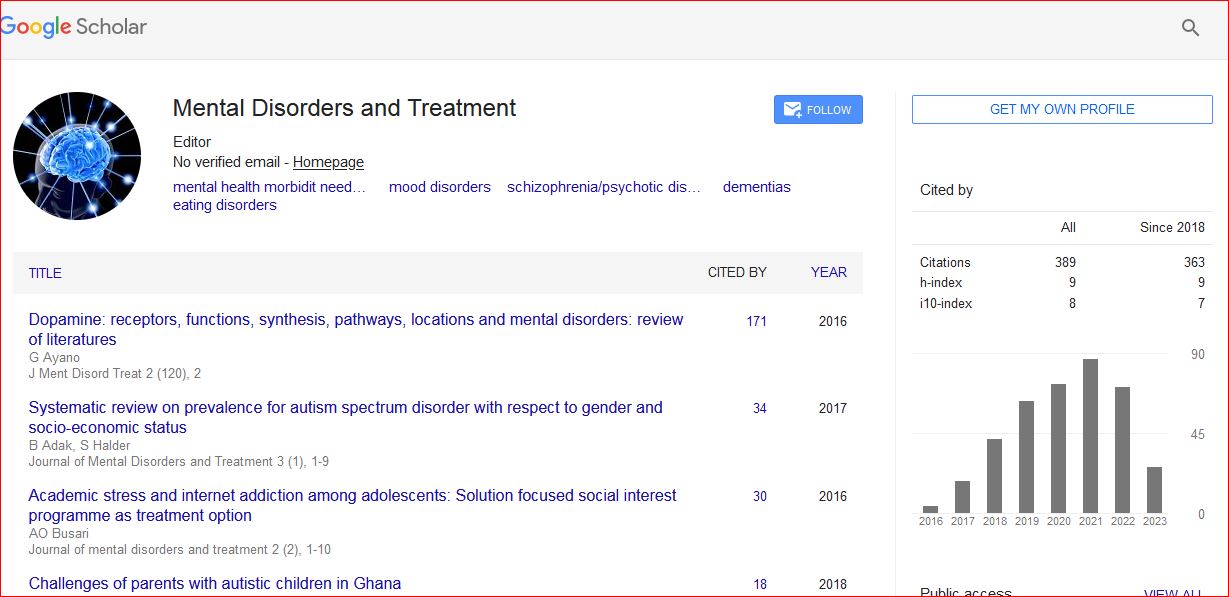
Mental Disorders and Treatment received 556 citations as per Google Scholar report