Brief Report - (2025) Volume 14, Issue 4
Received: 01-Aug-2025, Manuscript No. jeom-26-188177;
Editor assigned: 04-Aug-2025, Pre QC No. P-188177;
Reviewed: 18-Aug-2025, QC No. Q-188177;
Revised: 22-Aug-2025, Manuscript No. R-188177;
Published:
29-Aug-2025
, DOI: 10.37421/2169-026X.2025.14.540
Citation: Ionescu, Andrei. ”Dynamic Strategic Planning For Entrepreneurial Firms.” J Entrepren Organiz Manag 14 (2025):540.
Copyright: © 2025 Ionescu A. This is an open-access article distributed under the terms of the Creative Commons Attribution License, which permits unrestricted use, distribution and reproduction in any medium, provided the original author and source are credited.
Strategic planning in entrepreneurial firms is a field characterized by its inherent dynamism and adaptive requirements. Unlike in larger, more established organizations, entrepreneurs often operate within environments marked by significant uncertainty and resource limitations. This necessitates the adoption of flexible and responsive planning processes to navigate the complex entrepreneurial landscape. The iterative nature of strategy formulation is a key insight, emphasizing that planning is not a static, one-time event but rather a continuous cycle of development and refinement [1].
Resourcefulness emerges as another critical factor, as entrepreneurs must creatively leverage available assets to achieve strategic objectives. This often involves unconventional approaches to problem-solving and value creation. The founder's vision and leadership play a pivotal role in defining and driving the strategic direction of the venture. Their commitment and foresight are instrumental in shaping the firm's trajectory and its ability to adapt to changing market conditions [1].
Small and medium-sized enterprises (SMEs), while often having limited formal structures, can still effectively utilize strategic planning tools. Integration of market sensing capabilities and proactive environmental scanning are crucial for SMEs seeking to gain and maintain a competitive advantage [2].
Organizational culture significantly influences the adoption and successful execution of strategic plans within these firms. A culture that embraces strategic thinking and execution is more likely to see plans translated into tangible results [2].
Research also highlights the strong correlation between entrepreneurial orientation and the effectiveness of strategic planning. Firms exhibiting higher levels of innovativeness, proactiveness, and risk-taking tend to engage in more sophisticated and beneficial strategic planning activities [3].
Fostering an entrepreneurial culture can indeed enhance a firm's capacity for effective strategic decision-making and robust execution, leading to improved strategic outcomes [3].
For nascent entrepreneurs, strategic planning often takes an iterative and informal form in the initial stages of firm creation. Learning from market feedback and adapting to unexpected challenges are central to this early-stage strategic thinking process [4].
The findings underscore the importance of agility and a willingness to pivot strategy in response to the realities encountered in the early stages of a venture, a testament to the adaptive nature of entrepreneurial planning [4].
Digital transformation is increasingly shaping strategic planning for entrepreneurial firms. The utilization of digital tools and data analytics can substantially improve market analysis, customer understanding, and the agility of strategic responses, leading to more informed decisions [5].
These digital capabilities empower entrepreneurs to develop more responsive and data-driven strategic plans, a critical asset in today's rapidly evolving business environment [5].
Resource scarcity is a defining characteristic for many entrepreneurial firms, and it significantly impacts their strategic planning approaches. Entrepreneurs in such situations often employ improvisational and adaptive strategies, prioritizing flexibility and rapid learning over rigid, long-term plans [6].
This highlights the importance of resourcefulness and bricolage â?? the ability to create something from whatever is at hand â?? in navigating strategic challenges effectively [6].
External stakeholder relationships also play a crucial role in strategic planning for entrepreneurial firms. Engaging with investors, customers, and suppliers can provide invaluable insights and crucial support for strategic development, underscoring the collaborative essence of strategy formulation in many entrepreneurial contexts [7].
This collaborative approach can lead to more robust and well-supported strategic decisions, beneficial for long-term growth and stability [7].
As entrepreneurial firms grow, their strategic planning processes tend to evolve. Distinct phases of strategic development emerge, transitioning from informal planning in the early stages to more structured approaches as the firm scales. Successful scaling necessitates a corresponding evolution in strategic planning capabilities to match the firm's increasing complexity and scope [8].
This evolutionary perspective suggests that strategic planning must remain aligned with the firm's stage of development to ensure continued success and efficient resource allocation [8].
The dynamics of learning and knowledge acquisition are vital for strategic planning in innovative startups. Firms that excel at learning from their environment and internal experiences are better equipped to formulate agile and effective strategies [9].
This dynamic interplay between learning, knowledge generation, and strategic adaptation is a cornerstone of success for innovative ventures [9].
Finally, cognitive biases can significantly influence strategic planning in entrepreneurial firms. Common biases such as overconfidence and confirmation bias can have detrimental effects on decision-making. Strategies to mitigate these biases are essential for improving strategic planning outcomes and ensuring more rational and effective choices [10].
Acknowledging and actively managing these cognitive pitfalls is a critical aspect of robust strategic planning for entrepreneurs [10].
Strategic planning within entrepreneurial enterprises is characterized by its inherent dynamism and adaptability. Unlike in larger, more established organizations, entrepreneurs frequently face high levels of uncertainty and operate with limited resources, which necessitates flexible planning processes. Key insights into this area revolve around the iterative nature of strategy formulation, where planning is viewed as a continuous cycle rather than a singular event. The paramount importance of resourcefulness is another recurring theme, highlighting the need for entrepreneurs to creatively leverage their available assets to achieve strategic goals. Furthermore, the critical role of founder vision and leadership is emphasized, as these elements are crucial drivers of strategic direction in new ventures [1].
Small and medium-sized enterprises (SMEs) can effectively employ strategic planning tools even without extensive formal structures. This research underscores the integration of market sensing capabilities and proactive environmental scanning as vital components for achieving competitive advantage within these firms [2].
The organizational culture also plays a significant role in how strategic plans are adopted and implemented within SMEs. A supportive and strategic culture can greatly enhance the effectiveness of planning efforts [2].
The relationship between entrepreneurial orientation and strategic planning effectiveness is a notable area of study. Firms demonstrating higher levels of innovativeness, proactiveness, and risk-taking are found to engage in more sophisticated and beneficial strategic planning processes [3].
Consequently, fostering an entrepreneurial culture can bolster a firm's capacity for effective strategic decision-making and execution, leading to improved strategic outcomes [3].
In the initial phases of firm creation, nascent entrepreneurs often engage in strategic planning that is both iterative and informal. This early-stage strategic thinking is heavily influenced by learning derived from market feedback and adapting to unexpected challenges encountered along the way [4].
The findings from studies on nascent ventures highlight the critical importance of agility and a willingness to adjust strategy in response to real-world conditions, a hallmark of effective entrepreneurial planning [4].
The advent of digital transformation is increasingly reshaping strategic planning for entrepreneurial firms. By leveraging digital tools and advanced data analytics, firms can significantly enhance their market analysis, deepen customer understanding, and improve the agility of their strategic responses [5].
These digital capabilities empower entrepreneurs to make more informed and responsive strategic decisions, a crucial advantage in today's fast-paced business environment [5].
Resource constraints are a defining characteristic for many entrepreneurial ventures, profoundly impacting their approach to strategic planning. Entrepreneurs in resource-scarce environments often adopt improvisational and adaptive strategies, prioritizing flexibility and rapid learning over rigid, long-term plans [6].
This emphasis on resourcefulness and bricolage is essential for successfully navigating complex strategic challenges with limited means [6].
The influence of external stakeholder relationships on strategic planning in entrepreneurial firms is another significant factor. Engaging with investors, customers, and suppliers can provide invaluable insights and crucial support for strategic development, demonstrating the collaborative nature of strategy formulation in many entrepreneurial settings [7].
This collaborative approach can lead to more robust and widely supported strategic decisions, vital for sustained growth [7].
As entrepreneurial firms mature and grow, their strategic planning processes tend to evolve. This evolution typically involves a transition from informal planning in the early stages to more structured approaches as the firm scales its operations. Successful scaling necessitates a corresponding development in strategic planning capabilities to manage the increasing complexity [8].
This understanding of strategic evolution suggests that planning methodologies must adapt to the firm's current stage of development for sustained success [8].
The role of learning and knowledge acquisition in the strategic planning processes of innovative startups is critically important. Firms that are adept at learning from both their external environment and internal experiences are better positioned to formulate agile and effective strategies [9].
This dynamic interplay between learning, knowledge generation, and strategic adaptation is a fundamental element for the success of innovative startups [9].
Lastly, the impact of founder's cognitive biases on strategic planning in entrepreneurial firms is a critical consideration. Biases such as overconfidence and confirmation bias can lead to detrimental decision-making. Strategies aimed at mitigating these biases are therefore essential for enhancing strategic planning outcomes and ensuring more objective and effective choices [10].
Recognizing and actively managing these cognitive pitfalls is a key component of robust strategic planning for entrepreneurs [10].
Strategic planning in entrepreneurial firms is dynamic and adaptive, driven by high uncertainty and limited resources. Key aspects include the iterative nature of strategy formulation, resourcefulness, and the pivotal role of founder vision and leadership. Small and medium-sized enterprises (SMEs) can utilize strategic planning tools effectively through market sensing and environmental scanning, influenced by organizational culture. Entrepreneurial orientation, characterized by innovativeness, proactiveness, and risk-taking, enhances strategic planning effectiveness. Nascent ventures often employ informal, iterative planning based on market feedback and agility. Digital transformation enables enhanced market analysis and responsiveness. Resource scarcity leads to improvisational and adaptive planning. External stakeholder engagement provides valuable insights and support. As firms grow, strategic planning evolves from informal to structured approaches. Learning and knowledge acquisition are crucial for agile strategies in startups. Founder's cognitive biases can hinder planning, necessitating mitigation strategies.
None
None
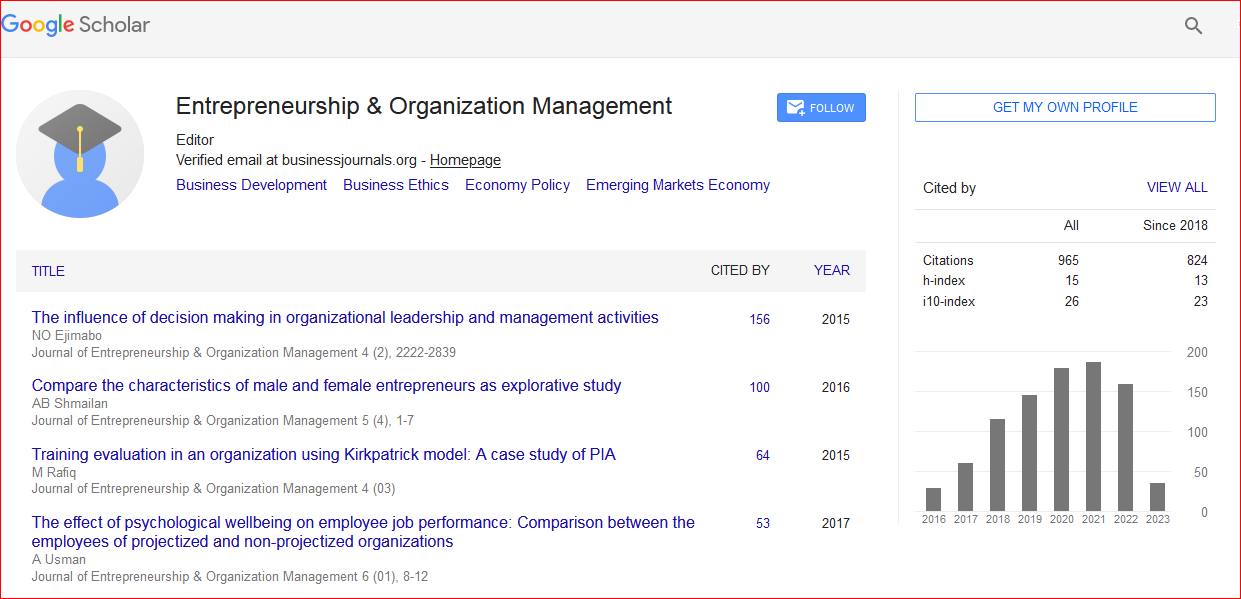
Entrepreneurship & Organization Management received 1115 citations as per Google Scholar report