Perspective - (2025) Volume 17, Issue 4
Received: 01-Jul-2025, Manuscript No. jcst-25-174955;
Editor assigned: 03-Jul-2025, Pre QC No. P-174955;
Reviewed: 17-Jul-2025, QC No. Q-174955;
Revised: 22-Jul-2025, Manuscript No. R-174955;
Published:
29-Jul-2025
, DOI: 10.37421/1948-5956.2025.17.718
Citation: Al-Hassan, Noura. ”Drug Repurposing: Advancing Cancer
Treatment and Discovery.” J Cancer Sci Ther 17 (2025):718.
Copyright: © 2025 Al-Hassan N. This is an open-access article distributed under the terms of the Creative Commons Attribution License, which permits unrestricted use,
distribution and reproduction in any medium, provided the original author and source are credited.
Drug repurposing, the innovative strategy of finding novel therapeutic uses for existing non-cancer drugs, is currently gaining significant traction in the challenging field of oncology. This approach inherently offers substantial benefits, particularly reduced development costs and accelerated timelines for bringing treatments to patients, primarily because these drugs already possess known safety profiles from their original applications. Researchers are now actively exploring a wide array of non-oncology drugs, thoroughly investigating their potential anti-cancer mechanisms and assessing their clinical applications. What this really means is that we can deliver effective treatments to patients much faster by leveraging the vast pharmacopeia we already possess [1].
Overcoming drug resistance stands as a formidable challenge in contemporary cancer treatment, and here's the thing: drug repurposing presents a highly promising solution to this persistent issue. By thoughtfully utilizing approved drugs, all of which come with well-established safety profiles, we can effectively identify compounds capable of disrupting complex resistance mechanisms or sensitizing stubborn cancer cells to existing therapeutic regimens. This strategic approach not only paves a significantly faster path to developing new treatments but also opens up novel combination options for patients who may have exhausted standard protocols, essentially providing clinicians with new, vital tools to fight persistent and aggressive cancers [2].
Combining repurposed drugs with advanced Immune Checkpoint Blockade (ICB) therapies holds truly significant potential for substantially enhancing anti-tumor immune responses within the body. Certain non-cancer drugs possess unique properties that allow them to modulate the intricate tumor microenvironment or directly affect crucial immune cells, thereby making ICB treatments demonstrably more effective. This sophisticated approach aims to overcome both primary and acquired resistance to immunotherapy, providing a cost-effective and efficient way to genuinely improve patient outcomes. It's about finding existing medicines that can act as powerful force multipliers for our most advanced immunotherapies, optimizing their impact against cancer [3].
Repurposing existing drugs to improve the efficacy of cancer immunotherapy is unequivocally a smart strategic move. Many non-oncology drugs, initially developed for entirely different conditions, often exhibit off-target effects that can profoundly impact the immune system or target cancer cells in ways that are highly beneficial for immunotherapy. Think about how a medication originally prescribed for a common condition might inadvertently boost crucial T-cell activity or make elusive tumor cells significantly more visible and vulnerable to the body's immune system. This innovative strategy offers exciting avenues for developing potent combination therapies that could substantially enhance the effectiveness of existing immunotherapies for a broader spectrum of patients [4].
Clinical trials are, without a doubt, absolutely key to validating the real-world potential and practical utility of drug repurposing in the context of cancer treatment. A comprehensive review of recent trials clearly demonstrates that several established non-oncology drugs, such as metformin, aspirin, and various beta-blockers, are currently being rigorously tested for their inherent anti-cancer properties. These trials investigate their effects either alone or crucially, in combination with existing standard cancer treatments. The results, though often in early stages, collectively highlight a clear and encouraging path for seamlessly translating these compelling concepts into demonstrably improved patient care, offering genuine hope for new, more accessible, and effective treatments [5].
Looking back at the last decade, drug repurposing has genuinely evolved from what was once a niche, intriguing idea into a major, systematically recognized strategy within cancer research globally. This progression outlines a comprehensive journey, spanning from initial preclinical findings that hinted at potential, to a rapidly growing clinical interest and subsequent validation. The field now touches on key successes, explores emerging methodologies, and clearly defines future directions, consistently emphasizing a critical shift towards more systematic and data-driven approaches. What this really means is that we're collectively getting much smarter and more efficient about identifying new, impactful uses for old, familiar drugs in the ongoing fight against cancer [6].
Glioblastoma, a notoriously highly aggressive and devastating brain tumor, remains exceptionally difficult to treat with conventional methods, making drug repurposing a particularly attractive and vital avenue for research. Researchers are diligently exploring various non-Central Nervous System (CNS) drugs, including compounds like anti-inflammatories or anti-parasitics, for their specific ability to effectively cross the formidable blood-brain barrier and precisely target glioblastoma cells. This focused work meticulously outlines both current progress and promising future strategies, collectively offering a fresh and much-needed perspective on how we might effectively tackle this devastating disease using existing pharmaceutical tools [7].
Artificial Intelligence (AI) is fundamentally changing the game for drug repurposing in cancer therapy, offering unprecedented capabilities. Advanced AI algorithms possess the remarkable ability to rapidly sift through vast and complex datasets encompassing drug properties, intricate disease pathways, and extensive patient data far more quickly and comprehensively than human analysis ever could. This capability allows AI to identify unexpected connections and pinpoint potential repurposed drug candidates with remarkable accuracy. This accelerated discovery process significantly helps in identifying drugs with the highest likelihood of clinical success, thereby making the entire search for novel cancer treatments considerably more efficient and thoroughly data-driven [8].
Here's the thing: machine learning and Artificial Intelligence (AI) are rapidly becoming indispensable, foundational tools for the entire drug repurposing paradigm in oncology. These sophisticated technologies can accurately predict intricate drug-target interactions, meticulously analyze complex genetic data, and even model disease progression with high fidelity to intelligently suggest existing drugs that might prove effective for various cancers. This isn't merely about accelerating the pace of discovery; it's crucially about uncovering highly complex biological relationships that human analysis might easily miss, leading directly to more targeted, precise, and ultimately more effective repurposing strategies. It's truly a significant leap forward for therapeutic discovery and patient care [9].
Let's break it down: a deep understanding of the exact mechanisms by which repurposed drugs exert their crucial anti-cancer effects is absolutely fundamental for their successful and widespread clinical application. This comprehensive overview meticulously details precisely how drugs initially developed for entirely different conditions can effectively interfere with critical aspects of cancer cell growth, survival, and metastasis, often through diverse and complex molecular pathways. Knowing these intricate mechanisms allows us to rationally design superior combination therapies and, importantly, to predict which specific patients might benefit most from these interventions, effectively moving us beyond a trial-and-error approach to significantly more informed and personalized treatment choices [10].
Drug repurposing, the strategy of finding new therapeutic uses for existing non-cancer drugs, is garnering significant attention in oncology. This approach capitalizes on the known safety profiles of existing medications, leading to reduced development costs and accelerated timelines for bringing treatments to patients [1]. What this really means is that treatments can reach patients faster by utilizing what we already have. Looking back at the last decade, this strategy has evolved from a niche idea into a major approach in cancer research. This journey covers initial preclinical findings to growing clinical interest, with a clear shift towards more systematic and data-driven methods [6]. We are getting smarter about finding new uses for old drugs in the fight against cancer.
A critical aspect of drug repurposing involves its potential to overcome major challenges in cancer treatment, notably drug resistance. Approved drugs with known safety profiles can be identified to disrupt resistance mechanisms or sensitize cancer cells to existing therapies [2]. This not only offers a faster path to new treatments but also provides novel combination options for patients facing persistent cancers. Furthermore, combining repurposed drugs with Immune Checkpoint Blockade (ICB) therapies holds substantial promise for enhancing anti-tumor immune responses. Certain non-cancer drugs can modulate the tumor microenvironment or directly affect immune cells, making ICB more effective [3]. This innovative approach aims to overcome primary or acquired resistance to immunotherapy. Many non-oncology drugs have off-target effects that can impact the immune system or cancer cells in ways beneficial for immunotherapy, potentially boosting T-cell activity or making tumor cells more visible to the immune system [4]. This offers exciting avenues for combination therapies that could make existing immunotherapies work better for more patients.
Clinical trials are essential for validating the real-world potential of drug repurposing in cancer. Recent reviews indicate that several non-oncology drugs, such as metformin, aspirin, and beta-blockers, are currently being tested for their anti-cancer properties, both alone and in combination with standard treatments [5]. These early-stage results point towards improved patient care and more accessible treatments. This strategy also provides fresh perspectives for notoriously difficult-to-treat cancers like glioblastoma, a highly aggressive brain tumor. Researchers are investigating non-Central Nervous System (CNS) drugs, including anti-inflammatories or anti-parasitics, for their ability to cross the blood-brain barrier and target glioblastoma cells, outlining current progress and future directions for this devastating disease [7].
Artificial Intelligence (AI) and Machine Learning (ML) are profoundly transforming the landscape of drug repurposing for cancer. AI algorithms efficiently sift through vast datasets of drug properties, disease pathways, and patient data, identifying unexpected connections and promising repurposed drug candidates at an accelerated pace [8]. This makes the search for new cancer treatments significantly more efficient and data-driven. These indispensable tools can predict drug-target interactions, analyze genetic data, and model disease progression to suggest drugs that might be effective for cancer [9]. This capacity goes beyond mere speed, uncovering complex relationships that human analysis might overlook, thus leading to more targeted and effective repurposing strategies and representing a true leap forward for therapeutic discovery.
Ultimately, understanding the precise mechanisms by which repurposed drugs exert their anti-cancer effects is crucial for their successful clinical application. It's important to know how drugs originally developed for other conditions can interfere with cancer cell growth, survival, and metastasis through various pathways [10]. This mechanistic insight allows for the rational design of sophisticated combination therapies and enables predictions of which patients are most likely to benefit, moving beyond a trial-and-error approach to more informed and personalized treatment choices. This commitment to understanding drives more effective and predictable outcomes in cancer therapy.
Drug repurposing, utilizing existing non-cancer drugs for oncology, is gaining significant momentum due to its benefits like reduced development costs and faster treatment timelines from known safety profiles. This strategy offers a promising solution to overcome drug resistance in cancer, identifying compounds that disrupt resistance mechanisms or sensitize cancer cells to existing therapies. Beyond this, it holds potential for enhancing anti-tumor immune responses, particularly when combined with Immune Checkpoint Blockade therapies, as certain non-cancer drugs can modulate the tumor microenvironment or directly affect immune cells. Clinical trials are actively validating this potential, with drugs such as metformin, aspirin, and beta-blockers being tested for anti-cancer properties. The field has evolved significantly over the last decade, shifting towards more systematic and data-driven approaches in identifying new uses for old drugs. This is crucial for hard-to-treat diseases like glioblastoma, where researchers are exploring non-Central Nervous System drugs to target aggressive brain tumor cells. Artificial Intelligence and Machine Learning are revolutionizing this discovery process, enabling rapid sifting of vast datasets to predict drug-target interactions, analyze genetic data, and model disease progression, leading to more efficient and targeted repurposing strategies. Ultimately, a deep understanding of the anti-cancer mechanisms of repurposed drugs is essential for their successful clinical application, allowing for rational design of combination therapies and informed patient-specific treatment choices.
Indexed at, Google Scholar, Crossref
Indexed at, Google Scholar, Crossref
Indexed at, Google Scholar, Crossref
Indexed at, Google Scholar, Crossref
Indexed at, Google Scholar, Crossref
Indexed at, Google Scholar, Crossref
Indexed at, Google Scholar, Crossref
Indexed at, Google Scholar, Crossref
Indexed at, Google Scholar, Crossref
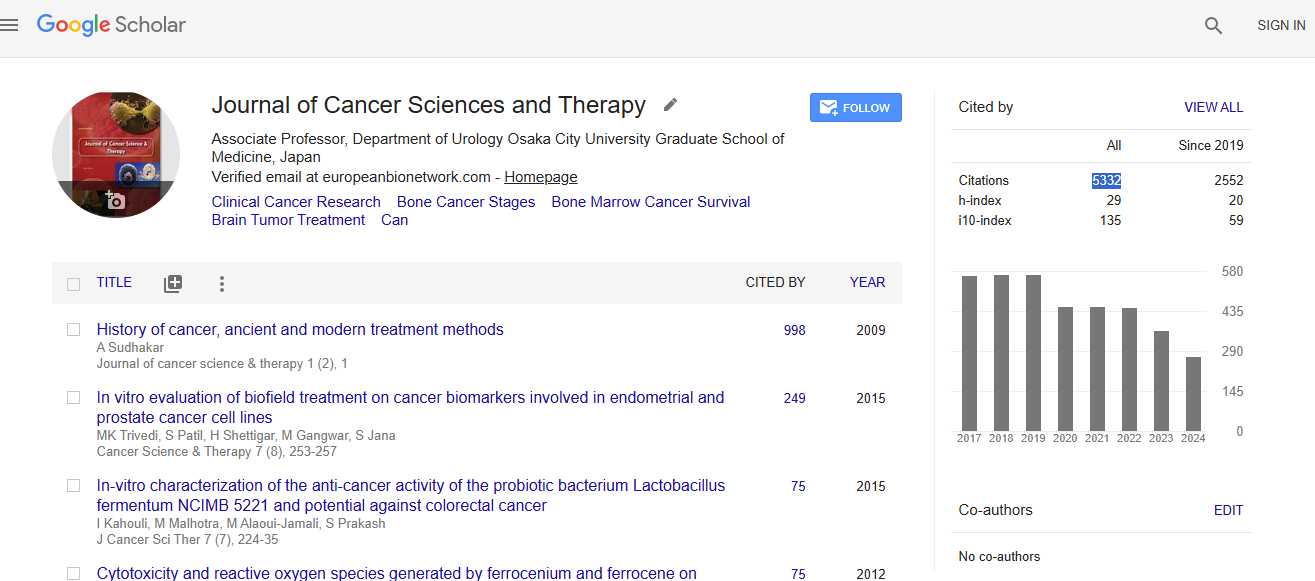
Cancer Science & Therapy received 5332 citations as per Google Scholar report