Short Communication - (2025) Volume 15, Issue 4
Received: 03-Aug-2025, Manuscript No. mccr-25-173798;
Editor assigned: 05-Aug-2025, Pre QC No. P-173798;
Reviewed: 19-Aug-2025, QC No. Q-173798;
Revised: 25-Aug-2025, Manuscript No. R-173798;
Published:
30-Aug-2025
, DOI: 10.37421/2161-0444.2025.15.796
Citation: Sharma, Priya. ”Drug Metabolism: Influences, Innovation, Personalization.” Med Chem 15 (2025):796.
Copyright: © 2025 Sharma P. This is an open-access article distributed under the terms of the Creative Commons Attribution License, which permits unrestricted use, distribution and reproduction in any medium, provided the original author and source are credited.
Understanding drug metabolism is fundamental to safe and effective patient care. Here's the thing: individual genetic differences profoundly impact how drugs are processed by the body. These variations can significantly alter drug efficacy and increase the risk of adverse reactions. Pharmacogenomics, a field that leverages this genetic information, aims to personalize drug therapy, shifting from a general approach to tailored, effective treatments. Integrating pharmacogenomic data into routine care helps predict individual drug responses, leading to safer prescribing and better patient outcomes[1].
Cytochrome P450 (CYP450) enzymes are central to this metabolic network, handling the biotransformation of a wide array of compounds. Recent research has provided new regulatory mechanisms and structural insights into these enzymes, enhancing our understanding of their catalytic roles. This knowledge is crucial for predicting drug-drug interactions and designing drugs with more predictable metabolic profiles, ultimately impacting drug development and clinical safety[2].
Beyond Phase I metabolism, Phase II reactions involve conjugation, which typically makes drugs more water-soluble for excretion. What's increasingly clear is the significant role the gut microbiota plays in this process. The microbes in our gut can influence the activity of host Phase II enzymes or perform their own biotransformations, altering a drug's bioavailability and overall effect. This complex interplay highlights a critical area for understanding individual drug responses and potential drug-microbiota interactions[3].
The gut microbiome, a complex ecosystem of microorganisms, has emerged as a significant modulator of drug metabolism and pharmacokinetics. These microbes possess a wide range of metabolic capabilities, influencing drug bioavailability, efficacy, and toxicity by transforming drugs directly or altering host metabolic enzyme activity. Understanding this microbial contribution is key to personalizing medicine and predicting drug responses, particularly for orally administered drugs[7].
The aging process also brings about physiological changes that significantly impact drug metabolism and pharmacokinetics. Older adults often experience reduced liver and kidney function, altered body composition, and changes in enzyme activity. This leads to different drug responses compared to younger individuals. Recognizing these age-related alterations is essential for appropriate drug dosing and minimizing adverse effects in geriatric patients, ensuring safer and more effective treatment regimens[4].
Similarly, environmental chemicals can alter the activity of drug-metabolizing enzymes. These xenobiotics, found in diet, pollutants, and lifestyle choices, can induce or inhibit key enzymes, leading to altered drug metabolism and potential drug interactions or altered responses to therapeutic agents. Understanding how environmental factors modulate these enzymes is crucial for assessing drug efficacy and safety in real-world populations[10].
Drug transporters, working in conjunction with metabolizing enzymes, form a sophisticated network that governs drug disposition within the body. These proteins control the uptake and efflux of drugs in various tissues, significantly influencing their bioavailability and clearance. The intricate interplay between transporters and metabolic enzymes can lead to complex drug-drug interactions, making it vital to consider both components when predicting a drug's overall pharmacological profile[5].
To better understand these intricate processes, advancements in analytical and computational techniques are paramount. Identifying drug metabolites is a critical step in drug discovery, affecting safety and efficacy. Advances in analytical techniques, especially mass spectrometry, coupled with sophisticated computational tools, have revolutionized how we characterize and quantify these metabolites. These modern strategies offer higher sensitivity and throughput, accelerating the process of understanding a drug's metabolic fate and potential toxicological implications[6].
Artificial Intelligence (AI) and Machine Learning (ML) are transforming drug development, particularly in predicting drug metabolism and pharmacokinetics (DMPK) properties. These advanced computational methods can analyze vast datasets to identify complex patterns, offering more accurate predictions of how drugs will be absorbed, distributed, metabolized, and excreted. Leveraging AI in DMPK assessments helps streamline lead optimization and reduce experimental costs, making drug discovery more efficient[8].
Furthermore, traditional animal models often fail to accurately replicate human drug metabolism and toxicity. That's why human liver models, including 2D cell cultures, 3D organoids, and 'liver-on-a-chip' systems, are becoming increasingly important. These advanced in vitro models offer more physiologically relevant platforms to study drug metabolism, predict drug-induced liver injury, and investigate liver diseases, bridging the gap between preclinical research and clinical outcomes[9].
Drug metabolism is a dynamic and multifaceted process crucial for drug development and patient safety. At its core, individual genetic variations significantly influence drug-metabolizing enzymes, impacting drug efficacy and increasing the risk of adverse reactions. This is where pharmacogenomics steps in, utilizing genetic information to personalize drug therapy, moving away from a one-size-fits-all approach. Integrating this data into routine clinical practice helps predict individual drug responses, leading to safer prescribing and better patient outcomes [1]. Key players in this metabolic network are Cytochrome P450 (CYP450) enzymes, responsible for biotransforming a wide range of compounds. Recent research has yielded new regulatory mechanisms and structural insights into these enzymes, which greatly improves our ability to predict drug-drug interactions and design drugs with more predictable metabolic profiles, ultimately enhancing clinical safety [2].
The human body's internal environment also plays a pivotal role in drug processing. Phase II drug metabolism, involving conjugation reactions, typically increases drug water-solubility for excretion. A significant, and increasingly recognized, factor in this process is the gut microbiota. The microbes residing in our gut can influence host Phase II enzyme activity or perform their own biotransformations, altering drug bioavailability and overall effect. This complex interplay highlights a critical area for understanding individual drug responses and potential drug-microbiota interactions [3]. Expanding on this, the gut microbiome, a complex ecosystem, acts as a major modulator of drug metabolism and pharmacokinetics. These microorganisms possess diverse metabolic capabilities, directly transforming drugs or altering host enzyme activity, thereby influencing drug bioavailability, efficacy, and toxicity. Understanding this microbial contribution is vital for personalizing medicine, particularly for orally administered drugs [7].
External factors, alongside internal ones, profoundly affect how drugs are handled. The aging process introduces physiological changes like reduced liver and kidney function, altered body composition, and shifts in enzyme activity. These age-related alterations lead to different drug responses in older adults compared to younger individuals, making appropriate drug dosing and minimization of adverse effects in geriatric patients a critical consideration for safer treatment [4]. Moreover, exposure to environmental chemicalsâ??xenobiotics found in diet, pollutants, and lifestyle choicesâ??can significantly alter the activity of drug-metabolizing enzymes. These chemicals can induce or inhibit key enzymes, leading to altered drug metabolism, potential drug interactions, or modified therapeutic responses. Understanding how these environmental factors modulate enzymes is crucial for assessing drug efficacy and safety in real-world populations [10].
Drug disposition is not solely governed by metabolism; drug transporters also form a sophisticated network with metabolizing enzymes. These proteins control drug uptake and efflux in various tissues, profoundly influencing bioavailability and clearance. The intricate interplay between transporters and metabolic enzymes can result in complex drug-drug interactions, emphasizing the need to consider both components when predicting a drug's overall pharmacological profile [5]. To advance our understanding and prediction capabilities, modern analytical and computational tools are indispensable. Identifying drug metabolites is a critical step in drug discovery, directly impacting safety and efficacy. Advances in analytical techniques, especially mass spectrometry combined with sophisticated computational tools, have revolutionized how we characterize and quantify these metabolites. These strategies offer higher sensitivity and throughput, accelerating the understanding of a drug's metabolic fate and toxicological implications [6].
Artificial Intelligence (AI) and Machine Learning (ML) are transforming drug development, particularly in predicting drug metabolism and pharmacokinetics (DMPK) properties. These advanced computational methods analyze vast datasets to identify complex patterns, offering more accurate predictions of how drugs will be absorbed, distributed, metabolized, and excreted. Leveraging AI in DMPK assessments streamlines lead optimization and reduces experimental costs, making drug discovery more efficient [8]. Furthermore, traditional animal models often fall short in accurately replicating human drug metabolism and toxicity. This limitation has spurred the development of human liver models, including 2D cell cultures, 3D organoids, and "liver-on-a-chip" systems. These advanced in vitro models provide more physiologically relevant platforms to study drug metabolism, predict drug-induced liver injury, and investigate liver diseases, effectively bridging the gap between preclinical research and clinical outcomes [9].
Drug metabolism is a complex process influenced by many factors, including individual genetics, environmental chemicals, and the gut microbiome. Pharmacogenomics, for instance, uses genetic information to personalize drug therapy, preventing adverse reactions and improving efficacy by understanding how genetic variations affect drug-metabolizing enzymes [1]. Cytochrome P450 (CYP450) enzymes are key players in this process, and recent insights into their mechanisms help predict drug-drug interactions and guide drug design [2]. The gut microbiome significantly modulates drug metabolism, altering bioavailability and efficacy through direct transformations or by influencing host enzymes, a critical consideration for personalized medicine and oral drugs [3, 7]. Beyond internal factors, external elements like environmental chemicals can induce or inhibit drug-metabolizing enzymes, impacting drug efficacy and safety in real-world populations [10]. The aging process also brings physiological changes that affect drug metabolism, necessitating adjusted dosing for geriatric patients [4]. Drug transporters work alongside metabolizing enzymes to control drug disposition, and their complex interplay is vital for predicting pharmacological profiles and drug-drug interactions [5]. Innovations in analytical techniques, such as mass spectrometry, and computational tools, including Artificial Intelligence (AI) and Machine Learning (ML), are revolutionizing metabolite identification and DMPK prediction, making drug discovery more efficient [6, 8]. Furthermore, human liver models like 3D organoids and 'liver-on-a-chip' systems offer more accurate platforms for studying drug metabolism and toxicity, bridging the gap between preclinical research and clinical outcomes, especially when traditional animal models fall short [9]. This collective understanding underscores the multifaceted nature of drug metabolism, emphasizing the need for a holistic approach to drug development and personalized patient care.
None
None
1. Daniel N, Kyle AV, Jeffrey LJ. "Pharmacogenomics of Drug-Metabolizing Enzymes in Clinical Practice".Clin Pharmacol Ther 108 (2020):928-941.
Indexed at, Google Scholar, Crossref
2. Cong Z, Bin M, Xiang-Ying Z. "Recent Advances in Cytochrome P450 Enzymes and Drug Metabolism: From Mechanism to Application".Molecules 25 (2020):3881.
Indexed at, Google Scholar, Crossref
3. Patrick BH, Neeral HB, Alexis TJ. "Phase II Drug Metabolism and the Gut Microbiota".Expert Opin Drug Metab Toxicol 17 (2021):1303-1314.
Indexed at, Google Scholar, Crossref
4. Klaus T, Andrea KW, Michael EK. "Drug Metabolism and Pharmacokinetics in Older Adults: An Update".Clin Pharmacokinet 58 (2019):1-14.
Indexed at, Google Scholar, Crossref
5. Shiew-Mei H, Issy P, Jasmita KG. "Drug Transporters and Metabolism: Complex Interplay in Drug Disposition and Response".Clin Pharmacol Ther 109 (2021):1533-1549.
Indexed at, Google Scholar, Crossref
6. Shang M, Xiao-Yan C, Jian-Ying M. "Recent advances in strategies for metabolite identification in drug discovery and development".J Pharm Biomed Anal 189 (2020):113401.
Indexed at, Google Scholar, Crossref
7. Hao X, Lingling L, Weikang W. "The Impact of the Gut Microbiome on Drug Metabolism and Pharmacokinetics".Clin Transl Sci 14 (2021):846-862.
Indexed at, Google Scholar, Crossref
8. Yan L, Chao L, Xinli L. "Artificial intelligence in drug metabolism and pharmacokinetics prediction".Drug Metab Dispos 51 (2023):1-13.
Indexed at, Google Scholar, Crossref
9. Huashan S, Fan Z, Xin L. "Human liver models for studying drug metabolism, toxicity, and disease".J Pharm Sci 111 (2022):12-25.
Indexed at, Google Scholar, Crossref
10. Yajuan N, Lin F, Min H. "Environmental Chemicals and Drug-Metabolizing Enzymes: Recent Updates and Future Perspectives".Curr Med Chem 27 (2020):2984-2997.
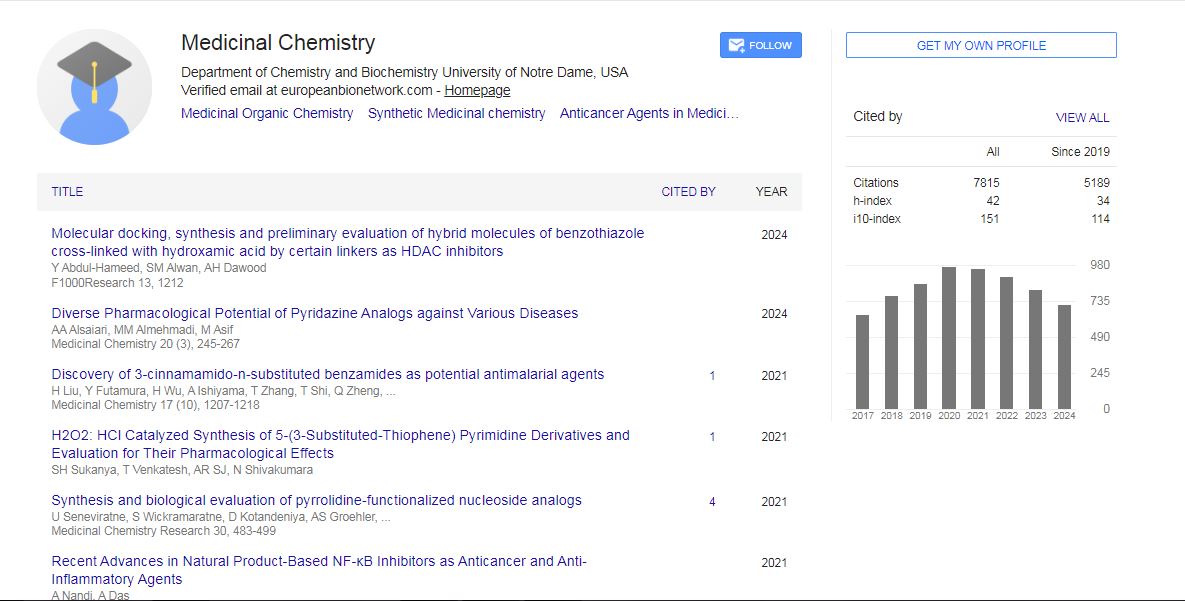
Medicinal Chemistry received 6627 citations as per Google Scholar report