Brief Report - (2025) Volume 15, Issue 6
Received: 01-Dec-2025, Manuscript No. mccr-25-178196;
Editor assigned: 03-Dec-2025, Pre QC No. P-178196;
Reviewed: 17-Dec-2025, QC No. Q-178196;
Revised: 22-Dec-2025, Manuscript No. R-178196;
Published:
29-Dec-2025
, DOI: I: 10.37421/2161-0444.2025.15.8150
Citation: Rahman, Ahmed. ”Drug Discovery: Enzyme Inhibitor Design and Optimization.” Med Chem 15 (2025):810.
Copyright: © 2025 Rahman A. This is an open-access article distributed under the terms of the Creative Commons Attribution License, which permits unrestricted use, distribution and reproduction in any medium, provided the original author and source are credited.
Designing effective small-molecule enzyme inhibitors represents a critical endeavor in contemporary drug discovery, demanding a profound comprehension of enzyme structure and function for targeted intervention in disease pathways. Key strategies encompass the identification of crucial binding sites, the application of structure-based drug design (SBDD) and fragment-based drug discovery (FBDD), alongside the deployment of computational methodologies for virtual screening and lead optimization [1].
The optimization phase is dedicated to enhancing potency, selectivity, pharmacokinetic characteristics, and mitigating off-target effects to yield safe and efficacious drug candidates, with medicinal chemistry serving as a vital bridge between initial conceptualization and potential clinical translation. Fragment-based drug discovery (FBDD) presents a potent alternative to conventional high-throughput screening for the identification of novel small-molecule inhibitors, capitalizing on the capacity to screen small molecular fragments exhibiting weak yet efficient binding to target proteins. Subsequent fragment linking and growth strategies, informed by structural insights, facilitate the rapid advancement of potent and selective inhibitors, where medicinal chemistry efforts are paramount in refining these fragments into drug-like entities with favorable pharmacological profiles [2].
Computational methods are increasingly integral to the design and refinement of enzyme inhibitors, with techniques such as molecular docking, molecular dynamics simulations, and quantitative structure-activity relationship (QSAR) studies enabling in silico evaluation of extensive compound libraries, prediction of binding affinities, and guidance of chemical modifications to augment potency and selectivity. These computational tools accelerate the drug discovery trajectory by prioritizing promising candidates for experimental validation, thereby reducing both costs and development timelines [3].
Achieving selectivity is a paramount concern in the design of enzyme inhibitors to minimize adverse off-target effects and inherent toxicity. Strategies to bolster selectivity involve a meticulous understanding of subtle distinctions between the active sites of related enzymes or allosteric sites unique to the target. Medicinal chemists leverage structure-activity relationship (SAR) studies and judicious chemical modifications to exploit these discrepancies, ensuring that the inhibitor predominantly interacts with the intended enzymatic target [4].
Pharmacokinetic (PK) and pharmacodynamic (PD) profiling are indispensable components of the optimization process for small-molecule enzyme inhibitors. Comprehending the absorption, distribution, metabolism, and excretion (ADME) of a drug is essential for achieving therapeutic efficacy and averting adverse events. Medicinal chemists iteratively refine inhibitor structures to improve PK properties, such as oral bioavailability and half-life, while concurrently ensuring the compound attains and sustains effective concentrations at the target site for the requisite duration [5].
Allosteric enzyme inhibitors offer a complementary strategy to orthosteric inhibitors, binding to a site distinct from the active site. This mechanism can confer unique regulatory attributes and potentially enhance selectivity. The design of allosteric inhibitors necessitates a comprehensive understanding of enzyme conformational dynamics and the identification of suitable allosteric binding pockets, frequently guided by biophysical techniques and sophisticated structural biology approaches [6].
The iterative nature of lead optimization for small-molecule enzyme inhibitors involves a continuous cycle of design, synthesis, testing, and analysis. Medicinal chemists endeavor to fine-tune molecular structures to enhance potency, selectivity, and ADMET (absorption, distribution, metabolism, excretion, and toxicity) properties. This often entails exploring diverse chemical spaces and employing advanced analytical techniques to evaluate compound behavior within biological systems [7].
Biophysical techniques play a pivotal role in characterizing the binding interactions of small-molecule enzyme inhibitors. Methodologies such as surface plasmon resonance (SPR), isothermal titration calorimetry (ITC), and X-ray crystallography furnish quantitative data on binding affinity, kinetics, and the structural underpinnings of inhibition. This information is invaluable for directing medicinal chemistry endeavors and optimizing inhibitor design [8].
The emergence of resistance to enzyme inhibitors poses a significant hurdle in therapeutic contexts. Elucidating the mechanisms of resistance, including target mutation or the activation of compensatory pathways, is crucial for the development of next-generation inhibitors capable of surmounting these challenges. Medicinal chemistry strategies focus on creating inhibitors that effectively target resistant mutant enzyme forms or alternative biological pathways [9].
The integration of artificial intelligence (AI) and machine learning (ML) into drug design is rapidly revolutionizing the field of small-molecule enzyme inhibitor development. AI/ML algorithms possess the capability to analyze vast datasets for predicting molecular properties, identifying potential therapeutic targets, and more efficiently optimizing inhibitor candidates. This synergistic union of AI/ML and medicinal chemistry accelerates the discovery of novel therapeutic agents [10].
The design of effective small-molecule enzyme inhibitors is fundamental to modern drug discovery, requiring a comprehensive understanding of enzyme structure and function for targeted therapeutic intervention. Central to this process are strategies such as identifying critical binding sites, employing structure-based drug design (SBDD) and fragment-based drug discovery (FBDD), and utilizing computational methods for virtual screening and lead optimization. The optimization process aims to improve potency, selectivity, pharmacokinetic properties, and reduce off-target effects to create safe and effective drug candidates. Medicinal chemistry is indispensable in synthesizing and characterizing these compounds, bridging the gap between initial design and potential clinical application [1].
Fragment-based drug discovery (FBDD) offers a powerful alternative to traditional high-throughput screening for identifying novel small-molecule inhibitors. This approach harnesses the ability to screen small molecular fragments that bind weakly but efficiently to target proteins. Subsequent fragment linking and growing strategies, guided by structural information, can lead to the rapid development of potent and selective inhibitors. The medicinal chemistry effort is crucial in optimizing these fragments into drug-like molecules with desirable pharmacological profiles [2].
Computational methods have become increasingly indispensable in the design and optimization of enzyme inhibitors. Techniques such as molecular docking, molecular dynamics simulations, and quantitative structure-activity relationship (QSAR) studies enable in silico screening of large compound libraries, prediction of binding affinities, and guidance of chemical modifications to enhance potency and selectivity. These computational tools accelerate the drug discovery process by prioritizing promising candidates for experimental validation, thereby reducing costs and timelines [3].
Selectivity is paramount when designing enzyme inhibitors to minimize off-target effects and toxicity. Strategies to enhance selectivity involve understanding subtle differences between the active sites of related enzymes or allosteric sites unique to the target. Medicinal chemists employ structure-activity relationship (SAR) studies and judicious chemical modifications to exploit these differences, ensuring that the inhibitor primarily acts on the intended enzyme [4].
Pharmacokinetic (PK) and pharmacodynamic (PD) profiling are essential components of small-molecule enzyme inhibitor optimization. Understanding how a drug is absorbed, distributed, metabolized, and excreted (ADME) is critical for achieving therapeutic efficacy and avoiding adverse events. Medicinal chemists iteratively refine inhibitor structures to improve PK properties, such as oral bioavailability and half-life, while ensuring the compound reaches and maintains effective concentrations at the target site for the desired duration [5].
Allosteric enzyme inhibitors present a complementary approach to orthosteric inhibitors, binding to a site distinct from the active site. This mechanism can lead to unique regulatory properties and potentially improved selectivity. Designing allosteric inhibitors requires a thorough understanding of enzyme conformational changes and the identification of suitable allosteric binding pockets, often guided by biophysical techniques and advanced structural biology [6].
The iterative process of lead optimization for small-molecule enzyme inhibitors involves a continuous cycle of design, synthesis, testing, and analysis. Medicinal chemists work to fine-tune the structure to enhance potency, selectivity, and ADMET (absorption, distribution, metabolism, excretion, and toxicity) properties. This often involves exploring diverse chemical spaces and utilizing advanced analytical techniques to assess compound behavior in biological systems [7].
Biophysical techniques play a crucial role in characterizing the binding interactions of small-molecule enzyme inhibitors. Methods such as surface plasmon resonance (SPR), isothermal titration calorimetry (ITC), and X-ray crystallography provide quantitative data on binding affinity, kinetics, and the structural basis of inhibition. This information is invaluable for guiding medicinal chemistry efforts and optimizing inhibitor design [8].
The development of resistance to enzyme inhibitors is a significant challenge in therapeutic settings. Understanding the mechanisms of resistance, such as target mutation or the activation of bypass pathways, is crucial for designing next-generation inhibitors that can overcome these challenges. Medicinal chemistry strategies involve developing inhibitors that bind to resistant mutant forms of the enzyme or target alternative pathways [9].
The application of artificial intelligence (AI) and machine learning (ML) in drug design is rapidly transforming the field of small-molecule enzyme inhibitor development. AI/ML algorithms can analyze vast datasets to predict molecular properties, identify potential drug targets, and optimize inhibitor candidates more efficiently. This synergistic approach between AI/ML and medicinal chemistry accelerates the discovery of novel therapeutic agents [10].
The development of small-molecule enzyme inhibitors is a cornerstone of drug discovery, requiring a deep understanding of enzyme structure and function. Key strategies include structure-based drug design (SBDD), fragment-based drug discovery (FBDD), and computational methods for screening and optimization. Optimization focuses on improving potency, selectivity, and pharmacokinetic properties while minimizing off-target effects. Medicinal chemistry is crucial for synthesizing and characterizing compounds. Fragment-based drug discovery leverages small molecular fragments to identify inhibitors, with medicinal chemistry refining them. Computational tools like molecular docking and simulations accelerate the process by predicting binding and guiding modifications. Selectivity is achieved by exploiting subtle differences in enzyme active or allosteric sites. Pharmacokinetic and pharmacodynamic profiling are essential for therapeutic efficacy and avoiding adverse events. Allosteric inhibitors offer a complementary approach by binding to sites distinct from the active site. Lead optimization is an iterative process of design, synthesis, and testing to enhance potency, selectivity, and ADMET properties. Biophysical techniques like SPR and ITC provide quantitative binding data. Resistance mechanisms are studied to develop next-generation inhibitors, and AI/ML integration is accelerating discovery by analyzing vast datasets.
None
None
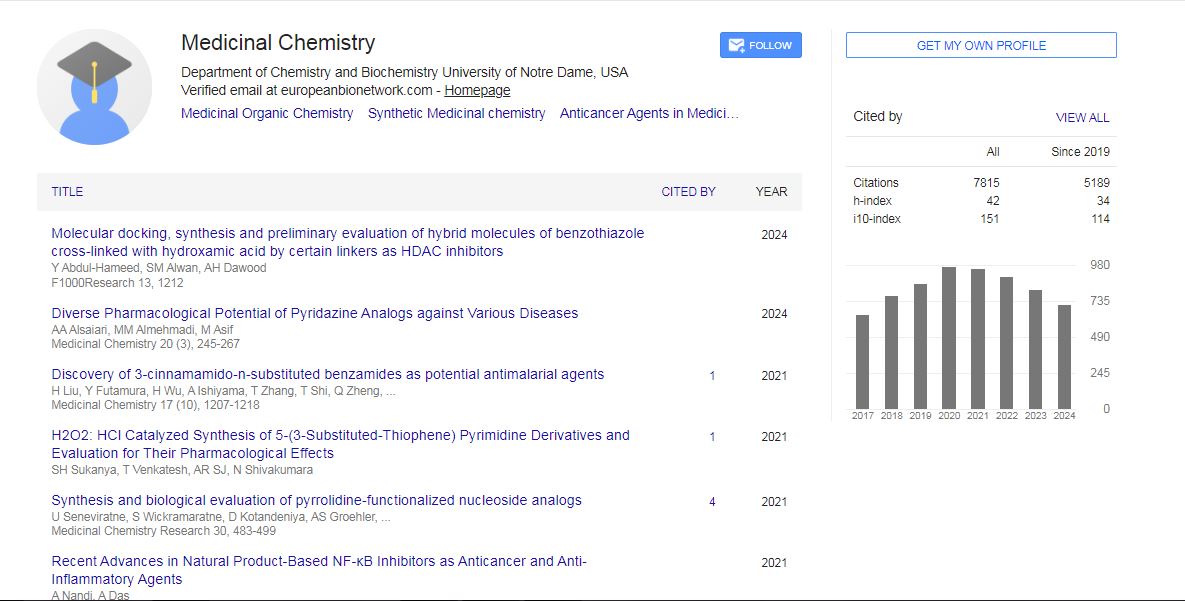
Medicinal Chemistry received 6627 citations as per Google Scholar report