Short Communication - (2025) Volume 14, Issue 4
Received: 01-Jul-2025, Manuscript No. iem-26-179822;
Editor assigned: 03-Jul-2025, Pre QC No. P-179822;
Reviewed: 14-Jul-2025, QC No. Q-179822;
Revised: 22-Jul-2025, Manuscript No. R-179822;
Published:
29-Jul-2025
, DOI: 10.37421/2169- 0316.2025.14.315
Citation: Svensson, Lars. âDriving Industrial Efficiency: A Multi- Faceted Approach.â J Ind Eng Manag 14 (2025):315.
Copyright: © 2025 Svensson L. This is an open-access article distributed under the terms of the Creative Commons Attribution License, which permits unrestricted use, distribution and reproduction in any medium, provided the original author and source are credited.
Optimizing industrial processes is a critical endeavor for organizations seeking to enhance their competitive edge and operational performance. This involves a comprehensive strategy that addresses various facets of production and management. A foundational aspect of this optimization lies in the meticulous measurement and improvement of key performance indicators (KPIs) related to efficiency, coupled with the implementation of strategic interventions designed to drive these metrics upward [1].
The landscape of modern industry is being reshaped by the integration of advanced technologies, often categorized under the umbrella of Industry 4.0. This revolution necessitates a deep understanding of how cyber-physical systems, the Internet of Things (IoT), and artificial intelligence can be leveraged to achieve real-time monitoring and control, thereby fostering significant enhancements in operational efficiency and responsiveness [2].
While digital transformation is paramount, traditional methodologies for streamlining operations remain highly relevant and continue to offer substantial benefits. Lean manufacturing principles, with their emphasis on identifying and eliminating waste through tools like value stream mapping and Kaizen events, provide a robust framework for continuous improvement and the enhancement of overall operational performance [3].
In parallel with production efficiency, energy consumption represents a significant operational cost and an area of considerable environmental impact. Therefore, strategies focused on assessing and improving energy efficiency in manufacturing facilities, through energy management systems and the adoption of energy-efficient technologies, are crucial for both economic sustainability and reduced ecological footprint [4].
The interconnectedness of modern business operations highlights the importance of supply chain management. Building more resilient and efficient supply chains, through advanced planning, robust risk management, and the adoption of digital tools, is essential for navigating disruptions and maintaining optimal flow, ensuring that efficiency extends beyond the factory walls [5].
Furthermore, the human element within industrial settings cannot be overstated. A human-centered approach that prioritizes employee training, effective workplace design, and sound management practices is vital for augmenting productivity, minimizing errors, and ultimately achieving optimal operational outcomes through enhanced employee engagement and skill development [6].
Maintenance strategies are also undergoing a significant evolution, moving from reactive to proactive models. Predictive maintenance, powered by machine learning algorithms and sensor data analysis, offers a transformative approach to forecasting equipment failures, thereby minimizing unplanned downtime and optimizing maintenance schedules for improved operational uptime and cost savings [7].
Ensuring the quality of products and processes is intrinsically linked to industrial efficiency. The implementation and adherence to rigorous quality management systems, encompassing frameworks like statistical process control and continuous quality improvement, are fundamental to reducing defects and enhancing overall performance, leading to increased customer satisfaction [8].
Emerging manufacturing paradigms, such as additive manufacturing or 3D printing, are presenting novel avenues for boosting industrial efficiency. This technology facilitates on-demand production, customization, and a reduction in material waste, offering opportunities to optimize design and production processes across various industrial sectors [9].
Finally, sophisticated analytical tools play a pivotal role in process optimization. Simulation and modeling techniques, particularly discrete-event simulation, enable the analysis of bottlenecks, the evaluation of diverse operational strategies, and the prediction of system performance, thereby facilitating informed decision-making for efficiency enhancement and the improvement of throughput [10].
The optimization of industrial processes is a multifaceted endeavor that requires a systematic approach to measurement and improvement. Key performance indicators (KPIs) serve as crucial benchmarks for assessing efficiency, and strategic interventions are essential for driving enhancements. A core tenet of this optimization strategy is the reliance on data-driven decision-making, supported by advanced analytics and the seamless integration of automation and digital technologies to achieve substantial gains in productivity and resource utilization [1].
The ongoing digital transformation in manufacturing, often referred to as Industry 4.0, is fundamentally reshaping industrial operations. This paradigm shift involves the intricate integration of cyber-physical systems, the Internet of Things (IoT), and artificial intelligence, which collectively enable real-time monitoring and control capabilities. Such advancements are pivotal in enhancing operational efficiency and achieving greater agility in response to dynamic market demands [2].
Despite the rapid advancements in digital technologies, the principles of lean manufacturing continue to provide a robust foundation for operational excellence. The application of established lean tools, including value stream mapping and Kaizen events, remains instrumental in identifying and systematically eliminating waste within production systems, thereby fostering a culture of continuous improvement and positively impacting overall operational performance [3].
Energy efficiency is a critical dimension of industrial sustainability and a significant factor in cost reduction. Effective strategies for assessing and enhancing energy consumption in manufacturing facilities are imperative. This involves the judicious use of energy management systems and the strategic adoption of energy-efficient technologies, which collectively contribute to substantial savings and a reduced environmental footprint [4].
In the contemporary global economy, the resilience and efficiency of supply chains are inextricably linked. Research in this area focuses on developing more robust and efficient supply chain models through advanced planning methodologies, comprehensive risk management frameworks, and the strategic adoption of digital tools. Emphasizing agility and end-to-end visibility is crucial for navigating disruptions and ensuring optimal material and information flow [5].
The human dimension within industrial operations is frequently underestimated, yet it profoundly influences overall efficiency. This paper underscores the importance of human factors, examining how targeted employee training, thoughtful workplace design, and effective management practices collectively contribute to enhanced productivity and a reduction in operational errors. A human-centered approach is paramount for achieving optimal operational outcomes [6].
Predictive maintenance represents a significant evolution in industrial maintenance strategies, shifting the focus from a reactive to a proactive stance. By applying sophisticated machine learning algorithms and analyzing real-time sensor data, industries can forecast potential equipment failures. This proactive approach minimizes unplanned downtime and optimizes maintenance schedules, leading to substantial improvements in operational uptime and significant cost savings [7].
Quality management systems are fundamental to achieving both industrial efficiency and high levels of customer satisfaction. This review examines various quality frameworks and their practical implementation within manufacturing settings. The critical role of statistical process control and the adoption of continuous quality improvement initiatives are highlighted as key drivers for defect reduction and overall performance enhancement [8].
The advent of additive manufacturing, commonly known as 3D printing, is introducing new opportunities for enhancing industrial efficiency. This technology enables on-demand production, facilitates product customization, and minimizes material waste. Its applications are expanding across various industrial sectors, offering significant potential for optimizing both design and production processes [9].
Simulation and modeling techniques are indispensable tools for optimizing complex industrial systems and processes. Discrete-event simulation, in particular, provides a powerful method for analyzing system bottlenecks, evaluating alternative operational strategies, and accurately predicting system performance. This analytical rigor supports informed decision-making aimed at improving throughput and reducing cycle times [10].
This collection of articles explores various dimensions of industrial efficiency. Advancing efficiency involves a multi-faceted approach encompassing key performance indicators (KPIs), strategic interventions, and data-driven decision-making, supported by advanced analytics and digital technologies. Industry 4.0 technologies like cyber-physical systems, IoT, and AI are crucial for real-time monitoring and control, leading to enhanced efficiency. Traditional lean manufacturing principles remain vital for waste elimination and continuous improvement. Energy efficiency strategies, including energy management systems and efficient technologies, are essential for cost reduction and sustainability. Resilient and efficient supply chains are built through advanced planning, risk management, and digital tools. Human factors, such as training and workplace design, significantly impact productivity and error reduction. Predictive maintenance leverages machine learning and sensor data to minimize downtime. Quality management systems are fundamental for efficiency and customer satisfaction. Additive manufacturing offers on-demand production and reduced waste, while simulation and modeling techniques aid in analyzing bottlenecks and optimizing processes for improved throughput.
None
None
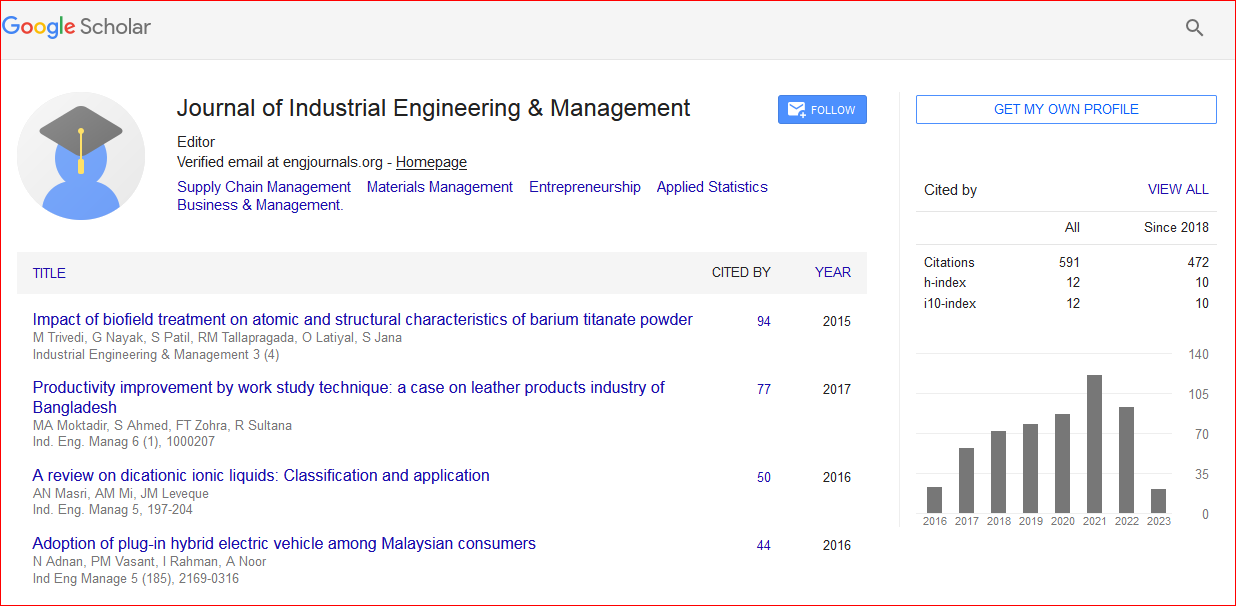
Industrial Engineering & Management received 739 citations as per Google Scholar report