Brief Report - (2025) Volume 16, Issue 4
Received: 01-Aug-2025, Manuscript No. jfr-26-184109;
Editor assigned: 04-Aug-2025, Pre QC No. P-184109;
Reviewed: 18-Aug-2025, QC No. Q-184109;
Revised: 22-Aug-2025, Manuscript No. R-184109;
Published:
29-Aug-2025
, DOI: 10.37421/2157-7145.2025.16.670
Citation: Prieto, Laura Sanchez. ”DNA Databases: Legal and
Ethical Challenges.” J Forensic Res 16 (2025):670.
Copyright: © 2025 Prieto S. Laura This is an open-access article distributed under the terms of the Creative Commons Attribution License, which permits unrestricted use,
distribution and reproduction in any medium, provided the original author and source are credited.
The proliferation of DNA databases has fundamentally reshaped forensic science and criminal justice, introducing a complex array of legal and ethical considerations that continue to evolve alongside technological advancements [1].
The utilization of familial DNA searching presents a particularly intricate ethical dilemma, raising profound questions about the privacy and due process rights of individuals who have not themselves committed any offense [2].
Direct-to-consumer (DTC) genetic testing has further complicated the landscape, creating vast, often unregulated, personal DNA databases that can intersect with law enforcement investigations, posing significant ethical challenges regarding consent and data protection [3].
The security and privacy of sensitive genetic information stored within national DNA databases are paramount, requiring robust technical and legal safeguards to prevent unauthorized access and maintain public trust [4].
Expanding the scope of DNA databases beyond convicted offenders, for purposes such as identifying victims or missing persons, introduces new ethical considerations regarding consent, the potential for mission creep, and the necessity of clear legislative guidance [5].
The admissibility of DNA evidence derived from databases in legal proceedings is subject to intense scrutiny, necessitating rigorous standards for chain of custody, contamination prevention, and scientific validity to ensure fairness [6].
Informed consent and the right to privacy are central ethical pillars governing the collection and storage of DNA samples for forensic databases, with a critical need for standardized and robust consent mechanisms across jurisdictions [7].
Concerns surrounding potential bias and discrimination in the application of DNA database technologies are significant, as disproportionate representation of certain demographic groups can lead to inequitable investigative outcomes and perpetuate societal disparities [8].
The international dimension of DNA databases introduces complex legal and ethical challenges related to cross-border data sharing, sovereignty, varying data protection laws, and the potential for misuse of sensitive genetic information [9].
The evolving legal and ethical frontiers of forensic genetic genealogy and the use of partial DNA profiles necessitate careful oversight to address warrant requirements, privacy concerns in public genealogy databases, and the ethical implications of indirect familial identification [10].
The intricate interplay between legal frameworks and ethical considerations is at the forefront of discussions surrounding the creation and utilization of DNA databases [1].
Advances in genetic technology have consistently outpaced legal regulations, creating challenges in areas such as privacy, informed consent, and data security, with significant implications for civil liberties and the ongoing debate about balancing public safety with individual rights in forensic DNA profiling [1].
Familial DNA searching, while offering investigative value, critically scrutinizes the ethical dimensions of privacy and due process, particularly concerning the indirect identification of relatives who are not suspects, prompting questions about proportionality and the potential for discrimination [2].
Safeguards and guidelines are proposed to mitigate these ethical concerns while acknowledging the investigative utility of such methods [2].
The legal landscape of direct-to-consumer (DTC) genetic testing is increasingly intertwined with law enforcement's access to DNA databases [3].
Unregulated consumer genetic databases present novel ethical challenges for criminal investigations, particularly concerning the complexities of obtaining informed consent and protecting sensitive genetic information from potential misuse by authorities [3].
Data security and privacy breaches within national DNA databases are critical issues demanding attention [4].
The paper examines the technical and legal measures essential for preventing unauthorized access and underscores the ethical responsibility of maintaining the integrity of sensitive genetic profiles, while also discussing the consequences of data leaks and the resulting trust deficit from inadequate security protocols [4].
Expanding the scope of DNA databases beyond individuals convicted of crimes raises significant ethical questions, especially when considering their use for identifying victims or missing persons [5].
Challenges related to consent, the potential for mission creep, and the need for clear legislative frameworks to govern the collection and use of DNA samples for non-criminal justice purposes are explored [5].
The admissibility of DNA evidence derived from databases in court is a subject of considerable legal and scientific scrutiny [6].
Issues pertaining to chain of custody, potential contamination, and the overall scientific validity of DNA profiling techniques are discussed, emphasizing the importance of rigorous standards and protocols for ensuring the reliability and fairness of such evidence in legal proceedings [6].
This review critically assesses the ethical framework governing the collection and storage of DNA samples in forensic databases, with a particular focus on informed consent and the right to privacy [7].
Disparities in consent procedures across different jurisdictions and their implications for individuals' autonomy over their genetic information are highlighted, leading to advocacy for standardized, robust consent mechanisms [7].
The ethical challenges arising from potential bias and discrimination in the application of DNA database technologies are examined [8].
The paper discusses how disproportionate representation of certain demographic groups within arrestee or convicted offender databases can lead to biased investigative outcomes and perpetuate existing societal inequalities, offering recommendations for mitigating such biases [8].
The international legal and ethical implications of sharing DNA databases across borders for law enforcement purposes are a significant area of concern [9].
Issues of national sovereignty, differing data protection laws in various countries, and the potential for misuse of shared genetic information are addressed, underscoring the need for harmonized international agreements to govern such data sharing [9].
The evolving legal and ethical landscape encompasses the use of partial DNA profiles and forensic genetic genealogy in criminal investigations [10].
Challenges related to obtaining warrants for such searches, privacy concerns for individuals whose data resides in public genealogy databases, and the ethical considerations of identifying individuals through indirect familial connections are explored, emphasizing the necessity of careful legal and ethical oversight [10].
This collection of research explores the multifaceted legal and ethical challenges surrounding DNA databases. Key themes include the impact of technological advancements on regulations, privacy concerns, informed consent, and data security. Familial DNA searching and direct-to-consumer genetic databases introduce complex issues of indirect identification and potential misuse of data. The admissibility of DNA evidence, potential biases, and international data sharing also present significant hurdles. Expanding database use beyond convicted offenders and the application of forensic genetic genealogy further highlight the need for robust legal frameworks and ethical oversight to balance public safety with individual rights and privacy.
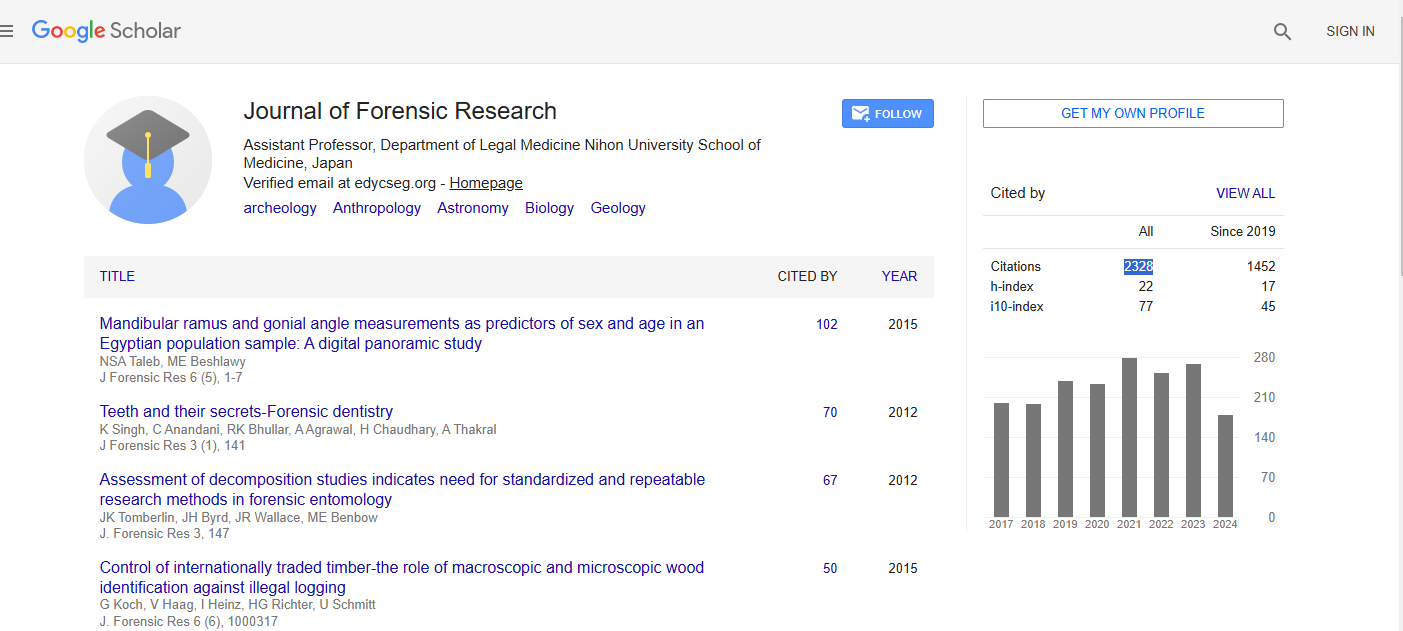
Journal of Forensic Research received 2328 citations as per Google Scholar report