Short Communication - (2025) Volume 17, Issue 5
Received: 01-Sep-2025, Manuscript No. jcst-25-176306;
Editor assigned: 03-Sep-2025, Pre QC No. P-176306;
Reviewed: 17-Sep-2025, QC No. Q-176306;
Revised: 22-Sep-2025, Manuscript No. R-176306;
Published:
29-Sep-2025
, DOI: 10.37421/1948-5956.2025.17.730
Citation: Novakovic, Igor. ”Diverse Strategies for Cancer Prevention.”
J Cancer Sci Ther 17 (2025):730.
Copyright: © 2025 Novakovic I. This is an open-access article distributed under the terms of the Creative Commons Attribution License, which permits unrestricted use,
distribution and reproduction in any medium, provided the original author and source are credited.
Cancer prevention remains a critical global health priority, with a multitude of strategies demonstrating significant effectiveness across various contexts. Recent research underscores the profound impact of both individual lifestyle modifications and population-level public health initiatives in reducing cancer incidence and improving patient outcomes. For example, systematic reviews highlight the efficacy of comprehensive lifestyle interventions. Improved diet, increased physical activity, and robust weight management programs are shown to reduce overall cancer risk, suggesting that integrating these approaches within primary care settings offers substantial public health benefits [1].
Vaccination programs stand out as exceptionally effective primary prevention measures against specific cancers. The widespread implementation of Human Papillomavirus (HPV) vaccination programs has a substantial impact on decreasing the incidence of cervical cancer, firmly establishing vaccination as a powerful public health strategy requiring sustained global uptake [2].
Similarly, strategic screening and vaccination initiatives against Hepatitis B and C are fundamental for preventing liver cancer. A global perspective on these programs emphasizes their crucial role in reducing the worldwide burden of hepatocellular carcinoma through widespread testing and immunization [9].
Beyond vaccinations, organized screening programs are vital for early detection and prevention. Population-based colorectal cancer screening, encompassing procedures like colonoscopy and various stool-based tests, significantly reduces both the incidence and mortality associated with colorectal cancer. These findings reinforce the essential role of regular screening in enhancing patient outcomes across diverse demographics [3].
In a similar vein, real-world evidence from European studies consistently confirms the effectiveness of organized mammography screening programs. These programs are indispensable for early detection, serving as a fundamental component of breast cancer prevention strategies and contributing to reduced breast cancer mortality [4].
Behavioral interventions also form a cornerstone of cancer prevention. The profound impact of smoking cessation interventions on lowering cancer risk is well-documented. Implementing comprehensive cessation programs emerges as a crucial primary prevention measure against numerous cancer types, underscoring its priority in public health efforts [5].
Furthermore, specific dietary interventions, as evidenced by meta-analyses of randomized controlled trials, play a pivotal role in primary cancer prevention. This research highlights the importance of nutritional guidance as an actionable strategy to diminish cancer incidence [6].
Complementing dietary changes, physical activity is recognized as a powerful tool for cancer prevention. Comprehensive systematic reviews synthesize robust evidence, providing clear recommendations for incorporating exercise into daily routines, offering practical guidance for individuals and public health campaigns focused on reducing cancer risk [7].
Community-level efforts also contribute significantly to prevention. Community-based skin cancer prevention programs, which include sun protection education and widespread awareness campaigns, are effective in fostering behavioral changes. These initiatives successfully reduce skin cancer incidence within communities, particularly among groups at higher risk [8].
Finally, the effectiveness of educational interventions, especially those tailored for underserved populations, is clear. These programs empower individuals with essential knowledge and practical tools, enabling them to adopt preventive behaviors. This emphasizes the critical need for equitable access to accurate health information as a core strategy for cancer prevention [10].
Collectively, these studies delineate a multi-faceted approach to cancer prevention, integrating clinical interventions, public health campaigns, and individual empowerment to create a healthier society.
The scientific literature consistently highlights a range of effective strategies for primary cancer prevention, encompassing lifestyle modifications, vaccination, screening programs, and educational initiatives. These approaches demonstrate significant public health benefits and underscore the importance of integrated prevention efforts.
Lifestyle interventions, for instance, are pivotal in reducing overall cancer risk. A systematic review and meta-analysis published in 2023 specifically points to the effectiveness of improved diet, increased physical activity, and weight management in this regard [1]. The research suggests that incorporating these interventions into primary care settings can substantially contribute to cancer prevention, yielding clear public health advantages. This emphasis on actionable lifestyle changes is further supported by dedicated studies on specific components; a systematic review and meta-analysis of randomized controlled trials from 2021 provides compelling evidence that particular dietary interventions are vital for primary cancer prevention, emphasizing the importance of nutritional guidance as a practical strategy to reduce incidence [6]. Similarly, a comprehensive systematic review from 2022 synthesizes strong evidence for physical activity as a powerful cancer prevention tool, outlining specific recommendations for integrating exercise into daily life and offering practical guidance for public health initiatives [7]. Addressing another critical lifestyle factor, a 2023 systematic review highlights the profound impact of smoking cessation interventions on significantly reducing cancer risk. This evidence strongly supports implementing comprehensive cessation programs as a crucial primary prevention measure against multiple types of cancer, positioning it as a priority for public health efforts [5].
Vaccination programs have proven to be game-changers in preventing infection-related cancers. The substantial impact of Human Papillomavirus (HPV) vaccination programs on reducing the incidence of cervical cancer is confirmed by a 2022 systematic review and meta-analysis [2]. This data unequivocally supports widespread vaccination as a highly effective public health strategy, stressing the importance of continued global implementation and uptake. Beyond HPV, a global perspective from 2021 on Hepatitis B and C screening and vaccination programs underscores their crucial role in preventing liver cancer [9]. The review highlights the importance of comprehensive public health strategies, including widespread testing and immunization, to significantly reduce the burden of hepatocellular carcinoma worldwide.
Early detection through systematic screening programs represents another cornerstone of cancer prevention, dramatically improving outcomes. A 2021 meta-analysis demonstrates the significant effectiveness of population-based colorectal cancer screening programs in reducing incidence and mortality [3]. The findings underscore the critical role of regular screening, such as colonoscopy and stool-based tests, in early detection and prevention. This helps improve patient outcomes across various populations. For breast cancer, a European study from 2022 provides real-world evidence confirming the effectiveness of organized mammography screening programs in reducing mortality [4]. The results emphasize the continued benefit of these programs for early detection, supporting their role as a foundational element of breast cancer prevention strategies.
Finally, targeted educational and community-based initiatives play a vital role in empowering individuals and communities to adopt preventive behaviors. A 2023 systematic review evaluates the effectiveness of community-based skin cancer prevention programs, identifying key strategies like sun protection education and awareness campaigns that successfully promote behavioral changes [8]. These programs are particularly effective in reducing skin cancer incidence within communities, especially among high-risk groups. Complementing this, a 2022 systematic review assesses the effectiveness of educational interventions for cancer prevention, with a specific focus on underserved populations [10]. The findings suggest that tailored educational programs can empower individuals with the knowledge and tools needed to adopt preventive behaviors, highlighting the necessity for equitable access to health information. These diverse studies collectively showcase the multi-pronged approach required to achieve meaningful progress in global cancer prevention efforts.
Primary cancer prevention efforts rely on a diverse range of effective interventions. Integrating lifestyle changes like improved diet, increased physical activity, and weight management into primary care settings significantly reduces overall cancer risk. Vaccination programs also show strong success; Human Papillomavirus (HPV) vaccination dramatically lowers cervical cancer incidence, highlighting its critical role as a public health strategy. Similarly, global efforts in Hepatitis B and C screening and vaccination are crucial in preventing liver cancer. Early detection through screening is another cornerstone. Population-based colorectal cancer screening, utilizing methods such as colonoscopy and stool tests, proves highly effective in reducing both incidence and mortality. In Europe, organized mammography screening programs demonstrate real-world benefits by reducing breast cancer mortality through early detection. Behavioral changes are equally important. Comprehensive smoking cessation interventions significantly reduce the risk of multiple cancer types, making these programs a public health priority. Beyond cessation, specific dietary interventions provide compelling evidence for primary cancer prevention through nutritional guidance, and promoting physical activity offers a powerful tool with practical recommendations for individuals and initiatives. Community-based programs, focusing on sun protection education, successfully promote behavioral changes that reduce skin cancer incidence. Furthermore, tailored educational interventions are effective in empowering individuals, particularly in underserved populations, to adopt preventive behaviors by providing essential health information. Together, these varied approaches underscore a comprehensive strategy for significantly impacting global cancer prevention.
Indexed at, Google Scholar, Crossref
Indexed at, Google Scholar, Crossref
Indexed at, Google Scholar, Crossref
Indexed at, Google Scholar, Crossref
Indexed at, Google Scholar, Crossref
Indexed at, Google Scholar, Crossref
Indexed at, Google Scholar, Crossref
Indexed at, Google Scholar, Crossref
Indexed at, Google Scholar, Crossref
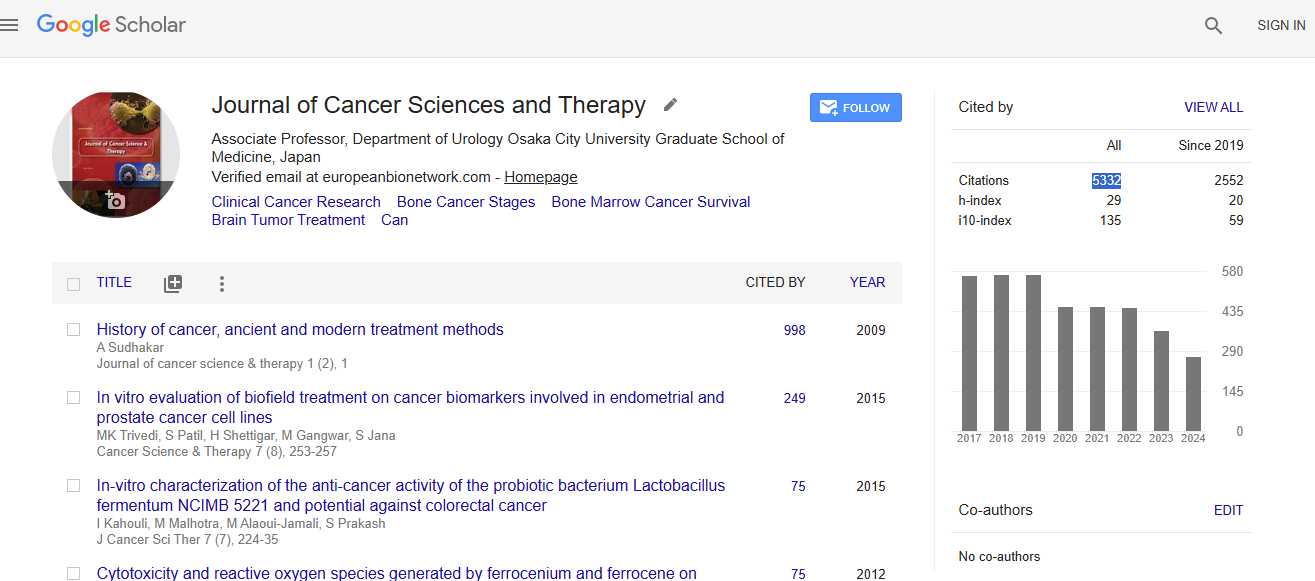
Cancer Science & Therapy received 5332 citations as per Google Scholar report