Brief Report - (2025) Volume 17, Issue 4
Received: 01-Jul-2025, Manuscript No. jcst-25-174947;
Editor assigned: 03-Jul-2025, Pre QC No. P-174947;
Reviewed: 17-Jul-2025, QC No. Q-174947;
Revised: 22-Jul-2025, Manuscript No. R-174947;
Published:
29-Jul-2025
, DOI: 10.37421/1948-5956.2025.17.711
Citation: Carlos Alvarez. ”Diverse Innovations Transforming
Cancer Treatment.” J Cancer Sci Ther 17 (2025):711.
Copyright: © 2025 A. Carlos This is an open-access article distributed under the terms of the Creative Commons Attribution License, which permits unrestricted use, distribution
and reproduction in any medium, provided the original author and source are credited.
The landscape of cancer therapy is continuously evolving, marked by significant advancements across various scientific disciplines. Researchers are developing innovative approaches to combat this complex disease. Gold nanoparticles (AuNPs) are increasingly recognized as promising anticancer agents. Their unique physicochemical properties enable versatile functionalization, targeted drug delivery, advanced imaging capabilities, and effective photothermal therapy. Ongoing research aims to enhance their biocompatibility, minimize toxicity, and overcome resistance mechanisms, signaling great promise for future cancer treatments [1].
Natural products and their derivatives continue to serve as a rich and invaluable source of potential anticancer agents. These compounds frequently exhibit a wide array of biological activities, including potent cytotoxic, anti-inflammatory, and immunomodulatory effects. Extensive research is dedicated to isolating these compounds, elucidating their structures, and modifying them synthetically to develop new, highly effective, and less toxic therapeutic alternatives derived from plant, microbial, and marine origins [2].
Immunotherapy has profoundly transformed the paradigm of cancer treatment, specifically by mobilizing the body's inherent immune system to effectively combat tumors. Notable recent advancements encompass the development of checkpoint inhibitors, sophisticated adoptive cell therapies like CAR T-cells, and the strategic use of oncolytic viruses. These innovative strategies consistently demonstrate the capacity for durable responses across a wide spectrum of cancers, unequivocally underscoring the critical and expanding role of immune modulation within contemporary oncology practices [3].
Drug repurposing, also known as drug repositioning, presents an accelerated and efficient pathway to developing novel cancer therapies by identifying new therapeutic applications for drugs that are already approved and on the market. This strategic approach capitalizes on existing knowledge of safety profiles and pharmacokinetic data, which significantly reduces the typical development timeline and associated costs. It proves particularly effective for precisely targeting specific signaling pathways or cellular processes that are abnormally altered in cancer, thereby introducing valuable new therapeutic options [4].
The revolutionary CRISPR-Cas9 gene editing technology offers an unprecedented and highly precise tool for advancing cancer therapy. This technology facilitates the exact modification of genes intimately involved in critical processes such as tumor growth, metastatic spread, and the development of drug resistance. Scientists are actively employing CRISPR to strategically disrupt oncogenes, effectively activate dormant tumor suppressors, and engineer immune cells for highly targeted cancer destruction, thereby opening exciting new avenues for personalized genomic medicine [5].
Targeted therapies stand as a fundamental cornerstone of precision medicine within the field of oncology. These advanced agents are designed to specifically block the growth and proliferation of cancer by interfering with distinct molecular targets that play pivotal roles in tumor development, progression, and dissemination. Moving beyond the generalized impact of traditional chemotherapy, targeted approaches aim to minimize damage to healthy host cells, which substantially improves therapeutic efficacy and significantly reduces adverse side effects [6].
Nanotechnology delivers truly innovative solutions for cancer therapy through its ability to enable precise drug delivery, advanced diagnostic imaging, and integrated theranostics. Nanoparticles possess the capacity to effectively encapsulate anticancer agents, thereby safeguarding them from premature degradation and significantly enhancing their selective accumulation within tumor sites, which in turn reduces systemic toxicity. This sophisticated approach markedly improves therapeutic indices and leads to better patient outcomes [7].
CAR T-cell therapy represents a particularly groundbreaking advancement within cancer immunotherapy, showing exceptional promise, especially for patients battling hematological malignancies. This intricate process involves genetically engineering a patient's own T-cells to express specialized chimeric antigen receptors (CARs) that are designed to specifically target particular antigens found on the surface of cancer cells. These re-engineered T-cells then efficiently recognize and destroy tumor cells, frequently yielding profound and long-lasting remission in certain patient populations [8].
Epigenetic drugs introduce a novel and crucial class of anticancer agents by specifically targeting reversible modifications in gene expression without causing any permanent alterations to the fundamental DNA sequence itself. These potent drugs, which include DNA methyltransferase inhibitors and histone deacetylase inhibitors, can effectively reactivate previously silenced tumor suppressor genes or modify critical pathways essential for cancer cell survival. Their effectiveness has been clearly demonstrated across various hematological and solid tumors [9].
Targeting cancer metabolism has emerged as a crucial and highly promising strategy for developing new anticancer agents. Cancer cells frequently exhibit profoundly altered metabolic pathways, which they exploit to fuel their rapid proliferation and aggressive growth, making these pathways exceptionally attractive as therapeutic targets. Interventions designed to disrupt key processes such as glycolysis, glutaminolysis, or mitochondrial function can selectively starve or significantly impair cancer cells, thereby opening valuable new avenues for effective treatment [10].
Together, these diverse and advanced therapeutic strategies are shaping a new era in oncology, offering enhanced efficacy, reduced toxicity, and personalized treatment options, ultimately improving patient outcomes.
The ongoing evolution in cancer therapy is driven by a multidisciplinary approach, with various innovative strategies emerging to address the inherent complexity of malignant diseases. Among these, nanotechnology stands out for its capacity to provide truly innovative solutions. It enables highly precise drug delivery mechanisms, sophisticated diagnostic imaging, and integrated theranostic applications. Nanoparticles are particularly adept at encapsulating anticancer agents, providing protection against premature degradation and significantly enhancing their selective accumulation within tumor sites. This targeted delivery substantially reduces systemic toxicity and fundamentally improves overall therapeutic indices and patient outcomes [7]. Building on this, gold nanoparticles (AuNPs) are increasingly recognized as remarkably promising anticancer agents. Their distinct physicochemical properties allow for extensive functionalization, leading to highly targeted drug delivery, superior diagnostic imaging capabilities, and effective photothermal therapy. Contemporary research is intensely focused on advanced surface modifications to further improve their biocompatibility, drastically reduce potential toxicity, and effectively circumvent drug resistance mechanisms, thereby showcasing immense potential for future breakthroughs in cancer treatment [1].
Immunotherapy has undeniably revolutionized the approach to cancer treatment by harnessing and amplifying the body's own immune system to actively fight against tumor cells. Recent groundbreaking advancements in this field include the development of highly effective checkpoint inhibitors, innovative adoptive cell therapies such as CAR T-cells, and the strategic application of oncolytic viruses. These diverse strategies have consistently demonstrated the capacity to elicit durable and meaningful responses across a wide array of cancer types, thereby emphasizing the absolutely critical and ever-growing role of immune modulation within the framework of modern oncology [3]. A particularly significant and groundbreaking advancement within cancer immunotherapy is CAR T-cell therapy, which has shown exceptional efficacy, especially in the context of hematological malignancies. This complex therapeutic process involves genetically engineering a patient's autologous T-cells to express specialized chimeric antigen receptors (CARs). These CARs are meticulously designed to specifically target particular antigens found on the surface of cancer cells. Once re-engineered, these T-cells are reintroduced into the patient, where they then efficiently recognize and destroy tumor cells, frequently offering profound and remarkably lasting remission in a notable number of patients [8].
Targeted therapies form a cornerstone of modern precision medicine in oncology. These highly specific agents are engineered to block the growth and proliferation of cancer by selectively interfering with particular molecular targets intrinsically involved in tumor initiation, development, progression, and metastatic spread. A key advantage of these targeted approaches, when compared to conventional chemotherapy, is their aim to minimize collateral damage to healthy cells, leading to enhanced therapeutic efficacy and a significant reduction in debilitating side effects [6]. In parallel, the revolutionary CRISPR-Cas9 gene editing technology provides an unprecedentedly precise tool for advanced cancer therapy. This powerful technology enables the exact modification of specific genes that are critically implicated in fundamental processes such as tumor growth, metastasis, and the development of drug resistance. Researchers are actively applying CRISPR to strategically disrupt oncogenes, activate dormant tumor suppressor genes, and engineer immune cells for highly targeted destruction of cancer, thereby opening vast new avenues for personalized genomic medicine [5]. Complementing this genetic approach, epigenetic drugs represent a novel and important class of anticancer agents. These drugs function by targeting reversible modifications in gene expression without inducing any permanent alterations to the underlying DNA sequence. Key examples include DNA methyltransferase inhibitors and histone deacetylase inhibitors, which can reactivate silenced tumor suppressor genes or beneficially alter pathways crucial for cancer cell survival. Their therapeutic effectiveness has been clearly demonstrated in various hematological and solid tumors, underscoring their clinical relevance [9].
The continuous quest for new therapeutic options in cancer is also fueled by traditional and novel drug discovery and development methodologies. Natural products and their derivatives steadfastly remain a rich and fertile source of potential anticancer agents. These compounds frequently exhibit a broad spectrum of valuable biological activities, encompassing potent cytotoxic effects, anti-inflammatory actions, and significant immunomodulatory properties. Extensive and ongoing research is dedicated to their meticulous isolation, detailed structural elucidation, and precise synthetic modifications, all with the goal of developing new, highly effective, and notably less toxic therapeutic options derived from a diverse array of natural origins, including plants, microbial sources, and marine organisms [2]. In a complementary strategy, drug repurposing, sometimes referred to as drug repositioning, provides an accelerated and cost-effective pathway to cancer therapy. This involves identifying entirely new uses for pharmaceutical drugs that are already approved and on the market for other conditions. This strategy cleverly leverages existing comprehensive safety profiles and extensive pharmacokinetic data, which dramatically reduces the typically lengthy development time and associated costs. It has proven particularly efficacious for precisely targeting specific signaling pathways or cellular processes that are abnormally altered in cancer, thereby introducing valuable new therapeutic options [4]. Finally, an increasingly recognized and highly promising strategy involves meticulously targeting cancer metabolism. Cancer cells, in their relentless pursuit of rapid proliferation, often exhibit profoundly altered and distinctive metabolic pathways that they exploit to fuel their aggressive growth. Consequently, these pathways present exceptionally attractive therapeutic targets. Targeted interventions designed to disrupt critical metabolic processes such as glycolysis, glutaminolysis, or mitochondrial function can selectively starve or significantly impair cancer cells, offering innovative and highly impactful new avenues for effective cancer treatment [10].
Significant advancements are transforming cancer treatment, leveraging diverse scientific and technological approaches. Gold nanoparticles (AuNPs) are proving to be promising anticancer agents due to their unique properties, enabling functionalization, precise drug delivery, advanced imaging, and photothermal therapy. Simultaneously, natural products and their derivatives continue to be explored as a rich source for new therapeutic options, showing diverse biological activities like cytotoxic and immunomodulatory effects. Immunotherapy has revolutionized oncology by engaging the body's own immune system, with strategies such as checkpoint inhibitors and CAR T-cells yielding durable responses across various cancer types. A pragmatic approach, drug repurposing, offers an expedited path to new therapies by identifying novel uses for existing drugs, thereby reducing development time and cost while targeting crucial cancer pathways. Genetic engineering is also making strides, with CRISPR-Cas9 technology providing an unprecedented tool for precise gene modification, disrupting oncogenes, and engineering immune cells for targeted destruction. This paves the way for personalized genomic medicine. Furthermore, targeted therapies embody precision medicine by specifically interfering with molecular targets involved in tumor development, minimizing harm to healthy cells. Nanotechnology complements these efforts by enabling precise drug delivery and diagnostic imaging, enhancing drug accumulation in tumor sites and mitigating systemic toxicity. Epigenetic drugs introduce a novel class of agents that modify gene expression without altering DNA sequence, reactivating tumor suppressors. Lastly, targeting cancer metabolism exploits altered metabolic pathways of cancer cells to selectively impair their growth and proliferation, offering distinct therapeutic avenues. These combined strategies underscore a comprehensive and evolving landscape in the fight against cancer.
Indexed at, Google Scholar, Crossref
Indexed at, Google Scholar, Crossref
Indexed at, Google Scholar, Crossref
Indexed at, Google Scholar, Crossref
Indexed at, Google Scholar, Crossref
Indexed at, Google Scholar, Crossref
Indexed at, Google Scholar, Crossref
Indexed at, Google Scholar, Crossref
Indexed at, Google Scholar, Crossref
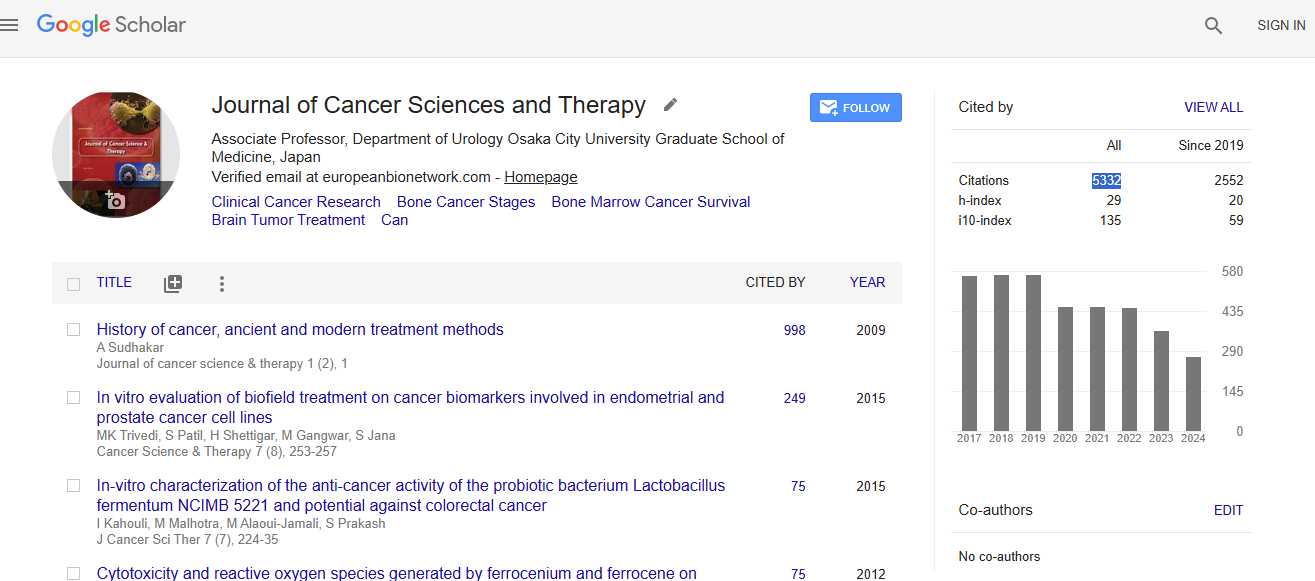
Cancer Science & Therapy received 5332 citations as per Google Scholar report