Commentary - (2025) Volume 11, Issue 5
Received: 01-Oct-2025, Manuscript No. abp-25-173913;
Editor assigned: 03-Oct-2025, Pre QC No. P-173913;
Reviewed: 17-Oct-2025, QC No. Q-173913;
Revised: 22-Oct-2025, Manuscript No. R-173913;
Published:
29-Oct-2025
, DOI: 10.37421/2472-0496.2025.11.348
Citation: Novak, Emily. ”Diverse Factors Shaping Quality of Life.” Abnorm Behav Psychol 11 (2025):348.
Copyright: © 2025 Novak E. This is an open-access article distributed under the terms of the Creative Commons Attribution License, which permits unrestricted use, distribution and reproduction in any medium, provided the original author and source are credited.
Quality of life (QOL) is a fundamental aspect of human well-being, encompassing an individual's physical health, psychological state, personal beliefs, social relationships, and their relationship to salient features of their environment. Understanding the diverse factors that impact QOL is crucial for developing effective public health strategies and personalized care. This collection of research highlights the broad spectrum of influences, from societal structures and environmental access to individual behaviors and technological advancements, all contributing to or detracting from an individual's overall sense of well-being. Social determinants of health (SDH) profoundly influence the quality of life for individuals dealing with chronic diseases. What this really means is that comprehensive interventions must go beyond just medical treatment. They need to address broader societal and economic factors to genuinely improve patient well-being[1].
Access to urban green spaces has a clear, positive correlation with improved health-related quality of life (HRQOL). Thoughtful urban planning, integrating more green areas, can play a significant role in boosting public well-being and overall health[2].
Lower socioeconomic status consistently correlates with poorer HRQOL for individuals with Type 2 Diabetes Mellitus. This points to clear health disparities and the urgent necessity for more equitable care delivery systems[5].
These findings collectively underscore how external conditions, from a person's financial standing to their immediate surroundings, are inextricable from their health outcomes and perceived quality of life. Mental health struggles among university students frequently affect their quality of life. This underscores the pressing need for dedicated and effective mental health support services within academic environments[4].
The emotional and psychological landscape is just as critical as the physical. Consistent physical activity demonstrably improves both mental health and overall quality of life in adults. This strongly suggests that regular movement is a foundational element for well-being and should be a core component of any health intervention[6].
Similarly, poor sleep quality is directly linked to a lower health-related quality of life. This really hammers home the fundamental importance of getting enough restorative sleep for your overall well-being and daily functioning[8].
These studies emphasize the direct, personal behaviors and internal states that significantly shape daily living. Technological and nutritional advancements also present powerful avenues for enhancing QOL, particularly for vulnerable populations. Digital health interventions offer a solid way to enhance the quality of life for older adults. They are particularly effective in fostering independent living and making healthcare more accessible, providing valuable support as people age[3].
Nutritional interventions are vitally important for boosting the quality of life in older adults, especially by tackling issues like sarcopenia and malnutrition. These efforts lead directly to better physical function and a greater sense of overall well-being[7].
Furthermore, assistive technologies notably improve the quality of life for individuals with disabilities. Here's the thing: these technologies foster greater independence and participation in social life, which ultimately leads to a better overall sense of well-being[9].
These demonstrate how targeted support systems and innovations can empower individuals. Finally, the internal resource of resilience plays a crucial role. There's a consistent link between higher resilience and a better quality of life among patients dealing with chronic diseases. This suggests that interventions aimed at building resilience can be a vital part of effective patient care, helping people cope and thrive[10].
What this all tells us is that improving QOL requires a holistic understanding, recognizing the interplay between an individual's environment, socioeconomic circumstances, mental and physical health, access to care, and personal coping mechanisms. Effective strategies must therefore integrate medical treatment with broader public health initiatives, social support, and individual empowerment to foster truly thriving lives.
The research compiled here paints a comprehensive picture of the many factors that shape an individual's quality of life (QOL). A major theme highlights how external, systemic elements profoundly influence well-being. For example, the social determinants of health (SDH) significantly impact the QOL for individuals managing chronic diseases, emphasizing the need for interventions beyond just medical treatment to address societal and economic factors [1]. Similarly, the presence of urban green spaces positively correlates with improved health-related QOL (HRQOL) [2], suggesting that thoughtful urban planning, which integrates more green areas, can be a vital public health strategy. Furthermore, a consistent link exists between lower socioeconomic status (SES) and poorer HRQOL, particularly observed in patients with Type 2 Diabetes Mellitus [5]. This points to clear health disparities and the urgent necessity for more equitable care delivery systems that recognize and mitigate socioeconomic disadvantages.
Individual behaviors and psychological states also play a pivotal role. University students, for instance, frequently encounter substantial mental health struggles that negatively affect their QOL [4]. This observation underscores the pressing need for dedicated and effective mental health support services within academic environments. On a broader scale, consistent physical activity demonstrably improves both mental health and overall QOL in adults [6]. This strongly suggests that regular movement is a foundational element for well-being and should be a core component of any health intervention. The importance of basic physiological needs extends to sleep; poor sleep quality is directly linked to a lower HRQOL [8]. What this really means is that getting enough restorative sleep is fundamentally important for overall well-being and daily functioning.
Targeted interventions, both digital and nutritional, are proving effective, especially for older adults. Digital health interventions offer a solid way to enhance the quality of life for this demographic, fostering independent living and making healthcare more accessible [3]. As individuals age, these technologies provide valuable support, bridging care gaps and enhancing autonomy. Concurrently, nutritional interventions are vitally important for boosting QOL in older adults, specifically by tackling issues like sarcopenia and malnutrition [7]. These efforts lead directly to better physical function and a greater sense of overall well-being, promoting healthier aging.
Beyond age-specific care, assistive technologies are making a substantial difference for individuals with disabilities. These technologies notably improve their quality of life by fostering greater independence and enabling fuller participation in social life [9]. This ultimately leads to a better overall sense of well-being and enhances their inclusion in society. The impact of such tools highlights how innovation can empower individuals and improve daily living.
Finally, internal coping mechanisms, particularly resilience, are crucial for those facing chronic health challenges. There's a consistent link between higher resilience and a better quality of life among patients dealing with chronic diseases [10]. This suggests that interventions aimed at building resilience can be a vital part of effective patient care. Empowering individuals to develop greater resilience can help them cope with the demands of their conditions, thrive despite challenges, and maintain a higher QOL. In summary, enhancing QOL requires a holistic understanding, integrating environmental, social, behavioral, technological, and psychological considerations for truly impactful care.
The provided data highlights diverse factors profoundly influencing the quality of life (QOL) across various populations. Social determinants of health (SDH) critically impact QOL for individuals with chronic diseases, emphasizing the need for broad societal and economic interventions beyond clinical care [1]. Environmental factors like access to urban green spaces are positively correlated with improved health-related QOL (HRQOL), suggesting urban planning plays a key role in public well-being [2]. Socioeconomic status (SES) also links directly to HRQOL, particularly for those with Type 2 Diabetes Mellitus, revealing significant health disparities [5]. Interventions spanning digital health and nutrition are shown to enhance QOL in older adults, promoting independent living, healthcare accessibility [3], and improved physical function by addressing malnutrition and sarcopenia [7]. For university students, mental health struggles significantly reduce QOL, underscoring the necessity for robust academic support services [4]. Physical activity stands out as a foundational element, demonstrably improving mental health and overall QOL in adults [6]. Conversely, poor sleep quality directly lowers HRQOL, stressing the importance of restorative sleep [8]. Furthermore, assistive technologies significantly improve QOL for individuals with disabilities by fostering greater independence and social participation [9]. Finally, building resilience is crucial for chronic disease patients, consistently linking to a better QOL and suggesting its vital role in patient care [10]. Collectively, these findings advocate for a holistic, integrated approach to enhancing well-being.
None
None
1. Mohammad S, Nahla H, Hoda E. "Social Determinants of Health and Their Impact on Quality of Life in Patients With Chronic Diseases: A Systematic Review".J Clin Med 12 (2023):5624.
Indexed at, Google Scholar, Crossref
2. Xinyi L, Qiang H, Xuyang C. "Green Spaces and Health-Related Quality of Life in Urban Areas: A Systematic Review and Meta-Analysis".Environ Res 236 (2023):116744.
Indexed at, Google Scholar, Crossref
3. Xiaomei L, Yiting M, Yunfan L. "The Impact of Digital Health Interventions on Quality of Life in Older Adults: A Systematic Review and Meta-Analysis".J Med Internet Res 26 (2024):e50389.
Indexed at, Google Scholar, Crossref
4. Ana MS, Laura MS, Karla PS. "Mental Health and Quality of Life in University Students: A Systematic Review and Meta-Analysis".Int J Environ Res Public Health 19 (2022):6451.
Indexed at, Google Scholar, Crossref
5. Yi L, Lijuan X, Tingting Z. "Socioeconomic Status and Health-Related Quality of Life in Patients with Type 2 Diabetes Mellitus: A Systematic Review and Meta-Analysis".Int J Environ Res Public Health 19 (2022):4794.
Indexed at, Google Scholar, Crossref
6. Yu-Hui H, Xin-Long T, Meng-Ting L. "Effects of Physical Activity on Quality of Life and Mental Health in Adults: A Systematic Review and Meta-Analysis".Front Psychol 14 (2023):1118182.
Indexed at, Google Scholar, Crossref
7. Yu-Chih L, Chia-Hsuan L, Hsiu-Fen F. "The Impact of Nutritional Interventions on Quality of Life in Older Adults: A Systematic Review and Meta-Analysis".Nutrients 15 (2023):3326.
Indexed at, Google Scholar, Crossref
8. Mengting C, Lu L, Jialin C. "Sleep Quality and Its Relationship with Health-Related Quality of Life: A Systematic Review and Meta-Analysis".J Clin Sleep Med 19 (2023):1787-1798.
Indexed at, Google Scholar, Crossref
9. Xiaoyan W, Yanling Z, Yue L. "The Impact of Assistive Technology on Quality of Life in Individuals with Disabilities: A Systematic Review and Meta-Analysis".J Rehabil Med 54 (2022):jrm00331.
Indexed at, Google Scholar, Crossref
10. Jing W, Qianqian L, Hongyu W. "The Relationship Between Resilience and Quality of Life in Chronic Disease Patients: A Systematic Review and Meta-Analysis".Qual Life Res 33 (2024):1-13.
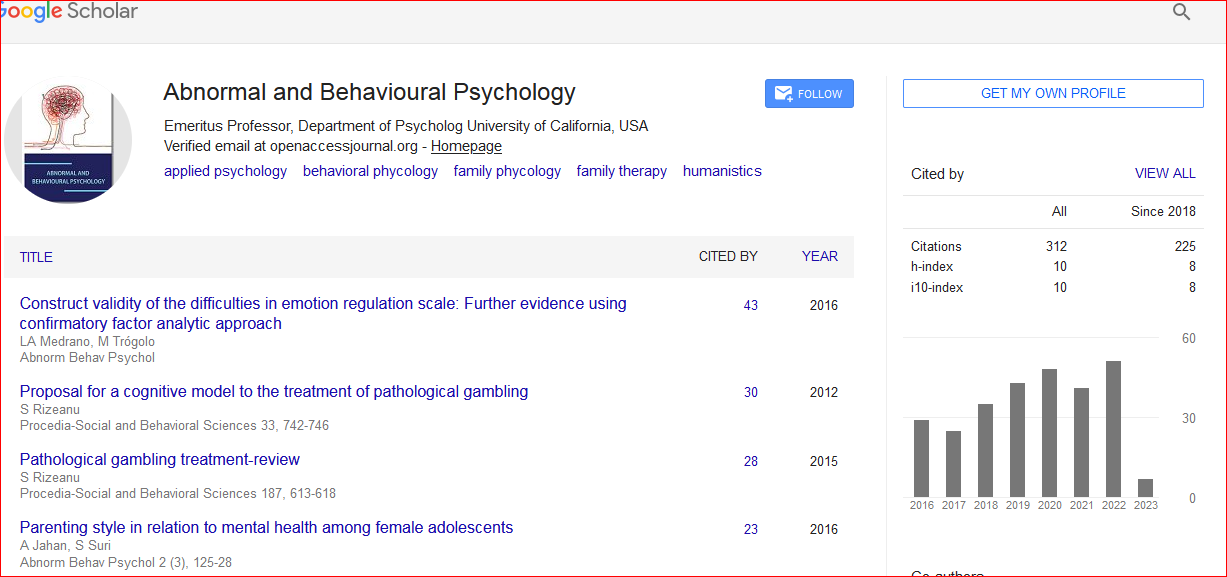
Abnormal and Behavioural Psychology received 361 citations as per Google Scholar report