Brief Report - (2025) Volume 16, Issue 5
Received: 01-Sep-2025, Manuscript No. assj-25-174787;
Editor assigned: 03-Sep-2025, Pre QC No. P-174787;
Reviewed: 17-Sep-2025, QC No. Q-174787;
Revised: 22-Sep-2025, Manuscript No. R-174787;
Published:
29-Sep-2025
, DOI: 10.37421/2151-6200.2025.16.681
Citation: Verri, Giacomo. "Dismantling Systemic Barriers for Health Equity." Arts Social Sci J 16 (2025):681
Copyright: © 2025 Verri G. This is an open-access article distributed under the terms of the Creative Commons Attribution License, which permits unrestricted use, distribution and reproduction in any medium, provided the original author and source are credited.
The integration of culturally responsive and social justice-oriented teaching methods within counseling education is a subject of critical examination, focusing on preparing future counselors with essential skills to confront systemic inequalities and champion the needs of diverse client populations, thereby fostering a transformative approach to professional practice [1].
A proposed social justice framework for public health ethics underscores the imperative to confront structural inequalities and power imbalances directly contributing to health disparities. This framework asserts that ethical public health practice necessitates an active commitment to promoting equity and human rights, shifting focus from individualistic solutions to comprehensive systemic interventions [2].
Within nursing ethics, a framework for applying social justice principles advocates for nurses to assume a more proactive role in achieving global health equity. This approach highlights the potential for nurses to critically challenge unjust health policies and practices, emphasizing collective action and solidarity as fundamental strategies to address the underlying social determinants of health [3].
Systematic reviews also demonstrate the integration of environmental justice and health equity frameworks into community-based participatory research (CBPR). This research illuminates the vital role of CBPR in empowering marginalized communities to address environmental health disparities effectively and advocate for policy changes that advance both social and environmental justice [4].
Further explorations delve into how social justice is woven into nursing education, identifying key themes and pedagogical approaches designed to prepare nurses for equitable practice. This often involves curricula that specifically address health disparities, champion vulnerable populations, and cultivate structural competency within the broader nursing profession [5].
Another critical area involves the implementation of a social justice framework within child and adolescent mental health services. This perspective critiques conventional approaches that frequently overlook systemic inequalities, proposing concrete strategies for service providers to address the root causes of mental health disparities and deliver more equitable and culturally responsive care for young individuals [6].
A social justice framework is likewise proposed to guide medical research, aiming to ensure that the benefits and burdens of scientific inquiry are distributed equitably, especially among vulnerable populations. This framework posits that research ethics must extend beyond mere individual consent to confront systemic injustices, promoting research outcomes that actively reduce health disparities and contribute to the common good [7].
Similar considerations extend to promoting mental health in schools, where a social justice framework is advocated to transcend individual resilience and address broader systemic factors impacting student well-being. This calls for school-based interventions that actively tackle inequalities, foster equity, and empower students and their communities to challenge entrenched structural injustices [8].
Moreover, a direct call to action for nurses emphasizes their role in championing social justice as an ethical imperative within the profession. It outlines various strategies for nurses to advocate robustly for vulnerable populations, challenge pervasive systemic inequities, and seamlessly integrate social justice principles across all facets of nursing practice, spanning from education to policy formulation [9].
Finally, a conceptual framework is developed to advance environmental justice within public health practice, bringing to light the disproportionate environmental burdens borne by marginalized communities. This framework outlines practical strategies for public health professionals to identify, assess, and mitigate environmental injustices, while advocating for policies that guarantee the equitable distribution of environmental benefits and protections [10].
The body of work consistently emphasizes the critical role of social justice frameworks in reimagining and transforming various health and human service sectors. A significant focus across these discussions is the imperative to move beyond individualistic interpretations of health and well-being, instead concentrating on the systemic inequalities and power imbalances that are root causes of disparities. For instance, in counseling education, there is a clear push to integrate culturally responsive and social justice-oriented pedagogies. This ensures that future counselors are not only skilled clinicians but also equipped to address profound systemic inequalities and become active advocates for diverse client populations, fostering a truly transformative approach to practice [1]. This proactive stance is mirrored in the field of public health, where a dedicated social justice framework is proposed for public health ethics. This framework critically highlights the necessity of confronting structural inequalities and power imbalances directly responsible for health disparities, arguing that ethical public health practice must vigorously champion equity and human rights by tackling systemic injustices rather than merely individual issues [2].
Nursing, as a profession, is repeatedly called to action to embrace and advance social justice principles. One paper proposes a clear framework for applying these principles within nursing ethics, urging nurses to take a more dynamic role in achieving global health equity. It underscores how nurses possess a unique position to challenge unjust health policies and practices, emphasizing the power of collective action and solidarity in addressing the broad social determinants of health [3]. This ethos is further reinforced by a scoping review that explores the integration of social justice into nursing education. This review identifies crucial themes and pedagogical strategies aimed at preparing nurses for equitable practice, stressing the need for curricula that directly confront health disparities, advocate for vulnerable populations, and instill structural competency within the profession [5]. Moreover, a specific call to action for nurses frames social justice as an ethical imperative, outlining strategies for robust advocacy for vulnerable populations, challenging systemic inequities, and embedding social justice principles into every aspect of nursing practice, from educational foundations to policy influence [9].
The intersection of environmental justice and health equity also receives significant attention, particularly within the context of community-based participatory research (CBPR). A systematic review highlights the crucial role of CBPR in empowering marginalized communities. These communities are often disproportionately affected by environmental burdens, and CBPR helps them to identify, understand, and effectively address environmental health disparities. This participative approach also strengthens their capacity to advocate for policy changes that promote both social and environmental justice [4]. Building on this, a conceptual framework is developed specifically to advance environmental justice within public health practice. This framework systematically identifies and addresses the disproportionate environmental burdens faced by marginalized communities, offering actionable strategies for public health professionals to assess and mitigate these injustices, while simultaneously advocating for policies that ensure a fair distribution of environmental benefits and protections across all communities [10].
Beyond broad public health and environmental concerns, the principles of social justice are being tailored for more specialized health domains, such as mental health and medical research. For child and adolescent mental health services, a social justice framework is advocated to critique existing approaches that often fail to recognize systemic inequalities. This framework proposes strategies for service providers to address the underlying causes of mental health disparities, ensuring that young people receive care that is not only equitable but also culturally responsive [6]. Similarly, a social justice framework is put forth to guide medical research. The aim here is to guarantee that the benefits and burdens of research are distributed equitably, with particular attention to vulnerable populations. This perspective argues that research ethics must go beyond individual consent to tackle systemic injustices, thereby promoting research that actively reduces health disparities and serves the broader common good [7]. Furthermore, applying a social justice lens to mental health promotion in schools moves beyond individual resilience, recognizing and addressing the systemic factors that influence student well-being. This approach advocates for school-based interventions that directly combat inequalities, foster equity, and empower students and their communities to challenge structural injustices impacting their overall mental health [8].
Overall, these diverse articles converge on a shared understanding: achieving genuine health equity and social justice requires a fundamental reorientation of professional practice, education, and research towards identifying and dismantling the systemic barriers that perpetuate disadvantage. This involves not only understanding the problem but actively engaging in advocacy, policy change, and community empowerment.
This collection of research highlights a critical and growing emphasis on integrating social justice and equity principles across various professional and academic fields related to health and human services. A recurrent theme is the necessity to move beyond individual-focused interventions, instead centering on systemic inequalities and power imbalances that perpetuate health disparities. For instance, counseling education is urged to adopt culturally responsive and social justice-oriented pedagogies, equipping future counselors to advocate for diverse client populations and drive transformative practice [1]. Similarly, frameworks are proposed for public health ethics and medical research, advocating for an active promotion of equity and human rights by addressing structural injustices and ensuring equitable distribution of research benefits and burdens [2, 7]. In nursing, there's a strong call to action for professionals to champion social justice, integrate these principles into education and practice, and actively challenge unjust health policies to achieve global health equity [3, 5, 9]. Environmental justice emerges as another crucial area, with research examining how it integrates into community-based participatory research to empower marginalized communities in tackling environmental health disparities and advocating for policy change [4, 10]. Mental health services, both for child and adolescent populations and within school settings, are also targeted for social justice frameworks. These frameworks aim to address the root causes of mental health disparities, ensuring culturally responsive care and empowering individuals and communities to challenge structural injustices impacting well-being [6, 8]. Overall, the data illustrates a unified push for ethical practices that actively dismantle systemic barriers, promote inclusivity, and empower vulnerable populations across the healthcare spectrum.
None
None
Indexed at, Google Scholar, Crossref
Indexed at, Google Scholar, Crossref
Indexed at, Google Scholar, Crossref
Indexed at, Google Scholar, Crossref
Indexed at, Google Scholar, Crossref
Indexed at, Google Scholar, Crossref
Indexed at, Google Scholar, Crossref
Indexed at, Google Scholar, Crossref
Indexed at, Google Scholar, Crossref
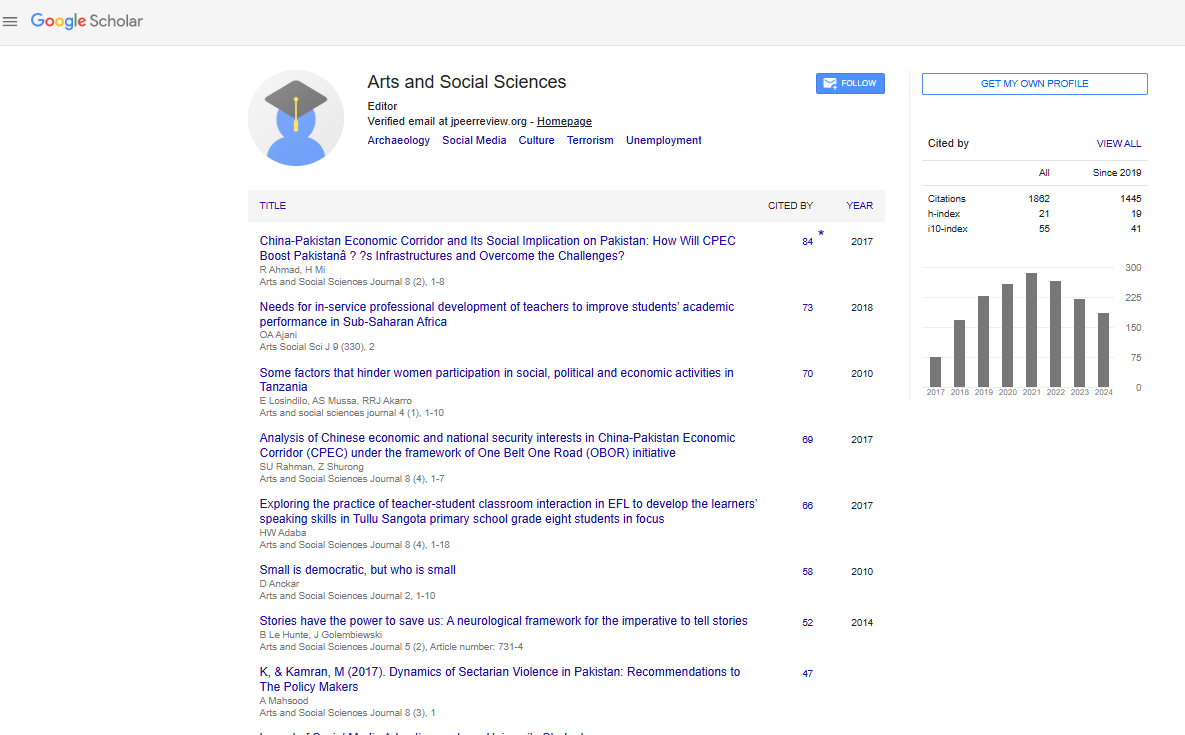
Arts and Social Sciences Journal received 1413 citations as per Google Scholar report