Perspective - (2025) Volume 16, Issue 6
Received: 01-Nov-2025, Manuscript No. assj-25-174912;
Editor assigned: 03-Nov-2025, Pre QC No. P-174912;
Reviewed: 17-Nov-2025, QC No. Q-174912;
Revised: 24-Nov-2025, Manuscript No. R-174912;
Published:
01-Dec-2025
, DOI: 10.37421/2151-6200.2025.16.700
Citation: Njenga, Amara. "Digital Youth: Opportunities, Risks, Well-being." Arts Social Sci J 16 (2025):700
Copyright: © 2025 Njenga A. This is an open-access article distributed under the terms of the Creative Commons Attribution License, which permits unrestricted use, distribution and reproduction in any medium, provided the original author and source are credited
The digital age profoundly shapes the experiences of young people, creating complex dynamics that influence various aspects of their development, from personal identity to civic engagement. One key area of inquiry involves how digital youth cultures influence identity formation and mental well-being in young people. Online spaces offer robust avenues for self-expression and fostering a sense of community. However, these very spaces also pose significant challenges, including the prevalence of cyberbullying and intense pressure to conform to online norms, underscoring the complex interplay between digital engagement and psychological health [1].
Furthermore, online gaming communities play a substantial role in adolescent identity formation. These virtual environments allow young individuals to experiment with diverse personas, refine their social skills, and discover a sense of belonging. This highlights the significant and often underestimated role that virtual worlds now play in the processes of self-discovery and essential peer interaction among adolescents [2].
Social media's impact extends into the realm of youth political participation and civic engagement. In this digital era, platforms empower young people to effectively voice their opinions and mobilize support for various social and political causes. Nevertheless, it is crucial to acknowledge the persistent challenges posed by misinformation and the formation of echo chambers, which undeniably shape the evolving nature of youth activism [3].
Digital media also exerts a significant influence on youth health-related cultural practices. While these platforms can be instrumental in promoting health awareness and creating vital support networks, they simultaneously expose young people to harmful content and undue pressures. This dual effect clearly underscores the critical need for developing balanced and thoughtful digital engagement strategies for adolescents [4].
Investigating the connection between digital literacy and adolescent mental well-being reveals the mediating role of online social support. The findings suggest that digital literacy can indeed enhance well-being by providing access to valuable support networks. However, its overall impact remains complex and largely dependent on an individual's ability to effectively navigate the intricacies of online interactions [5].
The intricate process of youth identity construction on social media platforms is a central theme. Young people actively engage in curating their digital selves, skillfully navigating both abundant opportunities for authentic self-expression and persistent pressures to conform to idealized images. This demonstrates the increasingly crucial role that social media plays in contemporary identity formation [6].
Examining the landscape of youth online political participation and civic engagement through systematic review reveals how digital platforms have become indispensable for young people to articulate political views, mobilize for social causes, and actively engage in civic discourse. Yet, this progress is tempered by ongoing challenges, such as digital divides and the pervasive spread of misinformation [7].
A broad review summarizing current research on digital cultures and youth well-being meticulously maps out areas where digital engagement positively impacts young people's lives through enhanced connection and learning. Conversely, it also identifies where digital engagement presents clear risks to mental health, calling for a more nuanced understanding and targeted intervention strategies [8].
The influence of digital peers on adolescent risk behaviors is another critical area. A systematic review shows that online peer networks possess the capacity to both promote and deter risky behaviors, highlighting the complex dynamics of digital social influence. This emphasizes the need for interventions that carefully consider the unique online context of youth interactions [9].
Finally, a scoping review explores the distinct benefits and risks of online communities for youth mental health. These platforms can offer vital social support and foster a strong sense of belonging, but they also expose young people to cyberbullying and negative social comparison. This duality undeniably emphasizes the complex and often contradictory nature of digital peer interactions [10].
In essence, the collective body of work presented here underscores the profound and intricate ways digital environments shape the lives of young people today. These studies illuminate a landscape where digital tools offer significant avenues for growth and connection, alongside presenting notable challenges to mental well-being and social development. A comprehensive understanding of these dynamics is paramount for guiding effective strategies that support healthy adolescent transitions into adulthood.
The digital landscape offers a complex and ever-evolving terrain for youth, particularly concerning identity formation and their overall mental well-being. For instance, digital youth cultures provide significant avenues for crucial self-expression and fostering a sense of community, allowing young individuals to explore and solidify their identities. However, these very online spaces also present dual and often formidable challenges, including the prevalence of cyberbullying and intense societal pressures to conform to idealized online images. This undeniably creates an intricate link between digital engagement and the psychological health of young people [1]. This dynamic is further observed with remarkable clarity in online gaming communities, which serve as crucial spaces for adolescents to experiment with different personas, develop vital social skills, and establish a profound sense of belonging. This phenomenon powerfully affirms the significant and often underappreciated role virtual worlds now play in the processes of self-discovery and essential peer interaction [2]. The construction of identity on social media platforms is similarly nuanced and multifaceted; young people actively engage in curating their digital selves, skillfully navigating both abundant opportunities for authentic self-expression and persistent pressures to fit within specific online molds, thereby underscoring social media's central and indispensable role in modern identity formation [6].
Regarding the crucial aspect of mental well-being, the mediating role of digital literacy and online social support is increasingly evident and critically important. Digital literacy can notably enhance adolescent well-being by facilitating informed access to supportive online networks, providing a buffer against some negative experiences. However, its overall impact remains inherently complex and largely contingent upon an individual's ability to skillfully and effectively navigate the often-perilous intricacies of online interactions [5]. Concurrently, online communities themselves present a clear duality for youth mental health. While they undeniably offer vital social support and foster a strong sense of belonging among peers, they simultaneously expose young individuals to significant risks such as pervasive cyberbullying and detrimental negative social comparison. This highlights the inherently dual and often contradictory nature of digital peer interactions [10]. General reviews of this field also consistently confirm that digital engagement offers both tangible positive impacts through enhanced connection and enriched learning experiences, alongside considerable risks to mental health, thus necessitating the development of more nuanced understanding and targeted intervention strategies [8].
Beyond personal development and psychological health, digital platforms have fundamentally and irreversibly reshaped the landscape of youth political participation and broader civic engagement. Social media, in particular, empowers young people to articulate their opinions with unprecedented reach and to effectively mobilize for various social and political causes, fostering a new wave of activism. Yet, this significant empowerment occurs even as substantial challenges like the rapid spread of misinformation and the formation of insular echo chambers persist, deeply influencing public discourse and indicating an evolving, sometimes fraught, landscape for youth activism [3]. This observed pattern is consistently corroborated by systematic reviews, which robustly demonstrate how digital platforms are not just useful but crucial for young people to express their political views, effectively mobilize for social causes, and actively engage in civic discourse. However, this promising landscape is also demonstrably fraught with persistent challenges such as digital divides, which limit access, and the pervasive spread of misinformation, which can distort understanding and influence, thereby affecting the quality and equity of online engagement [7].
The profound influence of digital media extends significantly to health-related cultural practices among youth, affecting their understanding and approach to well-being. While digital platforms are often effective in promoting crucial health awareness and establishing supportive networks for health-related issues, they regrettably also expose young people to harmful content, such as pro-anorexia sites, and unhealthy pressures, like body image ideals. This stark reality points to a critical and urgent need for balanced digital engagement strategies that are specifically designed to protect adolescents from adverse influences while still harnessing the positive aspects of technology [4]. Moreover, the role of digital peer influence has a profound and measurable effect on adolescent risk behaviors. Systematic reviews in this area reveal that online peer networks possess the distinct capacity to both encourage and deter risky actions, demonstrating the complex dynamics of digital social influence. This underscores the pressing need for interventions that are meticulously designed with the unique online context of youth interactions in mind, recognizing the powerful, often subtle, ways peers influence each other digitally [9].
Overall, the collective body of work presented here consistently illustrates that the digital realm is not a monolithic entity but rather a dynamic and highly influential space offering both immense potential and significant pitfalls for young people. It is a complex environment where identity is forged and reshaped, where social connections are made and sustained, where political voices are amplified, and where health practices are profoundly influenced. All these critical developmental processes unfold within a digital ecosystem that inherently demands careful navigation, robust digital literacy, and thoughtfully constructed support systems from parents, educators, and policymakers alike. Understanding these intricacies is paramount for fostering resilient and healthy youth in the modern world.
Digital youth cultures exert a profound and multifaceted influence on young people's lives. Online spaces serve as crucial arenas for identity formation, offering avenues for self-expression and community building, as seen in digital youth cultures and online gaming communities. However, these environments are not without challenges, often exposing youth to cyberbullying, pressure to conform, and negative social comparisons, which significantly impact their mental well-being. The role of online social support is complex; while digital literacy can enhance well-being through access to support networks, its effectiveness depends on navigating online interactions carefully. Beyond personal development, digital platforms also shape youth political participation and civic engagement, empowering young people to voice opinions and mobilize for causes. Yet, concerns about misinformation, echo chambers, and digital divides persist. The influence of digital peers extends to risk behaviors, where online networks can both promote and deter risky actions. Overall, digital media deeply influences health-related cultural practices, offering both awareness and support, but also exposing youth to harmful content. A balanced understanding of both the opportunities and risks is essential for fostering positive youth development in the digital age.
None
None
Indexed at, Google Scholar, Crossref
Indexed at, Google Scholar, Crossref
Indexed at, Google Scholar, Crossref
Indexed at, Google Scholar, Crossref
Indexed at, Google Scholar, Crossref
Indexed at, Google Scholar, Crossref
Indexed at, Google Scholar, Crossref
Indexed at, Google Scholar, Crossref
Indexed at, Google Scholar, Crossref
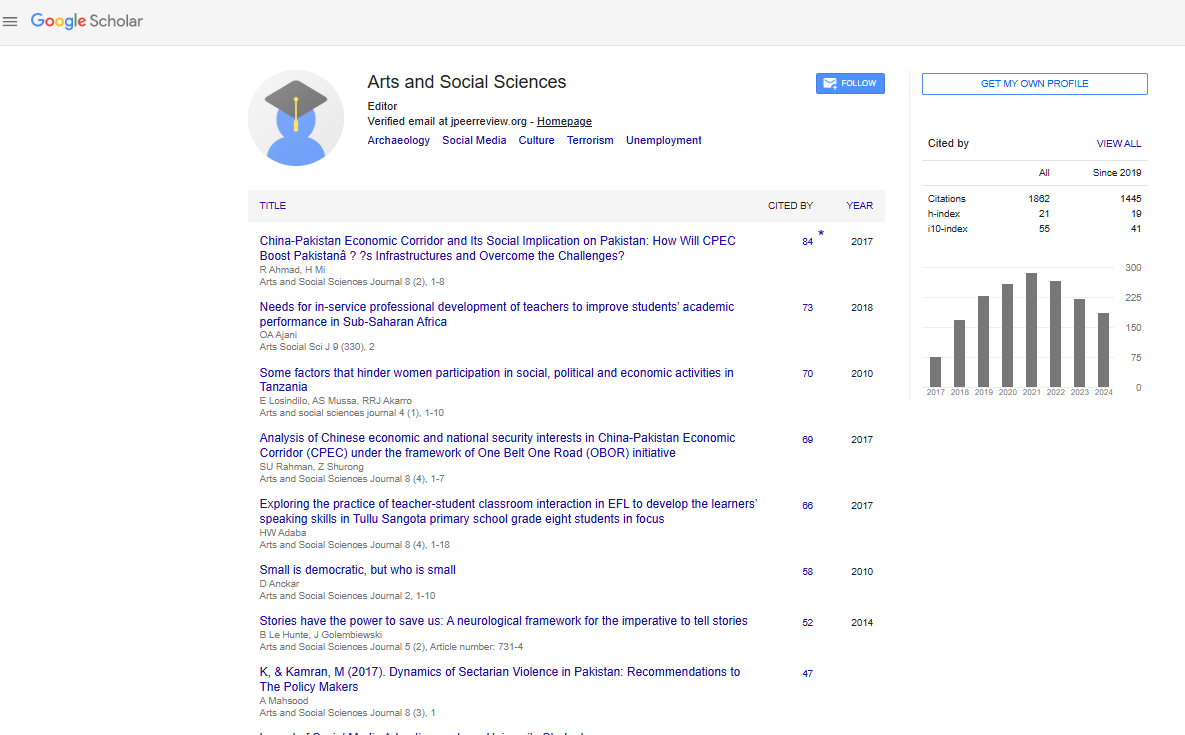
Arts and Social Sciences Journal received 1413 citations as per Google Scholar report