Brief Report - (2025) Volume 16, Issue 4
Received: 31-Jul-2025, Manuscript No. gjto-25-176000;
Editor assigned: 04-Aug-2025, Pre QC No. P-176000;
Reviewed: 14-Aug-2025, QC No. QC-176000;
Revised: 21-Aug-2025, Manuscript No. R-176000;
Published:
28-Aug-2025
, DOI: 10.37421/2229-8711.2025.16.454
Citation: Collins, Harriet. ”Digital Twins: Optimizing Industries, Predicting Futures.” Global J Technol Optim 16 (2025):454.
Copyright: © 2025 Collins H. This is an open-access article distributed under the terms of the Creative Commons Attribution License, which permits unrestricted use,
distribution and reproduction in any medium, provided the original author and source are credited.
Digital Twin technology reshapes industries by creating virtual representations of physical assets, processes, and systems. These virtual twins, synchronized with real-world counterparts, enable real-time monitoring, predictive maintenance, and simulation of future scenarios. This optimizes performance, detects issues before they arise, and drives innovation across sectors like manufacturing, healthcare, and smart cities. Adopting this technology requires infrastructure for data collection and integration, plus advanced analytical capabilities for decision-making and operational efficiency[1]. The application of Digital Twin technology in healthcare promises personalized medicine. Creating a virtual replica of an individual's health status, including physiological data, medical history, and genetic information, allows healthcare providers to monitor patients remotely, predict disease progression, and tailor treatment plans with precision. This facilitates proactive interventions, optimized drug dosages, and patient-specific risk assessments, ultimately enhancing outcomes and revolutionizing chronic disease management towards a preventative model of care[2].
Digital Twins are pivotal for smart cities, offering a dynamic, data-driven platform to manage urban infrastructure and services. These virtual city models integrate real-time data from sensors, IoT devices, and urban systems to simulate traffic, monitor energy, and plan development. The technology allows city planners to test scenarios, predict policy impacts, and optimize resource allocation, leading to efficient, sustainable, and resilient urban environments. It helps decision-makers see the city as a living entity[3]. In construction, Digital Twins transform project management and asset lifecycle. Integrating Building Information Modeling (BIM) with real-time operational data creates a living, evolving virtual model of a structure. This allows stakeholders to monitor progress, anticipate maintenance, and simulate operational performance throughout the building's lifespan. It means better collaboration, reduced errors, and informed decisions from design to demolition, making projects efficient and sustainable[4].
Digital Twins are essential for managing complex power systems and grids. These virtual replicas help engineers monitor grid performance, predict failures, and optimize energy distribution in real-time. By simulating different operating conditions, Digital Twins enable efficient integration of renewable energy, enhance grid resilience, and facilitate smarter energy management. It underpins the future of reliable and sustainable energy infrastructure[5]. Precision agriculture benefits significantly from Digital Twin technology. Farmers create virtual models of fields, crops, and livestock, integrating data from sensors, drones, and weather stations. This real-time synchronization allows precise monitoring of soil, crop health, and animal welfare. Insights from these Digital Twins enable optimized irrigation, fertilization, pest control, and livestock management, leading to increased yields, reduced waste, and sustainable farming. It is about making agricultural decisions with greater accuracy[6].
Digital Twins revolutionize supply chain management, providing end-to-end visibility and real-time operational insights. A virtual representation of the entire supply chain, from raw materials to customer delivery, allows companies to monitor inventory, track shipments, and simulate disruptions. This optimizes logistics, identifies bottlenecks, and builds resilient supply chains that adapt to changing market conditions or unforeseen events. It’s about creating a transparent and agile network[7]. In aerospace, Digital Twins are critical for aircraft and spacecraft design, manufacturing, and maintenance. High-fidelity virtual models of components and systems allow engineers to test designs, predict performance under extreme conditions, and monitor structural integrity in real-time. This reduces development costs, accelerates certification, and enables predictive maintenance for longer operational lifespans and enhanced safety. It provides insight and control traditional methods cannot match[8].
Digital Twins transform maintenance strategies from reactive to predictive across industrial settings. By creating a virtual model of a machine or system, updated with real-time operational and historical data, organizations accurately predict equipment failures. This enables technicians to perform maintenance exactly when needed, minimizing downtime, extending asset lifespans, and significantly reducing operational costs. It shifts the focus from fixing problems to preventing them[9]. Digital Twins are emerging as a powerful tool in smart education, offering immersive and interactive learning experiences. Virtual replicas of laboratories or complex machinery allow students to engage with subject matter in a hands-on, risk-free environment. This technology facilitates practical training, fosters problem-solving skills, and allows for personalized learning paths, bridging theoretical knowledge and practical application. It brings abstract concepts to life in a tangible way for learners[10].
Digital Twin technology is fundamentally changing how industries operate, building virtual representations of physical assets, processes, and systems. These virtual twins maintain constant synchronization with their real-world counterparts, enabling continuous monitoring, predictive maintenance, and the simulation of future scenarios. This capability significantly optimizes performance, helps identify potential issues proactively, and fosters innovation across diverse sectors, from manufacturing to healthcare and smart cities. Harnessing its benefits for decision-making and operational efficiency demands strong infrastructure for data collection and integration, alongside sophisticated analytical tools[1].
In healthcare, Digital Twin technology promises personalized medicine. Creating a virtual replica of an individual's health status, encompassing physiological data, medical history, and genetic information, allows providers to remotely monitor patients, predict disease progression, and precisely tailor treatment plans. This facilitates proactive interventions, optimized drug dosages, and patient-specific risk assessments, ultimately enhancing outcomes and transforming chronic disease management towards a preventative and predictive model of care[2]. Similarly, for smart cities, Digital Twins provide a dynamic, data-driven platform crucial for managing urban infrastructure and services. These virtual city models integrate real-time data from various urban systems, like sensors and IoT devices, to simulate traffic, monitor energy consumption, and inform urban development. City planners can test scenarios, anticipate policy impacts, and optimize resource allocation, leading to efficient, sustainable, and resilient urban environments[3].
The construction industry is experiencing a transformation through Digital Twins in project management and asset lifecycle. By merging Building Information Modeling (BIM) with real-time operational data, construction Digital Twins create a living, evolving virtual model of a structure. This allows stakeholders to monitor progress, anticipate maintenance needs, and simulate operational performance throughout a building's lifespan, improving collaboration, reducing errors, and leading to more informed, efficient, and sustainable projects from design to demolition[4]. Concurrently, Digital Twins are becoming indispensable for managing complex power systems and grids. These virtual replicas empower engineers to monitor grid performance in real-time, predict potential failures, and optimize energy distribution. By simulating various operating conditions, Digital Twins support the efficient integration of renewable energy sources, enhance grid resilience against disturbances, and facilitate smarter energy management decisions, laying the groundwork for a reliable and sustainable energy infrastructure[5].
Precision agriculture gains significant advantages from Digital Twin technology. Farmers can build virtual models of their fields, crops, and livestock, integrating data from sensors, drones, and weather stations. This real-time synchronization allows for precise monitoring of soil conditions, crop health, and animal welfare. The insights from these Digital Twins lead to optimized irrigation, fertilization, pest control, and livestock management, resulting in increased yields, reduced resource waste, and more sustainable farming practices[6]. Moreover, Digital Twins are revolutionizing supply chain management by providing comprehensive visibility and real-time operational insights. A virtual representation of the entire supply chain, from raw materials to customer delivery, enables companies to track shipments, monitor inventory levels, and simulate disruptions. This capability helps optimize logistics, identify bottlenecks, and build resilient supply chains that can quickly adapt to market changes or unforeseen events, creating a transparent and agile network[7].
In the aerospace industry, Digital Twins are vital for the design, manufacturing, and maintenance of aircraft and spacecraft. High-fidelity virtual models of components and entire systems allow engineers to rigorously test designs, predict performance under extreme conditions, and monitor structural integrity in real-time. This reduces development costs, speeds up certification, and enables predictive maintenance for extended operational lifespans and enhanced safety[8]. Beyond aerospace, Digital Twins are transforming maintenance strategies across various industrial settings, shifting from reactive to predictive models. By creating a virtual model of a machine or system, updated with real-time operational and historical data, organizations accurately predict equipment failures. This allows for just-in-time maintenance, minimizing downtime, extending asset lifespans, and significantly reducing operational costs by focusing on prevention[9]. Finally, Digital Twins are emerging as a powerful tool in smart education, offering immersive and interactive learning experiences. Virtual replicas of laboratories or complex machinery allow students to engage with subject matter hands-on in a risk-free environment. This technology facilitates practical training, develops problem-solving skills, and supports personalized learning paths, effectively bridging the gap between theoretical knowledge and practical application[10].
Digital Twin technology transforms industries by creating virtual replicas of physical assets, processes, and systems. These virtual twins sync with their real-world counterparts, allowing for real-time monitoring, predictive maintenance, and future scenario simulations. This capability helps optimize performance, foresee issues, and drive innovation across many sectors. For example, in manufacturing, it improves operations, while in healthcare, it enables personalized medicine through virtual health replicas. Smart cities use Digital Twins for managing urban infrastructure, simulating traffic, and optimizing resource allocation. The construction industry benefits from integrating Building Information Modeling (BIM) with real-time data to create living models of structures, improving project management. Power systems leverage them for monitoring grid performance, predicting failures, and optimizing energy distribution, especially with renewable sources. Precision agriculture utilizes virtual models of fields, crops, and livestock for optimized resource use and increased yields. Supply chain management gains end-to-end visibility and resilience against disruptions. In aerospace, Digital Twins are crucial for design, manufacturing, and maintenance, reducing costs and enhancing safety. They also shift maintenance strategies from reactive to predictive in industrial settings, minimizing downtime. Even smart education benefits from immersive learning experiences through virtual laboratories. Implementing this technology needs robust data infrastructure and advanced analytics for effective decision-making.
None
None
Gang T, Guangxin L, Tao H. "Digital Twin: A review of the technology, applications, and challenges".J. Intell. Manuf. 35 (2024):2043-2078.
Indexed at, Google Scholar, Crossref
Vikas KS, Kuldeep RS, Sanjay MS. "Digital Twin for Personalized Healthcare: A Review".J. Med. Syst. 47 (2023):52.
Indexed at, Google Scholar, Crossref
Peng H, Jing L, Yuan L. "Digital Twin for Smart City: A Comprehensive Review".IEEE Trans. Ind. Inform. 18 (2022):104-114.
Indexed at, Google Scholar, Crossref
Zheng Z, Yaoxing M, Shaowei W. "Digital Twin in construction: A critical review of current applications and future directions".Autom. Constr. 147 (2023):104721.
Indexed at, Google Scholar, Crossref
Ziwen W, Zhaohong W, Zhongkai L. "Digital Twin for Future Power Systems: A Comprehensive Survey".IEEE Trans. Smart Grid 13 (2022):749-762.
Indexed at, Google Scholar, Crossref
Zhaoli Y, Mingfeng W, Ji T. "Digital Twin in smart agriculture: A review of current research and future directions".Comput. Electron. Agric. 210 (2023):107777.
Indexed at, Google Scholar, Crossref
Hongjie W, Jiaojiao L, Yanping L. "Digital Twin in Supply Chain Management: A Systematic Review".Int. J. Prod. Res. 61 (2023):3617-3639.
Indexed at, Google Scholar, Crossref
Hongliang F, Yaqi F, Jian L. "Digital Twin in Aerospace: A Review on Concepts, Technologies, and Applications".Aerosp. Sci. Technol. 120 (2022):107298.
Indexed at, Google Scholar, Crossref
Ke S, Jianyun W, Xianfei L. "Digital Twin for Predictive Maintenance: A Comprehensive Review".J. Manuf. Syst. 66 (2023):1-13.
Indexed at, Google Scholar, Crossref
Xiaoli L, Yan Z, Qingli M. "Digital twin for smart education: A comprehensive review of emerging technologies, applications, and challenges".J. Intell. Fuzzy Syst. 46 (2024):2841-2856.
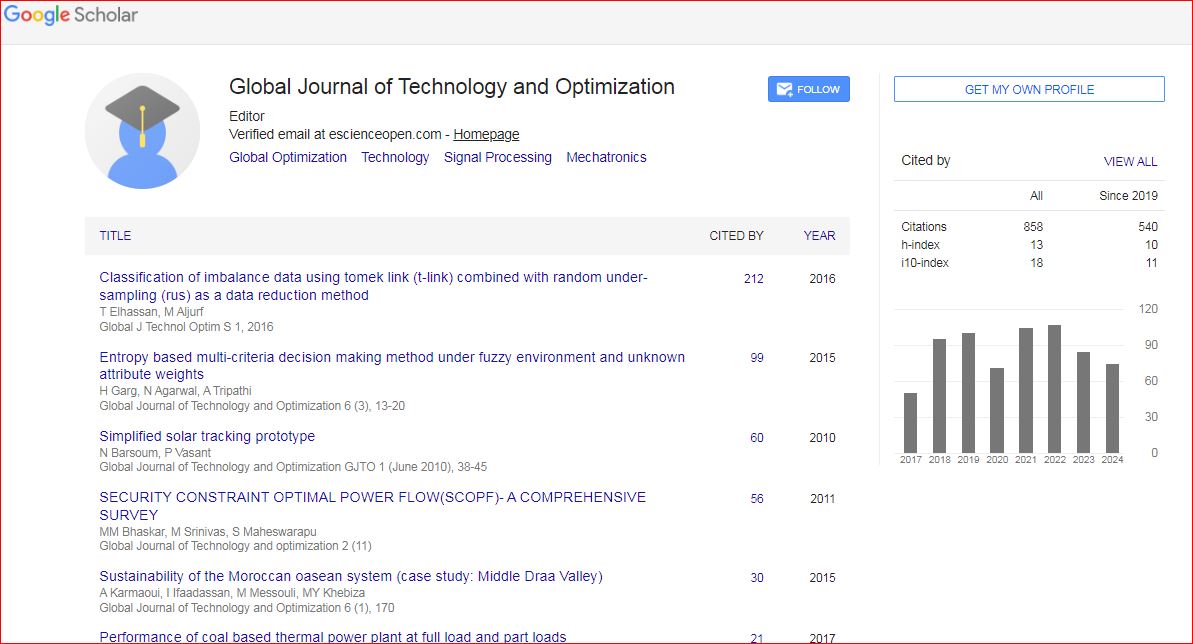
Global Journal of Technology and Optimization received 847 citations as per Google Scholar report