Perspective - (2025) Volume 15, Issue 6
Received: 27-Nov-2025, Manuscript No. jmcj-25-176935;
Editor assigned: 01-Dec-2025, Pre QC No. P-176935;
Reviewed: 15-Dec-2025, QC No. Q-176935;
Revised: 22-Dec-2025, Manuscript No. R-176935;
Published:
29-Dec-2025
, DOI: 10.37421/2165-7912.2025.15.657
Citation: Eriksson, Sofia P. Digital Transnational Journalism: Evolution, Ethics, Impact. J Mass Communicat Journalism 15(2025):657.
Copyright: © 2025 Eriksson P. Sofia This is an open-access article distributed under the terms of the Creative Commons Attribution License, which permits unrestricted use, distribution and reproduction in any medium, provided the original author and source are credited.
This body of research deeply explores the dynamic field of transnational journalism, detailing its evolution and impact in an interconnected world. The articles collectively illuminate how digital platforms are reshaping global reporting, creating new networked publics and presenting journalists with unique opportunities and significant challenges in engaging audiences across borders. One article extensively explores how transnational journalism is evolving with digital platforms, specifically focusing on how these technologies foster new networked publics. It scrutinizes the opportunities and challenges journalists encounter when engaging audiences internationally, particularly emphasizing the ethical dilemmas arising from this expanded reach and the crucial need to navigate diverse cultural and political contexts [1].
Another key contribution argues for a decolonized approach within transnational journalism studies, advocating for a move beyond traditional Eurocentric viewpoints. It critically examines how news flows are perceived and enacted from the Global South, highlighting the distinct challenges and invaluable contributions of Southern journalists in cultivating a more equitable global media landscape [2].
Further research offers a comparative analysis of transnational journalism cultures within Europe. This study specifically investigates how journalists in various European nations mediate the 'global-local nexus', uncovering differing perceptions of their roles in reporting international issues while maintaining relevance for local audiences. It underscores the intricate interplay between national journalistic traditions and broader transnational influences [3].
The emergence and impact of transnational investigative journalism are also thoroughly investigated. This work emphasizes the growing importance of collaborative networks among journalists across national boundaries. It details how these networks enhance accountability by enabling more effective scrutiny of complex global issues, despite the inherent difficulties of cross-cultural cooperation [4].
A comparative study meticulously analyzes how transnational journalism addresses the reporting of humanitarian crises. It delves into the varied practices and ethical considerations employed by journalists operating across different national contexts to cover global humanitarian challenges, examining the profound impact of these practices on public understanding and engagement [5].
The transformative influence of the digital age on transnational journalism is also a central theme. One article identifies both the vast opportunities for global reporting, such as increased reach and innovative collaborative tools, and the substantial challenges, including the spread of misinformation, the evolution of funding models, and the ongoing effort to maintain journalistic integrity within a rapidly changing media ecosystem [6].
Research also explores how transnational journalism affects local audiences' comprehension of global issues. It demonstrates that by skillfully connecting global narratives with specific local contexts, this form of journalism can significantly mold public perceptions, framing intricate international events in ways that resonate with domestic concerns and foster a valuable sense of shared experience [7].
A comparative perspective is also offered on the critical aspects of accountability and ethics in transnational journalism. This paper examines the distinct ethical challenges confronting journalists operating across varied legal and cultural frameworks, and it discusses how diverse accountability mechanisms are adapted or developed to ensure responsible and credible reporting on global matters [8].
Another article conducts a comprehensive comparative analysis of the professional identity of journalists working within a transnational context. It pinpoints how global news flows and cross-border collaborations distinctly shape journalists' self-perception, their defined roles, and their core professional values, revealing both convergences and divergences across different national journalistic cultures [9].
Finally, the intricate relationship between geopolitics, power dynamics, and the future trajectory of transnational journalism is thoroughly explored. This paper discusses how shifting geopolitical landscapes profoundly influence the production and consumption of global news, and it highlights how journalists skillfully navigate these power structures to reconfigure and reshape international news flows in an increasingly multipolar world [10].
Transnational journalism is a critical and evolving field, constantly adapting to new technologies and global dynamics. It involves journalists operating across borders, navigating complex cultural and political terrains to report on issues that transcend national boundaries. This research delves into various facets of this demanding profession, from its foundational principles to its contemporary challenges and future directions.
The evolution of transnational journalism is linked to digital platforms. These platforms have transformed how global news is produced and consumed, fostering "networked publics" and expanding reach. This brings opportunities but also significant ethical dilemmas as journalists navigate diverse cultural and political contexts. The digital age introduces challenges like misinformation, evolving funding models, and the pressure to uphold journalistic integrity in a rapidly changing media ecosystem [1], [6].
A crucial focus is the decolonization of transnational journalism studies. Traditional academic approaches have often been Eurocentric, overlooking the unique perspectives and contributions of journalists in the Global South. Shifting towards Southern perspectives offers a more comprehensive understanding of global news flows, fostering a more equitable media landscape. This approach acknowledges the distinct challenges and innovative practices employed by Southern journalists in shaping international narratives [2]. Furthermore, the professional identity of journalists in this cross-border context is shaped by global news flows and international collaborations, leading to both convergence and divergence in professional values across different national journalistic cultures [9].
Accountability and ethics are paramount in transnational journalism, given the diverse legal and cultural frameworks involved. Ensuring responsible reporting necessitates adapting and developing robust accountability mechanisms. This includes careful consideration of ethical dilemmas arising from expanded reach and the need to maintain public trust [1], [8]. Collaborative networks have become vital in transnational investigative journalism, allowing for more effective scrutiny of complex global issues. These networks enhance accountability by pooling resources, though they also present challenges related to cross-cultural cooperation [4].
Transnational journalism plays a pivotal role in mediating the 'global-local nexus'. Journalists report global issues in ways that resonate with local audiences, bridging international narratives with domestic concerns. This ability to connect the dots significantly shapes public perceptions and fosters a sense of shared experience, making complex international events more relatable. Comparative studies highlight variations in how journalists in different European countries perceive this role, underscoring the interplay of national journalistic traditions and transnational influences [3], [7]. Moreover, reporting humanitarian crises demands specific attention to varying practices and ethical considerations across national contexts, impacting public understanding and engagement with global challenges [5].
Finally, the future trajectory of transnational journalism is linked to geopolitics and power dynamics. Geopolitical shifts influence the production and consumption of global news. Journalists must skillfully navigate these power structures, working to reconfigure and reshape international news flows in an increasingly multipolar world. This continuous adaptation to evolving political landscapes and technological advancements defines the ongoing development and relevance of transnational journalism [10].
The collection of articles explores the multifaceted landscape of transnational journalism, highlighting its evolution in the digital age. Key themes include the opportunities and challenges presented by digital platforms, which foster networked publics and expand reach for global reporting. Journalists face ethical dilemmas, particularly in navigating diverse cultural and political contexts, and the need for accountability in cross-border reporting is paramount. The role of collaborative networks in transnational investigative journalism is emphasized, improving the scrutiny of complex global issues despite challenges in cross-cultural cooperation. Discussions also cover the decolonization of transnational journalism studies, urging a shift from Eurocentric views to incorporate Southern perspectives on global news flows, thus promoting a more equitable media landscape. The research compares journalism cultures within Europe, examining how professionals mediate global and local narratives and how their professional identity is shaped by cross-border collaborations. Further studies analyze how transnational journalism influences local audiences' understanding of global events, connecting international stories to domestic concerns. The impact of geopolitical shifts and power dynamics on global news production and consumption is also a critical area of focus, underscoring how journalists reconfigure international news flows in an increasingly multipolar world. The papers collectively demonstrate the dynamic nature of transnational journalism, its critical function in a globalized society, and the ongoing need to adapt to technological advancements and evolving geopolitical realities.
None
None
Mohamed Z, Jacqui E, Majed A. "The shifting landscapes of transnational journalism: Digital platforms, networked publics, and the dilemmas of engagement".Glob Media Comm 19 (2023):515-533.
Indexed at, Google Scholar, Crossref
Herman W, Elaine dL, Silvio W. "Decolonizing transnational journalism studies: Examining Southern perspectives on global news flows".Journalism 23 (2022):1836-1853.
Indexed at, Google Scholar, Crossref
Susanne F, Siegfried W, Armin S. "Mediating the ‘global-local nexus’: Comparing transnational journalism cultures in Europe".J Stud 22 (2021):2101-2117.
Indexed at, Google Scholar, Crossref
Helena S, Patrick R, Silke F. "The Rise of Transnational Investigative Journalism: Networks, Collaboration, and Accountability".Media Commun 7 (2019):228-239.
Indexed at, Google Scholar, Crossref
Carsten R, Nayla F, Patrick B. "Reporting on humanitarian crises: A comparative study of transnational journalism practices".J Commun 70 (2020):218-239.
Indexed at, Google Scholar, Crossref
Thomas H, Tim PV, Wiebke L. "Transnational Journalism in the Digital Age: Opportunities and Challenges for Global Reporting".Digit Journalism 11 (2023):1421-1439.
Indexed at, Google Scholar, Crossref
Claudia M, Lea H, Edson CTJ. "Connecting the dots: How transnational journalism shapes local audiences' perceptions of global issues".J Mass Commun Q 99 (2022):995-1014.
Indexed at, Google Scholar, Crossref
Esa R, Outi S, Juho R. "Accountability and Ethics in Transnational Journalism: A Comparative Perspective".J Pract 13 (2019):1198-1215.
Indexed at, Google Scholar, Crossref
Armin S, Henrik Ö, Thomas H. "The professional identity of journalists in a transnational context: A comparative analysis".J Stud 22 (2021):461-477.
Indexed at, Google Scholar, Crossref
Daya KT, Claudia M, Thomas H. "Geopolitics, power, and the future of transnational journalism: Reconfiguring global news flows".Int Commun Gaz 85 (2023):705-722.
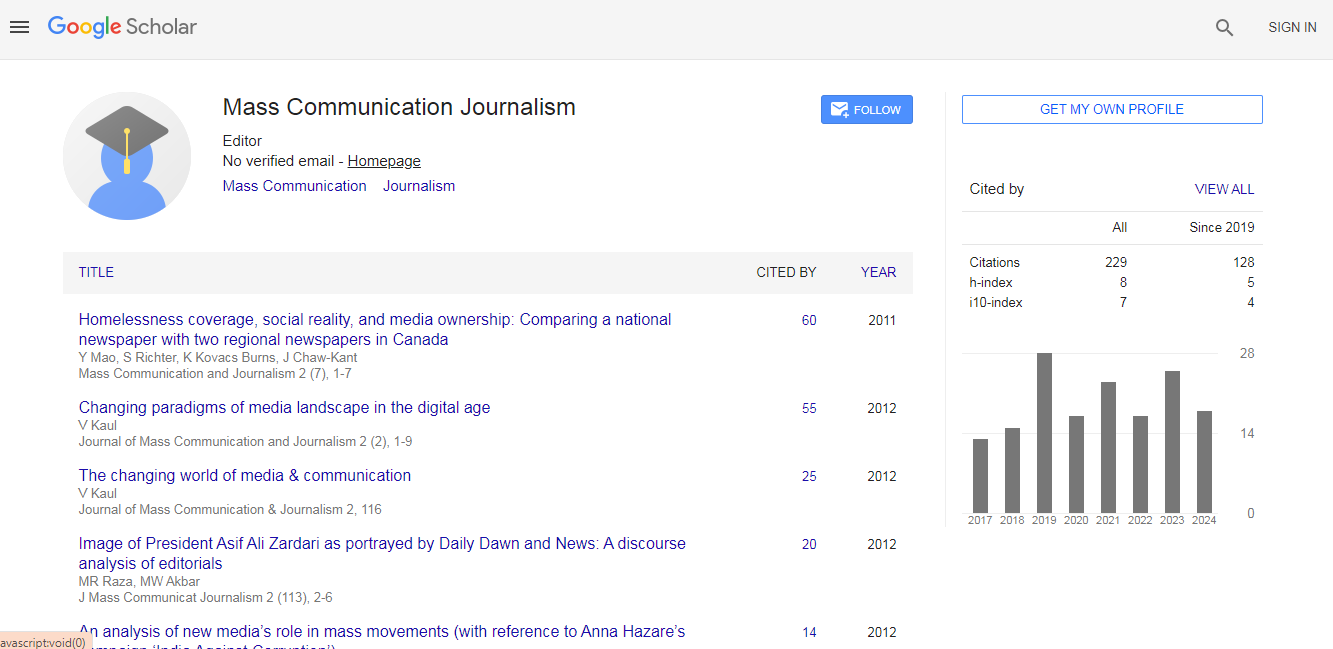
Journal of Mass Communication & Journalism received 205 citations as per Google Scholar report