Brief Report - (2025) Volume 10, Issue 5
Received: 01-Sep-2025, Manuscript No. apn-26-179341;
Editor assigned: 03-Sep-2025, Pre QC No. P-179341;
Reviewed: 14-Sep-2025, QC No. Q-179341;
Revised: 22-Sep-2025, Manuscript No. R-179341;
Published:
29-Sep-2025
, DOI: 10.37421/2573-0347.2025.10.456
Citation: Hoffman, Natalie. âDigital Transformation: APNs Shaping Future Healthcare.â J Adv Practice Nurs 10 (2025):456.
Copyright: © 2025 Hoffman N. This is an open-access article distributed under the terms of the Creative Commons Attribution License, which permits unrestricted use,
distribution and reproduction in any medium, provided the original author and source are credited.
The landscape of advanced nursing practice is undergoing a profound transformation, driven by the integration of cutting-edge technologies such as artificial intelligence, big data analytics, and telehealth. This digital evolution is fundamentally reshaping how patient care is delivered, moving towards more personalized interventions, enhanced diagnostic accuracy, and the widespread adoption of remote monitoring systems. Advanced practice nurses (APNs) are recognized as pivotal figures in this paradigm shift, requiring the development of new competencies to effectively leverage these technological tools, champion digital equity, and adeptly navigate the complex ethical considerations that arise from their implementation. The overarching promise of this integration is a healthcare system that is more efficient, widely accessible, and fundamentally patient-centered. However, significant challenges persist, particularly in the practicalities of implementation and the crucial need for robust workforce training to equip nurses with the necessary skills. The increasing reliance on digital platforms also necessitates a deeper understanding of how these tools can augment clinical decision-making and improve patient outcomes across diverse healthcare settings [1].
The expanded adoption of telehealth and remote patient monitoring (RPM) by advanced practice nurses is proving instrumental in broadening access to essential healthcare services, with a particularly pronounced impact on individuals residing in rural areas and those who are historically underserved. These advanced technological solutions enable continuous patient oversight from a distance, facilitate the early identification of emergent health issues, and allow for prompt and timely interventions. Consequently, this approach holds significant potential for reducing rates of hospital readmission and enhancing the effective management of chronic diseases. APNs are undeniably central to the success of these digital health initiatives, playing a critical role in their design, seamless implementation, and rigorous evaluation, thereby effectively bridging geographical barriers and fostering greater patient engagement in their own health management [2].
Artificial intelligence (AI) is emerging as a powerful force in augmenting the capabilities of advanced practice nurses, providing sophisticated tools designed to support diagnostic processes, refine risk stratification protocols, and enable the development of highly personalized treatment plans. AI algorithms possess the remarkable ability to analyze immense datasets, identify subtle patterns, and accurately predict patient outcomes, thereby empowering APNs to make more informed and evidence-based clinical decisions. As these AI technologies become increasingly interwoven into the fabric of clinical practice, it is imperative that ethical implications, including potential biases and the need for transparency, are thoroughly examined. Furthermore, the cultivation of AI literacy among APNs is a crucial consideration to ensure responsible and effective integration [3].
Big data analytics offers advanced practice nurses a powerful capability to extract meaningful and actionable insights from a vast array of health-related data sources, including comprehensive electronic health records (EHRs) and other relevant clinical information. This analytical prowess directly facilitates the advancement of evidence-based practice, supports robust population health management strategies, and drives significant quality improvement initiatives within healthcare organizations. By leveraging these sophisticated analytics, APNs can adeptly identify emerging trends in patient populations, optimize the development of care pathways, and make substantial contributions to ongoing clinical research, all of which ultimately contribute to the overarching goal of improving patient outcomes on a broader, more impactful scale [4].
Fundamentally, the ongoing digital transformation within healthcare mandates the deliberate and systematic development of novel competencies for advanced practice nurses. These essential new skills encompass a broad spectrum, including advanced digital literacy, the critical interpretation of complex data sets, and a high degree of proficiency in utilizing a diverse range of health information technologies. To effectively equip APNs with the requisite skills to not only navigate but also to lead the charge in digital health innovations, the establishment of comprehensive educational programs and continuous professional development initiatives is of paramount importance. Consequently, existing competency frameworks are undergoing necessary evolution to adequately encompass these new and rapidly expanding technological demands [5].
Multifaceted ethical considerations are intrinsically linked to the process of digital transformation within advanced nursing practice. These complex issues span a wide range of concerns, including the critical importance of data privacy and security, the potential for algorithmic bias in clinical decision-making tools, ensuring equitable access to all digital health resources, and understanding the profound impact these technologies can have on the fundamental nurse-patient relationship. It is incumbent upon APNs to remain exceptionally vigilant and proactive in addressing these complex ethical dilemmas to uphold patient trust, safeguard patient well-being, and ensure the ethical integrity of care delivery in an increasingly digital world [6].
The integration of immersive technologies such as virtual reality (VR) and augmented reality (AR) is opening up novel and exciting avenues for advanced practice nurses. These innovative technologies offer promising opportunities in critical areas such as enhancing patient education strategies, facilitating the development of clinical skills among healthcare professionals, and introducing new modalities for therapeutic interventions. VR and AR have the potential to significantly elevate learning experiences and provide innovative methods for delivering patient care, thereby leading to improved patient engagement and potentially greater adherence to prescribed treatment regimens [7].
The profound impact of digital transformation on the advanced practice nurse workforce extends to the potential for significant role evolution and an undeniable need for continuous adaptation. APNs are uniquely positioned to assume more complex and demanding roles, including the comprehensive management of sophisticated digital health systems, the intricate interpretation of vast amounts of patient data, and the effective coordination of care across a multitude of virtual platforms. This dynamic evolution necessitates a proactive and forward-thinking approach to workforce planning and the strategic development of relevant educational curricula to prepare nurses for these emerging responsibilities [8].
Interprofessional collaboration, a cornerstone of effective healthcare delivery, is itself being significantly transformed and enhanced by the proliferation of digital tools. These technologies empower advanced practice nurses to engage in more effective and seamless collaborations with physicians, allied health professionals, and importantly, with patients themselves, irrespective of their geographical location or the setting in which care is being provided. Digital platforms act as crucial enablers for clear and consistent communication, facilitate shared decision-making processes, and streamline the development of comprehensive coordinated care plans, ultimately leading to demonstrable improvements in patient safety and overall patient satisfaction [9].
The patient experience within the realm of advanced nursing practice is undergoing a significant redefinition, largely propelled by the ongoing digital transformation. This evolution places a strong emphasis on empowering patients and fostering their active engagement in their own healthcare journey. Digital tools are increasingly providing patients with enhanced access to vital health information, offering robust support for the self-management of chronic conditions, and enabling more personalized and conveniently accessible care interactions. In this evolving digital landscape, APNs play a crucial and indispensable role in guiding patients through these new technological avenues, ensuring they can effectively utilize these resources for their benefit [10].
Digital transformation is fundamentally altering the practice of advanced nursing, with technologies like artificial intelligence, big data analytics, and telehealth at the forefront of this change. These innovations are leading to significant improvements in patient care through personalized treatment plans, more accurate diagnoses, and the expansion of remote monitoring capabilities. Advanced practice nurses (APNs) are central to this ongoing evolution, requiring the acquisition of new skills and competencies to effectively utilize these digital tools. They are also tasked with advocating for digital equity, ensuring that all patients have access to these advancements, and navigating the complex ethical landscape that accompanies technological integration. The ultimate goal of this integration is to foster a healthcare delivery system that is not only more efficient and accessible but also profoundly patient-centered. Despite the promising outlook, considerable challenges remain in the practical implementation of these technologies and in the comprehensive training of the nursing workforce to meet these new demands [1].
The expanding use of telehealth and remote patient monitoring (RPM) by advanced practice nurses is a key driver in increasing access to healthcare, particularly for populations in rural areas and those who have traditionally faced barriers to care. These technologies enable continuous oversight of patient health status remotely, facilitating the early detection of potential health issues and allowing for timely medical interventions. This proactive approach is instrumental in reducing costly hospital readmissions and improving the management of individuals with chronic diseases. APNs are indispensable in the process of designing, implementing, and evaluating these digital health solutions, effectively overcoming geographical limitations and enhancing patient involvement in their treatment plans [2].
Artificial intelligence (AI) is increasingly being integrated to enhance the capabilities of advanced practice nurses, offering advanced tools that support diagnostic decision-making, improve patient risk stratification, and aid in the development of personalized treatment strategies. AI algorithms are capable of analyzing large volumes of patient data to identify complex patterns and predict health outcomes, thereby enabling APNs to make more informed and precise clinical judgments. As AI becomes more embedded in clinical workflows, careful consideration of its ethical implications, including the potential for bias, and the necessity for AI literacy among APNs are critical factors for its responsible and effective adoption [3].
Big data analytics provides advanced practice nurses with the capacity to derive valuable insights from extensive health datasets, including electronic health records (EHRs) and other health-related information repositories. This capability is essential for advancing evidence-based practice, implementing effective population health management strategies, and driving quality improvement initiatives within healthcare systems. APNs can leverage these analytical tools to identify trends, refine care pathways, and contribute to the body of clinical research, ultimately leading to enhanced patient outcomes across broader populations [4].
The digital transformation of healthcare necessitates the development of new and specialized competencies for advanced practice nurses. These essential skills include a high level of digital literacy, the ability to critically interpret complex data, and proficiency in operating various health information technologies. To ensure APNs are adequately prepared to manage and lead advancements in digital health, the development and implementation of robust educational programs and ongoing professional development initiatives are crucial. Consequently, competency frameworks are continuously evolving to incorporate these new technological requirements [5].
Ethical considerations are paramount in the context of digital transformation within advanced nursing practice, presenting a complex array of challenges. These include safeguarding patient data privacy and security, addressing the potential for bias in algorithmic decision-making, ensuring equitable access to digital health tools for all patients, and understanding the evolving nature of the nurse-patient relationship in a digital environment. APNs must remain acutely aware of and actively engaged in addressing these ethical dilemmas to maintain patient trust and ensure the highest standards of care [6].
The introduction of virtual reality (VR) and augmented reality (AR) technologies into advanced nursing practice offers innovative opportunities for patient education, skills development for nurses, and the delivery of therapeutic interventions. These immersive technologies have the potential to significantly enhance learning experiences and provide novel methods for patient care, which can lead to improved patient engagement and better adherence to treatment plans [7].
The digital transformation profoundly influences the advanced practice nurse workforce, leading to evolving roles and a continuous need for adaptation. APNs are increasingly taking on more complex responsibilities in managing digital health systems, interpreting complex health data, and coordinating patient care across various virtual platforms. This evolving landscape requires a proactive approach to workforce planning and the strategic enhancement of nursing education to meet future demands [8].
Digital tools are revolutionizing interprofessional collaboration, enabling advanced practice nurses to work more effectively with physicians, allied health professionals, and patients across different care settings. These platforms facilitate improved communication, support shared decision-making, and enhance the coordination of patient care plans, resulting in better patient safety and higher levels of patient satisfaction [9].
The patient experience in advanced nursing practice is being reshaped by digital transformation, with a growing emphasis on patient empowerment and active participation in their healthcare. Digital resources provide patients with greater access to health information, support self-management of chronic conditions, and enable more personalized and convenient healthcare interactions. APNs play a vital role in guiding patients through this changing digital landscape, ensuring they can effectively benefit from these advancements [10].
Digital transformation is profoundly impacting advanced nursing practice, driven by technologies like AI, big data, and telehealth. These advancements enhance patient care through personalization, improved diagnostics, and remote monitoring, positioning advanced practice nurses (APNs) as key players. APNs need new competencies to effectively use these tools, advocate for digital equity, and navigate ethical concerns. The integration aims for more efficient, accessible, and patient-centered healthcare, though implementation and training challenges persist. Telehealth and remote monitoring expand care access, especially for underserved populations, by enabling continuous oversight and early intervention, reducing readmissions and improving chronic disease management. AI offers diagnostic support and personalized treatment planning, requiring AI literacy and ethical consideration. Big data analytics enables APNs to derive insights for evidence-based practice and population health management. New competencies, including digital literacy and data interpretation, are crucial, necessitating updated educational programs. Ethical issues such as data privacy, bias, and equitable access require careful management. VR/AR present novel opportunities for patient education and therapeutic interventions. The workforce is evolving, with APNs taking on complex roles in digital health management. Digital tools enhance interprofessional collaboration, leading to better patient safety and satisfaction. The patient experience is being redefined by increased empowerment and engagement through digital resources, with APNs guiding patients in this new landscape.
None
None
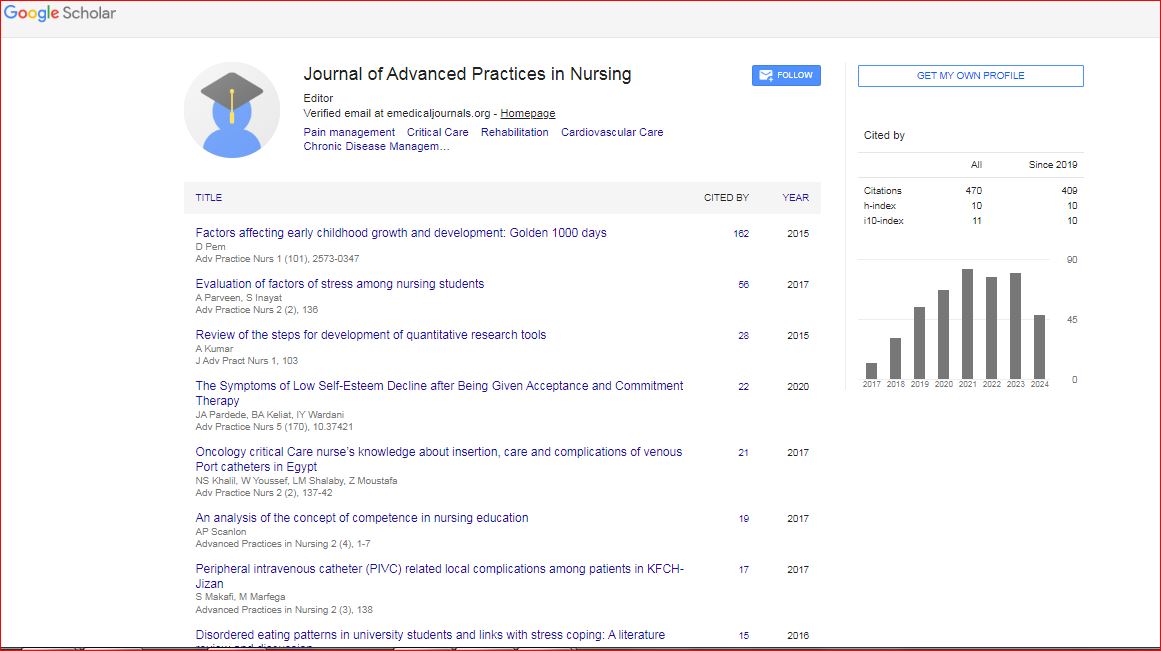
Journal of Advanced Practices in Nursing received 410 citations as per Google Scholar report