Perspective - (2025) Volume 15, Issue 4
Received: 01-Jul-2025, Manuscript No. jtese-26-184240;
Editor assigned: 03-Jul-2025, Pre QC No. P-184240;
Reviewed: 17-Jul-2025, QC No. Q-184240;
Revised: 22-Jul-2025, Manuscript No. R-184240;
Published:
29-Jul-2025
, DOI: 10.37421/2165-8064.2025.15.664
Citation: Kowalska, Maria. ”Digital Textile Printing: Production, Color, and Sustainability.” J Textile Sci Eng 15 (2025):664.
Copyright: © 2025 Kowalska M. This is an open-access article distributed under the terms of the Creative Commons Attribution License, which permits unrestricted use, distribution and reproduction in any medium, provided the original author and source are credited.
The field of digital textile printing has witnessed significant advancements, revolutionizing how designs are applied to fabrics and opening new avenues for creativity and customization. This technology allows for intricate patterns and high-resolution images to be printed directly onto textiles with remarkable precision. The optimization of production workflows is a critical aspect of leveraging the full potential of digital textile printing, ensuring efficiency and quality from design to finished product. Strategies focused on enhancing color fastness are paramount, as durability and vibrancy are key determinants of a textile's marketability and longevity. Advancements in ink formulations, printhead technology, and curing methods directly impact the durability and vibrancy of printed textiles, forming the bedrock of high-quality output. The authors meticulously discuss the critical role of pre-treatment and post-treatment processes in achieving superior results and ensuring long-term color stability across various fabric types, highlighting the comprehensive nature of the printing process. This research underscores the growing importance of innovative solutions that not only improve aesthetic qualities but also address the practicalities of large-scale production. The continuous evolution of digital textile printing technologies necessitates a deep understanding of each stage to achieve optimal outcomes and meet the demands of a dynamic industry. The interplay between material science, engineering, and design is crucial for pushing the boundaries of what is possible in textile decoration. The pursuit of enhanced color fastness, coupled with efficient production, remains a central theme in ongoing research and development efforts. Addressing these multifaceted challenges is essential for the sustained growth and success of digital textile printing applications worldwide. The following sections will explore specific research contributions that shed light on these critical areas of development. The influence of ink chemistry and substrate interaction is a fundamental consideration in achieving robust color fastness in digital textile printing. The study meticulously examines various dye classes and pigment formulations, assessing their performance under different washing, light, and rubbing conditions to understand these complex relationships. Key findings indicate that the surface energy of the textile material and the binder system in pigment inks play a crucial role in achieving robust color adhesion and minimizing fading, demonstrating the importance of material science. This understanding allows for the selection of appropriate inks and substrates to meet specific performance requirements. The intricate relationship between the ink and the fabric surface directly affects how well the color is retained over time and under various stresses. Consequently, advancements in this area promise to yield more durable and visually appealing textile products. The research emphasizes that a holistic approach, considering both ink properties and fabric characteristics, is necessary for success. This detailed analysis provides valuable insights for ink manufacturers and textile printers alike. By optimizing these interactions, printers can achieve higher quality and more sustainable textile products. The optimization of curing processes for digital textile prints is a critical step for achieving excellent color fastness, directly impacting the final product's durability. The authors undertake a comparative study of different curing methods, including infrared (IR) and ultraviolet (UV) curing, to effectively polymerize ink binders and fix dyes onto textile fibers. Their analysis emphasizes the importance of precise temperature and time control to prevent ink migration and ensure maximum color durability, showcasing the technical precision required. This careful control over the curing environment ensures that the ink penetrates and adheres to the fabric fibers effectively. Inadequate curing can lead to a range of issues, from poor wash fastness to color fading when exposed to light. Therefore, understanding the nuances of each curing technology is vital for achieving consistent and high-quality results. The findings offer practical guidance for optimizing curing parameters based on the specific ink and fabric being used. This research contributes significantly to the body of knowledge surrounding digital textile printing post-processing. Such advancements are crucial for industries demanding high-performance printed textiles. Exploring novel pre-treatment formulations for digital textile printing is essential for improving ink penetration and color yield, thereby enhancing the overall print quality. The study systematically evaluates various chemical agents and their impact on fabric wettability and dye affinity, aiming to optimize the substrate's readiness for printing. Results demonstrate that optimized pre-treatments significantly enhance print definition, color saturation, and wash fastness, particularly for challenging synthetic fabrics that often resist ink absorption. These formulations work by modifying the fabric surface, making it more receptive to the ink. This improved receptivity allows for deeper ink penetration and more uniform distribution, leading to richer colors and sharper details. The research highlights the critical nature of this preparatory step, which can often be overlooked but is fundamental to achieving professional-grade results. By enhancing ink uptake, pre-treatments reduce the likelihood of issues like banding and uneven coloration. The findings offer valuable insights for textile manufacturers seeking to improve the performance of their digital printing operations. Ultimately, these advancements contribute to more vibrant and durable textile designs. The application of advanced printing resolutions and controlled drop volumes significantly impacts the color reproduction and detail accuracy in digital textile printing. The authors conduct experiments with various printhead settings to meticulously achieve optimal image quality and proactively prevent common issues like banding and feathering. Their findings provide practical guidelines for print designers and technicians to fine-tune parameters, ensuring superior visual output and color consistency across batches. These technical parameters directly influence how ink is deposited onto the fabric, affecting the fineness of detail and the richness of color. By carefully controlling the size and placement of ink droplets, it is possible to render complex images with high fidelity. This level of precision is essential for applications where intricate designs and subtle color gradients are required. The research underscores the importance of understanding the capabilities and limitations of printing hardware. Such detailed studies empower users to maximize the performance of their digital printing systems. The insights gained are invaluable for achieving professional and aesthetically pleasing textile prints consistently. A comprehensive review of the latest developments in eco-friendly inks and sustainable practices for digital textile printing addresses the growing environmental concerns within the industry. The article thoroughly discusses the environmental impact of traditional textile printing methods and highlights the increasing demand for water-based and biodegradable ink systems. It further explores how process optimization, including efficient ink usage and waste reduction strategies, contributes significantly to a greener textile industry. The shift towards sustainable inks is driven by regulatory pressures, consumer demand, and a greater corporate responsibility to minimize ecological footprints. Water-based inks, for instance, reduce the reliance on harmful solvents, while biodegradable options offer a more environmentally benign end-of-life solution for printed textiles. Process optimization plays a crucial role by ensuring that inks are used efficiently, minimizing waste and reducing the overall environmental burden. This research provides a vital overview of current trends and future directions in sustainable textile printing. It emphasizes that environmental consciousness is no longer an option but a necessity for the industry's long-term viability. The findings encourage the adoption of more responsible manufacturing practices. The effect of post-treatment steaming on color fastness is a critical aspect, particularly for reactive inks applied to cotton textiles. This study systematically investigates the role of this crucial step, comparing different steaming times and temperatures to determine optimal conditions for dye fixation and wash fastness. Their research provides valuable insights into how effective steaming can significantly enhance color brilliance and durability, ensuring that the printed designs withstand rigorous use. Steaming allows the reactive dyes to fully react with the cotton fibers, creating a strong chemical bond that locks the color in place. This process is essential for achieving deep penetration and permanent fixation of the dye. Without proper steaming, the colors may appear dull and are prone to bleeding or fading during washing. The authors' detailed analysis offers a scientific basis for optimizing this post-treatment stage. Their findings are particularly relevant for manufacturers aiming to produce high-quality, long-lasting printed cotton textiles. The implications extend to improving the overall perceived value and performance of digitally printed cotton products. The challenge of achieving consistent color matching and reproduction in digital textile printing workflows is addressed through a detailed exploration of workflow optimization and color management strategies. The article highlights the importance of accurate color profiling, precise calibration of printing equipment, and the judicious use of spectrophotometry. The authors emphasize that rigorous process control is essential for meeting the stringent color standards demanded by the fashion and textile industries, where consistency is paramount. Color management in digital printing involves a complex chain of steps, from the creation of digital artwork to the final printed output. Each step must be meticulously managed to ensure that the colors seen on screen are accurately translated to the fabric. This includes creating profiles for the specific inks, substrates, and printers being used, and regularly calibrating the equipment to maintain accuracy. The research underscores that without these systematic approaches, achieving brand consistency and customer satisfaction becomes exceedingly difficult. The findings provide a roadmap for printers seeking to enhance the reliability and predictability of their color reproduction capabilities. This focus on consistency is vital for building trust and maintaining a competitive edge. This research focuses on the application of nanotechnology in digital textile printing inks to enhance color fastness and durability, representing a significant leap in ink technology. The study rigorously investigates how nanoparticles can improve pigment dispersion, UV resistance, and wash fastness, offering a novel approach to material enhancement. The authors present compelling evidence for the potential of nano-enhanced inks to revolutionize the performance of digitally printed textiles, promising greater longevity and resilience. Nanoparticles, due to their small size and high surface area, can effectively improve the way pigments are suspended within the ink. This leads to more uniform color distribution and enhanced light absorption properties. Furthermore, the incorporation of nanoparticles can create a protective barrier against environmental factors like UV radiation and abrasion, thus significantly boosting the durability of the printed design. The findings suggest that this advanced technology could lead to textiles that maintain their vibrant colors and intricate details for much longer periods. This represents a promising future for high-performance digital textile printing applications. An examination of the impact of different energy sources for curing, such as LED-UV, conventional UV, and hot air, on the color fastness and physical properties of digitally printed polyester fabrics provides critical insights. The study quantifies the improvements in rub fastness, wash fastness, and light fastness achieved through various curing methods. Key insights reveal that optimizing curing parameters is crucial for achieving high-performance prints on synthetic materials like polyester. Polyester, being a synthetic fiber, has different absorption and fixation properties compared to natural fibers, making the curing process particularly important for ensuring ink adhesion and durability. Different energy sources and their specific parameters (e.g., wavelength and intensity for UV, temperature and airflow for hot air) can influence how the ink binder polymerizes and how the pigment or dye is fixed to the fiber. The research provides a comparative analysis that helps printers select the most effective curing technology for polyester substrates. This optimization is essential for producing textiles that can withstand the demands of various applications, from apparel to home furnishings. The findings underscore the technological sophistication required for advanced textile printing.
Digital textile printing has emerged as a transformative technology, offering unparalleled flexibility and precision in applying designs to fabrics. The optimization of production workflows within this domain is paramount for achieving both efficiency and high-quality output. This involves a holistic approach that considers every stage of the printing process, from initial design to final finishing. Enhancing color fastness is a core objective, ensuring that printed textiles maintain their vibrancy and integrity under various conditions, such as washing, light exposure, and abrasion. Advancements in ink formulations play a crucial role by providing inks with improved color gamut, durability, and compatibility with different substrates. Similarly, innovations in printhead technology, such as piezoelectric and thermal inkjet heads, enable finer droplet control, leading to sharper details and more accurate color reproduction. The curing methods employed also significantly influence the final outcome, with technologies like UV and infrared curing being essential for solidifying the ink onto the fabric. Beyond these core components, the meticulous application of pre-treatment and post-treatment processes is vital for achieving superior results. Pre-treatments prepare the fabric surface for optimal ink absorption and adhesion, while post-treatments, such as steaming or washing, help to fix the dyes and enhance overall durability and wash fastness. The integration of these elements ensures that digitally printed textiles meet the demanding requirements of various industries, from fashion and apparel to home décor and technical textiles. The research presented underscores the multifaceted nature of digital textile printing and the continuous drive for innovation to achieve higher performance, greater sustainability, and expanded creative possibilities. Each element, from the chemical composition of the ink to the physical parameters of the curing process, contributes to the overall success of the printed textile, making it a complex yet rewarding field of study and application. The intricate relationship between ink chemistry and substrate interaction is fundamental to achieving exceptional color fastness in digital textile printing. Understanding how different dye and pigment formulations behave when applied to various textile materials allows for the selection of optimal combinations. Studies in this area meticulously assess the performance of inks under diverse conditions, including repeated washing cycles, prolonged light exposure, and mechanical rubbing. The findings consistently highlight the critical roles of the textile's surface energy and the binder system within pigment inks. A higher surface energy in the textile generally promotes better ink wetting and adhesion, leading to more robust color application. Concurrently, the formulation of the binder system in pigment inks is crucial for creating a strong bond between the pigment particles and the fabric fibers, thereby preventing premature fading or detachment. This detailed examination of ink-substrate interactions enables the development of more durable and visually appealing printed textiles. By tailoring ink formulations to specific fabric types and understanding the underlying chemical and physical interactions, manufacturers can significantly improve the longevity and performance of their printed products. This scientific approach to ink and substrate compatibility is a cornerstone of advancing the quality and reliability of digital textile printing. The continuous research in this domain promises further improvements in color fastness and overall textile durability. The optimization of curing processes represents a critical juncture in digital textile printing, directly influencing the color fastness and longevity of the final product. This stage involves the application of energy to polymerize ink binders and chemically fix dyes to textile fibers, effectively making the colors permanent. Comparative studies investigating different curing methods, such as infrared (IR) and ultraviolet (UV) technologies, provide essential insights into their respective efficacies. The research emphasizes the paramount importance of precise control over curing parameters, including temperature, time, and energy intensity. Deviations from optimal settings can lead to detrimental effects such as ink migration, where the ink spreads beyond the intended print area, or insufficient polymerization, resulting in poor color fastness. UV curing, for instance, utilizes specific wavelengths of light to initiate a rapid photochemical reaction, while IR curing employs heat to accelerate the drying and binding process. The choice of method often depends on the type of ink used (e.g., UV-curable inks versus water-based inks) and the fabric substrate. Achieving maximum color durability necessitates a thorough understanding of these processes and careful fine-tuning of the equipment. The findings from such studies are invaluable for print technicians and manufacturers seeking to enhance the quality and resilience of their digitally printed textiles. This attention to detail in the curing phase is indispensable for producing textiles that can withstand the rigors of use and washing. Novel pre-treatment formulations are being actively explored to significantly enhance ink uptake and color fastness in digital textile printing. These treatments are designed to modify the surface properties of the textile substrate, making it more receptive to the ink. By altering the fabric's wettability and affinity for dyes and pigments, pre-treatments ensure that the ink penetrates the fibers more effectively and adheres more strongly. This leads to a dramatic improvement in print definition, resulting in sharper lines and finer details. Furthermore, enhanced ink uptake contributes to greater color saturation and richness, allowing for a wider and more vibrant color gamut. The impact is particularly pronounced on challenging synthetic fabrics, which often possess smooth, low-energy surfaces that resist ink absorption. Optimized pre-treatments can overcome these inherent limitations, enabling high-quality printing on a broader range of materials. The result is not only improved aesthetics but also superior wash fastness, as the ink is more securely anchored within the fiber structure. This research highlights the indispensable role of the preparatory stage in achieving high-performance digital textile prints. By advancing pre-treatment technologies, the industry can unlock new possibilities for textile design and application, ensuring greater durability and visual appeal. The impact of print resolution and drop volume on color reproduction and quality in digital textile printing is a subject of ongoing investigation, essential for achieving superior visual output. Print resolution dictates the fineness of the printed detail, essentially the number of dots per inch (dpi) that the printer can lay down. Higher resolutions allow for the rendering of more intricate designs and sharper edges. Concurrently, controlling the volume of ink droplets expelled by the printhead is crucial for achieving accurate color densities and preventing oversaturation or under-saturation. Various printhead technologies, such as piezoelectric and thermal inkjet, offer different levels of control over drop volume and placement. Experimentation with different printhead settings allows researchers and technicians to identify optimal parameters that minimize common printing artifacts like banding (horizontal lines) and feathering (fuzzy edges). By fine-tuning these settings, it is possible to achieve a balance that maximizes image quality, ensuring that colors are reproduced faithfully and details are rendered with precision. These findings provide practical guidelines for print designers and technicians, enabling them to make informed decisions about print settings to achieve consistent and high-quality results across different designs and fabric types. The careful calibration of these parameters is a hallmark of professional digital textile printing. A comprehensive review of eco-friendly inks and sustainable practices addresses the critical need for environmental responsibility in digital textile printing. The article examines the ecological footprint of traditional textile printing methods, which often involve significant water usage and chemical discharge, and contrasts it with the growing adoption of more sustainable alternatives. The focus is on water-based and biodegradable ink systems, which offer reduced environmental impact through lower volatile organic compound (VOC) emissions and improved end-of-life biodegradability. Furthermore, the review explores how process optimization plays a vital role in achieving sustainability goals. This includes strategies for efficient ink usage, minimizing waste generation through precise printing and effective ink management, and optimizing energy consumption during the printing and curing stages. By implementing these practices, the textile industry can significantly reduce its environmental burden and move towards a more circular economy model. The growing demand for sustainable products from consumers and regulatory bodies is driving innovation in this area. This research provides a valuable overview of the current landscape and future directions for greener digital textile printing. It underscores the commitment to developing technologies that are not only high-performing but also environmentally conscious. The effect of post-treatment steaming on the color fastness of digitally printed textiles, particularly reactive inks on cotton, is a critical area of research for ensuring print durability. Steaming is a post-processing step where textiles are exposed to high-temperature steam, facilitating the chemical reaction between the dye and the fabric fibers. This process is essential for achieving deep and permanent dye fixation, which is crucial for good wash fastness and color stability. Studies in this domain involve comparing the outcomes of different steaming durations and temperatures to identify optimal conditions. Research has shown that insufficient steaming can lead to poor dye fixation, resulting in colors that are prone to bleeding or fading during washing. Conversely, excessive steaming might damage the fabric or lead to undesirable color changes. Therefore, precise control over the steaming process is vital for maximizing color brilliance and ensuring long-term durability. The findings provide valuable insights into how effective steaming contributes to the overall quality and performance of digitally printed cotton textiles. This understanding allows manufacturers to optimize their finishing processes, ensuring that their products meet high standards for color fastness and resilience. The research contributes significantly to the practical application of digital textile printing technologies. Achieving consistent color matching and reproduction in digital textile printing workflows presents a significant challenge, necessitating robust workflow optimization and effective color management strategies. This process begins with accurate color profiling, which involves creating digital representations of how specific inks and substrates will render colors on a particular printer. Rigorous calibration of printing equipment, including printheads and associated hardware, is essential to maintain consistency over time and across different machines. The use of spectrophotometry, a scientific method for measuring and quantifying color, plays a crucial role in this process. Spectrophotometers allow for objective assessment of color accuracy, enabling technicians to fine-tune printer settings and ink profiles to meet precise color specifications. The fashion and textile industries, in particular, demand stringent color standards due to brand consistency requirements and aesthetic expectations. Inconsistent color reproduction can lead to rejected batches, increased waste, and damage to brand reputation. Therefore, the implementation of systematic color management practices, from design conception to final production, is paramount. This research emphasizes that a disciplined and scientific approach to color management is not merely a technical requirement but a fundamental business imperative for success in the competitive digital textile printing market. This research explores the application of nanotechnology in digital textile printing inks, aiming to significantly enhance color fastness and durability. Nanoparticles, owing to their extremely small size, offer unique properties that can revolutionize ink performance. The study investigates how incorporating nanoparticles into ink formulations can improve pigment dispersion, leading to more uniform color application and greater color intensity. Furthermore, nano-enhanced inks demonstrate improved resistance to UV radiation, which is a common cause of color fading in textiles. The enhanced durability also extends to wash fastness, meaning the colors are less likely to fade or bleed when the fabric is laundered. The authors present compelling evidence that nanotechnology has the potential to transform the performance characteristics of digitally printed textiles, making them more resilient and longer-lasting. This advancement could lead to a new generation of textiles with superior aesthetic appeal and functional performance. By leveraging the unique properties of nanomaterials, the digital textile printing industry can overcome existing limitations and offer products that meet the increasingly demanding expectations of consumers for both visual quality and enduring performance. The findings represent a significant step forward in material science for textiles. A comparative study of energy sources for curing digital textile prints on polyester fabrics sheds light on their impact on color fastness and overall physical properties. Polyester, a widely used synthetic material, requires specific curing conditions to ensure optimal ink performance. The research quantifies improvements in key color fastness properties, including rub fastness (resistance to abrasion), wash fastness (resistance to laundering), and light fastness (resistance to fading from UV exposure), across different curing methods. These methods typically include conventional UV curing, LED-UV curing, and hot air curing. Each energy source has distinct characteristics that influence the polymerization of the ink binder and the fixation of the colorant. For example, LED-UV curing offers energy efficiency and precise wavelength control, while hot air curing relies on heat transfer to dry and cure the ink. The study's findings highlight that optimizing the specific parameters of the chosen curing methodâ??such as intensity, wavelength, duration, and temperatureâ??is crucial for achieving high-performance prints on polyester. This research provides valuable data for textile printers selecting the most appropriate curing technology and parameters to ensure the durability and longevity of their digitally printed polyester products, catering to diverse application needs.
Digital textile printing is a rapidly evolving technology focused on optimizing production workflows and enhancing color fastness. Key areas of development include advancements in ink formulations, printhead technology, and curing methods, which directly impact the durability and vibrancy of printed textiles. Pre-treatment and post-treatment processes, such as steaming, are critical for achieving superior results and long-term color stability across various fabric types. Research also explores the influence of ink chemistry and substrate interaction, the optimization of curing processes like IR and UV technologies, and novel pre-treatment formulations to improve ink penetration and color yield. Print resolution, drop volume, and color management strategies are essential for achieving consistent color reproduction. Furthermore, the industry is increasingly adopting eco-friendly inks and sustainable practices, with nanotechnology showing promise for enhancing ink performance. Different energy sources for curing, particularly on polyester fabrics, are being compared to optimize color fastness properties, including rub, wash, and light fastness. These collective efforts aim to produce high-quality, durable, and aesthetically pleasing digitally printed textiles while addressing environmental concerns.
None
None
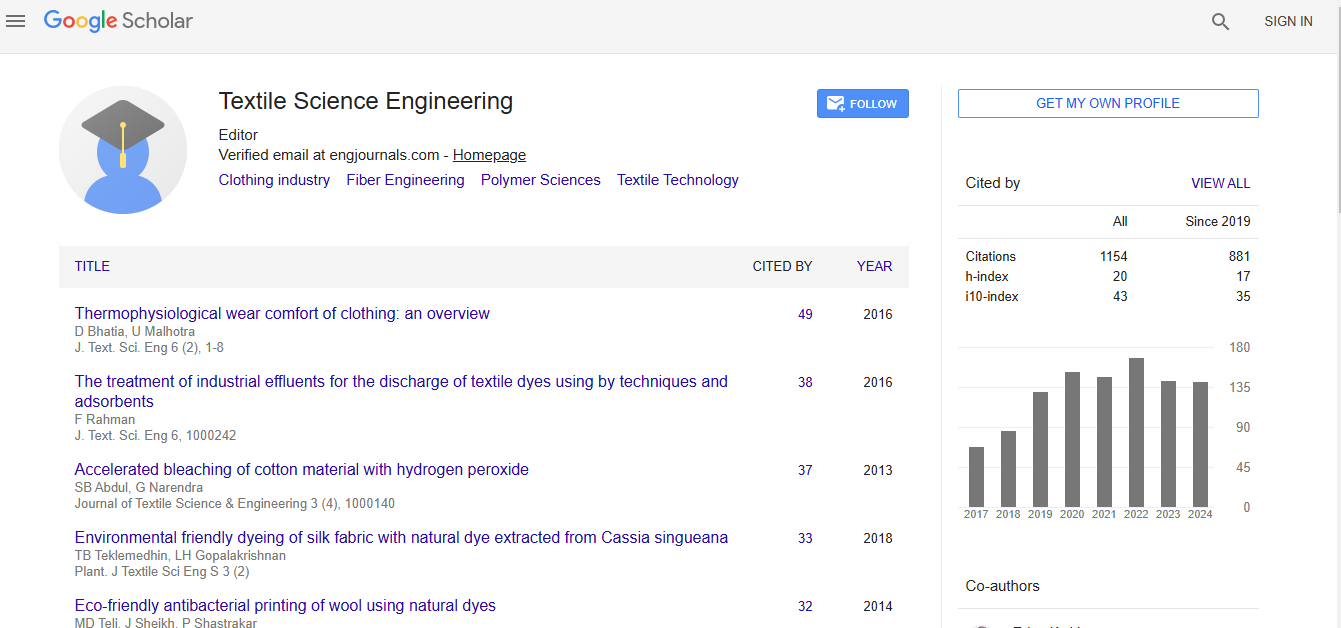
Journal of Textile Science & Engineering received 1008 citations as per Google Scholar report