Perspective - (2025) Volume 10, Issue 5
Received: 01-Oct-2025, Manuscript No. jcct-26-183271;
Editor assigned: 03-Oct-2025, Pre QC No. P-183271;
Reviewed: 17-Oct-2025, QC No. Q-183271;
Revised: 22-Oct-2025, Manuscript No. R-183271;
Published:
29-Oct-2025
, DOI: 10.37421/2577-0535.2025.9.334
Citation: Santos, Maria L.. ”Digital Technologies Revolutionizing Cancer Clinical Trials.” J Cancer Clin Trials 10 (2025):334.
Copyright: © 2025 Santos L. Maria This is an open-access article distributed under the terms of the Creative Commons Attribution License, which permits unrestricted use, distribution and reproduction in any medium, provided the original author and source are credited.
The landscape of cancer clinical trial data collection is undergoing a profound transformation driven by the integration of digital technologies, promising enhanced efficiency, improved data quality, and greater patient engagement. These advancements are pivotal in accelerating the development of novel cancer therapies by streamlining data acquisition and analysis processes. Wearable devices, for instance, offer continuous physiological monitoring, providing objective real-world data that complements traditional clinical assessments. Mobile health applications are also playing an increasingly vital role, particularly in capturing patient-reported outcomes (PROs), offering invaluable insights into treatment side effects, quality of life, and adherence directly from the patient's perspective. Electronic data capture (EDC) systems have become foundational, offering benefits such as reduced data entry errors and real-time data accessibility for trial monitoring. The emergence of decentralized clinical trials (DCTs), facilitated by digital tools, further enhances patient accessibility and retention by minimizing the need for frequent site visits, which is especially beneficial for patients with advanced disease or those residing far from trial centers. Blockchain technology is also being explored for its potential to enhance data security and integrity, providing a decentralized and immutable ledger system for managing trial data with transparency and auditability. Artificial intelligence (AI) and machine learning (ML) are becoming indispensable for analyzing the large datasets generated in cancer trials, enabling the identification of complex patterns and prediction of treatment responses. Data visualization tools are equally critical, transforming complex data into accessible and interpretable formats for researchers and clinicians, thereby aiding in informed decision-making. The integration of electronic health records (EHRs) with clinical trial data collection systems offers a more comprehensive view of patient health and treatment outcomes, streamlining data entry and enriching the dataset for analysis. Crucially, ensuring robust data privacy and security measures, including compliance with relevant regulations and anonymization techniques, is paramount to protect sensitive patient information and maintain public trust in the digital data collection processes of cancer trials. Digital technologies are revolutionizing how data is collected in cancer clinical trials, leading to significant improvements in efficiency and data quality. Wearable devices and mobile applications allow for real-time monitoring and patient-reported outcomes, respectively, enhancing the richness and dynamism of the data collected. This shift is crucial for adapting to the evolving needs of clinical research and accelerating therapeutic advancements [1].
The integration of patient-reported outcomes (PROs) through digital platforms is essential for capturing the patient's lived experience during cancer trials. Mobile health (mHealth) applications directly collect PROs, providing critical insights into treatment effects and patient well-being, thereby empowering patients to actively participate in their care [2].
Electronic data capture (EDC) systems are fundamental to modern cancer trial data management, offering improved accuracy, reduced errors, and real-time data access. Their implementation ensures data integrity and streamlines workflows for research staff throughout the trial lifecycle [3].
Wearable sensors are increasingly utilized in cancer trials to gather objective physiological data, continuously monitoring parameters like activity and sleep. This provides a comprehensive understanding of treatment toxicity and patient well-being, complementing traditional clinical assessments [4].
The adoption of decentralized clinical trials (DCTs), powered by digital technologies, significantly benefits cancer research by improving patient accessibility and retention. Technologies like remote monitoring and telemedicine are key enablers of this patient-centric approach [5].
Blockchain technology offers a novel approach to enhancing data security and integrity in cancer trials. Its decentralized ledger system can securely manage trial data, ensuring auditability and transparency while protecting patient privacy and building trust [6].
Artificial intelligence (AI) and machine learning (ML) are emerging as powerful tools for analyzing the vast data generated in cancer trials. These technologies can identify complex patterns, predict treatment responses, and optimize trial designs for more personalized therapies [7].
Data visualization tools are essential for making complex clinical trial data interpretable. Interactive platforms allow for quick identification of trends and outliers, facilitating informed decision-making and improving trial oversight [8].
Integrating electronic health records (EHRs) with clinical trial data collection systems provides a more holistic view of patient health. This integration streamlines data entry, reduces redundancy, and enriches datasets for deeper analysis in cancer research [9].
Ensuring data privacy and security is paramount in the digital collection of cancer trial data. Robust cybersecurity, regulatory compliance, and anonymization techniques are critical for protecting patient information and maintaining public trust in clinical research [10].
Digital technologies are fundamentally reshaping the collection of data within cancer clinical trials, leading to enhanced efficiency, superior data quality, and improved patient engagement. This technological evolution is a critical factor in accelerating the development of innovative cancer therapies by optimizing data acquisition and analytical processes. The incorporation of wearable devices, for instance, facilitates continuous monitoring of physiological parameters, generating objective real-world data that significantly complements traditional clinical assessments and offers a more nuanced understanding of treatment impact. Concurrently, mobile health applications are increasingly instrumental in capturing patient-reported outcomes (PROs), thereby providing invaluable direct insights into treatment side effects, quality of life, and adherence to therapeutic regimens, thereby empowering patients to take a more active role in their care. Electronic data capture (EDC) systems have become indispensable cornerstones in the contemporary management of cancer trial data. These systems provide distinct advantages, including a marked improvement in data accuracy, a reduction in data entry errors, and the availability of real-time data access, which is vital for effective trial monitoring and timely analysis. The workflow for research personnel is considerably streamlined through the implementation of EDC systems, ensuring the integrity of data throughout the entire trial lifecycle. Furthermore, the burgeoning field of decentralized clinical trials (DCTs), significantly enabled by a suite of digital technologies, offers substantial benefits for cancer research. DCTs reduce the necessity for frequent site visits, thereby enhancing patient accessibility and retention, which is particularly advantageous for individuals with advanced disease or those living at a considerable distance from trial sites. Key enabling technologies for this model include remote monitoring, telemedicine, and direct-to-patient drug delivery systems. Blockchain technology is emerging as a promising innovation for bolstering data security and integrity within cancer trials. Its inherent characteristics of a decentralized and immutable ledger system allow for the secure storage and management of trial data, guaranteeing auditability and transparency while simultaneously safeguarding patient privacy. This technological integration holds the potential to foster greater confidence in the data generated from clinical research endeavors. Artificial intelligence (AI) and machine learning (ML) are rapidly becoming powerful analytical tools capable of processing the vast quantities of data generated in cancer trials. These sophisticated technologies excel at identifying intricate patterns, predicting patient responses to various treatments, and optimizing trial designs, ultimately contributing to more efficient and personalized therapeutic development strategies. AI also plays a crucial role in real-time safety signal monitoring. Equally important are data visualization tools, which are essential for rendering the complex data derived from cancer trials accessible and interpretable. The deployment of interactive dashboards and advanced visual analytics platforms enables researchers and clinicians to swiftly identify trends, detect outliers, and pinpoint potential issues, thereby facilitating informed decision-making and enhancing the overall oversight of clinical trials. Effective data visualization is instrumental in gaining a profound understanding of treatment efficacy and safety profiles. The integration of electronic health records (EHRs) with established clinical trial data collection systems offers a more holistic and comprehensive perspective on patient health and treatment outcomes. This synergistic integration can significantly streamline the process of data entry, minimize redundancy, and contribute to a richer, more robust dataset for subsequent analysis, thereby substantially improving the efficiency and depth of cancer research. From a different perspective, digital technologies are revolutionizing cancer trial data collection, enhancing efficiency, data quality, and patient engagement. Wearable devices and mobile apps streamline data gathering and allow for real-time monitoring, reducing participant burden and enabling more responsive trial management [1].
Patient-reported outcomes (PROs) are crucial in cancer trials, and digital platforms facilitate their collection. Mobile health applications enable direct PRO capture from patients, offering valuable insights into treatment side effects and quality of life, thereby empowering patients [2].
Electronic data capture (EDC) systems are fundamental to modern cancer trial data management, improving accuracy, reducing errors, and providing real-time data accessibility. This streamlines workflows and ensures data integrity [3].
Wearable sensors are increasingly used to collect objective physiological data in cancer trials, monitoring parameters like activity levels and sleep patterns. This provides a comprehensive understanding of treatment toxicity and patient well-being [4].
Decentralized clinical trials (DCTs), enabled by digital technologies, improve patient accessibility and retention by reducing site visit requirements. Remote monitoring and telemedicine are key components of this model [5].
Blockchain technology offers enhanced data security and integrity through its decentralized, immutable ledger. This ensures auditability and transparency while protecting patient privacy [6].
Artificial intelligence (AI) and machine learning (ML) are powerful tools for analyzing vast cancer trial data. They can identify patterns, predict responses, and optimize trial design for personalized therapies [7].
Data visualization tools make complex clinical trial data accessible and interpretable. Interactive dashboards help researchers identify trends and facilitate informed decision-making [8].
Integrating electronic health records (EHRs) with clinical trial data collection systems provides a holistic view of patient health, streamlining data entry and enriching datasets for analysis [9].
Ensuring data privacy and security is paramount in digital cancer trial data collection. Robust cybersecurity and compliance with regulations are critical for protecting patient information and maintaining trust [10].
Digital technologies are transforming cancer clinical trials by enhancing data collection efficiency, quality, and patient engagement. Innovations such as wearable devices, mobile health apps, and electronic data capture (EDC) systems streamline processes and enable real-time monitoring. Patient-reported outcomes (PROs) are better captured, providing deeper insights into patient experiences. Decentralized clinical trials (DCTs) improve accessibility and retention. Emerging technologies like blockchain offer enhanced data security, while AI and machine learning aid in complex data analysis. Data visualization tools improve interpretability, and the integration of electronic health records (EHRs) provides a comprehensive patient view. Paramount to these advancements are robust data privacy and security measures to protect sensitive information and maintain trust in the research process.
None
None
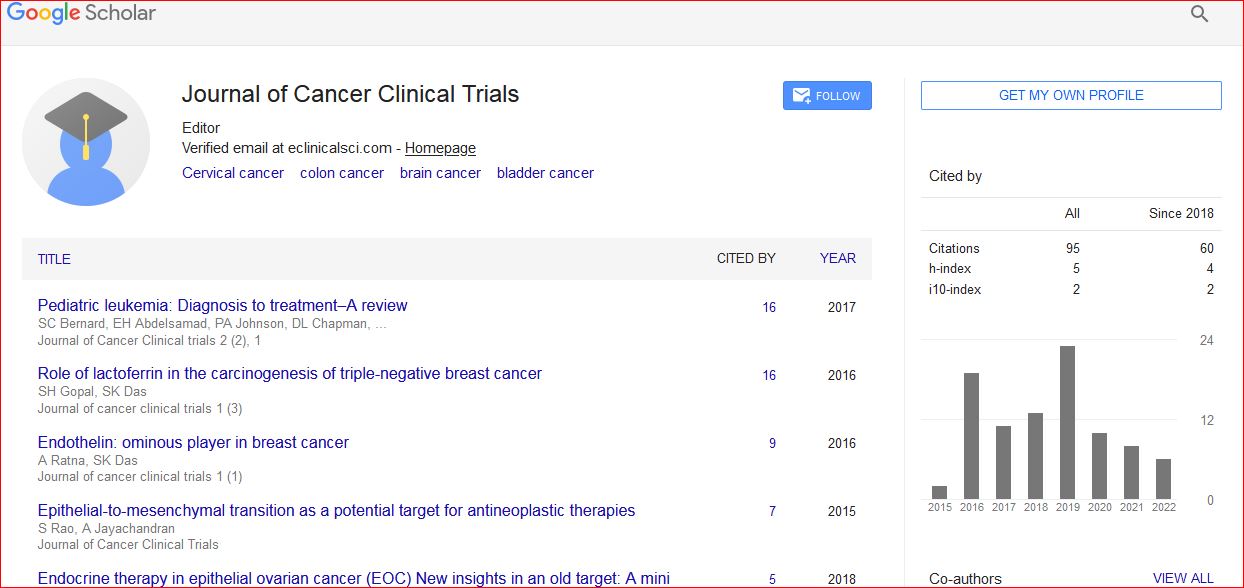
Journal of Cancer Clinical Trials received 95 citations as per Google Scholar report