Perspective - (2025) Volume 15, Issue 4
Received: 31-Jul-2025, Manuscript No. jmcj-25-176900;
Editor assigned: 04-Aug-2025, Pre QC No. P-176900;
Reviewed: 18-Aug-2025, QC No. Q-176900;
Revised: 21-Aug-2025, Manuscript No. R-176900;
Published:
28-Aug-2025
, DOI: 10.37421/2165-7912.2025.15.633
Citation: Sørensen, Emilia V.. ”Digital Regulation: Global Challenges, Divergence.” J Mass Communicat Journalism 15(2025):633.
Copyright: © 2025 Sørensen V. Emilia This is an open-access article distributed under the terms of the Creative Commons Attribution License, which permits unrestricted use,
distribution and reproduction in any medium, provided the original author and source are credited.
The digital realm presents an ever-evolving landscape of regulatory challenges, demanding nuanced approaches to content moderation, data protection, and the governance of emerging technologies. A central point of global divergence can be seen in Europe’s Digital Services Act (DSA), which aims to hold online platforms significantly more accountable for content moderation. This legislation places real obligations on these platforms, marking a departure from the often more hands-off regulatory philosophy observed in the United States, thereby highlighting distinct guiding principles for online governance in major jurisdictions. This comparative analysis is crucial for grasping the global divergence in internet regulation [1].
As new immersive digital spaces emerge, such as the metaverse, legal complexities are rapidly taking shape. Effectively regulating these nascent virtual worlds necessitates a strong call for international cooperation. Researchers explore potential legal gaps and propose strategies designed to foster a coherent global regulatory framework, moving away from a fragmented approach as these virtual environments become increasingly prevalent. This ensures that legal frameworks can keep pace with technological advancement [2].
The European Union, for its part, has articulated a comprehensive strategy for Artificial Intelligence (AI) governance. This strategy is conceptualized as a multi-layered system crafted to adeptly manage both the inherent risks and the significant opportunities presented by AI. It delves into the various legal instruments and policy initiatives that the EU is currently deploying, offering a clear understanding of how they intend to integrate AI into existing legal frameworks while simultaneously safeguarding fundamental rights across the bloc [3].
Another persistent challenge in the global digital economy involves data transfers under the General Data Protection Regulation (GDPR). This area presents new hurdles for businesses operating across borders. Experts explain the complexities companies and regulators face in navigating these intricate legal requirements, all with the goal of ensuring that data protection remains robust, even in an international context. This ensures a consistent approach to privacy across diverse jurisdictions [4].
Building on the theme of digital services, a sharp comparison can be drawn between the European Union's Digital Services Act and the United States' methodology for regulating online speech. This comparison brings into focus the distinct legal and philosophical frameworks at play in each region, demonstrating how both jurisdictions contend with the delicate act of balancing free expression against the imperative to combat harmful content found on digital platforms. Understanding these different paths offers critical insight into varying regulatory philosophies [5].
Beyond content and data, fundamental access to digital infrastructure also requires significant policy attention. Universal service obligations, traditionally associated with telephone services, need a complete overhaul to adequately address the critical issues of broadband access and affordability in our increasingly digitized world. The authors in one study investigate innovative policy frameworks and economic models that could guarantee equitable access to high-speed internet for everyone, recognizing it as a fundamental necessity rather than a luxury in modern society [6].
In the realm of advanced mobile technology, the intricate world of 5G and spectrum policy presents both significant challenges and vast opportunities for future communications. Delving into this, the discussion centers on how decisions regarding spectrum allocation directly influence the successful deployment of 5G networks, impacting crucial aspects such as speed, capacity, and the broader economic and social benefits derived from these advanced technologies [7].
The global landscape also grapples with the pervasive issue of online harms. Research offers a global overview of the varied attempts by different jurisdictions to manage these harms, underscoring a persistent struggle for regulatory coherence across borders. This highlights the complexities inherent in crafting effective rules to tackle problems like cyberbullying, hate speech, and misinformation, all while respecting the diverse legal and cultural norms prevalent across the world. It provides a nuanced perspective on a genuinely tough, multifaceted problem [8].
Here’s the thing, regulating disinformation presents its own unique set of challenges, particularly when considering the invaluable lessons learned during the COVID-19 pandemic. Authors explore the delicate tightrope walk required to curb harmful false narratives while simultaneously protecting free speech. They offer practical insights into how communications law might need to evolve to better address this pervasive issue without inadvertently stifling legitimate public discourse. This balance is critical for democratic societies [9].
Finally, the long-running debate surrounding net neutrality is revisited, drawing valuable insights from the United States’ experience following the repeal of its Title II regulations and contrasting these with lessons gleaned from European approaches. This analysis meticulously unpacks the economic, legal, and political factors that continuously shape policies governing internet service provider behavior. It offers a clearer perspective on what is truly at stake for both competition within the digital market and consumer access to internet services worldwide [10].
The modern digital age is characterized by rapid technological advancement and an equally swift evolution in regulatory challenges. One significant area of focus is online platform accountability, particularly concerning content moderation. Europe’s Digital Services Act (DSA) represents a strong regulatory framework designed to impose substantial obligations on online platforms, contrasting sharply with the United States' typically more hands-off approach to content governance. This divergence in philosophy highlights different strategies for managing digital spaces and underscores the complex interplay between legal frameworks and technological realities [C001, C005]. These contrasting regulatory models reveal a global split in how jurisdictions balance free expression with the necessity of mitigating harmful content online.
Emerging digital environments, such as the metaverse, introduce new frontiers for legal scrutiny. The intricate legal complexities inherent in these immersive spaces demand an international cooperative effort to establish effective regulation. Without such collaboration, there's a risk of fragmented legal frameworks that could hinder growth and create regulatory arbitrage. Experts suggest strategies to bridge potential legal gaps, aiming for a coherent global standard rather than a patchwork of regional rules as virtual worlds become more pervasive [C002]. Similarly, the European Union is pioneering a comprehensive, multi-layered strategy for Artificial Intelligence (AI) governance. This framework is meticulously designed to navigate both the significant risks and the substantial opportunities presented by AI. It integrates various legal instruments and policy initiatives to ensure AI development and deployment align with existing legal norms and uphold fundamental rights [C003].
Another critical aspect of digital governance involves the challenges surrounding data transfers under the General Data Protection Regulation (GDPR). As the digital economy globalizes, businesses face increasing hurdles when moving data across international borders. Regulators and companies are actively seeking ways to manage these complex requirements to uphold data protection standards universally. This ongoing effort is essential for maintaining trust and security in a globally interconnected data landscape [C004]. Moreover, fundamental access to digital services remains a key policy concern. Universal service obligations, historically applied to traditional telephony, require a fundamental re-evaluation to address contemporary needs for broadband access and affordability. Innovative policy frameworks and economic models are being explored to ensure equitable access to high-speed internet, recognizing it as an essential utility in the digital era [C006].
The infrastructure supporting advanced digital communication also presents its own set of regulatory considerations. The future of communications heavily relies on effective 5G and spectrum policy. Decisions on spectrum allocation directly influence the speed, capacity, and overall deployment of 5G networks, impacting their broad economic and social benefits. This highlights the strategic importance of regulatory decisions in fostering technological progress [C007]. Simultaneously, managing online harms is a persistent global struggle. Jurisdictions worldwide grapple with creating coherent rules to address issues like cyberbullying, hate speech, and misinformation. The challenge lies in developing effective regulations that respect diverse legal and cultural norms, underscoring the nuanced and multifaceted nature of this problem [C008].
The regulation of disinformation has emerged as a particularly pressing issue, illuminated by lessons learned during the COVID-19 pandemic. This involves a delicate balancing act: curbing harmful false narratives without stifling legitimate free speech. Communications law is evolving to meet this challenge, seeking practical insights to manage the pervasive spread of misinformation while preserving open discourse [C009]. Lastly, the long-standing debate around net neutrality continues to shape internet policy. Insights from the United States, particularly after the repeal of Title II regulations, contrasted with European experiences, reveal the economic, legal, and political factors influencing internet service provider behavior. This ongoing discussion is vital for determining the future of competition and consumer access in the digital landscape [C010].
The modern digital age is characterized by rapid technological advancement and an equally swift evolution in regulatory challenges. One significant area of focus is online platform accountability, particularly concerning content moderation. Europe’s Digital Services Act (DSA) represents a strong regulatory framework designed to impose substantial obligations on online platforms, contrasting sharply with the United States' typically more hands-off approach to content governance. This divergence in philosophy highlights different strategies for managing digital spaces and underscores the complex interplay between legal frameworks and technological realities [C001, C005]. These contrasting regulatory models reveal a global split in how jurisdictions balance free expression with the necessity of mitigating harmful content online.
Emerging digital environments, such as the metaverse, introduce new frontiers for legal scrutiny. The intricate legal complexities inherent in these immersive spaces demand an international cooperative effort to establish effective regulation. Without such collaboration, there's a risk of fragmented legal frameworks that could hinder growth and create regulatory arbitrage. Experts suggest strategies to bridge potential legal gaps, aiming for a coherent global standard rather than a patchwork of regional rules as virtual worlds become more pervasive [C002]. Similarly, the European Union is pioneering a comprehensive, multi-layered strategy for Artificial Intelligence (AI) governance. This framework is meticulously designed to navigate both the significant risks and the substantial opportunities presented by AI. It integrates various legal instruments and policy initiatives to ensure AI development and deployment align with existing legal norms and uphold fundamental rights [C003].
Another critical aspect of digital governance involves the challenges surrounding data transfers under the General Data Protection Regulation (GDPR). As the digital economy globalizes, businesses face increasing hurdles when moving data across international borders. Regulators and companies are actively seeking ways to manage these complex requirements to uphold data protection standards universally. This ongoing effort is essential for maintaining trust and security in a globally interconnected data landscape [C004]. Moreover, fundamental access to digital services remains a key policy concern. Universal service obligations, historically applied to traditional telephony, require a fundamental re-evaluation to address contemporary needs for broadband access and affordability. Innovative policy frameworks and economic models are being explored to ensure equitable access to high-speed internet, recognizing it as an essential utility in the digital era [C006].
The infrastructure supporting advanced digital communication also presents its own set of regulatory considerations. The future of communications heavily relies on effective 5G and spectrum policy. Decisions on spectrum allocation directly influence the speed, capacity, and overall deployment of 5G networks, impacting their broad economic and social benefits. This highlights the strategic importance of regulatory decisions in fostering technological progress [C007]. Simultaneously, managing online harms is a persistent global struggle. Jurisdictions worldwide grapple with creating coherent rules to address issues like cyberbullying, hate speech, and misinformation. The challenge lies in developing effective regulations that respect diverse legal and cultural norms, underscoring the nuanced and multifaceted nature of this problem [C008].
The regulation of disinformation has emerged as a particularly pressing issue, illuminated by lessons learned during the COVID-19 pandemic. This involves a delicate balancing act: curbing harmful false narratives without stifling legitimate free speech. Communications law is evolving to meet this challenge, seeking practical insights to manage the pervasive spread of misinformation while preserving open discourse [C009]. Lastly, the long-standing debate around net neutrality continues to shape internet policy. Insights from the United States, particularly after the repeal of Title II regulations, contrasted with European experiences, reveal the economic, legal, and political factors influencing internet service provider behavior. This ongoing discussion is vital for determining the future of competition and consumer access in the digital landscape [C010].
The digital landscape faces complex regulatory challenges globally. Europe's Digital Services Act (DSA) creates accountability for online platforms regarding content moderation, a stark contrast to the United States' more hands-off stance. This divergence highlights differing philosophies in online governance. Parallel to this, regulating the emerging metaverse demands international cooperation to avoid fragmented legal frameworks. The European Union has also adopted a multi-layered approach to Artificial Intelligence (AI) governance, aiming to manage risks and opportunities while upholding fundamental rights. Data transfers under the General Data Protection Regulation (GDPR) pose ongoing hurdles in a globalized digital economy, requiring nuanced navigation by businesses and regulators to maintain robust protection internationally. Meanwhile, policymakers need to re-evaluate universal service obligations to ensure equitable broadband access and affordability, acknowledging internet as a necessity. The deployment of 5G networks relies heavily on effective spectrum policy, influencing economic and social benefits derived from advanced mobile technology. Addressing online harms like cyberbullying, hate speech, and misinformation remains a global struggle for regulatory coherence, complicated by diverse legal and cultural norms. The COVID-19 pandemic offered lessons on the challenges of regulating disinformation, balancing free speech with the need to curb harmful narratives. Lastly, the long-standing net neutrality debate continues, with experiences from the US after repealing Title II regulations offering insights when compared with European approaches, shaping competition and consumer access.
None
None
Sofia R, Joost vE, Joris vH. "The Digital Services Act and the Future of Content Moderation: A Comparative Analysis with US Approaches".J. Inf. Pol. 13 (2023):114-142.
Indexed at, Google Scholar, Crossref
Nicolo Z, Pedro ASN, Paulo SAN. "Regulating the Metaverse: A Call for International Cooperation".J. Digital Media & Pol. 14 (2023):299-317.
Indexed at, Google Scholar, Crossref
Natali H, Michael V, M.I. vE. "Governing Artificial Intelligence in Europe: A Multi-Layered Approach".Int. Rev. Intell. Prop. & Comp. Law (IIC) 52 (2021):413-437.
Indexed at, Google Scholar, Crossref
Christopher K, Lee AB, Fred HC. "The GDPR and Data Transfers: Navigating New Challenges in a Globalized Digital Economy".Int. Data Privacy Law 10 (2020):1-20.
Indexed at, Google Scholar, Crossref
Clara IK, Monika Z, Christian K. "Regulating Online Speech: Comparing the European Union's Digital Services Act and the United States' Approach".Internet Pol. Rev. 12 (2023):1-20.
Indexed at, Google Scholar, Crossref
Christopher SY, David ES, Alison HG. "The Future of Universal Service Obligations in the Era of Digital Transformation".Telecomm. Pol. 45 (2021):102170.
Indexed at, Google Scholar, Crossref
Martin C, William L, Dirk vZ. "5G and Spectrum Policy: Challenges and Opportunities for Future Communications".J. Regul. Econ. 58 (2020):115-140.
Indexed at, Google Scholar, Crossref
Sonia L, Julian S, Ellen H. "Online Harms and the Struggle for Regulatory Coherence: A Global Perspective".J. Comm. 70 (2020):743-764.
Indexed at, Google Scholar, Crossref
Tarlach M, Daphne K, Damian T. "The Challenges of Regulating Disinformation: Lessons from the COVID-19 Pandemic".Digital J. 9 (2021):1-22.
Indexed at, Google Scholar, Crossref
Christopher SY, Johannes MB, Christopher TT. "Net Neutrality in a Post-Title II World: The US Experience and European Lessons".Telecomm. Pol. 43 (2019):416-431.
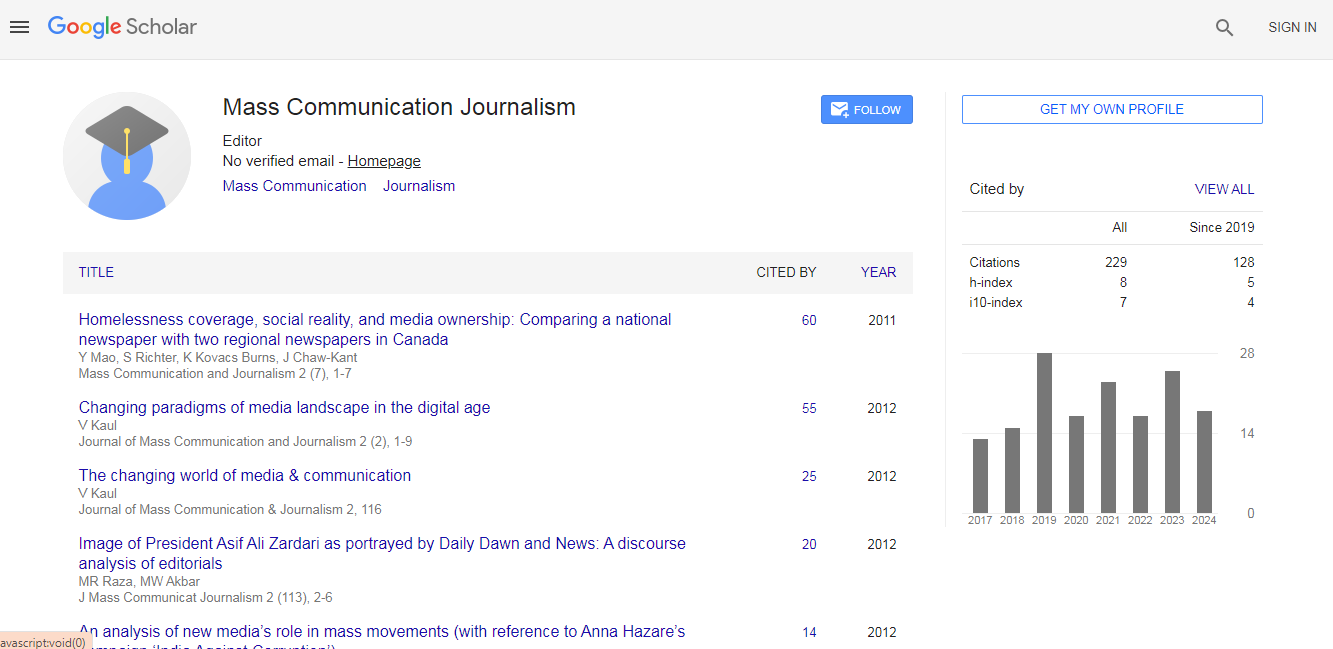
Journal of Mass Communication & Journalism received 205 citations as per Google Scholar report