Perspective - (2025) Volume 14, Issue 4
Received: 01-Aug-2025, Manuscript No. jeom-25-188182;
Editor assigned: 04-Aug-2025, Pre QC No. P-188182;
Reviewed: 18-Aug-2025, QC No. Q-188182;
Revised: 22-Aug-2025, Manuscript No. R-188182;
Published:
29-Aug-2025
, DOI: 10.37421/2169-026X.2025.14.545
Citation: Al-Harbi, Noura. ”Digital Innovation Drives Organizational Performance And Growth.” J Entrepren Organiz Manag 14 (2025):545.
Copyright: © 2025 Al-Harbi N. This is an open-access article distributed under the terms of the Creative Commons Attribution License, which permits unrestricted use, distribution and reproduction in any medium, provided the original author and source are credited.
Digital innovation has become a pivotal force, fundamentally altering the landscape of organizational performance across various sectors. Its influence is pervasive, driving improvements in operational efficiency and fostering the development of entirely new business models. Moreover, digital advancements are instrumental in enhancing customer engagement, a critical factor for sustained success in today's competitive market. These innovations facilitate data-driven decision-making, empowering organizations to make more informed and strategic choices. Internal processes are significantly streamlined through the automation enabled by digital tools, leading to greater productivity and reduced errors. Digital transformation also imbues organizations with greater agility, allowing them to respond more swiftly and effectively to evolving market dynamics. Consequently, organizations that adeptly integrate digital tools and strategies often witness a tangible improvement in their profitability and a notable expansion of their market share. This strategic adoption of digital technologies positions firms to achieve and maintain a stronger competitive advantage in their respective industries. The exploration of how firms leverage these digital technologies for competitive gain reveals a strong correlation with enhanced operational efficiency. It underscores the necessity of a supportive organizational culture and a workforce equipped with the requisite digital skills to fully realize the benefits of digital transformation.
Digital innovation significantly reshapes organizational performance by driving efficiency, fostering new business models, and enhancing customer engagement. It enables data-driven decision-making, improves internal processes through automation, and allows for greater agility in responding to market changes. Organizations that effectively integrate digital tools and strategies often experience improved profitability, increased market share, and a stronger competitive advantage. This study explores how firms leverage digital technologies for competitive advantage, finding that strategic adoption of digitalization correlates with improved operational efficiency and innovation capacity. It highlights the importance of a supportive organizational culture and skilled workforce in realizing the full benefits of digital transformation. This research investigates the link between digital innovation and firm performance in small and medium-sized enterprises (SMEs). Findings suggest that early adopters of digital technologies experience enhanced productivity and market reach, though access to capital and digital literacy remain key challenges. The study examines the moderating effect of organizational culture on the relationship between digital innovation and performance. A culture that embraces change and experimentation is found to amplify the positive impact of digital investments on organizational outcomes. This paper analyzes the role of artificial intelligence (AI) in enhancing organizational performance through process automation and improved decision-making.
Digital innovation is a transformative force that significantly enhances organizational performance by boosting efficiency, creating new business models, and improving customer engagement. It enables data-driven decisions, streamlines processes through automation, and increases market responsiveness. Organizations embracing digital tools achieve better profitability, market share, and competitive advantage. Strategic adoption of digitalization, supported by a positive culture and skilled workforce, is crucial for this success. This is particularly relevant for SMEs, despite challenges like capital access and digital literacy. Organizational culture acts as a moderator, amplifying the positive effects of digital investments. Artificial intelligence, through automation and better decision-making, further contributes to efficiency and productivity when integrated strategically. Digital tools also improve customer relationship management by enabling personalized experiences, leading to higher satisfaction and loyalty. Digital leadership is essential for driving innovation and performance. Digital platforms offer new revenue streams and competitive positioning. Ultimately, digital transformation fosters organizational agility, crucial for adapting to dynamic markets, and data analytics empowers more precise strategic planning.
None
None
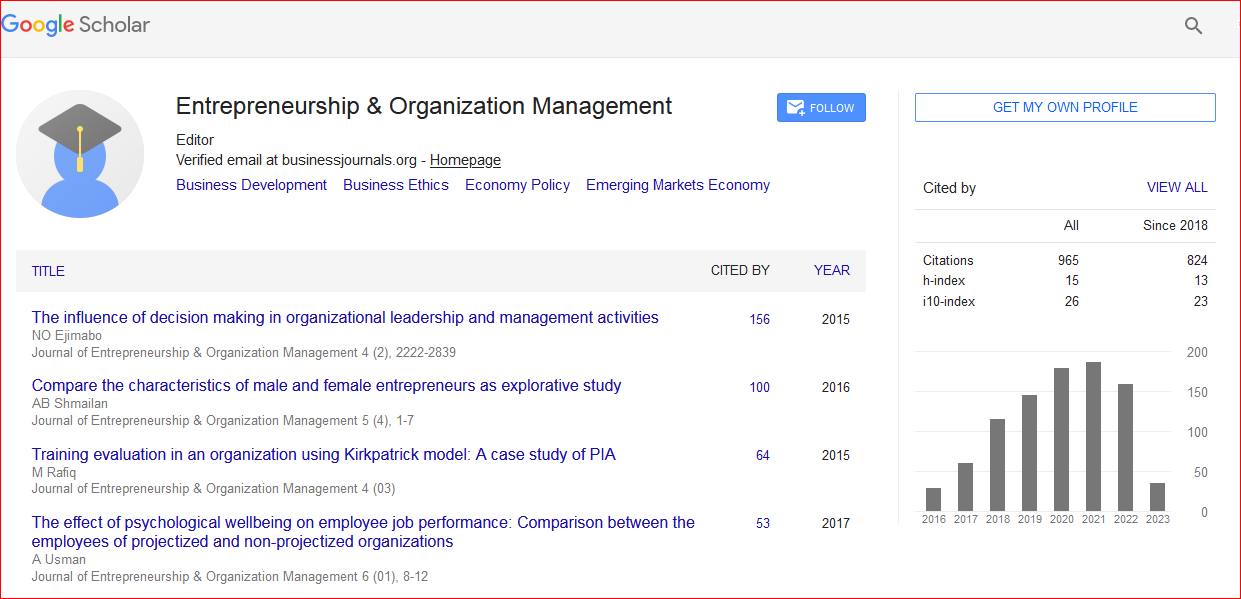
Entrepreneurship & Organization Management received 1115 citations as per Google Scholar report