Perspective - (2025) Volume 10, Issue 6
Received: 01-Dec-2025, Manuscript No. jidm-26-188116;
Editor assigned: 03-Dec-2025, Pre QC No. P-188116;
Reviewed: 17-Dec-2025, QC No. Q-188116;
Revised: 22-Dec-2025, Manuscript No. R-188116;
Published:
29-Dec-2025
, DOI: 10.37421/2576-1420.2025.10.437
Citation: Lopez, Fernando. ”Digital Health: Revolutionizing Infectious
Disease Monitoring and Response.” J Infect Dis Med 10 (2025):437.
Copyright: © 2025 Lopez F. This is an open-access article distributed under the terms of the Creative Commons Attribution License, which permits unrestricted use, distribution
and reproduction in any medium, provided the original author and source are credited.
Digital health technologies are fundamentally reshaping the landscape of infectious disease monitoring, offering unprecedented capabilities for rapid detection, real-time tracking, and the implementation of more effective public health interventions. These advancements, including mobile applications, wearable sensors, and sophisticated AI-powered analytics, are instrumental in fostering community-based surveillance, enhancing outbreak prediction accuracy, and enabling the deployment of personalized intervention strategies. This holistic approach significantly bolsters our collective capacity to combat the ever-present threat of infectious diseases [1].
The integration of artificial intelligence (AI) and machine learning (ML) into digital health platforms represents a substantial leap forward in the prediction of infectious disease outbreaks. By analyzing a wide array of data streamsâ??ranging from social media trends to comprehensive electronic health recordsâ??these intelligent systems can identify complex patterns and forecast potential epidemic trajectories with greater precision. This predictive power empowers public health agencies to initiate proactive interventions and mitigate the impact of emerging threats [2].
Wearable sensors are emerging as a groundbreaking tool for the continuous, passive monitoring of physiological data, which can serve as early indicators of infection. These devices meticulously detect subtle alterations in vital signs such as heart rate, body temperature, and respiratory patterns. This early detection capability can alert individuals and healthcare providers to potential illnesses even before overt symptoms manifest, thereby facilitating prompt isolation and treatment measures, crucial for containing outbreaks [3].
Mobile health applications are proving to be indispensable for decentralized infectious disease surveillance. They empower individuals to readily report their symptoms and potential exposure history, generating valuable crowdsourced data. When this information is aggregated and rigorously analyzed, it provides critical insights into the dynamics of disease spread at the community level. This approach complements traditional epidemiological methods and enables a more agile and rapid response to public health emergencies [4].
The application of big data analytics, in synergy with digital health tools, facilitates a comprehensive and in-depth monitoring of infectious diseases. By integrating diverse data sourcesâ??including insights from genomic sequencing, detailed electronic health records, and an understanding of social determinants of healthâ??a more holistic comprehension of disease dynamics, transmission patterns, and underlying risk factors can be achieved. This integrated approach offers a more complete picture for effective control strategies [5].
Digital contact tracing applications, many of which were developed and refined during the recent COVID-19 pandemic, have demonstrated significant potential in rapidly identifying individuals who may have been exposed to an infectious agent. Despite ongoing discussions regarding privacy concerns, the underlying technologies supporting swift notification of exposed individuals and the dissemination of essential public health guidance are now well-established and readily deployable [6].
The utilization of social media data for syndromic surveillance of infectious diseases presents a valuable complementary approach to conventional public health monitoring methods. By systematically analyzing online discussions, search queries, and public sentiment related to various symptoms, public health agencies can obtain early, real-time indicators of potential disease outbreaks, often before they are detected through other channels [7].
Telemedicine platforms are assuming an increasingly vital role in the effective management of infectious diseases. These platforms enable remote patient consultations, facilitate diagnostic assessments, and allow for continuous patient monitoring without the need for physical proximity. This is particularly beneficial for individuals residing in remote geographical areas or during periods of intense public health crises, thereby reducing the strain on healthcare facilities and minimizing the risk of disease transmission [8].
The successful global implementation of digital health strategies for infectious disease monitoring hinges on the establishment of robust data infrastructure, the adoption of interoperability standards, and the development of strong data privacy frameworks. Addressing these fundamental challenges is paramount to maximizing the effectiveness, scalability, and equitable adoption of these transformative technologies worldwide [9].
Blockchain technology is emerging as a promising solution for enhancing the security, transparency, and traceability of infectious disease data. Its inherent decentralized nature contributes to improved data integrity, facilitates secure data sharing among various stakeholders without a central point of failure, and fosters greater trust in the reliability of digital health surveillance systems and the data they generate [10].
Digital health technologies are revolutionizing infectious disease monitoring, offering enhanced capabilities for early detection, real-time tracking, and more efficient public health responses. The integration of mobile applications, wearable sensors, and AI-powered analytics enables community-based surveillance, improves outbreak prediction, and supports personalized intervention strategies, ultimately strengthening our defenses against infectious diseases [1].
Artificial intelligence and machine learning are significantly improving the accuracy and speed of infectious disease outbreak prediction when integrated into digital health platforms. These advanced tools analyze diverse data streams, including social media trends and electronic health records, to identify patterns and forecast epidemic trajectories, thus supporting proactive public health interventions [2].
Wearable sensors provide a novel means for continuous, passive monitoring of physiological data that can signal early infection. By detecting subtle changes in heart rate, temperature, and respiratory patterns, these devices can alert individuals and healthcare providers to potential illnesses before symptoms become apparent, enabling timely isolation and treatment [3].
Mobile health applications are critical for decentralized infectious disease surveillance, allowing individuals to self-report symptoms and exposure history. This crowdsourced data, when aggregated and analyzed, offers valuable insights into disease spread at the community level, complementing traditional epidemiological methods and facilitating rapid responses [4].
Big data analytics, used in conjunction with digital health tools, enable comprehensive monitoring of infectious diseases. By integrating data from sources like genomic sequencing, electronic health records, and social determinants of health, a more holistic understanding of disease dynamics and risk factors can be achieved [5].
Digital contact tracing applications, notably those developed during the COVID-19 pandemic, have shown potential for the rapid identification of exposed individuals. While privacy remains a concern, the technological capabilities for swift notification and public health guidance are well-established [6].
The use of social media data for syndromic surveillance of infectious diseases offers a complementary approach to traditional methods. Analyzing online discussions and search queries related to symptoms can provide public health agencies with early indicators of disease outbreaks [7].
Telemedicine platforms are increasingly vital for infectious disease management, allowing for remote patient consultations, diagnosis, and monitoring. This is especially important for individuals in remote areas or during public health crises, reducing healthcare facility burdens and transmission risks [8].
The global implementation of digital health strategies for infectious disease monitoring necessitates robust data infrastructure, interoperability standards, and strong data privacy frameworks. Addressing these challenges is key to maximizing the effectiveness and equitable adoption of these technologies worldwide [9].
Blockchain technology offers potential benefits for enhancing the security, transparency, and traceability of infectious disease data. Its decentralized nature can improve data integrity, facilitate secure data sharing among stakeholders, and build trust in digital health surveillance systems [10].
Digital health technologies, including AI, machine learning, wearable sensors, and mobile applications, are revolutionizing infectious disease monitoring and response. These tools enable faster detection, real-time tracking, and more efficient public health interventions. AI and ML enhance outbreak prediction by analyzing diverse data streams, while wearable sensors detect early infection signs through physiological monitoring. Mobile apps facilitate decentralized surveillance through crowdsourced data. Big data analytics and social media monitoring provide comprehensive insights and early outbreak indicators. Digital contact tracing shows potential for rapid exposure identification, and telemedicine improves remote management. Blockchain technology offers enhanced security and transparency for disease data. However, successful global implementation requires robust infrastructure, interoperability, and strong privacy frameworks.
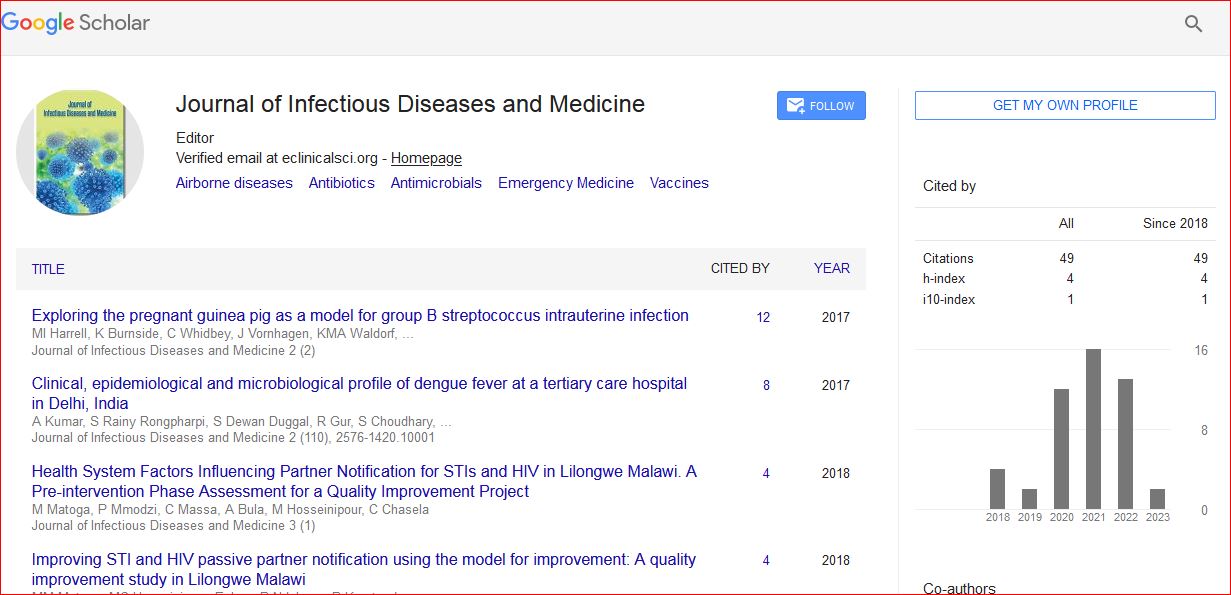
Journal of Infectious Diseases and Medicine received 1059 citations as per Google Scholar report