Commentary - (2025) Volume 11, Issue 4
Received: 03-Aug-2025, Manuscript No. abp-25-173837;
Editor assigned: 05-Aug-2025, Pre QC No. P-173837;
Reviewed: 19-Aug-2025, QC No. Q-173837;
Revised: 25-Aug-2025, Manuscript No. R-173837;
Published:
30-Aug-2025
, DOI: 10.37421/2472-0496.2025.11.338
Citation: Mbele, Grace. ”Digital Health, AI Transform Cancer Symptom Care.” Abnorm Behav Psychol 11 (2025):338.
Copyright: © 2025 Mbele G. This is an open-access article distributed under the terms of the Creative Commons Attribution License, which permits unrestricted use, distribution and reproduction in any medium, provided the original author and source are credited.
Systematic reviews highlight the increasing adoption of digital health tools for assessing and managing symptoms in cancer patients. It is clear that these interventions offer potential for improved symptom control and patient quality of life, but more research is needed to refine their implementation and measure long-term effectiveness across diverse populations [1].
Scoping reviews explore real-time symptom monitoring in pediatric oncology, pointing out the value of continuous data collection for managing treatment-related side effects. A key takeaway is how technology can empower families and clinicians to make timely, informed decisions, though careful consideration of feasibility and data interpretation is essential [2].
Digital symptom monitoring and management effectively improve cancer patients' symptoms and quality of life. Meta-analyses demonstrate how these tools reduce symptom severity and interference, clearly indicating that integrating digital solutions into cancer care can lead to better patient outcomes [3].
Artificial Intelligence (AI) is quickly becoming a valuable asset in symptom management across various conditions. Reviews point out AI's potential to personalize care, predict symptom exacerbations, and optimize treatment strategies, fundamentally shifting how we approach patient support [4].
Machine Learning (ML) offers a powerful approach for symptom assessment and prediction in patients with advanced cancer. Research indicates its promise in identifying patterns, predicting symptom trajectories, and informing proactive interventions to improve comfort and care planning [5].
The systematic integration of Patient-Reported Outcomes (PROs) into oncology care is fundamentally transforming how symptom management is approached. This article shows how systematic Patient-Reported Outcomes (PROs) collection leads to earlier detection of symptoms, better patient-clinician communication, and ultimately, more targeted and effective interventions, improving both survival and quality of life [6].
Digital tools for remote monitoring and managing symptoms in cancer patients are generally well-received and can lead to a sense of empowerment. Qualitative reviews emphasize that while these digital tools are promising, their design and implementation need to be patient-centered to truly enhance the care experience [7].
Assessing patient-reported symptom burden and quality of life is crucial in palliative care. Systematic reviews and meta-analyses underscore the importance of consistent, validated symptom assessment to ensure comprehensive, person-centered care that truly addresses patient needs and improves their overall well-being at end-of-life [8].
Digital health continues to grow in its vital role for supporting symptom management in cancer patients. Scoping reviews identify various digital tools and their applications, highlighting how they can facilitate self-management, improve communication with healthcare providers, and offer personalized support, ultimately enhancing care continuity [9].
Telehealth-based interventions show considerable promise for symptom management in cancer patients. Systematic reviews emphasize their capacity to deliver timely support, reduce treatment burden, and improve accessibility to care, particularly crucial for those in remote areas or with mobility challenges [10].
Digital health tools are increasingly central to modern symptom management, particularly within oncology. Systematic reviews highlight how these interventions enhance symptom control and considerably improve the quality of life for cancer patients [1, 3]. This widespread adoption signifies a critical shift towards more proactive and responsive care models. These tools effectively reduce symptom severity and mitigate the interference symptoms cause in daily life, leading to demonstrably better patient outcomes [3]. This indicates a clear advantage of integrating digital solutions into standard cancer care, promising a higher standard of support for complex health conditions.
Patient reception to digital tools for remote monitoring and active symptom management is generally positive, with many reporting a valuable sense of empowerment over their own health journey. This positive feedback underscores the importance of patient-centered design and thoughtful deployment to truly elevate the care experience and ensure maximum benefit [7]. Digital health plays a vital role in supporting comprehensive symptom management by facilitating patient self-management, improving communication pathways between patients and healthcare providers, and offering personalized support. This holistic approach ensures continuous and responsive care, adapting dynamically to patient requirements [9].
Beyond general digital tools, advanced technologies like Artificial Intelligence (AI) and Machine Learning (ML) are rapidly becoming indispensable for refining and optimizing symptom management across diverse health conditions. AI offers substantial potential to personalize care approaches, accurately predict symptom exacerbations, and strategically optimize overall treatment strategies, fundamentally transforming patient support [4]. Similarly, ML presents a powerful methodology for precise symptom assessment and accurate prediction, particularly beneficial for patients with advanced cancer. Research indicates ML's capacity to identify complex patterns and predict symptom trajectories, enabling proactive interventions that significantly enhance patient comfort and inform comprehensive care planning [5]. These computational approaches empower clinicians with invaluable predictive insights.
The systematic integration of Patient-Reported Outcomes (PROs) into routine oncology care represents a transformative development in symptom management. Consistent PRO collection facilitates earlier symptom detection, which is crucial for timely intervention. It also fosters significantly better communication between patients and their clinicians, leading to more targeted and effective therapeutic interventions. This holistic approach demonstrably improves both patient survival rates and their overall quality of life [6]. In palliative care settings, the accurate and consistent assessment of patient-reported symptom burden and quality of life holds paramount importance. Rigorous systematic reviews and meta-analyses emphasize the critical necessity of using consistent, validated symptom assessment methodologies. This is essential to guarantee comprehensive, person-centered care that genuinely addresses individual patient needs and actively works to improve their overall well-being during end-of-life stages [8].
Specialized applications of technology in symptom management include real-time monitoring specifically in pediatric oncology. This area highlights the critical value of continuous data collection for proactively managing treatment-related side effects in young patients, where rapid changes can occur. Such technology empowers families and clinicians alike to make informed, timely decisions, though careful consideration of practical feasibility and accurate data interpretation remains paramount [2]. Furthermore, telehealth-based interventions are showing considerable promise for effective symptom management among cancer patients. These platforms demonstrate a clear capacity to deliver timely and crucial support, effectively reduce treatment burden, and significantly improve accessibility to specialized care. This is especially vital for individuals residing in remote geographical areas or those facing significant mobility challenges, ensuring that geographical barriers do not impede necessary medical attention [10].
The landscape of symptom management, particularly in oncology and palliative care, is rapidly changing due to advanced technologies. Digital health tools are increasingly adopted for assessing and managing symptoms in cancer patients, offering potential for improved control and patient quality of life. Real-time monitoring, particularly in pediatric oncology, proves valuable for managing treatment-related side effects, empowering families and clinicians to make timely decisions. Digital symptom monitoring consistently improves cancer patients' symptoms and overall quality of life by reducing symptom severity and interference. Artificial Intelligence (AI) and Machine Learning (ML) are becoming valuable assets in symptom management, offering personalized care, predicting symptom exacerbations, and optimizing treatment strategies. These technologies are crucial for assessing and predicting symptom trajectories in advanced cancer, enabling proactive interventions. Patient-Reported Outcomes (PROs) are transforming oncology care by leading to earlier symptom detection, better patient-clinician communication, and more targeted interventions, improving both survival and quality of life. Digital tools for remote monitoring are generally well-received by cancer patients, fostering a sense of empowerment, though patient-centered design is key. Consistent, validated symptom assessment is vital in palliative care for comprehensive, person-centered care. Digital health supports cancer patients' self-management, communication, and personalized support. Telehealth-based interventions offer timely support, reduce treatment burden, and improve care accessibility, especially for those in remote areas or with mobility challenges.
None
None
1. Hesham E, Mary S, Alaa A. "Digital Health Interventions for Symptom Assessment and Management in Cancer: A Systematic Review".JCO Clin Cancer Inform 7 (2023):e2200169.
Indexed at, Google Scholar, Crossref
2. Risha MB, Jane K, Alicia L. "Real-time Symptom Monitoring in Pediatric Oncology: A Scoping Review".J Pediatr Nurs 69 (2023):e30-e41.
Indexed at, Google Scholar, Crossref
3. Marije J, Lotte N, Cathelijne vdV. "The Effectiveness of Digital Symptom Monitoring and Management in Cancer Patients: A Systematic Review and Meta-Analysis".Cancers (Basel) 14 (2022):1728.
Indexed at, Google Scholar, Crossref
4. Zyad A, Fadi H, Roua Q. "Leveraging Artificial Intelligence in Symptom Management: A Scoping Review".J Multidiscip Healthc 16 (2023):2349-2365.
Indexed at, Google Scholar, Crossref
5. Yim H, Janna C, Lihua Y. "Machine learning for symptom assessment and prediction in patients with advanced cancer: A systematic review".Palliat Med 36 (2022):421-435.
Indexed at, Google Scholar, Crossref
6. Ethan B, Deborah S, Barbra BR. "Integrating patient-reported outcomes for symptom management in oncology: Current approaches and future directions".CA Cancer J Clin 70 (2020):255-271.
Indexed at, Google Scholar, Crossref
7. Susan A, June B, Paul DA. "Digital tools for remote monitoring and management of symptoms in patients with cancer: a systematic review of the qualitative evidence".Support Care Cancer 29 (2021):3555-3571.
Indexed at, Google Scholar, Crossref
8. Jane B, Lorraine J, John M. "Patient-reported symptom burden and quality of life in palliative care: a systematic review and meta-analysis".Lancet Oncol 22 (2021):e447-e457.
Indexed at, Google Scholar, Crossref
9. Keiko W, Shota F, Yoko O. "Use of digital health to support symptom management in patients with cancer: A scoping review".Eur J Oncol Nurs 60 (2022):102146.
Indexed at, Google Scholar, Crossref
10. Suhee L, Eun-Young Y, Hyeonsik K. "Telehealth-Based Symptom Management Interventions for Patients With Cancer: A Systematic Review".J Pain Symptom Manage 63 (2022):e1-e12.
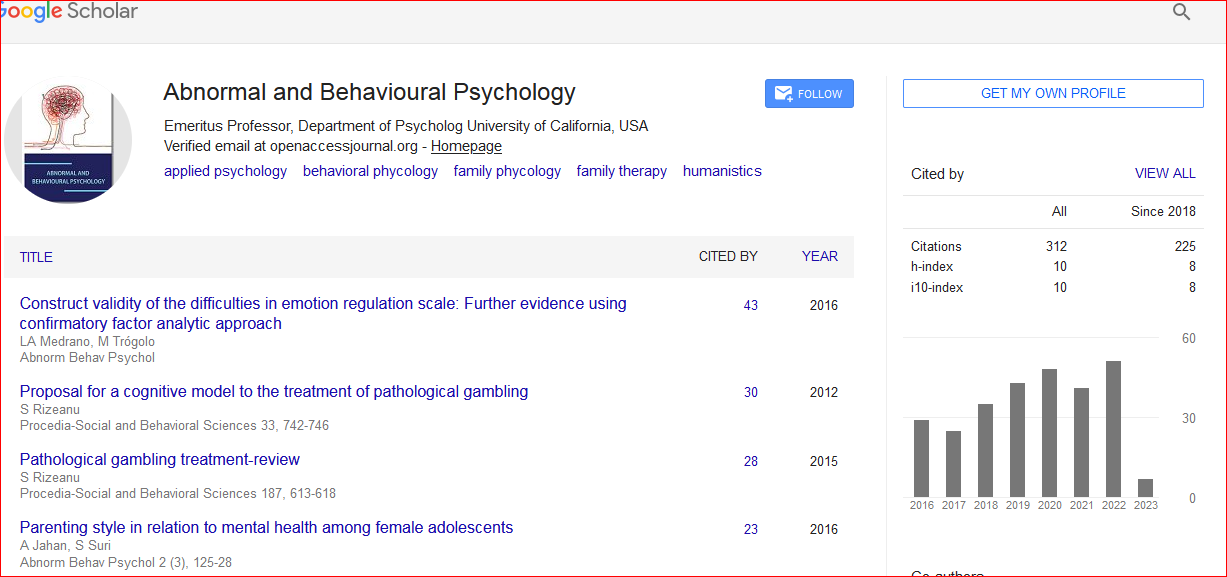
Abnormal and Behavioural Psychology received 361 citations as per Google Scholar report