Commentary - (2025) Volume 16, Issue 4
Received: 01-Aug-2025, Manuscript No. jfr-26-184111;
Editor assigned: 04-Aug-2025, Pre QC No. P-184111;
Reviewed: 18-Aug-2025, QC No. Q-184111;
Revised: 22-Aug-2025, Manuscript No. R-184111;
Published:
29-Aug-2025
, DOI: 10.37421/2157-7145.2025.16.672
Citation: Khan, Fatima Noor. ”Digital Forensics: Mobile, SIM,
and Evolving Challenges.” J Forensic Res 16 (2025):672.
Copyright: © 2025 Khan N. Fatima This is an open-access article distributed under the terms of the Creative Commons Attribution License, which permits unrestricted use,
distribution and reproduction in any medium, provided the original author and source are credited.
The forensic examination of mobile devices and SIM cards is a critical area within digital forensics, involving intricate methodologies and significant challenges in acquiring and analyzing digital evidence. These processes are paramount for preserving data integrity and ensuring the admissibility of evidence in legal proceedings, often requiring specialized tools and adherence to strict legal frameworks [1].
The field of mobile forensics has seen a rapid evolution, driven by the increasing complexity of mobile devices and the constant emergence of new technologies and data storage methods. This evolution has led to the development of advanced techniques aimed at overcoming challenges such as data encryption and secure messaging applications [2].
The ubiquitous nature of smartphones in modern society has unfortunately also made them prevalent in criminal activities, thus necessitating robust forensic analysis of SIM cards. Extracting crucial subscriber information, call logs, SMS messages, and application data from SIM cards is a key aspect of investigations [3].
Furthermore, the growing reliance on cloud services for data storage and synchronization by mobile devices introduces a new layer of complexity to forensic investigations. Acquiring and analyzing data offloaded to the cloud requires specific techniques while considering privacy concerns and legal implications [4].
A comprehensive understanding of the tools and methodologies employed in mobile device forensics is essential for practitioners. This includes knowledge of hardware-based acquisition, software-based extraction, and the analysis of diverse data types like GPS data and social media artifacts [5].
Specific operating systems, such as Android, present unique forensic challenges due to their distinct architecture and file system. Detailed methods for extracting user data, application logs, and system files from Android devices are crucial for effective investigations [6].
Beyond technical aspects, the increasing prevalence of mobile devices in investigations brings mobile forensics under the scrutiny of evolving privacy regulations, such as GDPR and CCPA. These regulations significantly impact data acquisition, storage, and analysis, demanding ethical considerations and legal compliance [7].
Similarly, the iOS ecosystem presents its own set of forensic challenges, requiring specialized techniques for data extraction and analysis from iPhones and iPads, particularly concerning file system structures and data encryption [8].
The expansion of digital ecosystems to include Internet of Things (IoT) devices, often interconnected with mobile devices, adds another dimension to forensic investigations. Acquiring and analyzing data from IoT devices, alongside mobile data, can provide a more comprehensive investigative picture [9].
Finally, the legal and ethical considerations surrounding mobile device forensics are of utmost importance. Adherence to legal standards concerning search warrants, consent, chain of custody, and expert testimony is vital to ensure the integrity and admissibility of digital evidence in court [10].
The forensic examination of mobile devices and SIM cards encompasses a detailed approach to digital evidence acquisition and analysis, emphasizing data integrity and the legal framework for admissibility in court. This involves employing specialized tools and techniques to extract and interpret both volatile and non-volatile data, thereby reconstructing events and identifying user activities essential for criminal investigations [1].
In response to technological advancements, mobile forensic techniques have evolved to address challenges posed by encrypted data and secure messaging applications. This includes developing advanced methods for bypassing device security and recovering deleted information from various storage locations, necessitating continuous skill development among practitioners [2].
The proliferation of smartphones in criminal activities has amplified the need for robust SIM card forensics. The process involves extracting subscriber information, call logs, SMS messages, and application data, while also addressing the complexities of SIM card cloning and data validation for authenticity [3].
Investigating data stored in cloud services, often synchronized with mobile devices, presents unique forensic challenges. Techniques for acquiring and analyzing this off-device data are crucial, requiring careful consideration of privacy concerns and the applicable legal implications, as well as the development of standardized protocols [4].
The landscape of mobile device forensics is continuously shaped by the array of available tools and methodologies. These range from hardware-based acquisition methods to software-based extraction techniques, covering the analysis of diverse data types such as GPS data and application-specific information, with a strong emphasis on validation and reporting [5].
Forensic analysis of Android devices requires a deep understanding of its operating system architecture and file system. Specific methodologies are employed to extract user data, application logs, and system files, including strategies for handling rooted devices and custom ROMs, underscoring the importance of grasping Android's security mechanisms [6].
Evolving privacy regulations, such as GDPR and CCPA, have a profound impact on mobile device forensics. These regulations influence how data is acquired, stored, and analyzed, requiring forensic practitioners to navigate international data laws and maintain ethical considerations and legal compliance throughout the investigative process [7].
Similarly, iOS device forensics involves specialized approaches to extract and analyze data from iPhones and iPads. This includes understanding iOS-specific file system structures, data encryption, and the analysis of user data and application artifacts, highlighting the necessity of employing specialized tools designed for the iOS ecosystem [8].
The integration of Internet of Things (IoT) devices into daily life creates new avenues for digital evidence. Forensic investigation of IoT devices, particularly their connection to mobile devices, presents challenges in data acquisition and analysis, yet offers opportunities to correlate information for a more comprehensive investigative picture [9].
Legal and ethical considerations form a cornerstone of mobile device forensics. Practitioners must navigate complex issues related to search warrants, consent, maintaining the chain of custody, and providing expert witness testimony, all while adhering to legal standards and ethical guidelines to ensure the integrity and admissibility of digital evidence [10].
Mobile device and SIM card forensics are essential for digital investigations, focusing on data integrity, specialized tools, and legal frameworks. The field is rapidly evolving to handle encrypted data, secure messaging, and diverse storage methods. SIM card analysis extracts subscriber data and communication records, while cloud-based data and IoT devices introduce new complexities. Specialized techniques are required for Android and iOS devices, respectively. Furthermore, privacy regulations and legal-ethical considerations, including search warrants and chain of custody, are paramount for ensuring the admissibility of digital evidence in court. Continuous adaptation of methodologies and tools is crucial for forensic practitioners.
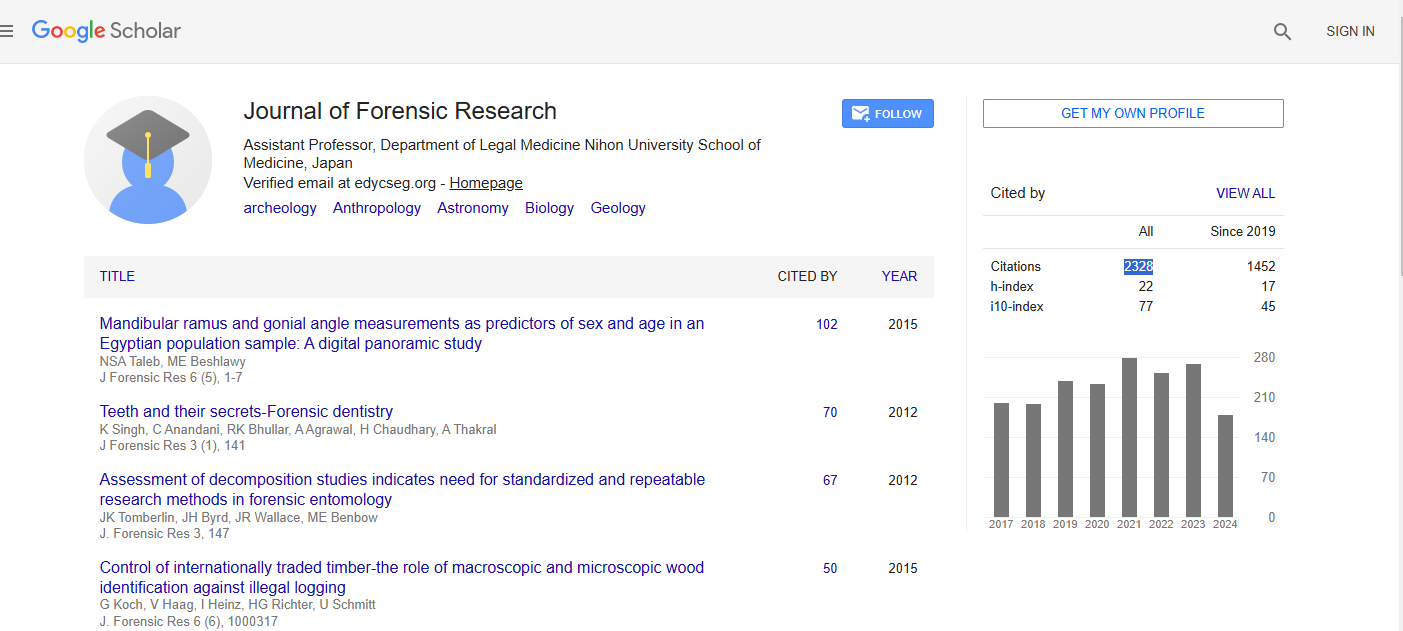
Journal of Forensic Research received 2328 citations as per Google Scholar report