Perspective - (2025) Volume 15, Issue 5
Received: 30-Sep-2025, Manuscript No. jmcj-25-176916;
Editor assigned: 02-Oct-2025, Pre QC No. P-176916;
Reviewed: 14-Feb-2025, QC No. Q-176916;
Revised: 21-Oct-2025, Manuscript No. R-176916;
Published:
28-Oct-2025
, DOI: 10.37421/2165-7912.2025.15.642
Citation: Clarke, Victoria M.. ”Digital Entertainment Journalism: Navigating Ethics and Trust.” J Mass Communicat Journalism 15(2025):642.
Copyright: © 2025 Clarke M. Victoria This is an open-access article distributed under the terms of the Creative Commons Attribution License, which permits unrestricted use,
distribution and reproduction in any medium, provided the original author and source are credited.
The landscape of entertainment journalism is complex and constantly evolving, marked by significant shifts in audience engagement, ethical considerations, and technological advancements. One key area of study examines how parasocial relationships—the one-sided connections audiences develop with media personalities—profoundly influence their perceptions of entertainment journalists and shape their news consumption behaviors [1].
These relationships, often driven by perceived similarity and attraction, play a substantial role in impacting credibility and overall engagement with entertainment news. Such dynamics highlight the unique psychological bond formed between media consumers and their preferred figures, adding a layer of complexity to how information is received and trusted. Ethical considerations remain a cornerstone of journalistic practice, particularly within the celebrity sphere [2].
Journalists covering celebrities frequently encounter difficult dilemmas concerning individual privacy, the imperative for accuracy, and the ongoing tension between serving the public interest versus succumbing to sensationalism. The pressure to secure exclusive content further compounds these moral challenges, requiring professionals to carefully navigate complex situations to uphold journalistic integrity. Understanding how these ethical landscapes are traversed offers critical insights into the real-world pressures faced by those reporting on public figures. Social media platforms have undeniably reshaped entertainment journalism, presenting both unprecedented opportunities and significant hurdles [3].
These platforms enable direct audience engagement, rapid content dissemination, and real-time reporting, fundamentally altering traditional news cycles. However, they also introduce challenges such as the rapid spread of misinformation, difficulties in assessing source credibility, and a blurring of lines between professional journalists and amateur content creators. This dynamic environment demands constant adaptation from media organizations and individual journalists alike. The perception of credibility varies significantly across different media channels, posing another crucial area of inquiry [4].
Comparative studies investigate how audiences judge the trustworthiness of entertainment journalism delivered through traditional outlets versus digital platforms. Differences in trust levels are often attributable to platform characteristics, content format, and audience demographics, indicating an ongoing evolution in the criteria used to evaluate journalistic trustworthiness within the entertainment sector. This evolving standard requires journalists to be mindful of how their content is presented and consumed across diverse mediums. Gender representation within entertainment journalism also merits close scrutiny [5].
Research often analyzes popular media outlets to identify prevailing stereotypes, disparities in coverage, and the overall portrayal of male and female celebrities. These analyses offer valuable insights into how media representations reflect and, at times, reinforce broader societal gender norms, influencing public perception and potentially shaping cultural attitudes. Addressing these disparities is vital for fostering more equitable and representative media landscapes. Innovation is a driving force as entertainment journalism adapts to the digital age and shifting audience expectations [6].
New journalistic forms, engagement strategies, and content delivery methods are emerging in direct response to the fast-paced, interactive, and increasingly personalized nature of online media consumption. This constant evolution includes exploring immersive storytelling techniques and leveraging new technologies to connect with audiences more effectively. Maintaining accuracy in the fast-moving world of entertainment news presents its own set of challenges and best practices [7].
Fact-checking is particularly difficult due to the prevalence of rumor mills, strategic celebrity public relations efforts, and the sheer speed of digital news cycles. Developing robust strategies to uphold accuracy while simultaneously maintaining relevance and audience engagement is paramount for credible reporting in this environment. The economic viability of entertainment journalism has necessitated the evolution of business models [8].
Organizations are exploring diverse revenue streams in a highly competitive digital landscape, including subscription services, branded content partnerships, and influencer marketing. These strategies aim to sustain operations and capitalize on evolving audience interests, reflecting a broader industry shift towards diversified income sources. The portrayal of celebrity activism within entertainment journalism is another area of interest [9].
Journalistic approaches to reporting on celebrities' social and political engagements are analyzed to understand their impact on public discourse. This includes examining how causes are amplified and distinguishing between genuine advocacy and potentially performative activism, which adds a layer of critical analysis to celebrity influence. Finally, the future trajectory of entertainment journalism is being charted within a rapidly converging media landscape [10].
Key trends point towards increased personalization, diversification across various platforms, and the adoption of immersive storytelling techniques. Concurrently, the field grapples with enduring challenges such as maintaining rigorous ethical standards, adapting to relentless technological shifts, and consistently meeting the ever-changing demands of a diverse audience. The ability to navigate these complexities will define the success and relevance of entertainment journalism moving forward.
The dynamic field of entertainment journalism is a subject of extensive academic inquiry, exploring its multifaceted impacts on audiences, ethical dimensions, and adaptive strategies in the digital age. A significant area of focus is the influence of parasocial relationships, which are the one-sided bonds audiences form with media personalities [1]. These connections, often stemming from perceived similarity and attraction, directly affect how audiences perceive the credibility of entertainment journalists and their subsequent news consumption habits. Understanding these psychological dynamics is crucial for grasping audience engagement in this sector.
Ethical considerations are paramount within celebrity journalism, where practitioners frequently grapple with complex dilemmas [2]. These challenges include safeguarding celebrity privacy, ensuring factual accuracy in reporting, and balancing the public's right to know against the potential for sensationalism. The inherent pressure to secure exclusive stories further complicates these ethical landscapes, demanding a high degree of moral judgment from journalists. Additionally, the broader media environment, particularly the rise of social media platforms, has dramatically reshaped how entertainment news is produced and consumed [3]. While offering unprecedented opportunities for direct audience engagement, content dissemination, and real-time updates, social media also introduces significant challenges. These include the rapid spread of misinformation, difficulties in verifying source credibility, and the blurring boundaries between professional and amateur content creators. These shifts necessitate constant vigilance and adaptation from news organizations.
Perceptions of credibility are not uniform across all platforms, highlighting a critical divergence in audience trust [4]. Comparative studies reveal that audiences assess the trustworthiness of entertainment journalism differently when presented through traditional media versus digital platforms. Factors such as platform characteristics, content format, and audience demographics play a crucial role in shaping these perceptions, indicating an evolving standard for what constitutes credible reporting in the entertainment sphere. In response to these shifts, entertainment journalism is continuously innovating to meet the demands of digital platforms and evolving audience expectations [6]. This involves developing new journalistic forms, engagement strategies, and content delivery methods that align with the fast-paced, interactive, and personalized nature of online media consumption. These innovations are essential for maintaining relevance and audience connection.
Moreover, the content itself is subject to rigorous examination. Research delves into gender representation within entertainment journalism, using content analysis to identify prevailing stereotypes, disparities in coverage, and the portrayal of male and female celebrities [5]. These studies offer vital insights into how media narratives reflect and reinforce broader societal gender norms. Similarly, the fact-checking process in entertainment news faces unique challenges due to the prevalence of rumor mills, celebrity public relations strategies, and the rapid pace of digital news cycles [7]. Developing and implementing best practices for upholding accuracy while simultaneously maintaining audience engagement and relevance is a continuous imperative for the industry.
The economic underpinnings of entertainment journalism are also evolving, with new business models emerging to sustain operations in a competitive digital landscape [8]. These models explore various revenue generation strategies, including subscription services, branded content collaborations, and influencer marketing, all aimed at capitalizing on audience interest and diversifying income streams. Another significant aspect is the portrayal of celebrity activism within entertainment journalism [9]. Analysis focuses on how journalists frame celebrity social and political engagements, exploring the impact on public discourse and differentiating between genuine advocacy and performative activism. These critical analyses contribute to a deeper understanding of celebrity influence and its media representation.
Looking forward, the future of entertainment journalism is characterized by several key trends, including increased personalization, platform diversification, and the adoption of immersive storytelling techniques [10]. However, this trajectory also brings enduring challenges, such as maintaining high ethical standards, adapting to continuous technological advancements, and consistently meeting the dynamic demands of a diverse audience. Navigating these complexities effectively will be crucial for the continued success and integrity of entertainment journalism in a converging media landscape.
Entertainment journalism is currently undergoing significant transformation, influenced by digital platforms and changing audience expectations. Research highlights how one-sided connections audiences form with media personalities impact trust and news consumption habits, underscoring the role of perceived similarity and attraction. At the same time, journalists in this field face profound ethical challenges, particularly concerning privacy, accuracy, and the balance between public interest and sensationalism when covering celebrities. The advent of social media has profoundly reshaped the landscape, offering new avenues for direct audience engagement and real-time reporting. This also poses considerable challenges related to misinformation and source credibility. This shift has led to varied perceptions of journalistic trustworthiness, with audiences evaluating credibility differently across traditional and digital platforms, influenced by content format and demographics. The industry is actively innovating, developing new journalistic forms and engagement strategies to meet the demands of fast-paced, interactive online media. Crucially, maintaining accuracy remains a persistent challenge, especially with the speed of digital news cycles and the prevalence of rumors, requiring robust fact-checking practices. Business models are also evolving, exploring strategies like subscription services and influencer marketing to generate revenue in a competitive digital environment. Beyond operational aspects, there's a focus on content itself, including analyzing gender representation and stereotypes, and examining how celebrity activism is framed and impacts public discourse. Looking ahead, the future of entertainment journalism involves greater personalization and diversified platforms, necessitating a continued commitment to ethical standards and adaptability in a convergent media world.
None
None
Sarah KL, Benjamin KJ, Elizabeth BC. "The role of parasocial relationships in influencing attitudes towards entertainment journalists and news consumption".J Mass Commun Q 100 (2023):111-131.
Indexed at, Google Scholar, Crossref
Karen MM, David HW, Emily RT. "Ethical Dilemmas in Celebrity Journalism: A Qualitative Study of Journalistic Practices".J Media Ethics 37 (2022):161-175.
Indexed at, Google Scholar, Crossref
Mark JW, Laura C, Robert FD. "Social Media and the Shifting Landscape of Entertainment Journalism: New Challenges and Opportunities".Digit J 9 (2021):669-688.
Indexed at, Google Scholar, Crossref
Jennifer LE, Michael ST, Sarah KG. "Perceptions of Credibility in Entertainment Journalism: A Comparative Study of Traditional and Digital Platforms".J Commun 73 (2023):153-171.
Indexed at, Google Scholar, Crossref
Olivia PM, Benjamin KH, Chloe LD. "Gender Representation in Entertainment Journalism: A Content Analysis of Popular Media Outlets".Fem Media Stud 20 (2020):531-547.
Indexed at, Google Scholar, Crossref
Andrew BC, Sarah JE, Michael DG. "Innovation in Entertainment Journalism: Adapting to Digital Platforms and New Audience Demands".J Pract 17 (2023):1475-1493.
Indexed at, Google Scholar, Crossref
Emily PW, Thomas RD, Laura JS. "Navigating Accuracy and Speed: The Challenges of Fact-Checking in Entertainment News".Media Cult Soc 44 (2022):1483-1500.
Indexed at, Google Scholar, Crossref
Kevin LA, Sarah MR, David PL. "The Business of Buzz: New Revenue Models in Entertainment Journalism".J Media Econ 34 (2021):201-218.
Indexed at, Google Scholar, Crossref
Megan ED, Christopher AS, Ashley LM. "Celebrity Activism and Its Portrayal in Entertainment Journalism".Celebrity Stud 14 (2023):1-17.
Indexed at, Google Scholar, Crossref
Richard PJ, Emma LG, Paul MD. "The Future of Entertainment Journalism: Trends, Challenges, and Opportunities in a Convergent Media Landscape".J Stud 25 (2024):84-101.
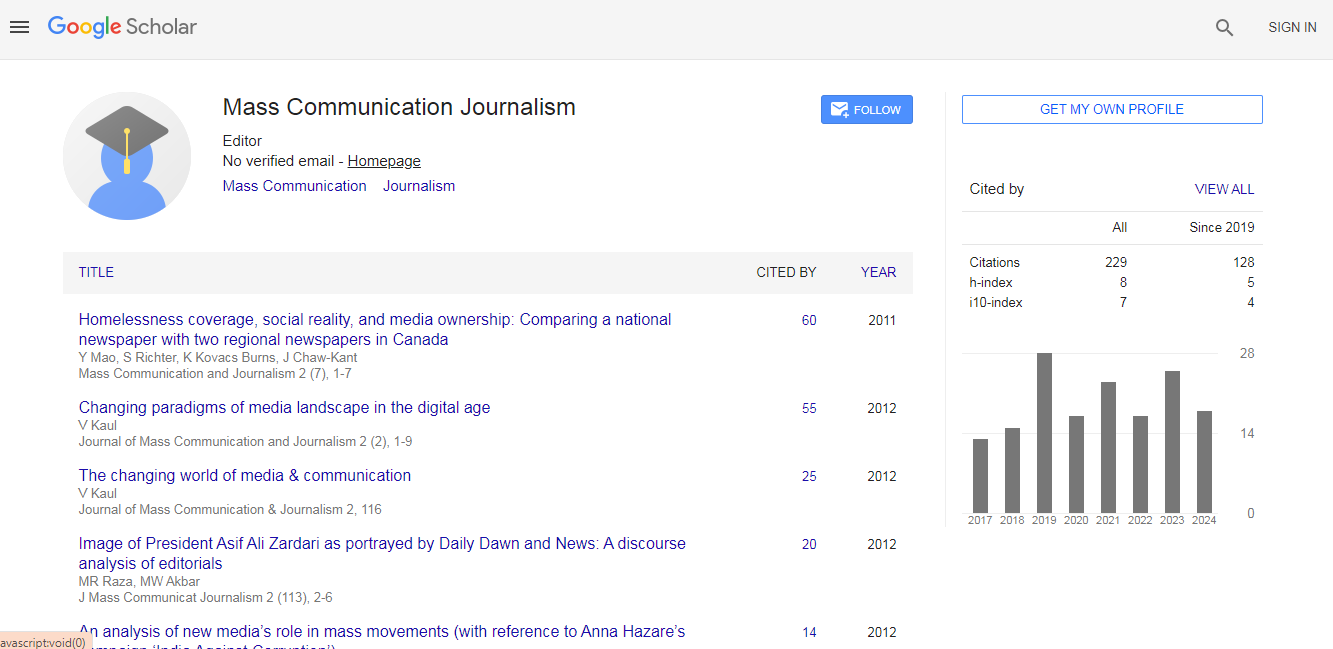
Journal of Mass Communication & Journalism received 205 citations as per Google Scholar report