Commentary - (2025) Volume 9, Issue 5
Received: 01-Sep-2025, Manuscript No. jma-26-184621;
Editor assigned: 03-Sep-2025, Pre QC No. P-184621;
Reviewed: 17-Sep-2025, QC No. Q-184621;
Revised: 22-Sep-2025, Manuscript No. R-184621;
Published:
29-Sep-2025
, DOI: 10.37421/2684-4265.2025.09.402
Citation: Villalobos, Andres. ”Digestive Histology Adaptations in Teleost Fish.” J Morphol Anat 09 (2025):402.
Copyright: © 2025 Villalobos A. This is an open-access article distributed under the terms of the Creative Commons Attribution License, which permits unrestricted use, distribution and reproduction in any medium, provided the original author and source are credited.
The digestive tract of teleost fish exhibits a remarkable degree of structural and functional diversity, a direct consequence of their varied diets and feeding strategies across a multitude of aquatic environments [1].
Histological features within this system are highly specialized, including distinct epithelial linings, the presence of goblet cells for vital mucus secretion, and varying thicknesses of the muscle layers essential for propelling food through the tract [1].
A deep understanding of these anatomical structures is paramount for effectively deciphering the intricate physiological functions and evolutionary adaptations observed in different fish species [1].
This review will explore variations in stomach morphology, intestinal length, and the presence and significance of accessory digestive organs such as the pyloric caeca across a broad spectrum of fish groups [1].
Herbivorous fish, in particular, possess a digestive tract that is significantly adapted for the efficient digestion of plant material, which is typically rich in cellulose and requires specialized enzymatic and microbial assistance [2].
Research in this area often focuses on the amplification of surface area within the intestine, the complex composition of the gut microbiota, and the enzymatic capabilities of the digestive epithelium, all crucial for extracting nutrients from plant-based diets [2].
Such insights are not only vital for a fundamental understanding of nutrient assimilation but also hold significant implications for optimizing aquaculture practices for species with herbivorous feeding habits [2].
The stomach of fish plays a critical role in the initial stages of digestion, primarily focusing on protein breakdown and the mechanical processing of food [3].
Histologically, this involves specialized secretory cells, such as chief cells and parietal cells, responsible for producing digestive enzymes and hydrochloric acid, respectively [3].
The presence of rugae, or folds within the stomach lining, allows for significant expansion to accommodate large meals, while the muscular nature of the stomach wall facilitates efficient mechanical churning [3].
Variations in stomach structure, ranging from simple to more complex arrangements, are often correlated with the diverse feeding habits of different fish species [3].
Intestinal morphology and function are intricately linked to the efficiency of nutrient absorption in fish [4].
The intestinal lining is characterized by villi and microvilli, which dramatically increase the surface area available for absorption, thereby maximizing nutrient uptake from digested food [4].
Specific transporter proteins embedded within the epithelial cells are responsible for the active transport of essential nutrients like carbohydrates, lipids, and proteins [4].
Differences in intestinal length and the complexity of folding patterns across various trophic levels are often examined to understand how these adaptations facilitate nutrient acquisition in different ecological niches [4].
Accessory digestive organs, such as the pyloric caeca, are crucial for enhancing digestive efficiency in many teleost fish [5].
These finger-like or sac-like structures are strategically positioned at the junction of the stomach and intestine [5].
Their histological examination reveals specialized epithelial cell types, including absorptive cells and endocrine cells, which contribute to both enzyme secretion and nutrient absorption [5].
The intricate structure and function of the pyloric caeca are believed to play a significant role in optimizing the digestive process, particularly for diets that require extensive breakdown and absorption [5].
Environmental factors, including salinity and temperature, can exert considerable influence on the histology of the fish digestive tract [6].
These stressors can induce significant histological changes in the gut epithelium, potentially impairing nutrient absorption and negatively affecting overall fish health [6].
Understanding these responses is critically important for effective aquaculture management, especially in the context of rapidly changing environmental conditions and the need to maintain optimal fish growth and health [6].
Fish with carnivorous diets exhibit distinct histological adaptations in their digestive tracts, specialized for efficiently processing animal matter [7].
These adaptations often include relatively shorter intestines compared to herbivores, reflecting the higher digestibility of animal tissues [7].
Furthermore, carnivorous fish possess digestive enzymes specifically tailored for breaking down animal proteins and fats, complemented by a muscular stomach adept at mechanical breakdown and the initiation of digestion [7].
Goblet cells are a ubiquitous and vital component of the fish digestive tract, playing a critical role in mucus production and secretion [8].
This secreted mucus serves multiple protective functions: it lubricates the gut, thereby easing the passage of food, and it shields the epithelial lining from mechanical abrasion and chemical damage from digestive enzymes and ingested material [8].
Additionally, the mucus layer plays a role in interacting with the gut microbiota, contributing to the overall health and function of the digestive system [8].
The digestive system of freshwater teleost fishes displays a wide array of histological adaptations that are intricately linked to their diverse feeding ecologies and aquatic habitats [9].
These adaptations are evident in variations of stomach structure, the relative length of the intestine, and the specialization of epithelial cells designed to process specific dietary components [9].
Such morphological and histological variations offer profound insights into the evolutionary pathways and ecological roles that these fish occupy within their respective freshwater ecosystems [9].
The hindgut, often overlooked in general digestive studies, plays a crucial role in osmoregulation and water absorption in fish, a function essential for maintaining internal fluid balance, particularly in varying environmental salinities [10].
The epithelial structure of the hindgut is specialized for efficient ion transport, and the presence of specific cell types facilitates the reabsorption of water and electrolytes [10].
These adaptations are directly correlated with the osmotic challenges that different fish species encounter in their unique aquatic environments, underscoring the diverse functional roles of the digestive tract [10].
The digestive tract of teleost fish is characterized by remarkable structural diversity, a direct reflection of their varied diets and feeding strategies [1].
Key histological features include specialized epithelial linings, the presence of goblet cells for mucus secretion, and varying muscle layer thickness for propulsion [1].
Understanding these structures is crucial for deciphering physiological functions and evolutionary adaptations in different fish species [1].
This article likely delves into the variations in stomach morphology, intestinal length, and the presence of accessory digestive organs like the pyloric caeca across diverse fish groups [1].
This study investigates the gut histology of herbivorous fish, highlighting adaptations for efficient plant material digestion [2].
It likely examines the surface area amplification within the intestine, the composition of the gut microbiota, and the enzymatic capabilities of the digestive epithelium [2].
Such insights are vital for aquaculture and understanding nutrient assimilation in fish that consume primarily plant-based diets [2].
The role of the stomach in protein digestion and mechanical breakdown is explored in this article [3].
The article probably discusses the secretory cells (chief cells, parietal cells), the presence of rugae for expansion, and the muscular nature of the stomach wall in different fish species [3].
Variations in stomach structure, from simple to complex, will likely be addressed, correlating with feeding habits [3].
Intestinal morphology and function in relation to nutrient absorption are the focus of this paper [4].
It likely details the villi and microvilli that increase surface area, the presence of specific transporter proteins, and the cellular mechanisms involved in absorbing carbohydrates, lipids, and proteins [4].
Differences in intestinal length and folding patterns across trophic levels are probably examined [4].
This research examines the histological adaptations of the pyloric caeca, accessory organs crucial for digestion in many teleosts [5].
The paper likely describes their structure, epithelial cell types (e.g., absorptive, endocrine), and their role in enzyme secretion and nutrient absorption, contributing to enhanced digestive efficiency [5].
The influence of environmental factors, such as salinity and temperature, on digestive tract histology is investigated [6].
This paper likely reveals how these stressors can induce histological changes in the gut epithelium, affecting nutrient absorption and overall fish health [6].
Understanding these responses is vital for managing aquaculture under changing environmental conditions [6].
This article explores the histological adaptations of the gut lining in fish with carnivorous diets, emphasizing their specialized structures for processing animal matter [7].
It likely discusses the relatively shorter intestines, the presence of digestive enzymes specific to animal proteins and fats, and the muscular stomach responsible for mechanical breakdown and initial digestion [7].
The presence and function of goblet cells in the fish digestive tract are detailed [8].
This paper likely elucidates their role in producing and secreting mucus, which serves to lubricate the gut, protect the epithelial lining from mechanical and chemical damage, and interact with the gut microbiota [8].
Variations in goblet cell density and distribution across different regions of the tract will likely be discussed [8].
This article provides a comprehensive overview of the histological adaptations in the digestive system of freshwater fish, considering their diverse feeding ecologies [9].
It probably examines differences in stomach structure, intestinal length, and the development of specialized epithelial cells related to their specific diets, offering insights into their evolutionary pathways and ecological roles [9].
This study examines the role of the hindgut in osmoregulation and water absorption in fish, a critical function in maintaining internal fluid balance [10].
The paper likely details the epithelial structure of the hindgut, including ion transport mechanisms and the presence of specialized cells, correlating these with the osmotic challenges faced by different fish species in their respective environments [10].
This collection of studies explores the diverse histological adaptations of the digestive system in teleost fish, driven by variations in diet and environment. Research covers general adaptations of the digestive tract, including specialized epithelia, mucus-producing goblet cells, and muscle layers [1].
Specific investigations focus on herbivorous fish and their adaptations for plant material digestion [2], the role of the stomach in protein digestion and mechanical breakdown [3], and intestinal morphology for nutrient absorption with an emphasis on villi and microvilli [4].
The function of accessory organs like pyloric caeca in enhancing digestion is examined [5].
The impact of environmental factors such as salinity and temperature on gut histology is also highlighted [6].
Further studies delve into the specialized gut lining of carnivorous fish [7], the crucial role of goblet cells in mucus production and protection [8], and broader histological adaptations in freshwater fish related to their feeding ecologies [9].
Finally, the osmoregulatory function of the hindgut and its specialized epithelial structures for water absorption is detailed [10].
None
None
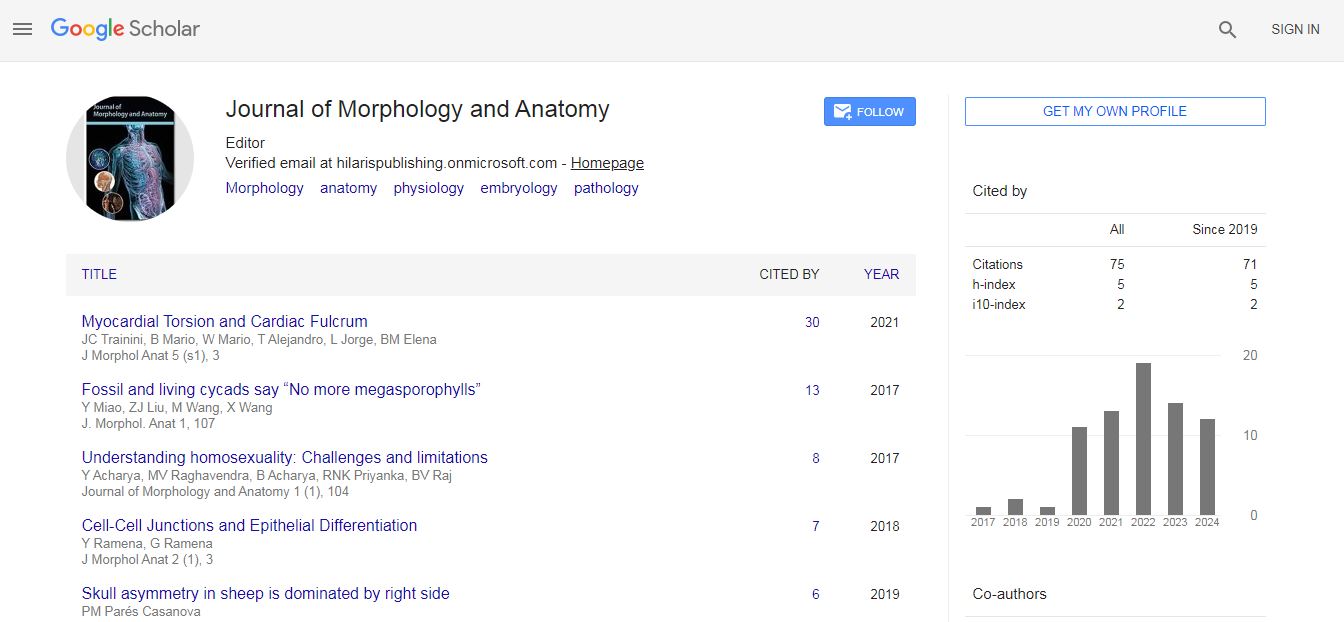
Journal of Morphology and Anatomy received 63 citations as per Google Scholar report