Commentary - (2025) Volume 12, Issue 4
Received: 01-Aug-2025, Manuscript No. reac-26-185844;
Editor assigned: 04-Aug-2025, Pre QC No. P-185844;
Reviewed: 18-Aug-2025, QC No. Q-185844;
Revised: 22-Aug-2025, Manuscript No. R-185844;
Published:
29-Aug-2025
, DOI: 10.37421/2380-2391.2025.12.441
Citation: Papadopoulos, Nikos. ”Detecting Engineered Nanoparticles in Aquatic Environments.” J Environ Anal Chem 12 (2025):441.
Copyright: © 2025 Papadopoulos N. This is an open-access article distributed under the terms of the Creative Commons Attribution License, which permits unrestricted use, distribution and reproduction in any medium, provided the original author and source are credited.
The detection and quantification of engineered nanoparticles (ENPs) in aquatic environments represent a significant scientific and environmental challenge, necessitating the development and application of sophisticated analytical methodologies. These minuscule contaminants, due to their unique properties, can exhibit complex behaviors in water bodies, impacting their fate and potential risks. Accurately assessing these risks is paramount for effective environmental management and safeguarding aquatic ecosystems from emerging pollutants. The behavior of specific ENPs, such as silver nanoparticles (AgNPs), within freshwater and marine systems is a critical area of investigation. Understanding how factors like pH, organic matter, and ionic strength influence their aggregation and dissolution is crucial for predicting their bioavailability and toxicity. This dynamic nature in complex aquatic matrices underscores the need for detailed studies on their transformation pathways. Advanced spectroscopic techniques are emerging as powerful tools for the sensitive detection of ENPs in challenging environmental samples. Surface-enhanced Raman spectroscopy (SERS), for instance, has shown great promise in identifying specific nanoparticle types and their surface modifications, overcoming limitations of traditional analytical methods and offering a path towards more accurate environmental monitoring. Furthermore, the interaction of ENPs with naturally occurring particulate matter in aquatic systems is a key determinant of their environmental distribution. The sorption behavior of nanoparticles, such as titanium dioxide nanoparticles (TiO2 NPs), onto suspended particles influences their transport and subsequent deposition in sediments, which is vital information for understanding their overall environmental presence. Characterizing the fundamental properties of nanoparticles in environmental waters, including their size, shape, and surface chemistry, presents considerable analytical hurdles. A critical review of techniques like Transmission Electron Microscopy (TEM), Dynamic Light Scattering (DLS), and X-ray Photoelectron Spectroscopy (XPS) reveals their respective strengths and limitations in this context, guiding the selection of appropriate methods. Investigating the fate of specific ENPs, such as quantum dots (QDs), in diverse environments like estuaries highlights the importance of factors like salinity and organic matter. These elements can significantly influence the aggregation and sedimentation of QDs, leading to potential accumulation in benthic compartments and raising ecotoxicological concerns. A persistent challenge in environmental analysis is the accurate differentiation between naturally occurring nanoparticles and engineered nanoparticles (ENPs). Developing robust methodological approaches, often involving multi-technique strategies combining spectroscopic and microscopic methods, is essential for improving the precision of ENP identification and quantification for reliable risk assessments. The release of ENPs from manufactured products into aquatic systems is another significant concern. Studies investigating the leaching of nanoparticles, such as copper nanoparticles (CuNPs) from antifouling paints, quantify release rates under various conditions, emphasizing the need for improved product design and regulatory oversight to mitigate environmental contamination. The interaction of ENPs with dissolved organic matter (DOM) in freshwater environments is a crucial factor influencing their stability and aggregation. The composition and concentration of DOM can profoundly affect the behavior of nanoparticles like gold nanoparticles (AuNPs), impacting their transport and ultimate fate in rivers and lakes. Advanced separation and detection techniques are vital for dissecting complex nanoparticle mixtures in water. Field-flow fractionation (FFF) coupled with various detectors offers a powerful means for size-fractionation and characterization, providing essential insights into nanoparticle size distribution and elemental composition for understanding their environmental behavior.
The detection of engineered nanoparticles (ENPs) in aquatic environments is a complex scientific endeavor, requiring advanced analytical techniques to accurately identify and quantify these minute contaminants. Understanding their behavior, such as aggregation, sedimentation, and potential bioaccumulation, is crucial for assessing environmental risks. The impact of nanoparticle properties on their environmental fate necessitates the development of precise analytical methods to address the challenges posed by these emerging pollutants [1].
Studies on the fate and transformation of specific ENPs, like silver nanoparticles (AgNPs), in different aquatic settings are essential for understanding their environmental impact. Research examines how factors such as pH, organic matter, and ionic strength influence AgNP aggregation and ion release, which directly affects their bioavailability and toxicity. This highlights the dynamic and context-dependent nature of ENPs in complex aquatic matrices [2].
Surface-enhanced Raman spectroscopy (SERS) has emerged as a highly sensitive technique for the detection of ENPs in environmental water samples. Its ability to identify specific nanoparticle types and their surface modifications offers a significant advantage over traditional methods, making it a powerful tool for environmental monitoring and risk assessment [3].
The sorption of ENPs onto suspended particulate matter in river systems is a key process that governs their transport and deposition. Investigations into the sorption behavior of nanoparticles, such as titanium dioxide nanoparticles (TiO2 NPs), quantify their association with different particle sizes and compositions, providing critical data for understanding their distribution within aquatic ecosystems [4].
Characterizing the physical and chemical properties of ENPs in environmental waters, including size, shape, and surface chemistry, presents considerable analytical challenges. A critical review of established techniques such as Transmission Electron Microscopy (TEM), Dynamic Light Scattering (DLS), and X-ray Photoelectron Spectroscopy (XPS) is necessary to understand their capabilities and limitations in this specific application [5].
The environmental fate of ENPs like quantum dots (QDs) in estuarine environments is influenced by aggregation and adsorption onto sediments. Factors such as salinity and organic matter play a crucial role in their behavior, potentially leading to accumulation in benthic compartments and raising ecotoxicological concerns. Understanding these processes is vital for assessing their environmental impact [6].
A significant challenge in ENP analysis is distinguishing them from naturally occurring nanoparticles. Methodological approaches that combine multiple spectroscopic and microscopic techniques are being developed to enhance the accuracy of ENP identification and quantification, which is indispensable for conducting robust environmental risk assessments [7].
The release of ENPs from consumer products into aquatic systems is a growing concern. Research focuses on quantifying the leaching of nanoparticles, such as copper nanoparticles (CuNPs) from antifouling paints, under various environmental conditions. This information is critical for informing product design and regulatory policies aimed at minimizing environmental contamination [8].
The stability and aggregation of ENPs in freshwater are significantly influenced by dissolved organic matter (DOM). Studies on gold nanoparticles (AuNPs) demonstrate how different types and concentrations of DOM can either stabilize or destabilize them, affecting their transport and ultimate fate in rivers and lakes, emphasizing the importance of considering DOM in risk assessments [9].
Field-flow fractionation (FFF) coupled with advanced detectors offers a promising approach for the size-fractionation and characterization of ENPs in water samples. This technique enables the analysis of complex mixtures, providing detailed insights into nanoparticle size distribution and elemental composition, which are crucial for understanding their behavior and impact in the environment [10].
This collection of research addresses the critical challenges in detecting and characterizing engineered nanoparticles (ENPs) within aquatic environments. Studies explore the behavior and fate of various ENPs, including silver nanoparticles, titanium dioxide nanoparticles, quantum dots, and copper nanoparticles, examining their interactions with natural particulate matter, dissolved organic matter, and varying environmental conditions like pH and salinity. Advanced analytical techniques such as Surface-Enhanced Raman Spectroscopy (SERS) and Field-Flow Fractionation (FFF) are highlighted for their sensitivity and effectiveness in identifying and quantifying ENPs. The research also emphasizes the importance of distinguishing ENPs from natural nanoparticles and addresses concerns related to nanoparticle leaching from products. Overall, these findings underscore the need for robust methodologies and a deeper understanding of ENP behavior to effectively assess and manage their environmental risks.
None
None
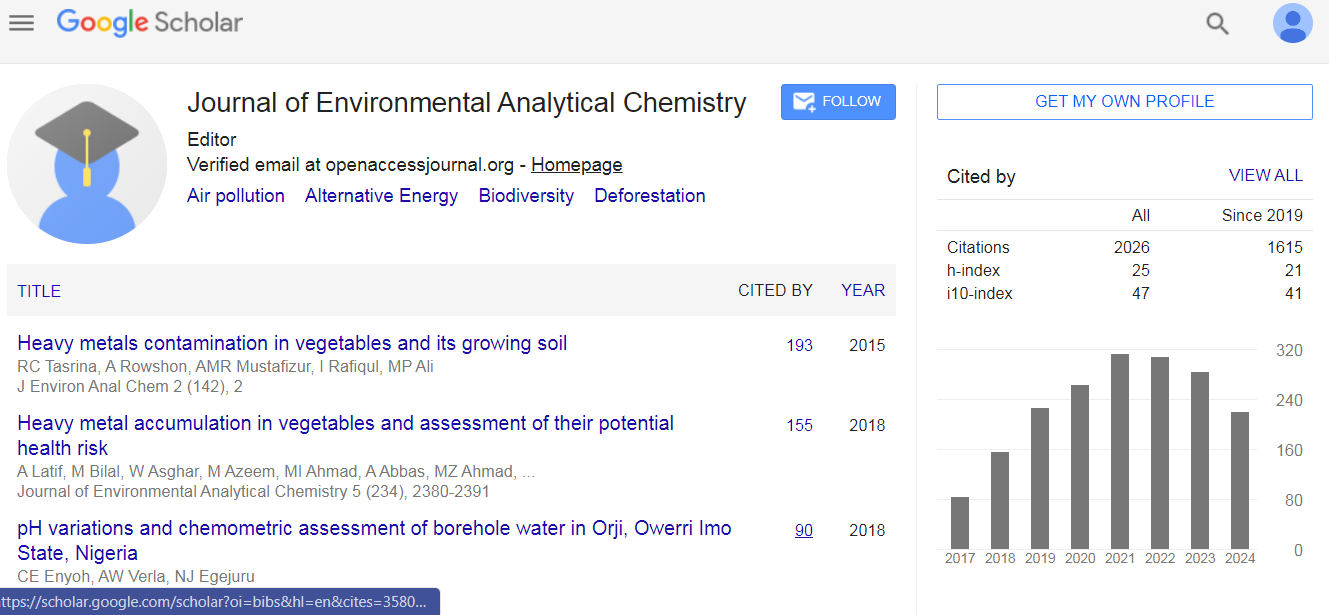
Journal of Environmental Analytical Chemistry received 1781 citations as per Google Scholar report