Brief Report - (2025) Volume 11, Issue 4
Received: 01-Jul-2025, Manuscript No. ohcr-25-174287;
Editor assigned: 03-Jul-2025, Pre QC No. P-174287;
Reviewed: 17-Jul-2025, QC No. Q-174287;
Revised: 22-Jul-2025, Manuscript No. R-174287;
Published:
29-Jul-2025
, DOI: 10.37421/2471-8726.2025.11.203
Citation: Hoffmann, Karl. ”Dental Implant Complications: Causes, Management, Success.” Oral Health Case Rep 11 (2025):203.
Copyright: © 2025 Hoffmann K. This is an open-access article distributed under the terms of the Creative Commons Attribution License, which permits unrestricted use, distribution and reproduction in any medium, provided the original author and source are credited.
The success of dental implants has revolutionized prosthetic dentistry, yet various complications can challenge their longevity and functional integrity. One prevalent concern revolves around peri-implant diseases, where peri-implant mucositis and peri-implantitis frequently affect a considerable number of implant patients. Key risk factors for these biological complications include a patient's history of periodontitis, inadequate oral hygiene, smoking habits, and even specific genetic predispositions, underscoring the critical need for meticulous patient selection and diligent post-operative care to avert such issues [1].
Beyond biological factors, mechanical complications also pose significant threats to dental implant prostheses. These often manifest as screw loosening, ceramic chipping, and abutment fractures. These frequently observed mechanical failures highlight the importance of careful prosthetic design, appropriate material selection, and thorough consideration of occlusal forces to ensure long-term implant success [2].
Furthermore, the increasing adoption of digital workflows in implant dentistry, while offering numerous advantages, is not entirely immune to complications. Potential problems can arise from inaccuracies during digital impressions, fitting discrepancies in computer-aided design and manufacturing (CAD/CAM) components, and various software-related errors. Achieving optimal results with these advanced techniques demands meticulous attention at every step of the digital process, emphasizing the importance of continuous training and ongoing validation for digital tools [3].
A deeper look into biological complications specifically points to peri-implant mucositis and peri-implantitis as central issues. Clinical factors like plaque accumulation, individual host susceptibility, and certain systemic conditions contribute significantly to their development. Effective management of these conditions encompasses a spectrum of strategies, from non-surgical debridement to more invasive surgical interventions. The emphasis here is on early diagnosis and the implementation of personalized treatment plans to ensure successful resolution and the long-term survival of the implant [4].
The overall survival rates and complication profiles of dental implants are influenced by a multitude of critical factors. Patient-related elements, such as smoking, uncontrolled diabetes, and a history of periodontal disease, are significant contributors to adverse outcomes. Additionally, implant-related characteristics, including the implant surface, length, and diameter, alongside the chosen surgical technique, play crucial roles. This highlights the absolute necessity for a comprehensive risk assessment and tailored treatment planning to minimize complications and ultimately enhance long-term implant success [5].
When peri-implantitis leads to bone defects, managing these can become a substantial clinical challenge. Different surgical approaches, including resective and regenerative techniques, are employed, with the specific morphology of the defect guiding treatment decisions. Success in these cases relies heavily on thorough decontamination of the implant surface, the careful selection of appropriate bone grafting materials, and meticulous management of soft tissues. Often, a multidisciplinary approach is essential for the effective resolution of these complex situations [6].
Aesthetic concerns, particularly in highly visible areas like the anterior maxilla, can profoundly affect patient satisfaction. Common aesthetic complications include soft tissue recession, loss of papilla, and undesirable gingival color changes. These issues frequently stem from improper implant placement, insufficient soft tissue volume, or poor prosthetic design. Preventing such outcomes requires careful case selection, precise surgical planning, and a robust understanding of soft tissue biology and prosthetic principles [7].
Implant fracture, although less frequent than biological complications, represents a severe mode of failure. Key predisposing factors identified include excessive occlusal forces, incorrect implant design or material, and material fatigue over time. Managing an implant fracture typically involves implant removal and replacement, stressing the importance of thorough occlusal analysis and appropriate implant selection during the initial planning phase to reduce the risk of such catastrophic events [8].
A severe, albeit rare, complication of dental implant placement, particularly in the mandible, is inferior alveolar nerve (IAN) injury. The primary causes are direct trauma during drilling, compression from the implant itself, or thermal injury. This risk necessitates a critical role for thorough pre-operative radiographic assessments, including cone-beam computed tomography (CBCT), to accurately map anatomical structures and minimize nerve damage. Prompt diagnosis and referral are vital for effective management of these injuries [9].
Lastly, peri-implant bone loss is a common issue that can undermine the long-term stability and success of dental implants. Its etiologies are diverse, encompassing biological factors like peri-implantitis and mechanical factors such as occlusal overload. Risk factors include poor oral hygiene, smoking, diabetes, and certain inherent implant characteristics. Understanding these contributing factors is paramount for effective prevention, early detection, and proper management, ensuring the longevity of dental implants [10].
Dental implant therapy has transformed restorative options for patients, yet the success of these treatments can be hampered by a range of complications, broadly categorized into biological, mechanical, aesthetic, and surgical risks. A common biological challenge is the occurrence of peri-implant diseases, specifically peri-implant mucositis and peri-implantitis. These conditions affect a significant proportion of implant patients, with risk factors closely linked to a patient's history of periodontitis, inadequate oral hygiene practices, smoking, and even genetic predispositions. This emphasizes the critical need for a comprehensive patient assessment and meticulous post-operative care to prevent the onset of these inflammatory conditions [1, 4]. Early diagnosis and tailored management, which can range from non-surgical debridement to surgical interventions, are essential for resolving these issues and preserving long-term implant survival. The management of resulting bone defects, often necessitating complex resective or regenerative surgical approaches, further highlights the need for thorough implant surface decontamination and careful material selection [6].
Mechanical complications present another significant set of challenges for dental implant prostheses. These often manifest as issues like screw loosening, ceramic chipping, and abutment fractures. These frequently observed failures underline the importance of sound prosthetic design principles, judicious material selection, and careful consideration of occlusal forces to prevent such mechanical breakdowns and ensure the prosthesis's longevity [2]. Similarly, despite the advancements, implant fracture, while less common, represents a severe failure mode. Predisposing factors include excessive occlusal forces, suboptimal implant design or material, and fatigue over time. Strategies to manage such fractures typically involve implant removal and replacement, stressing the importance of comprehensive occlusal analysis during initial treatment planning [8]. Peri-implant bone loss, whether due to biological factors like peri-implantitis or mechanical factors such as occlusal overload, is a critical concern for implant stability. Risk factors are similar to those for peri-implantitis, including poor oral hygiene, smoking, and diabetes, underscoring the interconnectedness of various complication etiologies [10].
The integration of digital workflows in implant dentistry, while offering numerous efficiencies, also introduces a unique set of potential complications. These can include inaccuracies during digital impressions, fitting discrepancies in CAD/CAM fabricated components, and various software-related errors. To achieve optimal outcomes with digital tools, meticulous attention to detail throughout the entire digital process is crucial, along with continuous professional training and validation of the technologies used [3]. Beyond functionality, aesthetic complications are particularly impactful, especially in highly visible areas like the anterior maxilla, where patient satisfaction is paramount. Issues such as soft tissue recession, loss of papilla, and undesirable gingival color changes are common. These problems frequently stem from improper implant placement, insufficient soft tissue volume, or flawed prosthetic design, necessitating careful case selection, precise surgical planning, and a deep understanding of soft tissue biology and prosthetics for prevention [7].
Patient-specific and implant-related factors significantly influence the overall survival and complication rates of dental implants. Patient characteristics such as smoking habits, uncontrolled diabetes, and a history of periodontitis are well-established contributors to adverse outcomes. Concurrently, implant characteristics like surface texture, length, and diameter, along with the surgical technique employed, play vital roles. This multivariate perspective emphasizes that a comprehensive risk assessment and personalized treatment plan are indispensable for minimizing complications and enhancing the long-term success of dental implants [5].
Finally, surgical complications, though often rare, can be severe. Inferior alveolar nerve (IAN) injury, for instance, is a critical, albeit uncommon, complication of implant placement in the mandible. Causes include direct trauma, compression from the implant, or thermal injury. The essential preventative measure is thorough pre-operative radiographic assessment, utilizing tools like cone-beam computed tomography (CBCT), to accurately map anatomical structures and minimize nerve damage. Early diagnosis and prompt referral are crucial for effective management when these injuries do occur [9]. Collectively, the data highlights that preventing and managing dental implant complications requires a holistic approach, considering biological, mechanical, aesthetic, and surgical factors, alongside individual patient and implant characteristics.
Dental implant therapy faces a variety of potential complications that can affect long-term success and patient satisfaction. Biological issues, such as peri-implant mucositis and peri-implantitis, are widespread, often linked to a history of periodontitis, poor oral hygiene, smoking, and genetic factors. Managing these frequently involves surgical and non-surgical interventions, emphasizing early diagnosis and thorough decontamination. Mechanical complications like screw loosening, ceramic chipping, and implant fractures also occur, driven by factors such as prosthetic design, material choice, and occlusal forces. Correct planning and material selection are crucial to mitigate these failures. Aesthetic concerns, particularly in visible areas, can arise from improper implant placement, inadequate soft tissue, or poor prosthetic design, necessitating precise surgical and prosthetic planning. Digital workflows, while beneficial, are not immune to issues like impression inaccuracies or CAD/CAM component discrepancies. Furthermore, systemic patient factors, including smoking and diabetes, and implant-specific attributes such as surface and size, significantly influence complication rates and implant survival. Rare but severe surgical complications, such as inferior alveolar nerve injury, highlight the importance of meticulous pre-operative imaging and careful surgical technique. Peri-implant bone loss, stemming from both biological and mechanical etiologies, underscores the need for comprehensive risk assessment and ongoing monitoring. Overall, a multidisciplinary approach, patient education, and vigilant follow-up are essential for minimizing risks and ensuring the long-term success and stability of dental implants.
None
None
1. Spyridon NP, Angelos P, Efthymia K. "Prevalence and risk factors for peri-implant diseases: A systematic review and meta-analysis".J Clin Periodontol 50 (2023):13-33.
Indexed at, Google Scholar, Crossref
2. Wei C, Shan P, Yan Z. "Mechanical Complications in Dental Implant Prostheses: A 10-Year Retrospective Study".J Prosthodont 31 (2022):386-394.
Indexed at, Google Scholar, Crossref
3. Francesco GM, Carlo M, Spyridon NP. "Digital Workflow in Implant Dentistry: A Systematic Review".J Clin Med 10 (2021):3097.
Indexed at, Google Scholar, Crossref
4. Frank S, Søren J, Thomas WO. "Biological complications of dental implants: a narrative review of clinical factors and management strategies".J Clin Periodontol 47 (2020):144-162.
Indexed at, Google Scholar, Crossref
5. Noora A, Fahad A, Ahmed A. "Factors influencing the survival and complications of dental implants: a systematic review and meta-analysis of cohort studies".Int J Implant Dent 9 (2023):43.
Indexed at, Google Scholar, Crossref
6. Stefan R, Marc Q, Daniel B. "Management of Peri-Implantitis Bone Defects: A Narrative Review".Int J Periodontics Restorative Dent 41 (2021):19-27.
Indexed at, Google Scholar, Crossref
7. Pedram G, Hamid MH, Maryam G. "Esthetic complications in implant dentistry: A systematic review".J Esthet Restor Dent 31 (2019):553-562.
Indexed at, Google Scholar, Crossref
8. Liliana G, Lissette S, RocÃo G. "Implant fracture: A systematic review of predisposing factors and management strategies".J Prosthet Dent 127 (2022):237-248.
Indexed at, Google Scholar, Crossref
9. Mohammad A, Mohammed A, Neda A. "Inferior alveolar nerve injury following dental implant placement: A systematic review".J Craniofac Surg 31 (2020):1474-1481.
Indexed at, Google Scholar, Crossref
10. Tara A, Hani M, Jaume P. "Peri-implant bone loss: A narrative review of etiologies and risk factors".J Oral Maxillofac Surg 80 (2022):863-875.
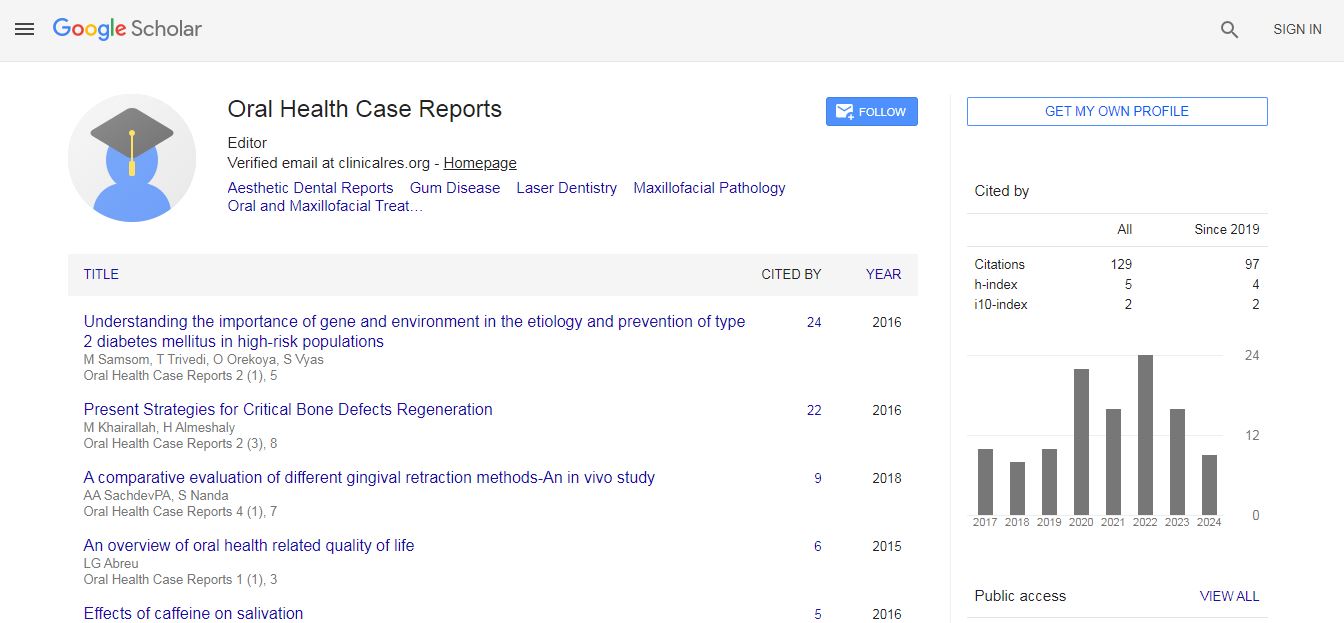
Oral Health Case Reports received 120 citations as per Google Scholar report