Perspective - (2025) Volume 14, Issue 4
Received: 03-Aug-2025, Manuscript No. jsp-26-182266;
Editor assigned: 05-Aug-2025, Pre QC No. P-182266;
Reviewed: 19-Aug-2025, QC No. Q-182266;
Revised: 21-Aug-2025, Manuscript No. R-182266;
Published:
30-Aug-2025
, DOI: 10.37421/2165-7939.2025.14.735
Citation: Nakamura, Koji. ”Degenerative Scoliosis: A Comprehensive Management Guide.” J Spine 14 (2025):735.
Copyright: © 2025 Nakamura K. This is an open-access article distributed under the terms of the Creative Commons Attribution License, which permits unrestricted use, distribution and reproduction in any medium, provided the original author and source are credited.
Degenerative scoliosis is a prevalent spinal deformity predominantly affecting older adults, marked by the progressive curvature of the spine resulting from age-related alterations in intervertebral discs, facet joints, and ligaments. This condition frequently leads to chronic back pain, neurological deficits, and impaired mobility, significantly diminishing the quality of life for affected individuals. Management strategies for degenerative scoliosis encompass a spectrum of approaches, from conservative measures such as physical therapy and pain management to surgical interventions designed to decompress neural structures and stabilize the spine. Significant advancements in imaging technologies, surgical techniques, and a deeper understanding of spinal biomechanics are collectively contributing to improved outcomes for this aging demographic [1].
The diagnostic process for degenerative scoliosis typically relies on comprehensive radiographic evaluation. Standing X-rays are instrumental in assessing the degree of spinal curvature and identifying associated instability. Magnetic Resonance Imaging (MRI) plays a crucial role in evaluating the extent of neural compression, while Computed Tomography (CT) scans offer detailed insights into the bony anatomy of the spine. Conservative management strategies are primarily focused on alleviating pain and enhancing functional capacity through targeted exercise programs, the judicious use of pain medications, and, in some cases, bracing. Surgical interventions are generally indicated for patients experiencing significant pain, progressive deformity, or neurological compromise that does not respond to conservative care. Posterior spinal fusion, often augmented with instrumentation, represents a common surgical approach [2].
Surgical outcomes in patients with degenerative scoliosis are multifactorial, influenced by intrinsic patient characteristics such as age, presence of comorbidities, and bone quality, as well as the specific surgical technique employed and the extent of the spinal fusion performed. There is a growing exploration of minimally invasive surgical techniques, aiming to reduce perioperative morbidity and accelerate patient recovery. Long-term follow-up is indispensable for monitoring potential complications, including pseudarthrosis (non-union), adjacent segment degeneration, and continued spinal deformity progression. Consequently, meticulous patient selection and the establishment of realistic therapeutic goals are paramount for achieving successful surgical management [3].
The relationship between osteoporosis and degenerative scoliosis is particularly significant. Osteoporosis, characterized by weakened bone density, can exacerbate existing spinal deformities and elevate the risk of fractures, especially during surgical correction procedures. Therefore, strategies aimed at managing osteoporosis, such as the administration of bisphosphonates and supplementation with calcium and vitamin D, are frequently integrated into the treatment plans for older patients undergoing surgery for degenerative scoliosis [4].
Patient-reported outcome measures (PROMs) are indispensable tools for rigorously evaluating the effectiveness of various treatment modalities for degenerative scoliosis. These measures typically involve the administration of questionnaires designed to assess levels of pain, functional capacity, and overall quality of life. PROMs provide clinicians and researchers with invaluable insights into the real-world impact of the condition and the success of interventions from the patient's perspective, thereby enhancing the patient-centeredness of care [5].
The sagittal balance of the spine emerges as a critical determinant of outcomes in degenerative scoliosis. Maintaining a balanced sagittal alignment is strongly associated with improved functional results and reduced rates of revision surgery. Consequently, surgeons prioritize the restoration or preservation of appropriate sagittal alignment during the surgical correction of degenerative scoliosis to optimize patient recovery and long-term stability [6].
Neurological complications, including radiculopathy and myelopathy, are frequently observed in patients with degenerative scoliosis, primarily due to spinal stenosis and nerve root compression. Prompt diagnosis and timely, appropriate management, which may necessitate surgical decompression, are crucial steps in preventing the development of permanent neurological deficits and preserving patient function [7].
Minimally invasive spinal fusion techniques present potential advantages for elderly patients diagnosed with degenerative scoliosis. These benefits include reduced blood loss during surgery, shorter hospital stays, and a more rapid recovery period. However, it is important to note that these advanced techniques necessitate specialized surgical training and may be associated with a steeper learning curve for the surgical team [8].
Adjacent segment disease (ASD) represents a recognized complication that can occur subsequent to spinal fusion for degenerative scoliosis. This condition arises from increased stress placed upon the motion segments located above or below the fused area, potentially leading to accelerated degeneration and the recurrence of symptoms. Therefore, meticulous surgical planning and the judicious selection of the appropriate levels for fusion are critical measures to mitigate the risk of developing ASD [9].
The intricate biomechanics of the spine play a substantial role in the progression of degenerative scoliosis, and this area remains an active frontier of research. A comprehensive understanding of the forces acting upon the spinal column holds the promise of guiding the development of more effective conservative and surgical treatment strategies. Advanced computational modeling techniques and in vivo studies are making significant contributions to this growing body of knowledge [10].
Degenerative scoliosis is characterized by the progressive curvature of the spine in older adults, stemming from age-related degeneration of the intervertebral discs, facet joints, and ligaments. This condition frequently results in chronic back pain, neurological deficits, and limitations in mobility, thereby significantly impacting the overall quality of life. The management of degenerative scoliosis involves a continuum of care, ranging from conservative interventions like physical therapy and pain management to surgical procedures aimed at decompressing neural elements and stabilizing the spinal column. Ongoing advancements in diagnostic imaging, surgical methodologies, and a deeper comprehension of spinal biomechanics are continuously improving treatment efficacy for this aging population [1].
Radiographic evaluation, particularly standing X-rays, is fundamental in diagnosing degenerative scoliosis by quantifying the degree of spinal curvature and assessing for instability. MRI is indispensable for visualizing neural compression, while CT scans provide detailed anatomical information of the bony structures. Conservative management primarily focuses on pain relief and functional improvement through exercises, pharmacotherapy, and occasionally bracing. Surgical intervention is typically reserved for cases with severe pain, progressive deformity, or neurological compromise refractory to conservative measures, with posterior spinal fusion often employed [2].
Several factors influence the success of surgical interventions for degenerative scoliosis, including patient demographics such as age, the presence of comorbidities, and bone mineral density, alongside surgical technique and the extent of fusion. Minimally invasive surgical approaches are increasingly being investigated for their potential to lower perioperative complications and enhance recovery times. Long-term follow-up is essential to monitor for complications like pseudarthrosis and adjacent segment degeneration. Effective patient selection and realistic expectation management are critical for optimal surgical outcomes [3].
The interplay between osteoporosis and degenerative scoliosis is clinically significant. Osteoporotic bone can worsen spinal deformity and increase fracture risk during surgery. Therefore, management of osteoporosis, utilizing agents like bisphosphonates and nutritional supplements, is an integral part of the preoperative and postoperative care for elderly patients undergoing surgical correction [4].
Patient-reported outcome measures (PROMs) are vital for assessing the effectiveness of treatments for degenerative scoliosis. These measures, often in the form of questionnaires, capture patient perspectives on pain, function, and quality of life, providing crucial real-world data on treatment success and guiding clinical decision-making [5].
Sagittal balance of the spine is a key prognostic indicator in degenerative scoliosis. Maintaining or restoring proper sagittal alignment is associated with better functional outcomes and a reduced need for revision surgery. Surgeons aim to optimize sagittal alignment during corrective procedures to improve patient mobility and reduce compensatory mechanisms [6].
Neurological deficits, such as radiculopathy and myelopathy, are common complications of degenerative scoliosis due to spinal stenosis and nerve compression. Early detection and appropriate management, including surgical decompression, are vital to prevent irreversible neurological damage and preserve functional capacity [7].
Minimally invasive spinal fusion techniques offer potential benefits for elderly patients with degenerative scoliosis, such as reduced blood loss and shorter hospital stays. However, these techniques require specialized training and may present a steeper learning curve, necessitating careful consideration of surgical expertise [8].
Adjacent segment disease (ASD) is a recognized complication following spinal fusion for degenerative scoliosis, characterized by accelerated degeneration in the levels adjacent to the fusion. Prudent surgical planning, including appropriate selection of fusion levels, is crucial to minimize the risk of ASD and its associated morbidity [9].
The biomechanical principles governing the progression of degenerative scoliosis are an active area of research. Understanding spinal loading patterns can lead to the development of more refined conservative and surgical treatment strategies. Computational modeling and in vivo studies are contributing valuable insights into these complex biomechanical interactions [10].
Degenerative scoliosis is a progressive spinal deformity in older adults, causing pain, neurological issues, and mobility problems. Diagnosis involves X-rays, MRI, and CT scans, with management ranging from conservative therapies to surgery. Surgical outcomes depend on patient factors and technique, with minimally invasive approaches gaining traction. Osteoporosis significantly impacts this condition, requiring integrated management. Patient-reported outcomes are crucial for assessing treatment effectiveness, while sagittal balance and biomechanics are key considerations. Neurological complications and adjacent segment disease are potential challenges, underscoring the importance of careful surgical planning and follow-up.
None
None
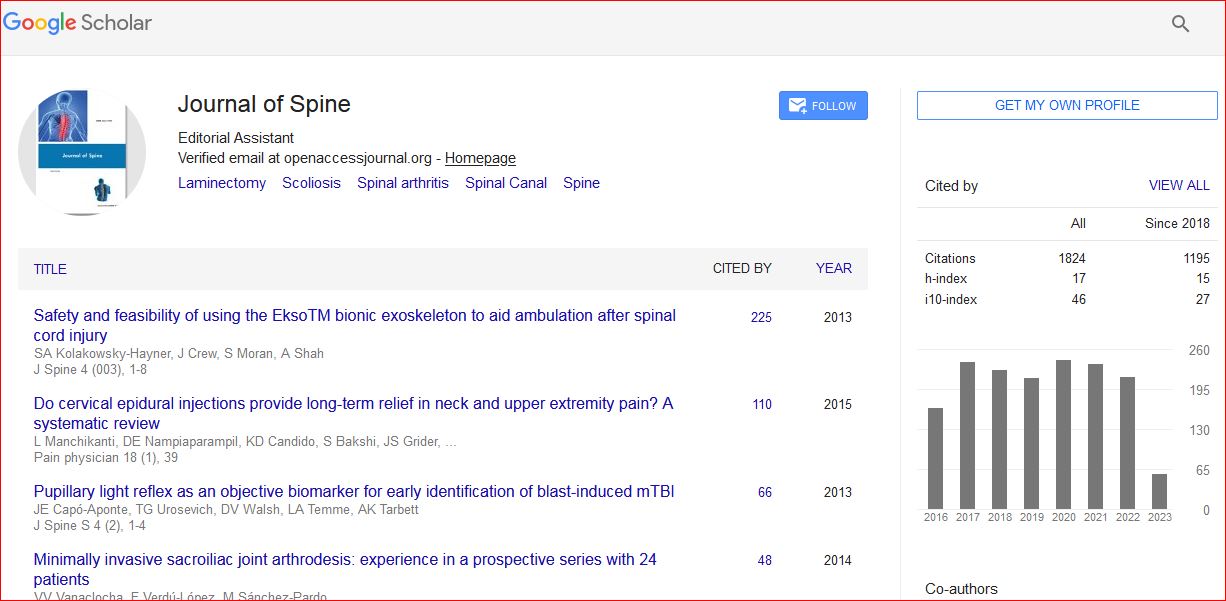
Journal of Spine received 2022 citations as per Google Scholar report