Perspective - (2025) Volume 14, Issue 2
Received: 02-Jun-2025, Manuscript No. ara-25-175578;
Editor assigned: 04-Jun-2025, Pre QC No. P-175578;
Reviewed: 18-Jun-2025, QC No. Q-175578;
Revised: 23-Jun-2025, Manuscript No. R-175578;
Published:
30-Jun-2025
, DOI: 10.37421/2168-9695.2025.14.330
Citation: Jensen, Carla. ”Deep Learning Transforms Robotic Vision Applications.” Adv Robot Autom 14 (2025):330.
Copyright: © 2025 Jensen C. This is an open-access article distributed under the terms of the Creative Commons Attribution License, which permits unrestricted use, distribution and reproduction in any medium, provided the original author and source are credited.
Robotics and autonomous systems heavily rely on advanced vision capabilities to perceive, understand, and interact with their surroundings. Recent developments underscore the critical role of deep learning and novel sensing methodologies in enhancing these capabilities, driving progress across diverse applications like object detection, navigation, manipulation, and human-robot interaction. Here's a look at key contributions and surveys in the field. This paper introduces a method for robust 3D object detection from a single RGB-D image, specifically tailored for robotic manipulation tasks. It addresses the challenge of accurately localizing objects despite occlusions and varying viewpoints, which is crucial for robots interacting with their environment. The approach combines deep learning with geometric reasoning to improve detection accuracy and efficiency, making it practical for real-world applications where speed and reliability are paramount[1].
This review article provides a comprehensive overview of how deep learning techniques are being integrated into visual servoing systems for robotics. It explores various architectures and strategies that enhance robot control by leveraging powerful visual feature extraction and robust pose estimation, moving beyond traditional methods. The paper highlights advancements in precision, adaptability, and performance in complex environments, which is essential for more flexible robotic operations[2].
This review focuses on real-time semantic segmentation techniques, vital for enabling robots and autonomous vehicles to understand their environment at an object level. The authors discuss various deep learning models designed for speed and accuracy, addressing the trade-offs involved in achieving high performance in computationally constrained robotic systems. The work is crucial for navigation, object interaction, and decision-making in dynamic settings[3].
This survey examines the advancements in visual Simultaneous Localization and Mapping (SLAM) for mobile robots, a cornerstone of autonomous navigation. It covers various methodologies, from traditional feature-based approaches to modern deep learning integration, highlighting how these systems enable robots to build maps of unknown environments while simultaneously tracking their own position within those maps. The paper underscores the challenges and future directions for robust visual navigation in complex, unstructured settings[4].
This review explores the significant progress in vision-based robotic grasping, a critical capability for robots to interact with objects in unstructured environments. It delves into various visual perception techniques, including object detection, pose estimation, and grasp planning, often leveraging deep learning for improved accuracy and robustness. The paper outlines how these systems enable robots to reliably pick up diverse objects, a fundamental step toward more versatile and intelligent robotic assistants[5].
This survey provides an in-depth look at vision-based human-robot interaction, crucial for creating intuitive and safe collaborative robotic systems. It covers the architectures, datasets, and techniques employed for understanding human gestures, intentions, and emotions, allowing robots to respond appropriately. The paper highlights the challenges and opportunities in enabling robots to perceive and adapt to human behavior, fostering more natural and effective interactions in various settings[6].
This survey presents a comprehensive overview of event-based vision systems and their applications in robotics. Unlike traditional frame-based cameras, event cameras react to pixel intensity changes asynchronously, offering advantages such as high temporal resolution, low latency, and high dynamic range, particularly in challenging lighting conditions or high-speed scenarios. The paper explores how these novel sensors can enhance robotic perception for tasks like visual SLAM, object tracking, and manipulation[7].
This survey investigates the critical area of Sim-to-Real transfer learning, addressing the challenge of transferring skills learned in simulation to real-world robotic systems. For robotic vision, this involves bridging the domain gap between synthetic and real sensor data to enable robust perception and control without extensive real-world training. The paper discusses various techniques used to improve the generalization of policies from simulated environments, making robot training more efficient and scalable[8].
This survey provides a comprehensive review of deep learning techniques applied to 6D object pose estimation, a fundamental problem in robotic vision for tasks like manipulation, assembly, and interaction. It covers various approaches that determine both the 3D position and 3D orientation of objects from camera inputs, addressing challenges such as occlusions, cluttered scenes, and varying object appearances. The paper highlights recent advancements that significantly improve the accuracy and robustness of pose estimation, enabling more precise robotic control[9].
This survey explores the emerging field of neuromorphic vision and its application in robot learning. It delves into how biologically inspired event-based cameras and spiking neural networks offer advantages over traditional vision systems, particularly in terms of power efficiency, low latency, and robustness to extreme lighting. The paper discusses how these technologies enable robots to perceive and learn more efficiently, paving the way for advanced autonomous systems that can operate in dynamic and unpredictable environments with reduced computational overhead[10].
Modern robotics heavily depends on sophisticated vision systems to operate effectively in complex environments. Significant progress is being made in robust 3D object detection from single RGB-D images, tailored specifically for robotic manipulation. This approach combines deep learning with geometric reasoning, improving detection accuracy and efficiency crucial for robots interacting with their environment [1]. Furthermore, deep learning techniques are being integrated into visual servoing systems, enhancing robot control through powerful visual feature extraction and robust pose estimation, thereby moving beyond traditional methods to achieve greater precision and adaptability in complex settings [2].
Understanding the environment at an object level is vital for autonomous systems. Real-time semantic segmentation techniques are essential for enabling robots and autonomous vehicles to process their surroundings quickly and accurately. These deep learning models balance speed and performance, addressing computational constraints inherent in robotic systems and supporting crucial functions like navigation, object interaction, and decision-making in dynamic situations [3]. For mobile robots, visual Simultaneous Localization and Mapping (SLAM) remains a cornerstone of autonomous navigation. Surveys in this area cover methodologies ranging from traditional feature-based approaches to modern deep learning integration, showcasing how robots build maps of unknown environments while tracking their own positions, emphasizing challenges and future directions for robust visual navigation in unstructured settings [4].
The ability to interact physically with objects is a fundamental robotic capability. Vision-based robotic grasping has seen substantial progress, exploring various visual perception techniques including object detection, pose estimation, and grasp planning. Deep learning often plays a significant role in improving the accuracy and robustness of these systems, enabling robots to reliably pick up diverse objects, a key step toward more versatile robotic assistants [5]. Beyond physical interaction, human-robot interaction is another critical domain. Vision-based surveys highlight architectures, datasets, and techniques for understanding human gestures, intentions, and emotions, allowing robots to respond appropriately and fostering natural, effective collaboration in various settings [6].
New sensor technologies and learning approaches are continuously pushing the boundaries of robotic vision. Event-based vision systems, for example, offer distinct advantages over traditional frame-based cameras. They react to pixel intensity changes asynchronously, providing high temporal resolution, low latency, and high dynamic range, which is particularly beneficial in challenging lighting or high-speed scenarios. These novel sensors significantly enhance robotic perception for tasks like visual SLAM, object tracking, and manipulation [7]. In addition, Sim-to-Real transfer learning addresses the challenge of moving skills learned in simulation to real-world robotic systems. This involves bridging the domain gap between synthetic and real sensor data to achieve robust perception and control, making robot training more efficient and scalable by improving policy generalization from simulated environments [8].
Achieving precise control and understanding in robotics relies on accurate object information. Deep learning techniques applied to 6D object pose estimation are fundamental, determining both the 3D position and orientation of objects from camera inputs. This addresses complex challenges such as occlusions and cluttered scenes, leading to significantly improved accuracy and robustness essential for precise robotic control, manipulation, and assembly [9]. Furthermore, the emerging field of neuromorphic vision, leveraging biologically inspired event-based cameras and spiking neural networks, offers advantages in power efficiency, low latency, and robustness to extreme lighting conditions. This technology enables robots to perceive and learn more efficiently, paving the way for advanced autonomous systems that operate effectively in dynamic and unpredictable environments with reduced computational overhead [10].
Robotic vision is experiencing rapid advancements, particularly through the integration of Deep Learning (DL) to enhance capabilities across diverse applications. One key area is robust 3D object detection, where DL and geometric reasoning improve accuracy and efficiency for robotic manipulation, even with occlusions and varying viewpoints. DL also plays a crucial role in visual servoing systems, enabling precise and adaptable robot control by improving visual feature extraction and pose estimation. For autonomous navigation, real-time semantic segmentation helps robots understand their environment at an object level, balancing speed and accuracy in computationally constrained systems. Visual Simultaneous Localization and Mapping (SLAM) is another cornerstone, evolving from traditional methods to DL-integrated approaches for robust environmental mapping and self-localization in mobile robots. Furthermore, vision-based robotic grasping benefits from DL, improving object detection, pose estimation, and grasp planning for reliable object interaction in unstructured settings. Human-Robot Interaction (HRI) is being made more intuitive and safe through vision systems that interpret human gestures, intentions, and emotions, fostering natural collaboration. Novel sensing paradigms like event-based vision systems offer advantages over traditional cameras, providing high temporal resolution and low latency for tasks such as visual SLAM and object tracking, especially in challenging lighting. Bridging the gap between simulation and reality, Sim-to-Real transfer learning is critical for efficiently training robots, reducing reliance on extensive real-world data by generalizing policies from synthetic environments. Finally, advancements in 6D object pose estimation using DL are fundamental for precise manipulation and interaction, while neuromorphic vision, inspired by biology, promises power-efficient and low-latency perception for future robot learning in dynamic environments.
None
None
Mengdi L, Yuyang S, Michael JB. "Learning 3D Object Detection for Robotic Manipulation from a Single View".IEEE Robotics and Automation Letters 6 (2021):2977-2984.
Indexed at, Google Scholar, Crossref
Yuancheng L, Huaping L, Guozheng L. "Deep Learning for Visual Servoing: A Review".IEEE Transactions on Cognitive and Developmental Systems 13 (2021):749-760.
Indexed at, Google Scholar, Crossref
Md ST, Arko B, Ashis KD. "Real-time Semantic Segmentation for Autonomous Driving and Robotics: A Review".Robotics and Autonomous Systems 153 (2022):104085.
Indexed at, Google Scholar, Crossref
Yanan L, Xinyu W, Yanhong C. "Visual SLAM for Mobile Robots: A Survey".IEEE Transactions on Cybernetics 53 (2023):3672-3684.
Indexed at, Google Scholar, Crossref
Bo M, Jin W, Qun Y. "Vision-based Robotic Grasping: A Review".Robotics and Autonomous Systems 146 (2021):103901.
Indexed at, Google Scholar, Crossref
Jose GV, Adrian RP, Daniel ML. "Vision-Based Humanâ??Robot Interaction: A Survey of Architectures, Datasets and Techniques".Sensors 23 (2023):6479.
Indexed at, Google Scholar, Crossref
Guoquan H, Ming-Hung C, Ling-Feng W. "A Survey of Event-Based Vision for Robotics".IEEE Transactions on Robotics 38 (2022):20-37.
Indexed at, Google Scholar, Crossref
Yuqian K, Rui Y, Qiang L. "Sim-to-Real Transfer Learning for Robot Manipulation: A Survey".IEEE Transactions on Cognitive and Developmental Systems 14 (2022):597-608.
Indexed at, Google Scholar, Crossref
Yuheng L, Yuzhe W, Bin C. "Deep Learning for 6D Object Pose Estimation: A Survey".IEEE Transactions on Pattern Analysis and Machine Intelligence 46 (2024):2529-2549.
Indexed at, Google Scholar, Crossref
Yanan L, Xinyu W, Yanhong C. "Neuromorphic Vision for Robot Learning: A Survey".IEEE Transactions on Neural Networks and Learning Systems 35 (2024):1610-1627.
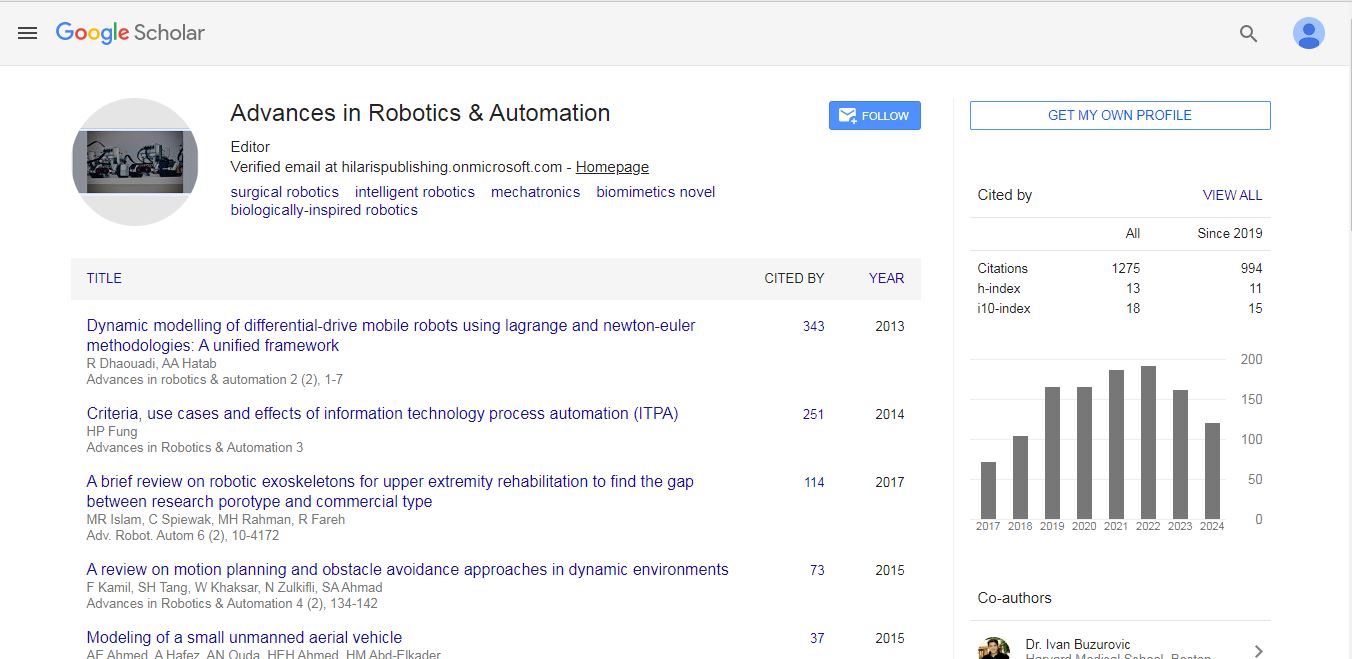
Advances in Robotics & Automation received 1275 citations as per Google Scholar report