Opinion - (2025) Volume 16, Issue 5
Received: 01-Sep-2025, Manuscript No. assj-25-174792;
Editor assigned: 03-Sep-2025, Pre QC No. P-174792;
Reviewed: 17-Sep-2025, QC No. Q-174792;
Revised: 22-Sep-2025, Manuscript No. R-174792;
Published:
29-Sep-2025
, DOI: 10.37421/2151-6200.2025.16.686
Citation: Kobayashi, Haruto. "Decolonizing Diverse Fields: In digenous Voices, Equitable Futures." Arts Social Sci J 16 (2025):686
Copyright: © 2025 Kobayashi H. This is an open-access article distributed under the terms of the Creative Commons Attribution License, which permits unrestricted use, distribution and reproduction in any medium, provided the original author and source are credited.
The discourse surrounding decolonization is rapidly gaining traction across various academic disciplines and practical applications. This comprehensive collection of articles collectively underscores the urgent necessity of challenging existing Eurocentric paradigms and integrating diverse, Indigenous epistemologies to foster more equitable and just futures. The imperative to decolonize extends from theoretical frameworks to tangible societal structures, reshaping how we perceive history, heritage, social practices, and environmental responses. This article challenges conventional decolonizing frameworks by examining how race, colonialism, and Indigeneity intersect within feminist geographies. It argues for moving beyond a singular focus on 'decolonizing' to embrace more complex and nuanced approaches that acknowledge diverse power dynamics and histories. The authors highlight the importance of recognizing ongoing colonial structures while engaging with Indigenous scholarship and local contexts [1].
This approach is fundamental for fostering meaningful dialogue and creating spaces for previously silenced voices. This editorial introduces a special issue on decolonizing heritage and museums, emphasizing the need for new approaches to pasts and futures. It explores how critical engagements with colonial histories can reshape understandings of cultural heritage, museum practices, and research methodologies. The piece calls for a re-evaluation of established narratives and an embrace of diverse perspectives to build more equitable and inclusive heritage landscapes [2].
Such efforts are vital for evolving museums into dynamic, inclusive platforms that truly reflect global heritage. The authors explore decolonial approaches within infrastructure studies, drawing critical insights from Latin American contexts. This work challenges Eurocentric perspectives on infrastructure development and highlights how colonial power dynamics continue to shape global material flows and spatial formations. It advocates for alternative frameworks that center Indigenous knowledge and local communities in shaping sustainable and equitable futures [3].
Reimagining infrastructure through a decolonial lens allows for sustainable development rooted in local needs and wisdom. This article examines the implications of indigenous knowledge systems for decolonizing social work education and practice in South Africa. It argues that incorporating local, indigenous epistemologies can challenge dominant Western paradigms, leading to more culturally relevant and effective social work interventions. The piece underscores the importance of acknowledging historical injustices and fostering practices that empower marginalized communities [4].
This integration enriches social work practice, making it more relevant and impactful for specific cultural contexts. The authors critically reflect on the colonial present within urban climate adaptation theory and practice. They argue that many adaptation strategies inadvertently perpetuate colonial power structures and inequalities, particularly in the Global South. The article calls for decolonial approaches to climate action that prioritize local knowledge, address historical injustices, and foster equitable and socially just responses to environmental change [5].
Decolonial climate action ensures that environmental solutions are just and do not perpetuate existing global inequalities. This article presents a conversation on decolonial feminisms, delving into praxis, power dynamics, and pedagogical approaches. It explores how feminist thought can engage with and challenge colonial legacies, advocating for methodologies that center marginalized experiences and epistemologies. The discussion highlights the importance of intersectionality and transnational solidarity in advancing decolonial feminist projects [6].
Engaging with decolonial feminisms provides powerful tools to dismantle patriarchal and colonial oppressions simultaneously. This piece explores decolonial ecologies and climate justice within the Caribbean context. It examines how colonial histories have shaped contemporary environmental vulnerabilities and discusses resistance strategies that draw on local knowledge and experiences. The authors advocate for climate justice frameworks that dismantle systemic inequalities and empower Caribbean communities in their efforts to adapt and build resilience against climate change [7].
Prioritizing local knowledge in climate justice helps communities in vulnerable regions build more effective and culturally appropriate resilience. The authors delve into decolonizing educational research, focusing on Indigenous epistemologies and methodologies. They critique the dominance of Western research paradigms and propose alternative approaches that honor diverse ways of knowing and being. This work emphasizes the ethical imperative to conduct research that is respectful, reciprocal, and relevant to Indigenous communities, contributing to more equitable knowledge production [8].
Decolonizing educational research profoundly transforms how knowledge is generated and valued, promoting ethical and culturally responsive practices. This article addresses the critical need to decolonize global mental health, scrutinizing the politics of evidence and experience. It argues that current mental health frameworks often impose Western models, overlooking the diverse cultural understandings of well-being and illness in postcolonial contexts. The authors advocate for approaches that center local epistemologies, challenge power imbalances, and promote more culturally sensitive and equitable mental health interventions [9].
By questioning the politics of evidence, global mental health can become more inclusive and responsive to diverse cultural realities. This piece explores new approaches to collections and interpretation in museums within postcolonial contexts, focusing on the imperative to decolonize these institutions. It addresses how museums can move beyond their colonial legacies by integrating diverse narratives, engaging local communities, and critically re-evaluating their curatorial practices. The article suggests ways for museums to foster more inclusive and representative cultural spaces [10].
Transforming museum practices helps ensure cultural institutions serve as spaces of genuine representation and dialogue rather than perpetuating colonial narratives. Collectively, these discussions emphasize a profound shift towards challenging dominant Western paradigms. They call for a conscious re-evaluation of established narratives, advocating for approaches that center local knowledge, address historical injustices, and foster practices that genuinely empower marginalized communities. The articles ultimately contribute to a broader understanding of decolonization as an ongoing, dynamic process essential for fostering truly equitable and representative societal structures across the globe.
The call to decolonize is a critical intervention across various fields, fundamentally challenging established norms and power structures. One key perspective challenges conventional decolonizing frameworks, advocating for nuanced approaches that acknowledge diverse power dynamics and histories, particularly concerning the intersection of race, colonialism, and Indigeneity within feminist geographies. It emphasizes moving beyond singular focuses to recognize ongoing colonial structures while engaging with Indigenous scholarship and local contexts [1]. Similarly, decolonial feminisms delve into praxis, power dynamics, and pedagogical approaches, exploring how feminist thought can challenge colonial legacies by centering marginalized experiences and epistemologies. This discussion highlights the importance of intersectionality and transnational solidarity in advancing decolonial feminist projects [6]. These theoretical underpinnings provide a robust foundation for understanding the broader implications of decolonial thought across disciplines.
Decolonizing cultural institutions like museums and heritage sites is a prominent theme, emphasizing the urgent need for new approaches to pasts and futures. An editorial introduces a special issue focusing on decolonizing heritage, museums, and research, stressing critical engagement with colonial histories to reshape understandings of cultural heritage, museum practices, and research methodologies. It calls for re-evaluating established narratives and embracing diverse perspectives to build more equitable and inclusive heritage landscapes [2]. In a related vein, another piece explores new approaches to collections and interpretation in museums within postcolonial contexts, focusing on the imperative to decolonize these institutions. This involves moving beyond colonial legacies by integrating diverse narratives, engaging local communities, and critically re-evaluating curatorial practices to foster more inclusive and representative cultural spaces [10]. These efforts collectively aim to transform institutions from sites of colonial power into spaces of genuine cultural exchange and representation.
The principles of decolonization also extend significantly to social practices and educational paradigms. Decolonizing social work education in South Africa, for instance, involves examining the implications of indigenous knowledge systems for practice. This argument posits that incorporating local, indigenous epistemologies can challenge dominant Western paradigms, leading to more culturally relevant and effective social work interventions and fostering practices that empower marginalized communities and acknowledge historical injustices [4]. Concurrently, another article addresses the critical need to decolonize global mental health, scrutinizing the politics of evidence and experience. It argues that current mental health frameworks often impose Western models, overlooking diverse cultural understandings of well-being and illness in postcolonial contexts. Authors advocate for approaches that center local epistemologies, challenge power imbalances, and promote culturally sensitive and equitable mental health interventions [9]. Furthermore, the discourse around decolonizing educational research directly focuses on Indigenous epistemologies and methodologies, critiquing the dominance of Western research paradigms. It proposes alternative approaches that honor diverse ways of knowing and being, emphasizing the ethical imperative to conduct research that is respectful, reciprocal, and relevant to Indigenous communities, thereby contributing to more equitable knowledge production [8]. These analyses highlight how decolonization reshapes human-centered fields.
Decolonial approaches are proving vital in addressing environmental challenges and the development of infrastructure, particularly in contexts shaped by colonial histories. For example, some authors explore decolonial approaches within infrastructure studies, drawing critical insights from Latin American contexts. This work challenges Eurocentric perspectives on infrastructure development and highlights how colonial power dynamics continue to shape global material flows and spatial formations, advocating for alternative frameworks that center Indigenous knowledge and local communities in shaping sustainable and equitable futures [3]. Parallel to this, critical reflections on urban climate adaptation theory and practice reveal the colonial present, arguing that many adaptation strategies inadvertently perpetuate colonial power structures and inequalities, especially in the Global South. The article calls for decolonial approaches to climate action that prioritize local knowledge, address historical injustices, and foster equitable and socially just responses to environmental change [5]. Additionally, decolonial ecologies and climate justice are explored within the Caribbean context, examining how colonial histories have shaped contemporary environmental vulnerabilities. This work discusses resistance strategies that draw on local knowledge and experiences, advocating for climate justice frameworks that dismantle systemic inequalities and empower Caribbean communities in their efforts to adapt and build resilience against climate change [7]. These studies underscore the interconnectedness of historical injustices, environmental degradation, and the necessity of decolonial solutions.
The collected works delve into the imperative of decolonization across diverse academic and practical domains. One article challenges traditional decolonizing frameworks, emphasizing the complex interplay of race, colonialism, and Indigeneity within feminist geographies, advocating for nuanced approaches that acknowledge varied power dynamics and histories, while recognizing ongoing colonial structures and Indigenous scholarship. Another piece introduces a special issue on decolonizing heritage and museums, stressing the need for fresh perspectives on pasts and futures. It advocates for critical engagement with colonial histories to transform cultural heritage, museum practices, and research methodologies, pushing for a re-evaluation of established narratives and an embrace of diverse viewpoints for more equitable heritage landscapes. Further reflection critically examines the colonial present in urban climate adaptation, arguing that many strategies inadvertently perpetuate colonial power structures, particularly in the Global South. This work champions decolonial approaches to climate action that prioritize local knowledge, address historical injustices, and foster equitable responses to environmental change. Insights from educational research focus on decolonizing the field by centering Indigenous epistemologies and methodologies, critiquing Western research dominance. This work calls for respectful, reciprocal, and relevant research for Indigenous communities, ensuring equitable knowledge production. Finally, new approaches to collections and interpretation in museums are explored, focusing on decolonizing these institutions. This involves integrating diverse narratives, engaging local communities, and re-evaluating curatorial practices to create inclusive cultural spaces.
None
None
Indexed at, Google Scholar, Crossref
Indexed at, Google Scholar, Crossref
Indexed at, Google Scholar, Crossref
Indexed at, Google Scholar, Crossref
Indexed at, Google Scholar, Crossref
Indexed at, Google Scholar, Crossref
Indexed at, Google Scholar, Crossref
Indexed at, Google Scholar, Crossref
Indexed at, Google Scholar, Crossref
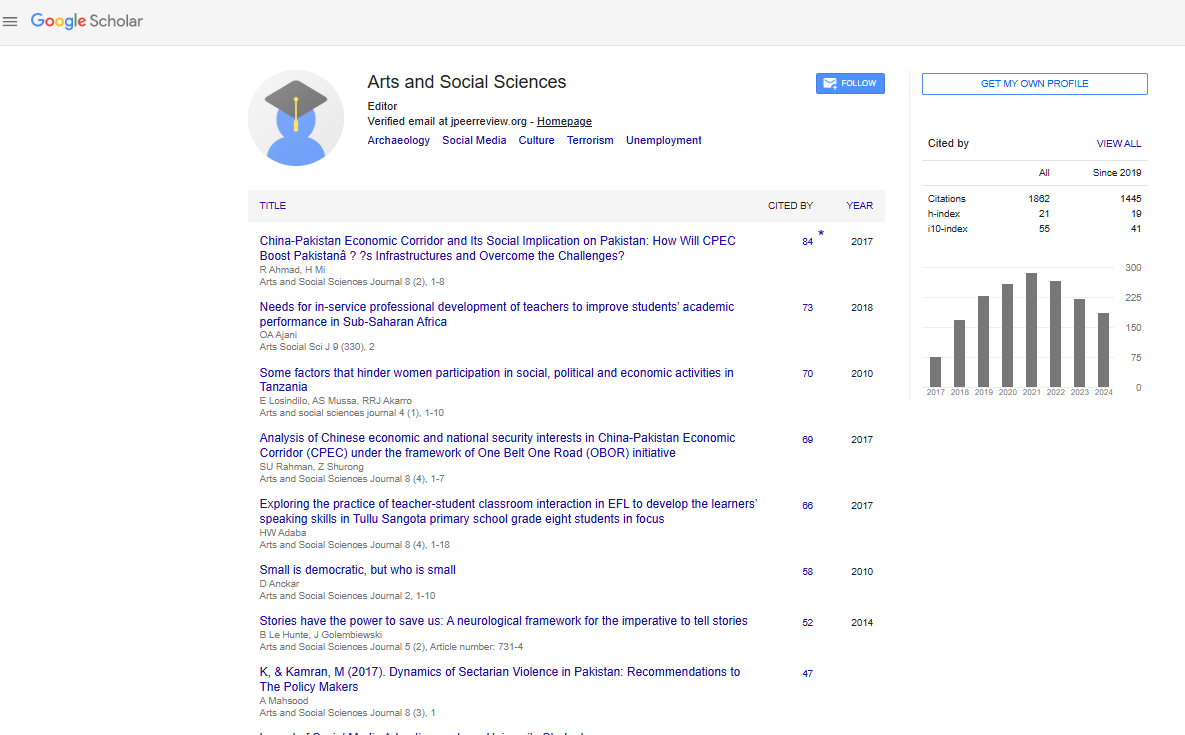
Arts and Social Sciences Journal received 1413 citations as per Google Scholar report