Commentary - (2025) Volume 21, Issue 5
Received: 01-Sep-2025, Manuscript No. jos-26-185173;
Editor assigned: 03-Sep-2025, Pre QC No. P-185173;
Reviewed: 17-Sep-2025, QC No. Q-185173;
Revised: 22-Sep-2025, Manuscript No. R-185173;
Published:
29-Sep-2025
, DOI: 10.37421/1584-9341.2024.20.222
Citation: Noor, Abdul Rahman. ”Day-Case Surgery for Elderly:
Safe, Effective, and Cost-Beneficial.” J Surg 21 (2025):222.
Copyright: © 2025 Noor R. Abdul This is an open-access article distributed under the terms of the Creative Commons Attribution License, which permits unrestricted use,
distribution and reproduction in any medium, provided the original author and source are credited.
The feasibility and safety of day-case surgery for selected elderly patients have been increasingly recognized, presenting numerous advantages such as a reduced hospital stay and enhanced patient satisfaction, all without compromising clinical outcomes. This approach necessitates careful patient selection, thorough pre-operative assessments, and comprehensive post-operative care to ensure successful implementation [1].
Further investigation into specific procedures, such as elective laparoscopic cholecystectomy in the elderly, has shown promising results, with low complication rates and high patient satisfaction observed in prospective studies. The involvement of a multidisciplinary team and adequate social support emerged as critical factors in achieving these positive outcomes [2].
It is imperative to understand that advanced age alone should not serve as an absolute contraindication for day-case surgery. Instead, a more critical evaluation of a patient's physiological reserve, existing comorbidities, and overall functional status is essential in determining their suitability for ambulatory surgical procedures [3].
The economic implications of adopting day-case surgery for the elderly population are substantial. Significant reductions in healthcare costs and more efficient utilization of hospital resources can be realized, making this an attractive option from a financial perspective while simultaneously maintaining positive patient outcomes [4].
Effective management of postoperative pain and the facilitation of early mobilization are fundamental pillars for the successful execution of day-case surgery in elderly patients. This involves the implementation of optimal analgesic strategies and targeted physiotherapy interventions to promote rapid recovery and timely discharge [5].
The role of family and caregiver support in the successful application of day-case surgery for the elderly cannot be overstated. Robust social support networks have been shown to positively influence readmission rates and contribute significantly to the overall well-being of the patient during their recovery period [6].
Minimally invasive surgical techniques, particularly laparoscopic procedures, are exceptionally well-suited for day-case surgery in the elderly. These techniques lead to reduced postoperative pain and accelerated recovery times, making them a preferred choice for this demographic [7].
Prehabilitation programs, which focus on optimizing a patient's physical condition through exercise and nutritional enhancement prior to surgery, can markedly improve the resilience of elderly patients undergoing day-case procedures. This proactive approach leads to superior functional outcomes and a reduction in postoperative complications [8].
A comprehensive geriatric assessment conducted preoperatively is crucial for accurately identifying frail elderly patients who might not be suitable candidates for day-case surgery. This assessment must delve into cognitive function, mobility, nutritional status, and other relevant geriatric parameters [9].
Educating patients and their families about post-discharge care is a vital component for the safe and successful implementation of day-case surgery for the elderly. This education should cover medication management, activity restrictions, and recognition of warning signs indicative of potential complications, thereby empowering them to manage recovery effectively at home [10].
Day-case surgery for selected elderly patients represents a viable and safe surgical option, offering distinct advantages such as a shorter hospital stay and improved patient satisfaction without compromising the quality of surgical outcomes. The successful application of this model hinges upon meticulous patient selection, a thorough pre-operative assessment process, and the provision of comprehensive post-operative care [1].
A prospective study examining elective laparoscopic cholecystectomy in elderly patients undergoing day-case surgery revealed a low incidence of complications alongside a high degree of patient satisfaction. This study underscored the significant contribution of multidisciplinary team collaboration and the provision of adequate social support systems in achieving favorable results [2].
It is increasingly evident that advanced age, considered in isolation, is not an insurmountable barrier to day-case surgery. The critical determinants of suitability are not merely chronological but rather a detailed assessment of the patient's physiological reserves, the presence and management of comorbidities, and their existing functional status [3].
The economic benefits associated with the implementation of day-case surgery for the elderly population are considerable. This model contributes to a reduction in overall healthcare expenditures and optimizes the utilization of valuable hospital resources, demonstrating a clear advantage in terms of cost-effectiveness alongside positive patient outcomes [4].
Key elements for the successful execution of day-case surgery in elderly patients include the effective management of postoperative pain and the promotion of early mobilization. This necessitates the application of optimized analgesic regimens and tailored physiotherapy interventions to expedite recovery and facilitate timely discharge from the hospital setting [5].
The importance of social support from family and caregivers in the context of day-case surgery for the elderly cannot be overstated. Studies have indicated that the strength of a patient's social support network has a direct impact on readmission rates and plays a crucial role in their overall recovery and well-being [6].
Laparoscopic surgical procedures are particularly well-suited for day-case interventions in elderly patients. The minimally invasive nature of these techniques often results in reduced postoperative pain and a more rapid recovery trajectory, making them an ideal choice for ambulatory surgery [7].
Prehabilitation strategies, which involve preparing elderly patients for surgery through exercise and nutritional optimization, can significantly enhance their resilience. This proactive approach is associated with improved functional outcomes and a notable reduction in postoperative complications for patients undergoing day-case procedures [8].
A thorough geriatric assessment performed prior to surgery is indispensable for identifying elderly patients who may be considered too frail for day-case surgery. This evaluation should encompass a comprehensive review of cognitive function, mobility status, and nutritional health [9].
Effective patient and family education concerning post-discharge care is a critical determinant of success in day-case surgery for the elderly. This education should meticulously cover medication management, activity limitations, and the recognition of potential warning signs that may indicate complications, thereby ensuring a safe transition home [10].
Day-case surgery is feasible and safe for selected elderly patients, offering benefits like shorter hospital stays and improved satisfaction without compromising outcomes. Careful patient selection, pre-operative assessment, and post-operative care are crucial. Laparoscopic procedures are well-suited due to minimally invasive techniques. Advanced age alone is not a contraindication; physiological reserve and comorbidities are key. Economic benefits include reduced healthcare costs. Effective pain management, early mobilization, and prehabilitation programs enhance recovery. Social support from family and caregivers is vital. Comprehensive geriatric assessment and patient education are paramount for successful outcomes and safe discharge.
None
None
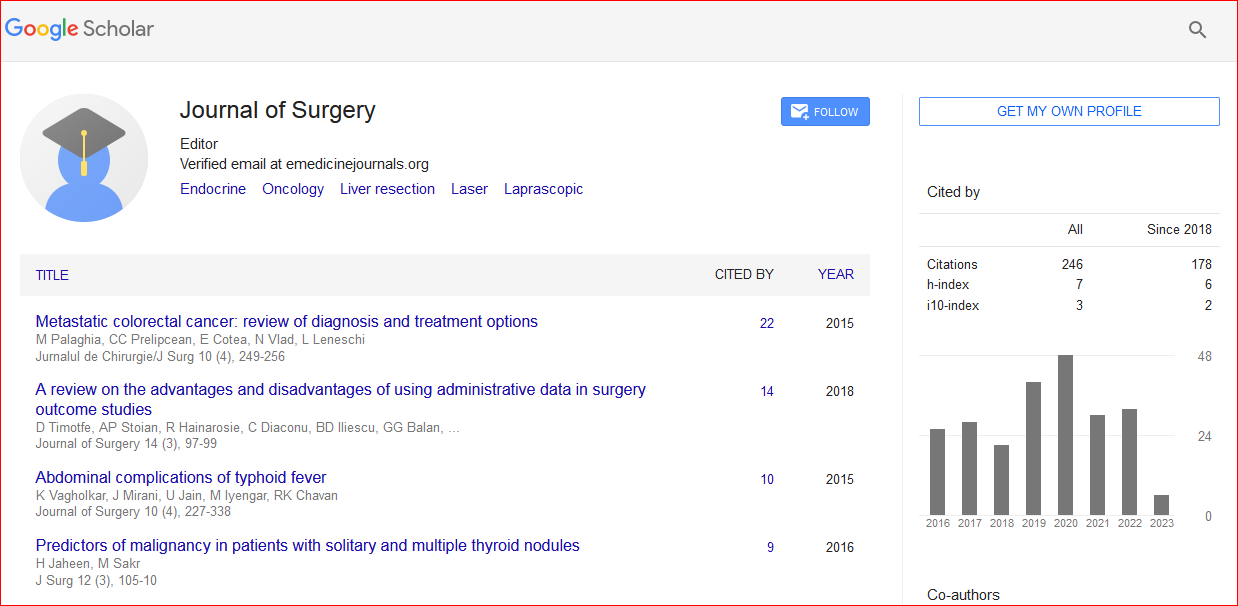
Journal of Surgery received 288 citations as per Google Scholar report