Opinion - (2025) Volume 16, Issue 2
Received: 28-Mar-2025, Manuscript No. gjto-25-175397;
Editor assigned: 31-Mar-2025, Pre QC No. P-175397;
Reviewed: 14-Apr-2025, QC No. QC-175397;
Revised: 21-Apr-2025, Manuscript No. R-175397;
Published:
28-Apr-2025
, DOI: 10.37421/2229-8711.2025.16.440
Citation: Belinsky, Anton. ”Data-Driven Transformation Across Engineering Disciplines.” Global J Technol Optim 16 (2025): 440.
Copyright: © 2025 Belinsky A. This is an open-access article distributed under the terms of the Creative Commons Attribution License, which permits unrestricted use,
distribution and reproduction in any medium, provided the original author and source are credited.
Modern engineering systems increasingly rely on sophisticated methods for predictive maintenance and operational optimization. One significant area of focus involves predicting the Remaining Useful Life (RUL) of components. A novel data-driven framework leverages deep learning, specifically a multi-feature fusion attention network, to analyze diverse sensor data and degradation patterns, enhancing prognostic accuracy and system reliability. This enables proactive maintenance strategies in complex engineering environments[1]. Alongside RUL prediction, the concept of data-driven digital twins is revolutionizing intelligent manufacturing. These twins create a comprehensive architecture by integrating real-time data from physical systems with simulation and machine learning models. This integration facilitates real-time monitoring, predictive analysis, and intelligent decision-making, ultimately improving manufacturing efficiency and flexibility[2].
Structural Health Monitoring (SHM) also benefits immensely from data-driven deep learning. Comprehensive reviews highlight various deep learning architectures, demonstrating their effectiveness in detecting, localizing, and quantifying damage in structures using sensor data. These advancements contribute to developing automated and robust SHM systems for civil, mechanical, and aerospace engineering applications[3]. The design of high-performance materials is another field transformed by data-driven approaches. Machine learning, coupled with large datasets and computational methods, accelerates the discovery and optimization of novel materials with desired properties. This involves using various machine learning techniques to establish structure-property relationships and guide experimental synthesis, significantly reducing the time and cost associated with traditional material development[4].
Advanced control systems are also being enhanced through data-driven reinforcement learning. This approach allows algorithms to learn optimal control policies directly from interaction data, eliminating the need for explicit system models. This adaptability is particularly valuable for complex, dynamic systems where traditional model-based control faces challenges, leading to improved performance and efficiency in various engineering applications[5]. Optimization within manufacturing processes greatly benefits from data-driven techniques. Machine learning and advanced analytics model process behavior, predict outcomes, and optimize parameters to improve quality, reduce costs, and increase throughput. This includes applications in process control, scheduling, and resource allocation, showcasing the profound impact of data in modern manufacturing operations[6]. In the realm of smart grids, data-driven approaches are crucial for fault diagnosis and prognosis. Machine learning and deep learning methods identify anomalies, predict equipment failures, and enhance the reliability and resilience of complex power systems. Big data analytics plays a pivotal role in enabling predictive maintenance and improving operational efficiency within this evolving infrastructure[7].
Civil engineering, too, is experiencing a transformation through data-driven applications. The integration of big data, machine learning, and Artificial Intelligence (AI) is impacting structural analysis, construction management, infrastructure monitoring, and smart city development. Advancements in predictive modeling, anomaly detection, and decision support systems are enhancing safety, sustainability, and efficiency across the civil engineering lifecycle[8]. Specifically for aerospace components, a data-driven prognostic framework utilizing deep learning techniques is being developed. This framework uses sensor data and historical performance records to accurately predict the RUL of critical parts. By employing advanced neural networks, the goal is to improve maintenance scheduling, reduce unscheduled downtime, and enhance the overall safety and reliability of aerospace systems[9]. Finally, recent advances in data-driven process monitoring and fault diagnosis in chemical engineering demonstrate the growing reliance on these methods. Big data analytics, machine learning, and statistical techniques are employed to enhance the operational safety, efficiency, and reliability of chemical processes. These techniques detect anomalies, diagnose root causes of faults, and enable predictive maintenance in complex industrial settings[10].
The application of data-driven methods for predicting Remaining Useful Life (RUL) stands out as a critical area of research. One paper introduces a novel framework that employs a deep learning model, specifically a multi-feature fusion attention network, to analyze diverse sensor data and degradation patterns in engineering systems [1]. This approach aims to boost the accuracy and reliability of prognostics, enabling proactive maintenance and improving overall system resilience. In a similar vein, research tailored for aerospace components also presents a data-driven prognostic framework utilizing deep learning techniques. This framework capitalizes on sensor data and historical performance records to precisely predict RUL, leading to better maintenance scheduling, reduced downtime, and enhanced safety in aerospace operations [9]. Intelligent manufacturing is seeing a paradigm shift with data-driven digital twins. One article outlines a comprehensive architecture for these digital twins, which merge real-time data from physical systems with advanced simulation and machine learning models [2].
The core purpose here is to enable real-time monitoring, predictive analysis, and informed decision-making, ultimately leading to greater manufacturing efficiency and flexibility. Furthermore, the optimization of manufacturing processes is a key focus. Review papers explore how machine learning and advanced analytics can model process behavior, predict outcomes, and fine-tune parameters for improved quality, lower costs, and increased throughput. These techniques find application in process control, scheduling, and resource allocation, demonstrating data's transformative power in modern production environments [6]. Structural Health Monitoring (SHM) greatly benefits from data-driven deep learning methodologies. A comprehensive review discusses various deep learning architectures and their efficacy in detecting, localizing, and quantifying structural damage using sensor data. These developments are crucial for creating automated and reliable SHM systems across civil, mechanical, and aerospace engineering [3]. Beyond SHM, data-driven approaches are vital for fault diagnosis and prognosis in smart grids. Reviews in this area cover diverse machine learning and deep learning methods that pinpoint anomalies, anticipate equipment failures, and bolster the reliability of complex power systems. Big data analytics is central to enabling predictive maintenance and boosting operational efficiency within smart grid infrastructures [7]. Similarly, recent advances in chemical engineering focus on data-driven process monitoring and fault diagnosis, using analytics, machine learning, and statistical methods to enhance operational safety and reliability [10]. The data-driven design of high-performance materials is accelerating discovery and optimization. Machine learning, combined with large datasets, helps establish structure-property relationships and guides experimental synthesis, drastically cutting down the time and cost of traditional material development cycles [4]. In advanced control systems, data-driven reinforcement learning is gaining traction. This involves RL algorithms learning optimal control policies directly from interaction data, bypassing the need for explicit system models. This method offers adaptability and robustness, particularly valuable for intricate, dynamic systems where conventional model-based control presents challenges, leading to enhanced performance [5]. More broadly, data-driven applications are transforming civil engineering. A comprehensive review highlights how integrating big data, machine learning, and Artificial Intelligence (AI) impacts structural analysis, construction management, infrastructure monitoring, and smart city development. The advancements in predictive modeling, anomaly detection, and decision support systems collectively enhance safety, sustainability, and efficiency throughout the civil engineering lifecycle [8]. This shows a consistent trend: data-driven methods are not confined to niche applications but are fundamental to improving diverse engineering fields by leveraging insights from vast datasets.
This collection of papers highlights the widespread application of data-driven methodologies across various engineering disciplines. Central themes include prognostic frameworks for Remaining Useful Life (RUL) prediction in engineering and aerospace systems, often leveraging deep learning and multi-feature fusion attention networks to analyze sensor data and degradation patterns. These approaches aim to improve maintenance scheduling and system reliability. The works also explore data-driven digital twins for intelligent manufacturing, integrating real-time data from physical systems with simulation and machine learning models. This integration facilitates real-time monitoring, predictive analysis, and intelligent decision-making for enhanced efficiency and flexibility. Structural Health Monitoring (SHM) benefits from deep learning, enabling automated damage detection and quantification in diverse structures. Further applications span the data-driven design of high-performance materials using machine learning to accelerate discovery, and reinforcement learning for advanced control systems in complex dynamic environments. Optimization techniques driven by data are shown to refine manufacturing processes, leading to better quality and reduced costs. The collection also reviews data-driven strategies for fault diagnosis and prognosis in smart grids, enhancing power system reliability through big data analytics. Finally, civil engineering is seeing a transformation with data-driven applications in structural analysis, construction management, and infrastructure monitoring, propelled by Artificial Intelligence (AI) and machine learning. Chemical engineering similarly employs these methods for process monitoring and fault diagnosis, demonstrating a consistent trend towards using data analytics to improve safety, efficiency, and predictive capabilities across the industrial spectrum.
None
None
Qian Y, Shuxin L, Yan L. "A data-driven prognostic framework for remaining useful life prediction of engineering systems".Reliab Eng Syst Saf 236 (2023):109289.
Indexed at, Google Scholar, Crossref
Fei T, Wei L, Jing L. "Data-driven digital twin for intelligent manufacturing".J Manuf Syst 64 (2022):356-370.
Indexed at, Google Scholar, Crossref
Oussama A, Ozkan A, Serkan K. "Data-driven deep learning for structural health monitoring: A comprehensive review".J Sound Vib 504 (2021):116124.
Indexed at, Google Scholar, Crossref
Tianxiang X, Yangyang W, Chen X. "Data-driven design of high-performance materials using machine learning".Matter 6 (2023):1775-1798.
Indexed at, Google Scholar, Crossref
Tao L, Min Z, Bo C. "Data-Driven Reinforcement Learning for Advanced Control of Engineering Systems".IEEE Trans Ind Inf 20 (2024):1253-1262.
Indexed at, Google Scholar, Crossref
Jiaxin L, Dan W, Weiming S. "Data-driven optimization of manufacturing processes: A review".J Manuf Syst 62 (2022):631-645.
Indexed at, Google Scholar, Crossref
Boyi C, Weimin M, Zhaoshuai Z. "Data-driven approaches for fault diagnosis and prognosis in smart grids: A review".Renew Sustain Energy Rev 180 (2023):113264.
Indexed at, Google Scholar, Crossref
Haochen M, Dapeng L, Zhisheng M. "Data-driven applications in civil engineering: A comprehensive review".Autom Constr 129 (2021):103792.
Indexed at, Google Scholar, Crossref
Yonggang W, Xinjian M, Jianjun H. "A data-driven prognostic framework for aerospace components based on deep learning".Aerosp Sci Technol 96 (2020):105527.
Indexed at, Google Scholar, Crossref
Qi L, Youcai M, Yue C. "Data-driven process monitoring and fault diagnosis in chemical engineering: A review of recent advances".Comput Chem Eng 172 (2023):108169.
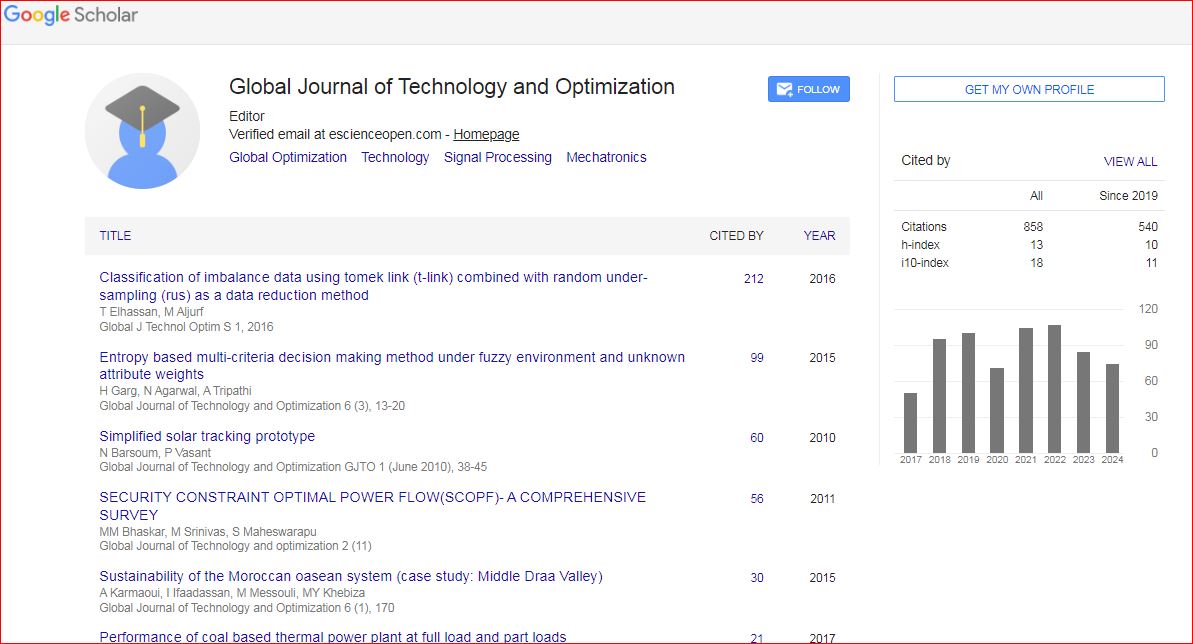
Global Journal of Technology and Optimization received 847 citations as per Google Scholar report