Case Report - (2025) Volume 15, Issue 6
Received: 27-Oct-2025, Manuscript No. jccr-25-172469;
Editor assigned: 29-Oct-2025, Pre QC No. P-172469;
Reviewed: 10-Nov-2025, QC No. Q-172469;
Revised: 17-Nov-2025, Manuscript No. R-172469;
Published:
24-Nov-2025
, DOI: 10.37421/2165-7920.2025.15.1689
Citation: Milazzo, Martina, Vladimir J. Lozanovski, Chiara, Zandonella Necca and Pablo Ruiz Garcia, et al. “da Vinci Single-port Roboticassisted Cervical Approach for Left Nodal Recurrence Dissection in Esophageal Cancer: An Innovative Surgical Management.” J Clin Case Rep 15 (2025): 1689.
Copyright: © 2025 Milazzo M, et al. This is an open-access article distributed under the terms of the Creative Commons Attribution License, which permits unrestricted use, distribution, and reproduction in any medium, provided the original author and source are credited.
Background: Esophageal cancer is one of the most prevalent cancers globally. Despite advancements in treatment, including systemic therapy and surgical resection, the recurrence rate remains high, with 35% to 50% of patients experiencing recurrence after complete Resection (R0). These recurrences, often occurring within two years, are a primary factor contributing to the poor survival rates associated with esophageal cancer. While new treatment modalities, including targeted therapy and immunotherapy, have improved survival, disease relapse continues to be a significant challenge.
Case presentation: This case report presents a 62-year-old male diagnosed with Siewert type II adenocarcinoma of the Esophagogastric Junction (EGJ), who underwent Ivor-Lewis esophagectomy with preoperative chemotherapy. Despite achieving a partial response to chemotherapy, the patient developed an isolated regional recurrence in the left recurrent laryngeal nerve lymph nodes, two years post-surgery. Given his prior chemotherapy-related toxicity, the patient was not considered eligible for systemic therapy. A minimally invasive resection of the recurrent lymph nodes was performed using the da Vinci Single-Port Robotic-Assisted system (SP) through a cervical approach. Postoperative recovery was uneventful and the patient was discharged in good clinical condition.
Conclusion: This case demonstrates the feasibility and safety of a minimally invasive robotic-assisted approach for managing regional recurrence of esophageal cancer in patients with limited treatment options. The procedure allowed for an oncologically radical resection and the patient experienced a short recovery. This approach may offer a valuable alternative in the management of regional recurrences, especially in patients who are not candidates for further systemic therapies, contributing to the ongoing exploration of personalized treatment strategies in esophageal cancer.
Esophageal cancer • Esophagectomy • Robotic surgery • Single port • Lymph node recurrence • Metastatic esophageal cancer • Lymphadenectomy
Esophagogastric Junction (EGJ); da Vinci Single-port Robotic-assisted System (SP); Local Recurrence (LR); Regional Recurrence (RR)
In 2020, esophageal cancer emerged as the seventh most prevalent cancer, with new cases exceeding 600,000. That same year, it was the sixth leading cause of cancer-related deaths, responsible for more than 500,000 deaths [1,2].
The standard treatment for locally advanced esophageal carcinoma is multimodal and includes systemic therapy and surgical resection [3-5]. However, following surgery, recurrence develops in 35% to 50% of patients, even when complete Resection (R0) is achieved. Most of them develop within two years after surgery and this represents the key factor associated with the poor survival rate observed in this type of cancer [5-11]. Despite recent discoveries regarding immunohistochemical patterns and the introduction of new therapeutic approaches (such as target therapy and immunotherapy), that have improved patient survival, disease relapse remains a significant concern [1,3,10-15].
This case report presents a patient with a regional nodal recurrence involving the left recurrent laryngeal nerve lymph nodes from adenocarcinoma of the Esophagogastric Junction (EGJ), following Ivor-Lewis esophagectomy and preoperative chemotherapy. The recurrence was managed surgically through a minimally invasive resection of the affected lymph nodes, using the daVinci Single-Port Robotic-Assisted system (SP) through a cervical approach [12,16].
The aim of this study is to demonstrate the feasibility and safety of this surgical approach in the management of regional recurrences and to illustrate specific technical considerations.
A 62-year-old male patient with a medical history of appendectomy and obstructive sleep apnea presented with progressive dysphagia of unknown etiology. In December 2022, he was diagnosed with Siewert type II adenocarcinoma. Histopathological evaluation revealed a poorly differentiated signet-ring cell adenocarcinoma, Microsatellite Stable (MSS), HER2 and PD-L1 negative. Clinical staging showed a cT3N1M0 tumor with perilesional lymphadenopathy according to the 8th edition of the American Joint Committee on Cancer Staging Manual of the tumor-node-metastasis classification (AJCC [1,13]).
After discussing the patient in our multidisciplinary oncologic board, he was scheduled for preoperative chemotherapy (FLOT). He completed four preoperative cycles, achieving a partial radiological and endoscopic response both on the primary lesion and associated lymphadenopathies.
In March 2023, the patient underwent Ivor-Lewis esophagectomy with standard mediastinal and D2 abdominal lymphadenectomy.
Final pathological analysis confirmed residual microscopic foci of adenocarcinoma (ypT1aN0, 0/37 nodes), with no evidence of lymphovascular or perineural invasion. The postoperative course was uneventful. Later, the patient developed an anastomotic stricture, successfully managed with serial endoscopic dilations with clinical improvement.
Adjuvant chemotherapy with FLOT was initiated but discontinued after the first cycle due to chemotherapy-related toxicity.
Oncologic follow-up (including CT scan and endoscopy) has remained negative until March 2025.
At this re-evaluation, the CT scan revealed a lymphadenopathy in the left superior mediastinum, adjacent to the origin of the ipsilateral subclavian artery, suspicious for regional disease recurrence (Figure 1). The radiological results were discussed in our multidisciplinary board, where the presence of a single site of locoregional recurrence was confirmed, with no evidence of distant metastases.
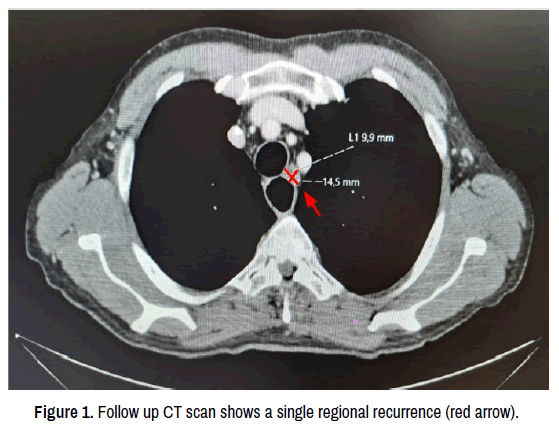
Figure 1. Follow up CT scan shows a single regional recurrence (red arrow).
A surgical resection was recommended, given the clinical and radiological findings, along with the previous toxicity observed during adjuvant.
In April 2025, the patient underwent surgical excision of left recurrent lymph nodes using the da Vinci Single-Port Robotic-Assisted system (SP) through a cervical approach. Patient positioning, robotic trocar placement and the technique for cervical access and subsequent port kit placement have been previously described by the Upper GI Surgical team at the University Hospital of Mainz [12,17]. The following main surgical steps of the procedure are illustrated in the Supplementary Figures 2-5.
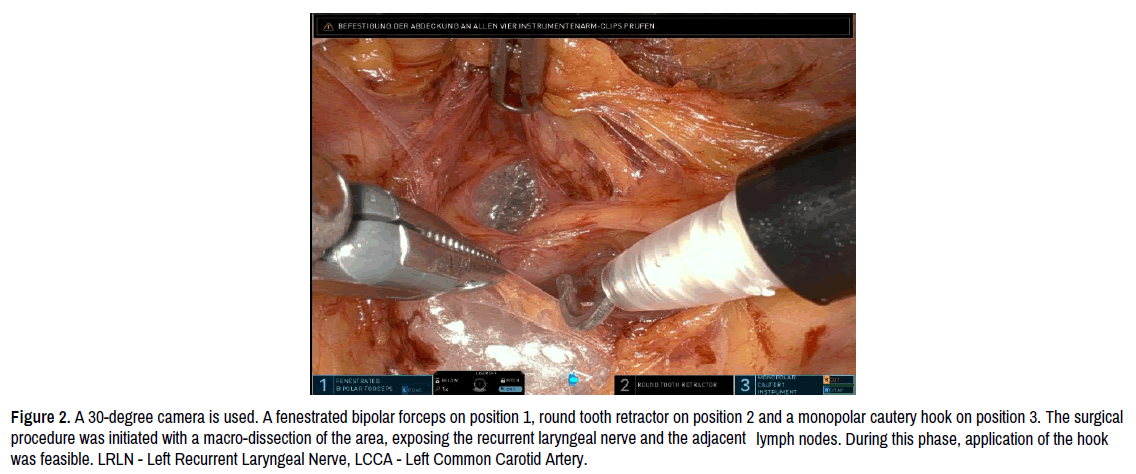
Figure 2. A 30-degree camera is used. A fenestrated bipolar forceps on position 1, round tooth retractor on position 2 and a monopolar cautery hook on position 3. The surgical procedure was initiated with a macro-dissection of the area, exposing the recurrent laryngeal nerve and the adjacent lymph nodes. During this phase, application of the hook was feasible. LRLN - Left Recurrent Laryngeal Nerve, LCCA - Left Common Carotid Artery.
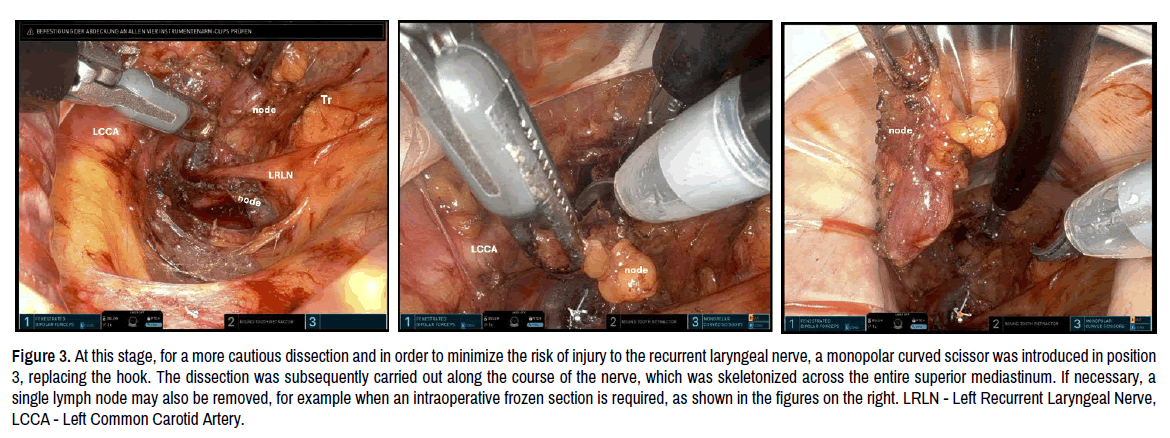
Figure 3. At this stage, for a more cautious dissection and in order to minimize the risk of injury to the recurrent laryngeal nerve, a monopolar curved scissor was introduced in position 3, replacing the hook. The dissection was subsequently carried out along the course of the nerve, which was skeletonized across the entire superior mediastinum. If necessary, a single lymph node may also be removed, for example when an intraoperative frozen section is required, as shown in the figures on the right. LRLN - Left Recurrent Laryngeal Nerve, LCCA - Left Common Carotid Artery.
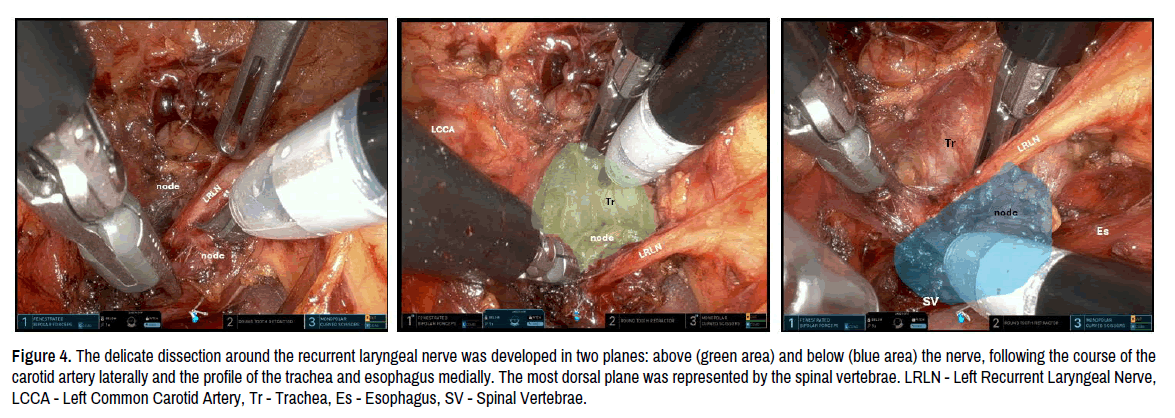
Figure 4. The delicate dissection around the recurrent laryngeal nerve was developed in two planes: above (green area) and below (blue area) the nerve, following the course of the carotid artery laterally and the profile of the trachea and esophagus medially. The most dorsal plane was represented by the spinal vertebrae. LRLN - Left Recurrent Laryngeal Nerve, LCCA - Left Common Carotid Artery, Tr - Trachea, Es - Esophagus, SV - Spinal Vertebrae.
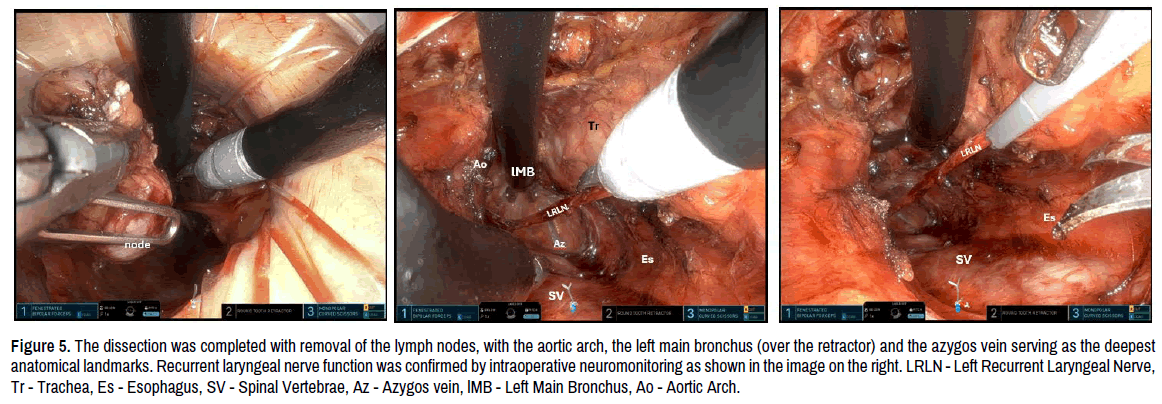
Figure 5. The dissection was completed with removal of the lymph nodes, with the aortic arch, the left main bronchus (over the retractor) and the azygos vein serving as the deepest anatomical landmarks. Recurrent laryngeal nerve function was confirmed by intraoperative neuromonitoring as shown in the image on the right. LRLN - Left Recurrent Laryngeal Nerve, Tr - Trachea, Es - Esophagus, SV - Spinal Vertebrae, Az - Azygos vein, lMB - Left Main Bronchus, Ao - Aortic Arch.
Postoperative recovery was uneventful, permitting discharge on the first postoperative day. Final histopathological analysis confirmed metastatic spread of signet-ring cell adenocarcinoma in one of the three lymph nodes harvested, with evidence of extracapsular extension.
Based on the histopathological findings, the case was re-evaluated in a multidisciplinary oncological board, considering the previous chemotherapy-related toxicity, only oncological follow-up is recommended. At the two-month postoperative follow-up, the patient revealed preserved general condition, with no clinical signs of recurrence.
Recurrences could be categorized into three different groups based on anatomical location:
(1) Local Recurrence (LR) defined as disease isolated to the conduit;
(2) Regional Recurrence (RR), involving only regional lymph nodes; and
(3) Distant recurrence, hematogenous metastasis to non-regional lymph nodes, visceral organs, bones, pleura or peritoneum.
The increased use of neoadjuvant chemo- or chemo-radiotherapy followed by surgical resection has reduced the incidence of overall recurrence compared to patients treated with surgery alone [6,14,15,18,19]. Additionally, in recent years the introduction of target therapies and immunotherapy has led to significant advances in the management of patients with metastatic or recurrence disease [10,11]. However, currently standardized guidelines for the management of recurrences are lacking.
For this reason, most of these patients are treated with local therapies (such as radiotherapy ablation), systemic therapies (such as chemotherapy), or a combination of both approaches. Only rarely are cases treated with surgical resection combined with systemic therapy.
Nevertheless, a significant proportion of these patients receive only palliative care, especially in patients who are not eligible for chemotherapy due to comorbidities or prior chemotherapy-related toxicities [1,5,16].
Another technical issue that requires attention is the re-irradiation of previously treated areas. A significant proportion of LR and RR tend to occur in fields that have already been exposed to radiation during neoadjuvant therapy. Depending on the proximity of critical structures to the tumor site and the overlapping field, re-irradiation may require modifications in both radiation fields and dosage. Consequently, the decision to re-irradiate a previously treated zone represents a complex therapeutic dilemma and, in some cases, this may result in suboptimal treatment for the patient.
Finally, from a surgical perspective, prior studies have suggested that lymphadenectomy may offer a survival benefit in patients with RR confined to the cervical area. Surgical treatment of isolated cervical nodal recurrence has been associated with more favorable outcomes compared to non-cervical RR [1,5-18].
This study demonstrates one potential application of da Vinci SP through cervical access in a patient with a single site of regional recurrence that was not eligible for systemic treatment. The oncologically radical procedure proved to be both feasible and safe for the patient.
Managing regional recurrences in esophageal cancer remains a clinical challenge, particularly in the absence of standardized guidelines and in patients who are not eligible for systemic therapy.
This case demonstrates how a targeted surgical approach, using da Vinci Single-Port Robotic-Assisted system via a cervical access, can offer an effective and safe treatment strategy for patients with isolated nodal recurrence. This surgical intervention allows for an oncologically radical resection and a rapid, uncomplicated postoperative recovery. This approach provides an important alternative for patients with locoregional recurrences that are unsuitable for systemic treatments, contributing to the ongoing exploration of personalized treatment strategies in esophageal cancer
MM wrote the manuscript. MM, VJL and PPG conceptualized the study, analyzed and interpreted the procedure. VJL and PPG participated in writing of the manuscript. MM, EH, VJL, CZN, AFA and PRG collected data, edited and analyzed data. PRG participated in conceptualization and methology. VJL and PPG supervised and reviewed the manuscript. All authors have read and agreed to the final version of the manuscript.
PPG is a proctor for Intuitive Surgical. All other authors declare no conflicts of interest.
Google Scholar, Cross Ref, Indexed at
Google Scholar, Cross Ref, Indexed at
Google Scholar, Cross Ref, Indexed at
Google Scholar, Cross Ref, Indexed at
Google Scholar, Cross Ref, Indexed at
Google Scholar, Cross Ref, Indexed at
Google Scholar, Cross Ref, Indexed at
Google Scholar, Cross Ref, Indexed at
Google Scholar, Cross Ref, Indexed at
Google Scholar, Cross Ref, Indexed at
Google Scholar, Cross Ref, Indexed at
Google Scholar, Cross Ref, Indexed at
Google Scholar, Cross Ref, Indexed at
Google Scholar, Cross Ref, Indexed at
Google Scholar, Cross Ref, Indexed at
Google Scholar, Cross Ref, Indexed at
Google Scholar, Cross Ref, Indexed at
Google Scholar, Cross Ref, Indexed at
Journal of Clinical Case Reports received 1345 citations as per Google Scholar report