Brief Report - (2025) Volume 11, Issue 5
Received: 02-Oct-2025, Manuscript No. icoa-25-173605;
Editor assigned: 06-Oct-2025, Pre QC No. P-173605;
Reviewed: 20-Oct-2025, QC No. Q-173605;
Revised: 23-Oct-2025, Manuscript No. R-173605;
Published:
30-Oct-2025
, DOI: 10.37421/2469-9756.2025.11.320
Citation: Nguyen, Michael T.. ”Cytokine Profiling: Revolutionizing Precision Medicine.” Immunochem Immunopathol 11 (2025):320.
Copyright: © 2025 Nguyen T. Michael This is an open-access article distributed under the terms of the Creative Commons Attribution License, which permits unrestricted use,
distribution and reproduction in any medium, provided the original author and source are credited.
This article explores how single-cell cytokine profiling provides a detailed look into immune cell functions and their diverse responses. It really helps us understand the complex roles of these cells in health and disease, moving beyond bulk analysis to identify unique cellular behaviors and potential therapeutic targets. What this means for research is a deeper insight into personalized medicine and targeted immunotherapies. [1] Here's the thing, advancements in cytokine profiling are really shaping precision medicine. This review highlights innovative techniques that allow for highly specific and sensitive detection of cytokines, crucial for tailoring treatments. It's about getting more accurate diagnoses and predicting treatment responses, making patient care much more individualized and effective. [2] Specifically, cytokine profiling on COVID-19 patients has uncovered distinct immune responses directly linked to how severe their disease became. What this really means is identifying specific cytokine signatures that could serve as markers for disease progression, helping doctors better manage critical cases and develop targeted therapies for the virus. [3] Let's break it down: a systematic review focused on inflammatory cytokine profiling in Chronic Obstructive Pulmonary Disease (COPD) synthesizes current knowledge on specific cytokines involved in COPD pathogenesis, highlighting their potential as biomarkers for diagnosis, disease activity monitoring, and even guiding therapeutic strategies to improve patient outcomes. [4] Another systematic review looks at cytokine profiling in early arthritis, trying to figure out if these patterns can predict the disease's progression. It points to certain cytokines as promising predictors, which could allow for earlier, more aggressive treatment for those at risk of severe disease. This offers a path toward preventing irreversible joint damage and improving long-term patient health. [5] High-throughput cytokine profiling has also identified crucial biomarkers for disease activity in systemic lupus erythematosus (SLE). This means we're getting closer to precise, measurable indicators that can monitor disease progression and tailor treatments. Discovering these biomarkers is a big step towards improving how we manage SLE, ultimately leading to better patient outcomes. [6] This approach extends to infectious diseases, where multiplex cytokine profiling in serum has pinpointed unique inflammatory signatures present in severe malaria cases. What they found offers specific insights into the immune dysregulation driving severe disease. These identified signatures could pave the way for early diagnosis and better-targeted interventions, especially in resource-limited settings where rapid assessment is crucial. [7] Furthermore, cytokine profiling of cerebrospinal fluid in neuroinflammatory disorders is a powerful tool. It helps differentiate between various neurological conditions by revealing distinct immune mediator patterns. This approach is critical for accurate diagnosis and monitoring of disease activity, ultimately guiding treatment decisions for patients with complex neuroinflammatory issues. [8] In critical care, plasma cytokine profiling in sepsis patients reveals crucial biomarkers for disease progression and predicting mortality. Identifying these specific cytokine patterns means clinicians could potentially stratify patients, predict outcomes earlier, and intervene with more targeted therapies. This is a game-changer for managing a life-threatening condition like sepsis. [9] Lastly, cytokine profiling of aqueous humor in diabetic retinopathy is explored in this study, providing insights into the inflammatory mechanisms driving this vision-threatening complication. By analyzing the cytokine milieu in the eye, researchers can pinpoint key inflammatory mediators. This understanding is vital for developing novel therapeutic strategies that specifically target inflammation to preserve vision in diabetic patients. [10]
Cytokine profiling, particularly single-cell analysis, offers a detailed understanding of immune cell functions and their diverse responses. It moves beyond bulk analysis to identify unique cellular behaviors and potential therapeutic targets, providing deeper insights into personalized medicine and targeted immunotherapies [1]. Here's the thing, these advancements are truly shaping precision medicine by introducing innovative techniques for highly specific and sensitive cytokine detection. This capability is crucial for tailoring treatments, leading to more accurate diagnoses and predictions of treatment responses, which makes patient care significantly more individualized and effective [2].
The application of cytokine profiling extends to infectious diseases and acute critical conditions. For instance, studies on COVID-19 patients have revealed distinct immune responses directly linked to disease severity. What this really means is the identification of specific cytokine signatures that can serve as markers for progression, aiding in managing critical cases and developing targeted antiviral therapies [3]. Similarly, multiplex cytokine profiling in serum has pinpointed unique inflammatory signatures in severe malaria cases, offering specific insights into immune dysregulation. These identified signatures are crucial for early diagnosis and better-targeted interventions, particularly in resource-limited settings where rapid assessment is key [7]. In a life-threatening condition like sepsis, plasma cytokine profiling reveals crucial biomarkers for disease progression and predicting mortality. Identifying these specific cytokine patterns enables clinicians to stratify patients, predict outcomes earlier, and intervene with more targeted therapies, truly a game-changer for managing sepsis [9].
Cytokine profiling is also instrumental in managing chronic inflammatory and autoimmune conditions. Let's break it down: a systematic review on inflammatory cytokine profiling in Chronic Obstructive Pulmonary Disease (COPD) synthesizes current knowledge on specific cytokines involved in its pathogenesis. This highlights their potential as biomarkers for diagnosis, monitoring disease activity, and guiding therapeutic strategies to improve patient outcomes [4]. Another systematic review focused on early arthritis suggests that cytokine patterns can predict disease progression, pointing to certain cytokines as promising predictors. This could lead to earlier, more aggressive treatment for those at risk of severe disease, ultimately preventing irreversible joint damage and improving long-term patient health [5]. Furthermore, high-throughput cytokine profiling has identified crucial biomarkers for disease activity in systemic lupus erythematosus (SLE). This means we're getting closer to precise, measurable indicators that can monitor disease progression and tailor treatments, representing a big step towards improving SLE management and patient outcomes [6].
The utility of cytokine profiling extends even to less accessible biological compartments. Cytokine profiling of cerebrospinal fluid in neuroinflammatory disorders is a powerful tool, helping differentiate various neurological conditions by revealing distinct immune mediator patterns. This approach is critical for accurate diagnosis and monitoring of disease activity, guiding treatment decisions for patients with complex neuroinflammatory issues [8]. In the eye, cytokine profiling of aqueous humor in diabetic retinopathy provides insights into the inflammatory mechanisms driving this vision-threatening complication. By analyzing the cytokine milieu, researchers can pinpoint key inflammatory mediators, an understanding vital for developing novel therapeutic strategies to specifically target inflammation and preserve vision in diabetic patients [10].
Cytokine profiling has emerged as a critical tool for understanding diverse immune responses across various health conditions and diseases. This technique offers a detailed look into immune cell functions, moving beyond traditional bulk analysis to identify unique cellular behaviors and potential therapeutic targets. The advancements in cytokine profiling are shaping precision medicine, allowing for highly specific and sensitive detection of cytokines essential for tailoring treatments, improving diagnostic accuracy, and predicting treatment responses for individualized patient care. Research shows its application in various contexts, such as uncovering distinct immune responses linked to COVID-19 severity, identifying specific cytokine signatures as markers for disease progression, and guiding management of critical cases. It also plays a key role in understanding inflammatory cytokine patterns in Chronic Obstructive Pulmonary Disease (COPD) and in predicting disease progression in early arthritis, which helps prevent irreversible joint damage. High-throughput methods have further identified crucial biomarkers for disease activity in systemic lupus erythematosus (SLE) and revealed unique inflammatory signatures in severe malaria, leading to better-targeted interventions. Cytokine profiling of cerebrospinal fluid aids in differentiating neuroinflammatory disorders, while plasma profiling in sepsis patients helps predict mortality. Even in diabetic retinopathy, analysis of aqueous humor cytokines provides insights into inflammatory mechanisms, crucial for preserving vision. What this really means is cytokine profiling is revolutionizing diagnostics, prognostics, and personalized treatment strategies across a broad spectrum of medical challenges.
None
None
1. Rujun Z, Zelin C, Zhiyu Z. "Single-cell cytokine profiling to unravel immune cell heterogeneity and function".Signal Transduct Target Ther 8 (2023):298.
Indexed at, Google Scholar, Crossref
2. Yuting C, Wenhui Z, Qing W. "Advancements in cytokine profiling techniques for precision medicine".Front Immunol 13 (2022):1046162.
Indexed at, Google Scholar, Crossref
3. Clara L, Alessandro P, Laura M. "Cytokine profiling of COVID-19 patients reveals distinct immune responses associated with disease severity".Cell Rep Med 1 (2020):100085.
Indexed at, Google Scholar, Crossref
4. Bayan A, Amer A, Huda K. "Inflammatory Cytokine Profiling in Chronic Obstructive Pulmonary Disease: A Systematic Review".Life (Basel) 13 (2023):2125.
Indexed at, Google Scholar, Crossref
5. Aliyah AM, Ali R, Faraz A. "Cytokine Profiling in Early Arthritis to Predict Disease Course: A Systematic Review".Cureus 16 (2024):e52092.
Indexed at, Google Scholar, Crossref
6. Yuan X, Bin W, Xinyi Z. "High-throughput cytokine profiling identifies biomarkers for disease activity in systemic lupus erythematosus".Nat Commun 11 (2020):3224.
Indexed at, Google Scholar, Crossref
7. Siew-Ching O, Kok-Lian L, Zhi-Shang T. "Multiplex cytokine profiling in serum identifies unique inflammatory signatures in severe malaria".Malar J 20 (2021):236.
Indexed at, Google Scholar, Crossref
8. Tereza Z, Lucia K, Jana J. "Cytokine profiling of cerebrospinal fluid in neuroinflammatory disorders".J Neuroimmunol 374 (2023):578007.
Indexed at, Google Scholar, Crossref
9. Xi W, Yang Z, Shuhui L. "Plasma cytokine profiling in sepsis patients reveals biomarkers for disease progression and mortality".Front Med (Lausanne) 8 (2021):635848.
Indexed at, Google Scholar, Crossref
10. Jong-Ki P, Jin-Hee P, Junhwa A. "Cytokine Profiling of Aqueous Humor in Diabetic Retinopathy".J Clin Med 11 (2022):2845.
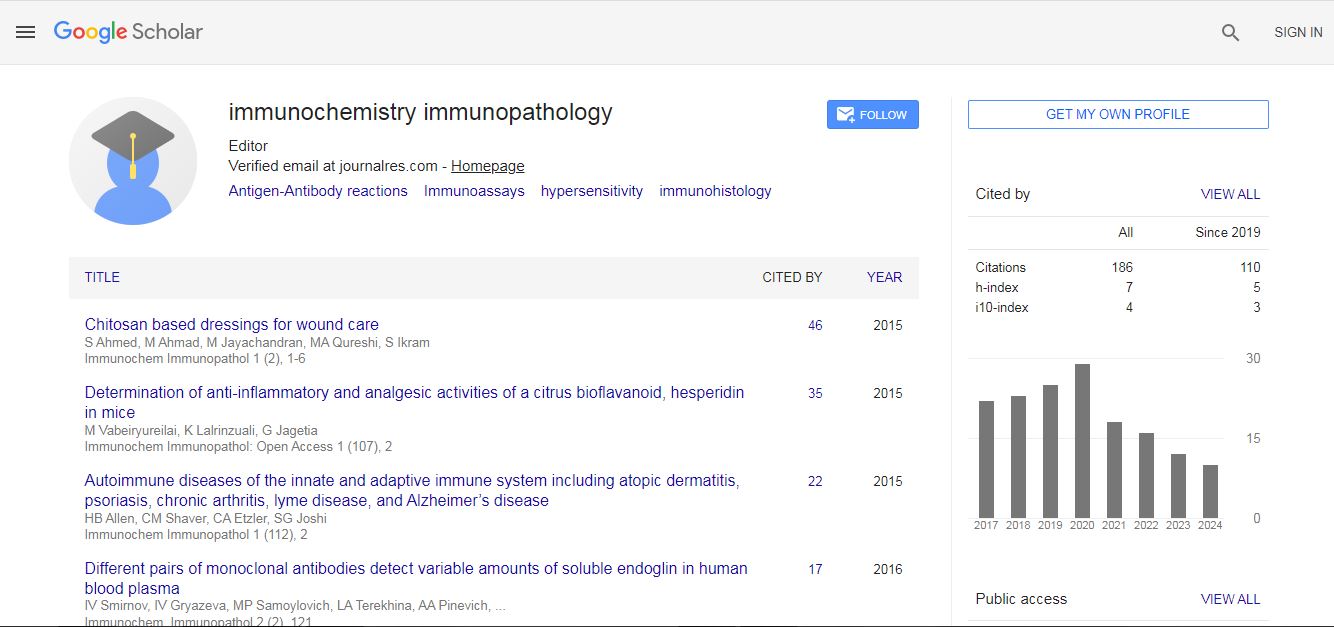
Immunochemistry & Immunopathology received 174 citations as per Google Scholar report