Opinion - (2025) Volume 16, Issue 3
Received: 01-Aug-2025, Manuscript No. hgec-25-174739;
Editor assigned: 04-Aug-2025, Pre QC No. P-174739;
Reviewed: 18-Aug-2025, QC No. Q-174739;
Revised: 22-Aug-2025, Manuscript No. R-174739;
Published:
29-Aug-2025
, DOI: 10.37421/2161-0436.2025.16.293
Citation: Han, Yoon-ji. ”Cytogenetics’ Evolution: Enhancing Diagnosis and Understanding.” Human Genet Embryol 16 (2025):293.
Copyright: © 2025 Han Y. This is an open-access article distributed under the terms of the Creative Commons Attribution License, which permits unrestricted use, distribution and reproduction in any medium, provided the original author and source are credited.
The field of clinical cytogenetics has undergone a remarkable evolution, marked by significant progress in genomic testing for pediatric patients. This shift moves from traditional karyotyping to advanced techniques like chromosomal microarray and next-generation sequencing, enhancing diagnostic yield and guiding personalized medicine approaches. The evolution of cytogenetic analysis in solid tumors traces from early banding techniques to modern molecular methods. These techniques have revealed specific chromosomal rearrangements, which are crucial for tumor classification, prognosis, and therapeutic targeting, even as challenges in complexity and the need for integrative approaches persist. Prenatal cytogenetic diagnosis has seen a detailed progression from traditional karyotyping to fluorescence in situ hybridization (FISH), chromosomal microarray analysis (CMA), and non-invasive prenatal testing (NIPT). These technologies have significantly improved the detection of chromosomal abnormalities prenatally, providing vital information for expectant parents. Molecular cytogenetics has charted an evolution from classical karyotyping to comprehensive genome-wide analyses. Techniques such as FISH, mFISH, and array Comparative Genomic Hybridization (array-CGH) have revolutionized the detection of chromosomal aberrations, allowing for higher resolution and more precise characterization of genetic changes across the genome. Cytogenetic studies play a vital role in identifying the genetic causes of neurodevelopmental disorders. Techniques like array Comparative Genomic Hybridization (aCGH) and next-generation sequencing are used to detect copy number variations and other chromosomal anomalies, leading to improved diagnostic rates and a better understanding of these complex conditions. In acute myeloid leukemia (AML), cytogenetics and molecular genetics hold a critical role in diagnosis and prognostic assessment. Specific chromosomal aberrations and gene mutations inform risk stratification and guide treatment strategies, highlighting the dynamic interplay between conventional and advanced molecular profiling for refined patient management. The emerging field of single-cell cytogenetics explores technological advancements and diverse applications. Analyzing chromosomal aberrations at a single-cell level can reveal intratumoral heterogeneity, detect rare cell populations, and provide unprecedented insights into disease mechanisms, particularly in cancer and developmental biology. Within the genomics era, cytogenetics examines its evolving role for Mendelian disorders. Advanced cytogenetic techniques, integrated with genomic sequencing, offer a comprehensive view of chromosomal structural variations and copy number changes, thereby improving diagnostic accuracy for inherited conditions often missed by sequencing alone. Automation in cytogenetics explores its historical development, current state, and future potential. Automated systems enhance efficiency, standardize processes, and reduce human error in tasks like slide preparation, image acquisition, and karyotype analysis, ultimately streamlining diagnostic workflows in clinical laboratories. Bioinformatics plays a crucial role in modern clinical cytogenetics, transforming raw genomic data into meaningful diagnostic interpretations. Computational tools and pipelines are essential for processing complex datasets from techniques like array-CGH and NGS, enabling accurate identification and characterization of chromosomal anomalies for clinical decision-making.
The field of cytogenetics has experienced a profound transformation, moving decisively from conventional karyotyping to highly sophisticated molecular and genomic testing methodologies. This evolution has introduced a suite of advanced techniques, including chromosomal microarray (CMA), fluorescence in situ hybridization (FISH), array comparative genomic hybridization (aCGH), and next-generation sequencing (NGS) [1, 3, 4]. These modern approaches provide unparalleled resolution and precision in detecting a wide array of chromosomal aberrations, such as copy number variations and complex structural rearrangements, significantly expanding diagnostic capabilities beyond what was traditionally possible [4, 5]. This shift has been instrumental in gaining a more comprehensive understanding of the genetic architecture underlying various health conditions.
These advanced cytogenetic methods are now indispensable across a broad spectrum of clinical applications. In the realm of pediatric health, they are crucial for diagnosing intricate genetic disorders in children, leading to substantially improved diagnostic yields and facilitating the development of personalized medicine strategies [1]. Similarly, for individuals affected by neurodevelopmental disorders, cytogenetic studies, often employing aCGH and NGS, are fundamental in pinpointing the genetic causes by effectively detecting chromosomal anomalies, thereby enhancing diagnostic accuracy and deepening our comprehension of these complex conditions [5]. The impact extends to oncology, where cytogenetic analysis in solid tumors has evolved from early banding techniques to modern molecular methods, allowing for the precise identification of chromosomal rearrangements critical for accurate tumor classification, prognostic assessment, and guiding therapeutic interventions [2].
Furthermore, cytogenetics plays a pivotal role in hematological malignancies. For instance, in acute myeloid leukemia (AML), the detailed analysis of specific chromosomal aberrations and gene mutations is paramount for precise risk stratification and for tailoring treatment plans. This highlights the essential and dynamic interplay between classical cytogenetics and contemporary molecular profiling in optimizing patient management strategies [6]. Prenatal diagnostic capabilities have also been significantly enhanced. The progression from traditional karyotyping to techniques like FISH, CMA, and non-invasive prenatal testing (NIPT) offers expectant parents vital and detailed information regarding potential chromosomal abnormalities, empowering them with crucial insights for informed decision-making [3]. In the broader context of Mendelian disorders, cytogenetics in the genomics era, particularly when integrated with genomic sequencing, provides a holistic view of chromosomal structural variations and copy number changes, improving diagnostic accuracy for inherited conditions that might be overlooked by sequencing alone [8].
Beyond direct diagnostic applications, the field continues to innovate technologically and computationally. The emerging domain of single-cell cytogenetics exemplifies this progress, offering the ability to analyze chromosomal aberrations at the individual cell level. This breakthrough capability is vital for uncovering intratumoral heterogeneity, detecting rare cell populations, and providing profound insights into disease mechanisms, especially in cancer and developmental biology [7]. Operational aspects within cytogenetic laboratories have also been transformed through automation. Automated systems improve efficiency, standardize critical processes such as slide preparation and image acquisition, and mitigate human error in tasks like karyotype analysis, thereby streamlining diagnostic workflows considerably [9]. Finally, bioinformatics has become an utterly essential component of modern clinical cytogenetics. It serves as the bridge for transforming complex raw genomic data from techniques like array-CGH and NGS into meaningful, actionable diagnostic interpretations, ensuring accurate identification and characterization of chromosomal anomalies for robust clinical decision-making [10].
The field of cytogenetics has undergone significant transformation, evolving from traditional karyotyping to sophisticated genomic analyses. This progression has introduced advanced techniques like chromosomal microarray (CMA), fluorescence in situ hybridization (FISH), array comparative genomic hybridization (aCGH), and next-generation sequencing (NGS), which offer higher resolution and more precise detection of chromosomal aberrations and copy number variations. These advanced methods are now fundamental across diverse clinical applications. In pediatric care, they are essential for diagnosing complex genetic disorders, improving diagnostic yield, and paving the way for personalized medicine approaches. For solid tumors, cytogenetic analysis helps in classification, prognosis, and identifying therapeutic targets. Prenatally, these technologies provide critical information for expectant parents by detecting chromosomal abnormalities. Furthermore, cytogenetics is crucial in understanding the genetic causes of neurodevelopmental disorders and plays a vital role in the diagnosis and prognostic assessment of acute myeloid leukemia (AML), guiding treatment strategies through the identification of specific chromosomal aberrations and gene mutations. Beyond specific disease applications, the field is also advancing technologically. Single-cell cytogenetics is emerging, offering insights into intratumoral heterogeneity and rare cell populations. Automation is streamlining laboratory workflows by improving efficiency and reducing human error. Bioinformatics is becoming indispensable, transforming complex genomic data into actionable diagnostic interpretations. This collective evolution highlights how cytogenetics, especially when integrated with genomics, continues to improve diagnostic accuracy and deepen our understanding of genetic architecture across a wide spectrum of inherited and acquired conditions.
None
None
Indexed at, Google Scholar, Crossref
Indexed at, Google Scholar, Crossref
Indexed at, Google Scholar, Crossref
Indexed at, Google Scholar, Crossref
Indexed at, Google Scholar, Crossref
Indexed at, Google Scholar, Crossref
Indexed at, Google Scholar, Crossref
Indexed at, Google Scholar, Crossref
Indexed at, Google Scholar, Crossref
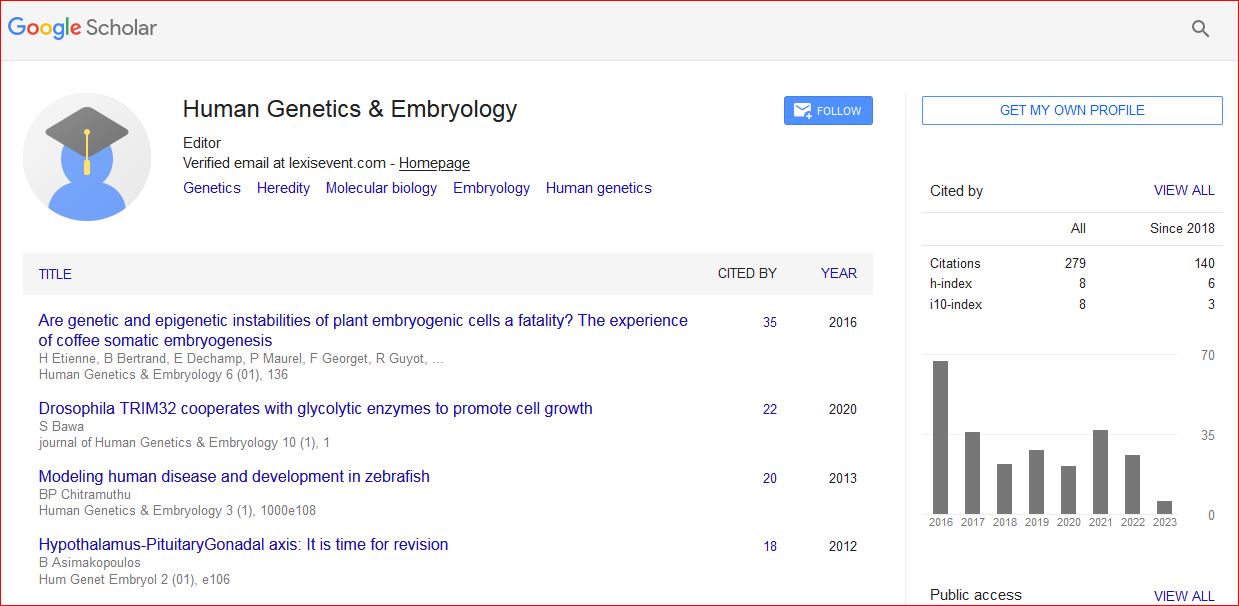
Human Genetics & Embryology received 309 citations as per Google Scholar report