Perspective - (2025) Volume 9, Issue 3
Received: 01-May-2025, Manuscript No. fsb-26-189950;
Editor assigned: 05-May-2025, Pre QC No. P-189950;
Reviewed: 19-May-2025, QC No. Q-189950;
Revised: 22-May-2025, Manuscript No. R-189950;
Published:
29-May-2025
, DOI: 10.37421/2577-0543.2025.9.236
Citation: Carter, Olivia. ”Cyclodextrins: Enhancing Drug Solubility and Delivery.” J Formul Sci Bioavailab 09 (2025):236.
Copyright: © 2025 Carter O. This is an open-access article distributed under the terms of the Creative Commons Attribution License, which permits unrestricted use, distribution and reproduction in any medium, provided the original author and source are credited.
Cyclodextrins, a class of cyclic oligosaccharides, have emerged as crucial excipients in pharmaceutical science, primarily for their remarkable ability to form inclusion complexes with a wide array of drug molecules. This complexation mechanism is particularly effective in addressing the challenges posed by poorly soluble drugs. By encapsulating hydrophobic drug moieties within their internal cavity, cyclodextrins effectively shield them from the aqueous environment, thereby significantly enhancing their solubility. This improvement in solubility is a cornerstone for achieving higher drug concentrations in solution, which directly translates to improved absorption across biological membranes and, consequently, enhanced bioavailability. The selection of specific cyclodextrin derivatives, such as beta-cyclodextrin, hydroxypropyl-beta-cyclodextrin, and sulfobutylether-beta-cyclodextrin, is a strategic decision dictated by the physicochemical characteristics of the drug and the intended route of administration, spanning oral, parenteral, and topical applications [1].
Hydroxypropyl-beta-cyclodextrin (HP-beta-CD) stands out as a widely utilized derivative due to its favorable properties, including superior water solubility and a reduced toxicity profile when compared to native beta-cyclodextrin. Its efficacy in forming stable inclusion complexes with various hydrophobic active pharmaceutical ingredients (APIs) has been extensively documented. The incorporation of HP-beta-CD into drug formulations leads to a substantial increase in the drug's dissolution rate, a critical factor influencing oral bioavailability. The underlying mechanism involves the formation of a hydrophilic outer shell around the hydrophobic drug molecule, which facilitates its dispersion and dissolution in aqueous media. The precise molar ratio of HP-beta-CD to the drug is a key parameter that requires careful optimization to achieve maximal complexation efficiency [2].
Sulfobutylether-beta-cyclodextrin (SBE-beta-CD) is another prominent cyclodextrin derivative, distinguished by its high water solubility and excellent safety record, making it a preferred choice for parenteral drug formulations. Its anionic nature, coupled with a higher degree of substitution, confers upon it a superior capacity for complexing positively charged or neutral hydrophobic drugs. SBE-beta-CD plays a vital role in enhancing the solubility and stability of drugs intended for injection, thereby preventing precipitation and ensuring smooth administration. Its reduced hemolytic activity in comparison to other cyclodextrins further solidifies its position as a preferred agent for intravenous and intramuscular delivery systems. This improved delivery profile is instrumental in achieving adequate drug concentrations at the target site, leading to enhanced therapeutic outcomes [3].
The intricate process of cyclodextrin-drug complexation is governed by a confluence of non-covalent forces, including hydrophobic interactions, van der Waals forces, and hydrogen bonding. The primary driving force behind the formation of these inclusion complexes is the energetic advantage gained by displacing high-energy water molecules from the cyclodextrin cavity with the more hydrophobic drug molecule. A thorough understanding of these molecular interactions is paramount for the rational design of effective cyclodextrin-based drug delivery systems. Factors such as the drug molecule's size and shape, the specific cyclodextrin derivative employed, and the characteristics of the solvent system all exert a significant influence on the stability and stoichiometry of the resulting inclusion complex, ultimately impacting the drug's solubility and bioavailability [4].
Solid dispersions that incorporate cyclodextrins represent a potent strategy for augmenting the dissolution rate and bioavailability of drugs that exhibit poor water solubility. Through the formation of inclusion complexes in the solid state, employing techniques such as kneading, spray drying, or freeze-drying, the drug is rendered into a molecularly dispersed form with an increased surface area available for dissolution. This approach effectively circumvents common challenges like drug crystallization and aggregation, leading to enhanced absorption. The efficacy of this method is contingent upon the judicious selection of the cyclodextrin derivative and the solid dispersion technique, both of which critically influence the drug release profile and the overall therapeutic effectiveness of the formulation [5].
The physiological environment of the gastrointestinal tract often presents significant obstacles to the absorption of poorly soluble drugs. Cyclodextrin complexation offers a viable solution by effectively increasing the drug's solubility within the intestinal fluid, thereby accelerating its absorption rate. This improved absorption can lead to a reduction in the variability of drug plasma concentrations among individuals and may permit the administration of lower effective doses. The application of cyclodextrins in oral formulations is particularly advantageous for drugs characterized by a narrow therapeutic index or those subject to extensive pre-systemic metabolism. Furthermore, ongoing research is exploring the complex interactions between cyclodextrins and intestinal transporters, which may offer additional avenues for optimizing oral drug delivery [6].
Nanotechnology-based approaches, frequently integrating cyclodextrins, are at the forefront of efforts to refine drug delivery systems. Cyclodextrin-modified nanoparticles possess the potential to elevate drug encapsulation efficiency, enable controlled drug release, and promote cellular uptake. For instance, cyclodextrins can be utilized to functionalize the surface of nanoparticles, thereby enhancing their interaction with biological barriers and improving the targeting of drugs. This synergistic integration of nanotechnology and cyclodextrin chemistry aims to address multiple limitations associated with poorly soluble drugs, including their inherent poor solubility, low bioavailability, and propensity for rapid clearance from the body [7].
The safety profile of cyclodextrins is a non-negotiable aspect that warrants careful consideration in their pharmaceutical applications. While native beta-cyclodextrin has been associated with nephrotoxicity at elevated doses, modified derivatives such as HP-beta-CD and SBE-beta-CD generally exhibit considerably improved safety margins. Extensive toxicological assessments have established acceptable daily intake levels for these derivatives, underscoring their therapeutic viability. A comprehensive understanding of the pharmacokinetic and pharmacodynamic properties of cyclodextrin-drug complexes is indispensable for accurately predicting their in vivo behavior and ensuring patient safety. Key elements of their safety evaluation include detailed investigations into their metabolism and excretion pathways [8].
In the realm of topical drug delivery, cyclodextrins offer a valuable means to enhance the solubility of poorly permeable drugs, thereby facilitating their penetration through the stratum corneum. By forming inclusion complexes, cyclodextrins can increase the drug's thermodynamic activity and diminish its tendency to partition back into the formulation. This leads to an elevated drug concentration within the epidermis and dermis, ultimately augmenting therapeutic efficacy for various dermatological conditions. The concurrent use of permeation enhancers alongside cyclodextrins can further optimize the efficiency of topical drug delivery [9].
The continuous development of novel cyclodextrin derivatives with precisely tailored properties is instrumental in broadening their pharmaceutical utility. Current research endeavors are focused on synthesizing derivatives that exhibit enhanced complexation capabilities for specific drug classes, improved water solubility, and reduced toxicity. Supramolecular chemistry plays a pivotal role in the design of these advanced derivatives and in elucidating their complex interactions with drugs and biological systems. The overarching objective is to engineer more efficient and targeted drug delivery systems capable of overcoming existing formulation hurdles and ultimately improving patient outcomes [10].
Cyclodextrins are cyclic oligosaccharides that are highly effective at forming inclusion complexes with drugs that have poor solubility. This complexation process significantly boosts drug solubility by shielding hydrophobic drug molecules within the cyclodextrin cavity, which minimizes their interaction with water. Consequently, this improved solubility directly leads to enhanced bioavailability by increasing the concentration of dissolved drug available for absorption through biological membranes. The choice of an appropriate cyclodextrin derivative, such as beta-cyclodextrin, hydroxypropyl-beta-cyclodextrin, or sulfobutylether-beta-cyclodextrin, is contingent upon the drug's specific physicochemical properties and the desired route of drug delivery, including oral, parenteral, and topical formulations [1].
Hydroxypropyl-beta-cyclodextrin (HP-beta-CD) is a frequently employed derivative for solubility enhancement due to its superior water solubility and lower toxicity compared to native beta-cyclodextrin. Numerous studies have confirmed its effectiveness in creating stable inclusion complexes with a variety of hydrophobic active pharmaceutical ingredients (APIs). This leads to a notable increase in the dissolution rate and subsequent oral bioavailability of the incorporated drugs. The mechanism of action involves the creation of a hydrophilic exterior around the hydrophobic drug, which aids in its dispersion within aqueous environments. It is crucial to carefully consider the molar ratios of HP-beta-CD to the drug to ensure optimal complexation [2].
Sulfobutylether-beta-cyclodextrin (SBE-beta-CD) is a highly water-soluble and safe cyclodextrin derivative that is often utilized in parenteral drug formulations. Its anionic character and a higher degree of substitution contribute to its enhanced complexation efficiency, particularly for positively charged or neutral hydrophobic drugs. SBE-beta-CD plays a significant role in improving the solubility and stability of drugs intended for parenteral administration, thereby preventing precipitation and facilitating administration. Its reduced hemolytic activity relative to other cyclodextrins makes it a preferred option for intravenous and intramuscular injections, ultimately contributing to improved therapeutic efficacy by ensuring adequate drug concentrations at the site of action [3].
The formation of inclusion complexes between cyclodextrins and drugs is a process dictated by a combination of forces, including hydrophobic interactions, van der Waals forces, and hydrogen bonding. The primary driving force for inclusion is typically the expulsion of high-energy water molecules from the cyclodextrin cavity, which are then replaced by the hydrophobic drug molecule. A deep understanding of these molecular interactions is essential for the successful design of cyclodextrin-based drug delivery systems. Various factors, such as the drug molecule's size and shape, the specific cyclodextrin derivative used, and the solvent system, all influence the stability and stoichiometry of the inclusion complex, which in turn affects solubility and bioavailability [4].
Solid dispersions that incorporate cyclodextrins offer a powerful approach to enhance the dissolution rate and bioavailability of drugs with poor water solubility. By forming inclusion complexes within the solid state, achieved through methods like kneading, spray drying, or freeze-drying, the drug becomes molecularly dispersed and exhibits an increased surface area available for dissolution. This strategy helps to overcome issues related to drug crystallization and aggregation, leading to improved absorption. The selection of the cyclodextrin and the solid dispersion technique significantly impacts the resulting drug release kinetics and the overall therapeutic outcome [5].
The gastrointestinal environment can pose substantial challenges to the absorption of poorly soluble drugs. Cyclodextrin complexation can mitigate these challenges by increasing the drug's solubility in the intestinal fluid, thereby enhancing its absorption rate. This can lead to reduced variability in drug plasma concentrations between individuals and potentially allow for lower required doses. The use of cyclodextrins in oral formulations is particularly beneficial for drugs with a narrow therapeutic index or those that undergo extensive metabolism before reaching systemic circulation. Research is also ongoing to investigate the interactions of cyclodextrins with intestinal transporters [6].
Nanotechnology-based strategies, often integrating cyclodextrins, are being explored to further optimize drug delivery. Cyclodextrin-modified nanoparticles can improve drug encapsulation efficiency, enable controlled drug release, and enhance cellular uptake. For instance, cyclodextrins can be used to functionalize the surface of nanoparticles, improving their interaction with biological barriers and increasing drug targeting. This combined approach aims to overcome multiple limitations associated with poorly soluble drugs, including poor solubility, low bioavailability, and rapid clearance [7].
The safety profile of cyclodextrins is a critical factor in their pharmaceutical application. While native beta-cyclodextrin can cause nephrotoxicity at high doses, modified derivatives like HP-beta-CD and SBE-beta-CD generally show improved safety margins. Extensive toxicological studies have established acceptable daily intake levels for these derivatives. Understanding the pharmacokinetic and pharmacodynamic properties of cyclodextrin-drug complexes is essential for predicting their in vivo behavior and ensuring patient safety. Key aspects of their safety assessment include their metabolism and excretion pathways [8].
For topical drug delivery, cyclodextrins can enhance the solubility of poorly permeable drugs, facilitating their passage through the stratum corneum. By forming inclusion complexes, cyclodextrins can increase the drug's thermodynamic activity and reduce its tendency to partition back into the formulation. This results in higher drug concentrations in the epidermis and dermis, thereby improving therapeutic efficacy for dermatological conditions. Permeation enhancers can often be used in conjunction with cyclodextrins to further optimize topical delivery [9].
The ongoing development of novel cyclodextrin derivatives with tailored properties continues to expand their application range. Research is focused on synthesizing derivatives with enhanced complexation abilities for specific drug types, improved water solubility, and reduced toxicity. Supramolecular chemistry is vital in designing these new derivatives and understanding their interactions with drugs and biological systems. The ultimate goal is to create more efficient and targeted drug delivery systems that can address existing formulation challenges and improve patient outcomes [10].
Cyclodextrins are versatile cyclic oligosaccharides that enhance the solubility and bioavailability of poorly soluble drugs by forming inclusion complexes. Derivatives like hydroxypropyl-beta-cyclodextrin and sulfobutylether-beta-cyclodextrin offer improved solubility and safety profiles, making them suitable for various delivery routes including oral, parenteral, and topical applications. The complexation process is driven by hydrophobic interactions and van der Waals forces, and understanding these interactions is key to designing effective delivery systems. Solid dispersions and nanotechnology-based approaches further leverage cyclodextrins to improve drug dissolution and absorption. While generally safe, the toxicological profiles of different cyclodextrins, especially concerning nephrotoxicity of native beta-cyclodextrin, are carefully evaluated. Ongoing research focuses on developing novel derivatives with enhanced properties to overcome drug delivery challenges and improve patient outcomes.
None
None
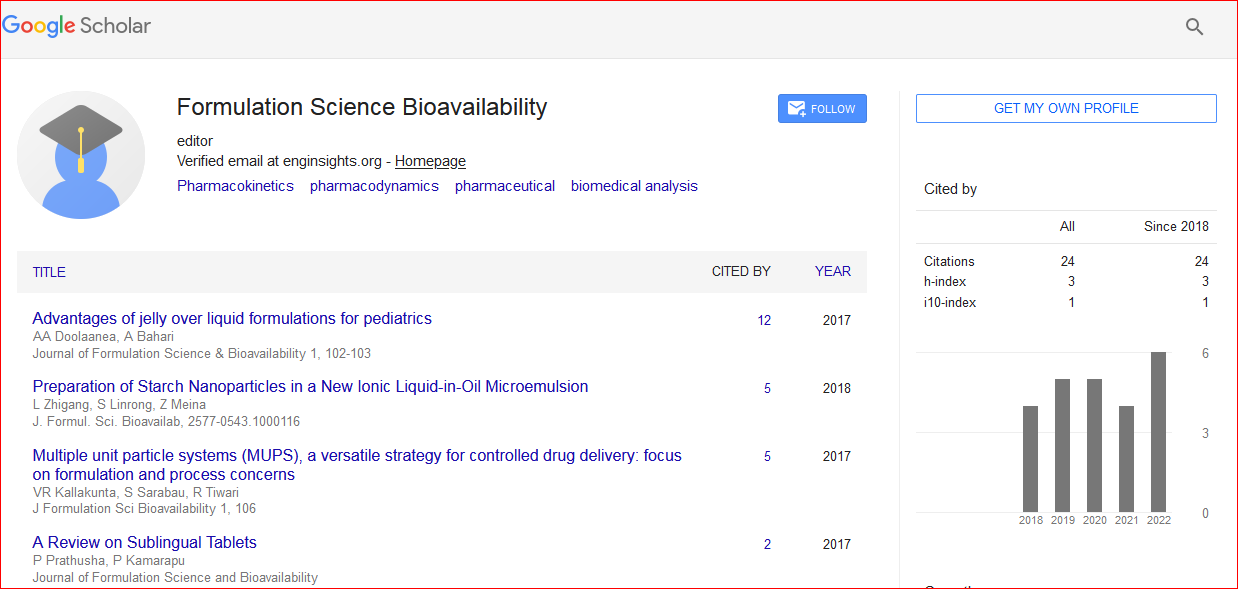
Journal of Formulation Science & Bioavailability received 23 citations as per Google Scholar report