Perspective - (127) Volume 14, Issue 2
Received: 01-Apr-2025, Manuscript No. jeom-26-188160;
Editor assigned: 03-Apr-2025, Pre QC No. P-188160;
Reviewed: 17-Apr-2025, QC No. Q-188160;
Revised: 22-Apr-2025, Manuscript No. R-188160;
Published:
29-Apr-2025
, DOI: 10.37421/2169-026X.2025.14.523
Citation: Bianchi, Luca. ”Culture Drives Performance: Commitment, Productivity, Advantage.” J Entrepren Organiz Manag 14 (2025):523.
Copyright: © 2025 Bianchi L. This is an open-access article distributed under the terms of the Creative Commons Attribution License, which permits unrestricted use, distribution and reproduction in any medium, provided the original author and source are credited.
Organizational culture plays a pivotal role in shaping employee performance, influencing their behaviors, motivations, and overall engagement within the workplace. A culture that is supportive and encourages innovation has been shown to cultivate higher levels of productivity, creativity, and employee commitment, thereby directly impacting performance outcomes [1].
Conversely, the presence of a toxic or overly rigid organizational culture can have detrimental effects, leading to a significant decline in employee morale, increased instances of burnout, and elevated turnover rates, all of which ultimately hinder performance [1].
Innovative cultures, defined by their openness to novel ideas and a willingness to embrace calculated risks, exhibit a direct correlation with enhanced employee performance, particularly within knowledge-intensive sectors. Such environments empower individuals to experiment, learn from setbacks, and actively contribute to the organization's growth trajectory [2].
The critical alignment between an organization's core values and the individual needs and aspirations of its employees is paramount for optimizing performance outcomes across the workforce. This synergy is a key determinant of success [1].
Fostering psychological safety within an organization is identified as a crucial element in unlocking the full potential of an innovative culture, enabling employees to feel secure in expressing ideas and taking initiative without fear of negative repercussions [2].
The link between a positive organizational culture and tangible improvements in employee performance is well-established and undeniable, pointing to a strong cause-and-effect relationship that benefits both individuals and the organization [3].
Strong leadership commitment in cultivating a specific culture, such as one that prioritizes collaboration and the pursuit of continuous learning, directly translates into observable and measurable performance gains for employees within the organization [3].
Employee well-being is also recognized as a critical mediating factor in the relationship between organizational culture and performance. When employees feel cared for and supported, their performance naturally improves [3].
Cultures that emphasize ethical practices, social responsibility, and provide avenues for employee voice are found to contribute not only to better performance but also to the development of a more sustainable business model, underscoring the strategic significance of culture [4].
The strategic importance of organizational culture in achieving long-term success cannot be overstated; it is a foundational element that influences all aspects of business operations and employee engagement [4].
Organizational culture significantly impacts employee performance by molding their behaviors, boosting their motivations, and fostering engagement. A supportive and innovative atmosphere cultivates superior productivity, creativity, and commitment, whereas a detrimental or inflexible culture leads to diminished morale, burnout, and higher turnover, ultimately impeding performance [1].
The alignment between an organization's values and individual employee needs is crucial for maximizing performance. This synergy ensures that employees are motivated and aligned with the company's objectives, leading to better results [1].
Innovative cultures, characterized by openness to new ideas and a propensity for risk-taking, are directly linked to improved employee performance, especially in knowledge-based industries. These cultures encourage experimentation and learning from mistakes, driving organizational advancement [2].
Within these progressive cultures, the establishment of psychological safety is paramount. It empowers employees to freely experiment and learn from failures, thereby contributing more effectively to the organization's overall growth [2].
The connection between a positive organizational culture and enhanced employee performance is a well-documented phenomenon. Leadership plays a crucial role in establishing and reinforcing these positive cultural attributes [3].
When leadership actively commits to fostering a culture of collaboration and continuous learning, it directly translates into tangible performance improvements among employees. This proactive approach yields significant benefits [3].
Furthermore, employee well-being is identified as a key mediating factor in this dynamic. A culture that supports employee well-being leads to greater job satisfaction and, consequently, higher performance levels [3].
In the context of sustainable development, organizational cultures that prioritize ethical practices, social responsibility, and employee input contribute to both superior performance and the creation of a more sustainable business framework [4].
Such cultures underscore the strategic imperative of embedding ethical considerations and social awareness into the fabric of the organization, driving long-term success and positive impact [4].
Understanding how different cultural dimensions influence employee performance is vital. For instance, cultures with lower power distance and higher individualism tend to promote greater employee initiative and enhanced performance, highlighting the need for culturally attuned management [5].
Organizational culture profoundly affects employee performance by influencing behavior, motivation, and engagement. Supportive and innovative cultures enhance productivity, creativity, and commitment, while toxic or rigid environments lead to decreased morale, burnout, and turnover. Key factors contributing to improved performance include psychological safety, strong leadership commitment, and employee well-being. Ethical practices, social responsibility, and employee voice further bolster performance and sustainability. Cultural dimensions like power distance and individualism also play a role, underscoring the need for culturally sensitive management. Ultimately, a strong, positive culture aligned with strategic goals is essential for employee commitment, productivity, and competitive advantage.
None
None
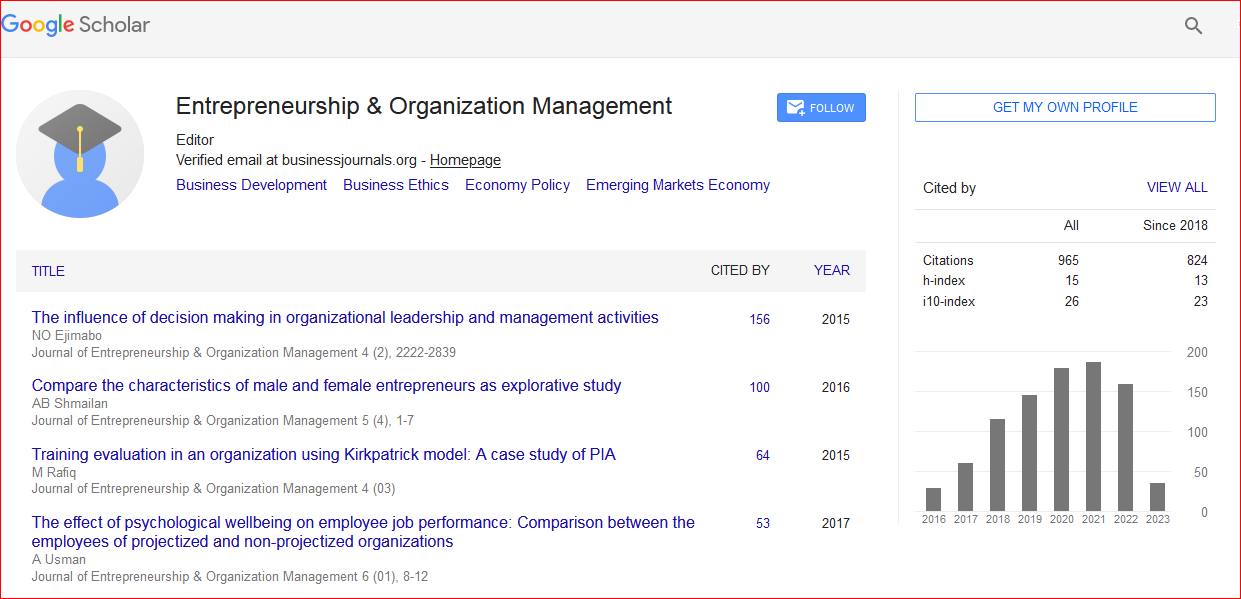
Entrepreneurship & Organization Management received 1115 citations as per Google Scholar report