Opinion - (2025) Volume 16, Issue 4
Received: 01-Jul-2025, Manuscript No. assj-25-174781;
Editor assigned: 03-Jul-2025, Pre QC No. P-174781;
Reviewed: 17-Jul-2025, QC No. Q-174781;
Revised: 22-Jul-2025, Manuscript No. R-174781;
Published:
29-Jul-2025
, DOI: 10.37421/2151-6200.2025.16.675
Citation: Shirase, Kaito. ”Cultural Mediation: Fostering Under standing, Enabling Integration.” Arts Social Sci J 16 (2025):675.
Sources of funding : © 2025 Shirase K. This is an open-access article distributed under the terms of the Creative Commons Attribution License, which permits unrestricted use, distribution and reproduction in any medium, provided the original author and source are credited
Cultural mediation stands as a pivotal practice across increasingly diverse global societies, serving as an essential bridge between individuals and groups with differing cultural backgrounds. It is much more than mere linguistic translation; it encompasses a complex array of roles aimed at fostering understanding, enhancing access to services, and promoting social cohesion. The literature consistently demonstrates that cultural mediators play a crucial role in bridging communication and understanding gaps, particularly within sensitive domains like healthcare systems. These professionals function as vital cultural brokers, effectively facilitating access to care and improving health outcomes for diverse populations by deftly navigating the intricate cultural nuances that often exist between patients and providers [1].
Building upon this foundational understanding, the conceptualization of cultural mediation has considerably expanded, moving beyond an exclusive focus on language or overt cultural differences. Contemporary research suggests that truly effective mediation inherently involves a keen awareness and skilled navigation of deeper societal structures, including power dynamics, systemic inequalities, and often implicit social norms. This broadened understanding positions cultural mediation as a crucial, proactive tool for achieving more profound societal integration and empowerment, especially for those groups who are historically marginalized or underserved within various community frameworks [3].
In practical terms, this means mediators are not merely translating words but actively interpreting and bridging entire cultural contexts, unspoken expectations, and structural barriers that might otherwise impede understanding or access to vital resources. This expanded scope is fundamental for developing genuinely inclusive and equitable practices across all sectors. The application of cultural mediation is remarkably diverse, spanning from critical clinical and public service environments to enriching cultural institutions and essential educational settings. Within clinical environments, for example, cultural mediators operate in distinct yet profoundly complementary roles alongside mental health professionals. Their presence is fundamental in establishing and maintaining trust and mutual understanding by effectively bridging significant cultural gaps. This, in turn, enables more accurate diagnostic processes and ultimately more effective therapeutic outcomes for diverse patient populations, particularly those with migrant backgrounds. Ensuring culturally sensitive care through mediation can make a dramatic difference in both treatment efficacy and patient engagement, leading to better overall health [4].
Similarly, cultural mediation emerges as a powerful and indispensable tool for fostering social inclusion within public services. By significantly enhancing access, streamlining communication, and promoting a clearer overall understanding between migrants and various service providers, mediators contribute substantially to successful migrant integration and lead to marked improvements in service delivery across myriad public sectors [8].
Beyond direct social services, cultural institutions such as museums have also proactively embraced cultural mediation to evolve into more inclusive, accessible, and engaging spaces. This approach underscores the profound role of education and language in empowering diverse audiences to connect meaningfully with their own cultural heritage and that of others. By carefully employing tailored interpretive strategies and multilingual approaches, museums can ensure their extensive collections and compelling narratives resonate deeply with a broader public, thereby fostering a collective sense of shared ownership and appreciation for cultural assets [2].
Further exploring the realm of heritage, there is a strong and growing advocacy for implementing a co-creative approach to cultural mediation at heritage sites. This innovative method involves actively engaging both visitors and local communities directly in the interpretive process. The core idea is that by involving diverse stakeholders in the co-creation of meaning, heritage sites can move significantly beyond mere one-way information dissemination. Instead, they can offer more resonant, truly inclusive, and deeply meaningful experiences, fostering stronger, more personal connections to cultural heritage for everyone involved [5].
The complex and often sensitive contexts of geopolitical tension and the presence of highly vulnerable populations further underscore the indispensable nature of cultural mediation. Consider the specific challenges within the Ukrainian context, where cultural mediators are proving to be absolutely vital. They expertly foster intercultural dialogue, work tirelessly to resolve misunderstandings, and actively promote social cohesion amidst diverse cultural groups and populations profoundly affected by ongoing conflict [6].
Furthermore, detailed ethnographic studies vividly reveal the pivotal role played by cultural mediators in providing crucial support for unaccompanied migrant children. In both demanding educational and critical reception settings, these dedicated mediators act as essential bridges, navigating profound linguistic and cultural barriers with great skill. Their diligent work is fundamental not only for fostering successful integration but also for supporting the psychological well-being and enabling the academic success of these particularly vulnerable young individuals, offering them a crucial lifeline [7].
In the rapidly expanding and evolving landscape of digital education, cultural mediation finds compelling new avenues for significant impact and influence. One insightful case study clearly illustrates the vital role mediators play in skillfully adapting online content and communication to be culturally relevant and accessible for migrants and refugees. This critical adaptation effort helps to effectively overcome pervasive digital divides, thereby promoting more effective learning outcomes and smoother integration within virtual environments [9].
However, it is essential to acknowledge that the intricate and demanding work of cultural mediation is not without its inherent ethical complexities and substantial challenges. Working extensively with refugees, for instance, often presents significant dilemmas regarding maintaining strict neutrality, upholding confidentiality, navigating often pronounced power imbalances, and managing the often-unseen emotional toll experienced by the mediators themselves. This reality profoundly underscores the urgent need for clearer ethical guidelines, comprehensive training, and robust support systems to ensure that the practice remains consistently effective, ethically responsible, and ultimately sustainable for both mediators and those they serve [10].
This comprehensive body of scholarly work collectively underscores the profound and multifaceted contribution of cultural mediation to fostering deeper understanding, promoting successful integration, and enhancing overall well-being across incredibly diverse societal contexts.
Cultural mediation is a dynamic and essential process that bridges gaps in communication and understanding across diverse cultural landscapes. It moves beyond simple language translation to encompass a holistic approach to intercultural communication. At its core, mediators act as cultural brokers, enabling smoother interactions between distinct groups. For example, within healthcare systems, these professionals are crucial for ensuring diverse populations receive equitable and effective care. They navigate complex cultural nuances that can otherwise impede patient-provider communication, thereby improving access to vital services and ultimately enhancing health outcomes for individuals from varied backgrounds [1]. This proactive engagement helps to mitigate misunderstandings and build trust, which is fundamental in sensitive areas like medical care.
The scope of cultural mediation has significantly broadened, recognizing that effective intervention requires addressing more than just explicit cultural differences. It involves a sophisticated understanding of underlying power dynamics, pervasive systemic inequalities, and often implicit social norms that shape interactions. This expanded view posits that cultural mediation is a powerful instrument for achieving deeper societal integration and fostering empowerment, particularly for marginalized groups who often face multiple barriers to participation and access [3]. By actively identifying and addressing these deeper structural issues, mediators can facilitate more meaningful engagement and advocate for equitable conditions, moving beyond surface-level communication to create lasting positive change. This critical perspective ensures that mediation efforts are not superficial but instead contribute to genuine social justice.
Cultural mediators play a vital role in specialized professional environments, such as mental health services. Here, their contributions are distinct yet entirely complementary to those of mental health professionals. Mediators build essential trust and foster mutual understanding by bridging cultural divides, which is indispensable for accurate diagnoses and successful therapeutic processes for diverse patients, especially those from migrant backgrounds [4]. This collaborative approach ensures that care is not only clinically sound but also culturally sensitive and relevant. Similarly, in wider public services, cultural mediation serves as an important tool for the social inclusion of migrants. Mediators facilitate better access, clearer communication, and deeper understanding between migrants and service providers, making a significant contribution to integration efforts and improving the quality and reach of public service delivery [8]. These roles underscore the multifaceted utility of cultural mediation in practical, real-world applications.
Cultural institutions and educational settings also greatly benefit from cultural mediation. Museums, for instance, leverage mediation to become more inclusive and accessible, effectively connecting diverse audiences with cultural heritage. This involves creative educational strategies and multilingual engagement, transforming how heritage is interpreted and experienced [2]. A progressive approach in heritage sites further suggests a co-creative model, advocating for greater involvement from visitors and local communities. This fosters shared ownership and more resonant, inclusive, and meaningful experiences, moving beyond traditional one-way information dissemination [5]. Furthermore, in the realm of education, particularly for vulnerable populations, cultural mediators are indispensable. An ethnographic study on unaccompanied migrant children highlights how mediators navigate linguistic and cultural barriers in school and reception settings to foster integration, psychological well-being, and academic success for these young individuals [7].
The role of cultural mediation extends to complex global challenges and evolving digital landscapes. In contexts marked by geopolitical tensions, such as Ukraine, cultural mediators are pivotal in fostering intercultural dialogue, resolving misunderstandings, and promoting social cohesion among diverse cultural groups and conflict-affected populations [6]. Their work is crucial for maintaining stability and understanding during times of crisis. Moreover, cultural mediation is increasingly relevant in digital education. A case study reveals its vital role in adapting online content and communication for migrants and refugees using e-learning platforms, effectively overcoming digital divides and promoting successful learning and integration in virtual environments [9]. These applications demonstrate the adaptability and critical importance of mediation in contemporary global challenges.
However, the practice of cultural mediation is not without its significant ethical considerations and practical challenges. Mediators often face complex issues, particularly when working with highly vulnerable groups like refugees. Concerns surrounding neutrality, confidentiality, the inherent power imbalances in interactions, and the profound emotional toll on the mediators themselves are prominent [10]. This highlights a crucial need for clear ethical guidelines, comprehensive training, and robust support systems to ensure that cultural mediation remains an effective, responsible, and sustainable practice. Addressing these ethical complexities is paramount for safeguarding the well-being of both the mediators and the communities they serve, reinforcing the professional integrity and impact of cultural mediation.
Cultural mediation plays a vital role across diverse sectors, essentially acting as a bridge for communication and understanding. In healthcare, mediators facilitate access to care and improve outcomes for diverse populations by navigating complex cultural nuances between patients and providers. The scope of mediation extends beyond language to encompass power dynamics, systemic inequalities, and implicit social norms, promoting deeper societal integration for marginalized groups. Museums utilize cultural mediation to become more inclusive spaces, connecting diverse audiences with heritage through tailored strategies and multilingual approaches. Similarly, in heritage sites, a co-creative approach to mediation, involving visitors and local communities, fosters more resonant and meaningful experiences. Mediators are crucial in supporting vulnerable populations like unaccompanied migrant children in educational and reception settings, bridging linguistic and cultural barriers to foster integration and psychological well-being. They also enhance the social inclusion of migrants in public services by improving access and communication. In digital education, mediators adapt online content for migrants and refugees, overcoming digital divides. The practice of cultural mediation is particularly complex in conflict-affected regions, such as Ukraine, where it promotes intercultural dialogue and social cohesion. However, the ethical dimensions of this work, especially with refugees, involving issues of neutrality, confidentiality, and emotional toll, require careful consideration and robust support systems.
None
None
Indexed at, Google Scholar, Crossref
Indexed at, Google Scholar, Crossref
Indexed at, Google Scholar, Crossref
Indexed at, Google Scholar, Crossref
Indexed at, Google Scholar, Crossref
Indexed at, Google Scholar, Crossref
Indexed at, Google Scholar, Crossref
Indexed at, Google Scholar, Crossref
Indexed at, Google Scholar, Crossref
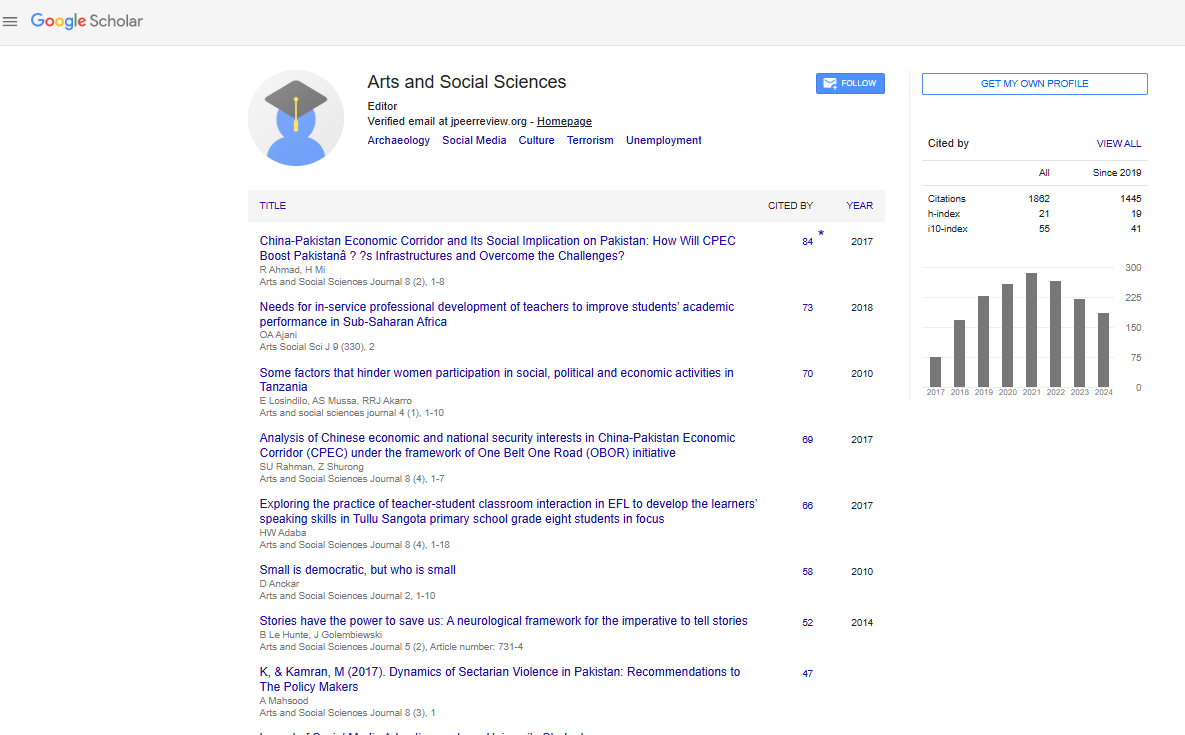
Arts and Social Sciences Journal received 1413 citations as per Google Scholar report